The Thermodynamic Truth About Your Cookware
Welcome to the thermodynamic thunderdome. If you have spent any amount of time wandering the aisles of high-end culinary boutiques or scrolling through aesthetic food blogs, you have probably been assaulted by an endless barrage of pretentious chef-speak. You’ve been told that you need a culinary degree, a trust fund, and a kitchen outfitted with space-age materials to cook a decent meal. I am here to tell you, with a glass of wine in one hand and a bench scraper in the other, that this is absolute nonsense. You do not need magic to cook like an expert; you just need a basic grasp of physics, a healthy dose of common sense, and the willingness to ditch toxic kitchen gear that is actively sabotaging your Tuesday night dinners.
As a busy professional who learned to cook through rigorous trial, catastrophic error, and setting off the smoke detector more times than my neighbors appreciated, I have zero patience for fluff. When it is a Tuesday evening and you are staring down a hungry family, time is money. We need efficiency, we need speed, and we need reliable tools that do exactly what the laws of thermodynamics dictate they will do. This brings us to the ultimate heavyweight debate of traditional kitchenware: carbon steel versus cast iron.
For decades, home cooks have treated these two materials as mystical artifacts, passing down bizarre maintenance rituals and half-baked theories about heat retention. But today, we are leaving the folklore behind. We are going to perform an objective, data-driven, mercilessly detailed analysis of the exact thermodynamic properties of traditional carbon steel cookware. We are going to talk about specific heat capacities, thermal diffusivity, and the radiant infrared power of polymerized cooking oils. By the end of this masterclass, you will understand exactly how carbon steel eliminates prep bottlenecks through rapid heat adjustments, and you will never look at a frying pan the same way again.
Metallurgical Breakdown: Carbon Steel vs. Cast Iron
Before we can argue about which pan sears a steak better, we have to look under the microscopic hood. The fundamental differences between carbon steel and cast iron are not born in the kitchen; they are born in the foundry. Both materials are an alloy of iron and carbon, but the exact ratio of that carbon completely alters their physical and thermal destinies.
The Carbon Content Difference
It sounds entirely counterintuitive, but carbon steel actually contains significantly less carbon than cast iron. Traditional cast iron contains anywhere from 2% to 4% carbon by weight, along with a healthy dose of silicon. This high carbon content gives cast iron a crystalline structure filled with graphite flakes. While these flakes provide natural lubricating properties and make the molten metal very easy to pour into intricate molds, they also make the resulting metal incredibly brittle. Because it is so prone to cracking under stress, cast iron cookware must be poured thick—usually between 3.5 to 6.0 millimeters.
Carbon steel, on the other hand, contains a mere 0.5% to 1.5% carbon. This lower carbon content drastically changes the mechanical properties of the alloy. It is no longer brittle; it is highly malleable and ductile. Instead of being poured into a thick, heavy sand mold, carbon steel can be forged, rolled, stamped, or spun into remarkably thin sheets—typically ranging from a nimble 1.2 to 2.0 millimeters in thickness. This structural difference is the foundational reason why carbon steel thermodynamics operate on a completely different timeline than cast iron.
Density, Mass, and Thermal Inertia
Because of the differing manufacturing processes, the two materials have slightly different densities. Carbon steel sits at a dense 7,850 kg/m³, while cast iron is slightly less dense, ranging from 7,100 to 7,300 kg/m³ due to those microscopic graphite pockets. However, density alone does not dictate kitchen performance—total mass does.
When you pick up a thick cast iron skillet, you are hoisting a massive amount of physical material. In physics, this translates directly to thermal mass, or thermal inertia. A heavy cast iron pan is essentially a giant, stubborn bucket for heat. It takes a tremendous amount of energy—and time—to fill that bucket up. But once it is full, it absolutely refuses to let that heat go. Carbon steel, being roughly one-third the thickness of cast iron, has a fraction of the thermal mass. It acts less like a bucket and more like a high-speed conduit. It absorbs energy instantly and sheds it just as fast, giving the cook unparalleled agility.
Thermal Conductivity: Why Speed is Your Best Friend
Now that we know what these pans are made of, let’s talk about how heat actually moves through them. This is where the culinary myths usually go off the rails. You will often hear people claim that cast iron is a “great conductor of heat.” I am sorry to burst the bubble of cast iron purists everywhere, but scientifically speaking, both cast iron and carbon steel are objectively terrible conductors of heat.
The Numbers Game: W/m·K Explained
Thermal conductivity is measured in Watts per meter-Kelvin (W/m·K). To put things in perspective, pure copper—the undisputed king of cookware conductivity—clocks in at a blistering 400 W/m·K. Aluminum, the reliable workhorse hidden inside most modern clad pans, sits around 205 W/m·K.
Where do our traditional iron alloys sit? Cast iron manages a sluggish 50 to 55 W/m·K. Carbon steel is actually slightly lower, generally ranging between 43 and 50 W/m·K depending on the specific alloy. On paper, this means that heat struggles to move laterally across both materials, which is why a poorly sized burner will create a massive hot spot right in the center of your pan while the edges remain lukewarm.
But if carbon steel has a slightly lower raw thermal conductivity than cast iron, why do professional kitchens rely on it for high-speed wok cooking and rapid searing? The answer lies in the thickness of the material and a beautiful metric known as thermal diffusivity.
Thermal Diffusivity and Eliminating Prep Bottlenecks
Thermal diffusivity (measured in m²/s) tells us how quickly a material can adjust its temperature in response to a change in thermal input. The formula is the thermal conductivity divided by the product of density and specific heat capacity. The specific heat capacity of carbon steel is roughly 460 J/kg·K, which is nearly identical to cast iron’s 450-500 J/kg·K.
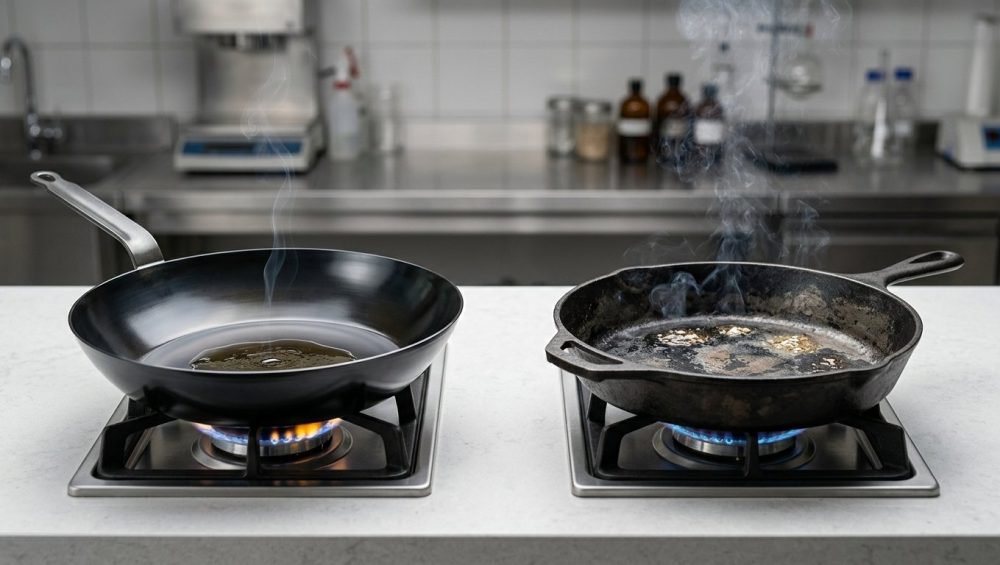
Because carbon steel is stamped incredibly thin, the effective heat transfer rate from the burner to your food is lightning fast. A standard 1.5mm carbon steel wok can rocket from room temperature to a blistering 400°F (200°C) in under 90 seconds on a medium-high gas flame. A thick cast iron skillet might take five full minutes to reach the same surface temperature.
When you are trying to eliminate kitchen chaos on a busy Wednesday night, you do not have five minutes to stand around waiting for a pan to preheat. Furthermore, when you drop a cold, half-pound chicken breast into your hot pan, the surface temperature immediately plummets. Cast iron, with its massive thermal inertia, will slowly stubbornly fight its way back to temperature. Carbon steel, however, rebounds three to four times faster. This rapid recovery prevents your proteins from boiling in their own extruded juices, saving your meal from turning into a gray, steamed disaster.
Emissivity and the Magic of Radiant Cooking
We have covered how heat travels through the metal (conduction), but we also need to address how heat travels from the metal into your food. This brings us to one of the most misunderstood and fascinating properties of traditional cookware: thermal emissivity.
What is Emissivity?
Emissivity is a measure of a material’s ability to radiate absorbed thermal energy as infrared radiation. It is measured on a scale from 0 to 1, where 0 is a perfect thermal mirror (reflecting all radiant heat) and 1 is a perfect “black body” (emitting 100% of its thermal energy as radiation).
Standard stainless steel cookware has a relatively low emissivity, usually hovering around 0.34. This means that in a stainless steel pan, the vast majority of the cooking happens strictly through direct physical contact (conduction). If the food isn’t physically touching the metal, it isn’t browning efficiently.
The Infrared Power of Polymerized Oil
Here is where traditional iron alloys pull off a spectacular magic trick. A bare, unseasoned carbon steel pan also has relatively low emissivity. However, once you subject that pan to the seasoning process—building up a dark, black patina of polymerized cooking oil—the emissivity of the surface skyrockets to an astonishing 0.82 or higher.
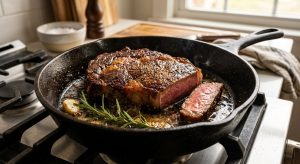
This means a well-seasoned carbon steel or cast iron pan acts like a miniature infrared broiler. It aggressively blasts the food with radiant heat energy. When you throw a beautifully marbled, incredibly uneven ribeye into a seasoned carbon steel skillet, the radiant heat cooks the microscopic dips and crevices of the meat that aren’t even touching the metal. This dual-action cooking—conduction punishing the contact points, and high-emissivity radiation blasting the rest—is the absolute secret to perfecting the Maillard reaction. You get a deeper, more even, and texturally superior crust than you could ever achieve in a shiny, low-emissivity stainless steel pan.
The Science of Polymerization: Building the Ultimate Non-Stick Surface
Let us address the elephant in the room. You cannot talk about carbon steel or cast iron without talking about “seasoning.” For decades, people thought seasoning was about flavor. It is not. The black coating on your pan is not a collection of savory memories from past meals; it is a highly durable, naturally hydrophobic bioplastic. And building it requires a strict adherence to chemical laws.
Lipid Breakdown and Cross-Linking
When you coat a carbon steel pan with a microscopic layer of cooking oil and expose it to immense heat, a cascade of violent chemical reactions occurs. The triglycerides in the oil undergo thermal oxidation, autoxidation, cyclization, and fission. In plain English: the heat shatters the fat molecules into volatile free radicals.
If you are using an unsaturated fat—like grapeseed oil, flaxseed oil, or canola oil—those molecules contain reactive double bonds. As the heat breaks them apart, these double bonds eagerly seek out new partners, linking together in massive, interconnected molecular chains. This process is called cross-linking, or polymerization.
The resulting polymer matrix physically bonds to the micro-texture of the metal. Because cast iron has a porous, open atomic arrangement due to its graphite flakes, the polymer mechanically locks into the iron with incredible grip. Carbon steel is smoother, but its crystalline structure still provides enough microscopic tooth for the polymer to anchor itself permanently, creating a slick, hydrophobic shield that repels the water naturally present in your food. This is the fundamental wok seasoning science that has allowed traditional Asian kitchens to produce flawless non-stick stir-fries for centuries.
Temperature Thresholds for Perfect Seasoning
Here is where most weekend culinary hobbyists completely ruin their pans. Polymerization is not a gentle process. It requires aggressive thermal energy. If you apply oil to your pan and bake it at 300°F, you are not polymerizing the oil; you are just making it hot, sticky, and eventually rancid.
To achieve a true, hard bioplastic layer, you must push the oil past its smoke point. For most highly unsaturated seasoning oils, this means sustaining temperatures between 400°F and 500°F (200°C to 260°C) for an extended period. The smoke you see is the visual evidence of fission—the volatile, non-polymerizing compounds burning off, leaving behind only the hard, cross-linked carbon matrix. If you do not cross this thermal threshold, your seasoning will fail, your food will stick, and you will find yourself angrily scrubbing a gummy brown mess in your sink at midnight.
Real-World Kitchen Applications: Time is Money
Understanding the physics of your cookware is only half the battle. The real test is applying this data to your actual life. As a home cook, your needs fluctuate wildly between the frantic rush of a weekday evening and the leisurely, perfectionist pursuits of a Sunday afternoon. Carbon steel is the rare material that adapts to both, provided you know how to drive it.
The Weekday Stir-Fry: Maximum Heat, Minimum Time
Let’s look at a standard Tuesday night. You are making a chicken and vegetable stir-fry. You need maximum heat to sear the meat, but you also need the pan to cool down quickly when you toss in your delicate aromatics so the garlic doesn’t instantly incinerate into bitter ash.
If you attempt this in a cast iron pan, the massive thermal inertia works against you. The pan will take forever to heat up, and once it is screaming hot, it will stay screaming hot. You cannot quickly dial the temperature back; the cast iron simply holds too much stored energy.
Carbon steel, with its high thermal diffusivity and low thermal mass, responds to your burner knob almost instantly. You can flash-sear your chicken at 450°F, pull the meat, drop the flame, and watch the pan’s surface temperature plummet to a gentle 275°F in seconds, perfectly accommodating your minced garlic and ginger. This rapid responsiveness is one of the greatest foolproof cooking secrets you can master. It entirely eliminates the bottleneck of waiting for your equipment to catch up to your recipe.
The Weekend Sear: Controlling the Maillard Reaction
When the weekend rolls around and you have the time to treat cooking like an art form, carbon steel scales up to meet your perfectionism. Let’s say you are searing a thick-cut pork chop. You want a deeply caramelized crust without overcooking the center.
To achieve this, you need to rely on accelerating the Maillard reaction. This complex chemical dance between amino acids and reducing sugars requires sustained temperatures above 300°F (150°C). Because carbon steel boasts that incredibly high emissivity (0.82) once seasoned, it acts as a radiant heat engine.
Furthermore, by utilizing the pan’s responsiveness, you can expertly surf the thermal edge required for utilizing the Leidenfrost effect. While the Leidenfrost effect is most commonly associated with uncoated stainless steel, understanding how moisture vaporizes upon contact with hot metal is crucial for carbon steel as well. If the pan is too cold, the meat’s moisture pools, turning your sear into a steam bath. If it’s too hot, the proteins instantly carbonize into charcoal. Carbon steel allows you to micro-adjust the heat input on the fly, keeping the pan exactly in that sweet spot where the moisture violently vaporizes, allowing the dry meat surface to fry perfectly in its own rendered fat.
The “No-Go” Rule: Why We Banish Toxic Gear
I am going to step onto my soapbox for a moment, because as your sassy, fiercely protective culinary advocate, I absolutely refuse to let you poison yourself or waste your hard-earned money on garbage equipment. There is a deeply disturbing trend in modern home kitchens: the reliance on cheap, synthetic non-stick pans.
The Danger of PTFE at High Temperatures
Teflon and other polytetrafluoroethylene (PTFE) coated pans are a crutch for bad technique, and worse, they are a chemical hazard. The marketing departments for these “mystery metal” pans will promise you a lifetime of effortless egg-flipping. What they don’t tell you is that PTFE coatings begin to rapidly degrade and off-gas toxic perfluoroalkyl substances when heated above 420°F to 450°F.
Remember our discussion about the Maillard reaction and the temperatures required to properly sear a steak or stir-fry vegetables? Those techniques routinely push pan surface temperatures well past 400°F. If you try to achieve a restaurant-quality sear in a cheap non-stick pan, you are not just ruining the food; you are actively vaporizing toxic chemicals into your kitchen air. This is the ultimate “No-Go” rule. I will take a slightly sticky egg in a safe pan over a flawless omelet cooked on a bed of degrading forever-chemicals every single time. Upgrading to safe, high-heat capable materials is the first step in curating your beginner kitchen tools.
Investing in Generational Cookware
The beauty of carbon steel is that it is virtually indestructible. If you accidentally leave a PTFE pan on a high burner, you have to throw it in the trash. If you leave a carbon steel pan on a high burner and burn the seasoning off, you simply break out the steel wool, scrub it down to the bare metal, and re-polymerize a new layer of oil.
It is a living, breathing piece of metallurgy that actually improves the more you use it. Every time you fry an egg, sear a steak, or sauté a batch of onions, you are laying down microscopic layers of new cross-linked polymers, reinforcing the bioplastic matrix and increasing the pan’s emissivity and non-stick properties. It is one of the only essential kitchen tools that gets better with age, making it an incredible value for the home cook.
Conclusion: Cooking Like an Expert Without the Pretense
At the end of the day, cooking is not magic. It is applied physics, chemistry, and thermodynamics, wrapped up in a delicious, edible package. You do not need a pristine white chef’s coat or a degree from a French culinary institute to make mind-blowing food in your own home. You just need to understand your tools.
By recognizing that carbon steel offers a lower thermal mass and a higher thermal diffusivity than cast iron, you empower yourself to cook with speed and agility. By understanding that polymerization requires unsaturated fats and temperatures exceeding 400°F, you can build a natural, non-toxic, highly emissive non-stick surface that rivals any synthetic coating on the market.
Stop fighting your equipment. Embrace the science, ditch the toxic shortcuts, and let the thermodynamics do the heavy lifting. Now, if you’ll excuse me, my pan is preheated, the oil is shimmering, and I have a Tuesday night dinner to conquer.