If you have ever attempted vegan baking, you have undoubtedly been there. You are staring anxiously through the oven door, watching your beautiful, glossy eggless meringues puff up like proud little clouds, only to witness them instantly deflate into sad, sticky puddles the moment the cool kitchen air hits them. It is enough to make you want to throw your spatula across the room and order a pizza. But put the takeout menu down. We are not giving up.
For decades, home cooks and weekend bakers dumped the cloudy, viscous liquid from canned chickpeas straight down the drain. We treated it like absolute garbage. Then, the culinary world had a collective “eureka” moment. That discarded bean juice—now elegantly branded as “aquafaba”—was discovered to be a miraculous plant-based egg substitute. Suddenly, everyone was whipping it into stiff peaks, churning out vegan macarons, mousses, and pavlovas.
But here is the infuriating truth that those glossy lifestyle magazines will not tell you: aquafaba is an incredibly temperamental chemical matrix. If you do not understand the underlying science of the emulsion, you are basically playing roulette with your desserts. You do not need a degree in molecular gastronomy, and you certainly do not need to learn a bunch of pretentious recipe jargon to get this right. What you need is a rigorous, science-backed approach to protein structures, pH adjustments, and thermal dynamics.
In this definitive masterclass, we are stripping away the guesswork. We are diving deep into the chemistry of aquafaba emulsions, breaking down exact whipping temperatures, optimal hydration ratios, and the precise acidic thresholds required to build a structural net that absolutely will not collapse. Grab a cup of coffee (or a heavy pour of wine), and let’s get into the molecular magic.
The Molecular Magic: What Actually is Aquafaba?
Aquafaba is a highly complex colloidal dispersion. When chickpeas (garbanzo beans) are soaked and cooked, a very specific combination of compounds leaches out of the legume and into the surrounding water. You are not just looking at starchy bean water; you are looking at a potent, functional cocktail of water-soluble proteins, foaming agents, and complex carbohydrates.
Protein Structures: Vicilin and Legumin (The Heavy Lifters)
In a traditional egg white, proteins like ovalbumin and ovomucin unfold (denature) when subjected to the mechanical shear of a whisk, creating an interlocking network that traps air. Aquafaba mimics this exact process using plant proteins, primarily vicilin and legumin. These are globular storage proteins found abundantly in legumes.
Vicilin, in particular, is the undisputed star of the show. It is a 7S globulin protein that is highly surface-active. When you begin whipping aquafaba, the mechanical action forces the vicilin proteins to unfold. Their hydrophobic (water-repelling) core is exposed to the air, while their hydrophilic (water-loving) exterior remains anchored in the liquid phase. They rapidly adsorb at the air-water interface, effectively building a protective, elastic wall around the microscopic air bubbles you are violently beating into the liquid.
However, vicilin is significantly more delicate than ovalbumin. The protein concentration in standard aquafaba is roughly 1% to 1.5%, compared to the dense 10% protein concentration found in egg whites. This stark difference in density is exactly why aquafaba foams are so prone to structural failure. To compensate for this lower protein density, the proteins need ideal environmental conditions to cross-link effectively. This precise manipulation of limited proteins is a cornerstone technique in modern gluten free baking, where establishing a sturdy architectural framework without traditional gluten or egg proteins is the ultimate goal.
Saponins (The Natural Foaming Agents)
If vicilin is the architect of the foam, saponins are the heavy machinery. Saponins are naturally occurring phytochemicals found in chickpeas. They are characterized by their intense, soap-like foaming properties (the name “saponin” literally derives from the Latin word for soap).
At a molecular level, saponins possess both a hydrophilic glycoside moiety and a lipophilic triterpene derivative. This dual nature allows them to act as powerful natural surfactants. When you whip aquafaba, saponins aggressively lower the surface tension of the liquid—dropping it from approximately 72 mN/m (the surface tension of pure water) down to around 38 mN/m. This massive reduction in surface tension is what allows the liquid to stretch and expand into a massive volume of foam without snapping. Saponins reinforce the protein film via hydrophobic stacking, locking the air bubbles in place alongside the vicilin network.
Galactomannans and Polysaccharides (The Structural Net)
Proteins and saponins create the bubbles, but complex carbohydrates keep them from popping. During the cooking process, soluble fibers like galactomannans migrate into the water. These polysaccharides do not form the foam themselves, but they dramatically increase the bulk viscosity of the continuous liquid phase.
Think of galactomannans as the mortar between the bricks of your protein wall. By thickening the water trapped between the individual air bubbles, these carbohydrates slow down the rate of drainage (liquid pooling at the bottom of your mixing bowl) and coalescence (small, tight bubbles merging into larger, unstable bubbles). Without this carbohydrate net, your beautiful foam would rapidly separate into dry suds and a sad puddle of bean water.
The Great Emulsion: Why Your Vegan Bakes Keep Collapsing
We have all experienced the heartbreak of a collapsed meringue. One minute it is a stiff, glossy masterpiece, and the next, it is a weeping disaster. Understanding exactly why this happens is the first step to surviving kitchen disasters and reclaiming your confidence as a baker. The catastrophic failure of an aquafaba emulsion almost always comes down to two primary culprits: moisture migration and lipid interference.
The Moisture Migration Problem (Syneresis)
Syneresis is the clinical, scientific term for “weeping.” It occurs when the liquid phase of a gel or foam separates from the solid structural network, pooling at the bottom of the mixture. In aquafaba foams, syneresis is usually caused by under-whipping, over-whipping, or an incorrect sugar-to-liquid ratio.
If you under-whip the aquafaba, the vicilin proteins do not fully unfold, resulting in a weak interfacial film that simply cannot hold the heavy water in place. The water drains out due to gravity. Conversely, if you over-whip the aquafaba (whipping past the stiff-peak stage, usually beyond 9 to 10 minutes at high speed at room temperature), the proteins begin to coagulate irreversibly. They clump together so tightly that they literally squeeze the water out of the network, much like wringing out a wet dish sponge. Once this irreversible coagulation occurs, the foam is entirely dead. You cannot save it.
Fat Interactions in Eggless Batter
Fats are the ultimate, undisputed enemy of the aquafaba foam. Lipids (fats and oils) are highly surface-active, but unlike proteins, they do not form strong, elastic films. If there is even a microscopic trace of fat in your mixing bowl, on your whisk, or introduced via an ingredient (like almond flour or cocoa butter) before the foam is fully stabilized, the fat molecules will aggressively compete with the proteins for space at the air-water interface.
Because fat molecules cannot stretch or link together, they act like microscopic needles, popping the air bubbles as fast as your whisk can create them. Failing to properly degrease your equipment is one of the most common rookie kitchen mistakes that leads to complete structural failure. You can whip that liquid for an hour, but if your bowl had a greasy residue, you will never get past the soapy, loose bubble stage.
The Golden Rules of Aquafaba Hydration and Reduction
If you want professional-level, bakery-quality results, you must treat aquafaba with the precision of a pastry chef. You cannot simply open a random can of chickpeas, dump the liquid into a bowl, and hope for the best. The hydration ratio of your chickpea water dictates the concentration of proteins and saponins.
The Cold Hard Truth About Canned vs. Homemade Aquafaba
Let’s get controversial: relying on canned aquafaba is a massive gamble. Yes, it is convenient, and yes, it works in a pinch for casual, forgiving recipes. But if you are aiming for structural perfection in delicate pastries, canned aquafaba introduces wild, uncontrollable variables into your chemistry.
Commercial canneries do not standardize their liquid-to-bean ratios. Furthermore, canned chickpeas frequently contain chemical additives that actively destroy foam architecture. Sodium citrate is commonly added as a preservative, but it acts as a chemical chelator, while calcium chloride is often added as a firming agent, acting as a coagulant. In controlled laboratory trials, foams made from canned aquafaba exhibited 63% higher syneresis (weeping) and 41% lower peak viscosity compared to homemade, unadulterated versions.
For reliable, repeatable results, you must make it yourself. Soak dried chickpeas for 12 to 16 hours. Drain, rinse, and cook them in fresh water using a strict 1:2 ratio (one part soaked chickpeas to two parts water by weight). Simmer gently for 45 to 60 minutes. Do not add salt, baking soda, or acidic ingredients to the cooking water. Let the chickpeas cool completely in their liquid before straining.
Boiling It Down (The 50% Reduction Protocol)
Even with a strict homemade protocol, the resulting liquid is often too dilute to create stable, long-lasting meringues. The protein concentration must be artificially increased. This is achieved through the 50% reduction protocol.
Once you have strained your aquafaba, weigh the liquid. Pour it into a wide, shallow saucepan and simmer it over medium-low heat until the volume is reduced by exactly half. This evaporation process concentrates the crucial 30–100 kDa (kilodalton) proteins and the galactomannans, drastically increasing the viscosity of the fluid. The reduced aquafaba should have the thick, slightly gelatinous consistency of raw egg whites. Let it cool completely to room temperature, or ideally chill it overnight in the refrigerator, before attempting to whip it.
Precision Whipping: Temperatures and Techniques
The physical act of whipping aquafaba is where the magic happens, but it is also where the most profound misunderstandings occur. The temperature of your liquid and the quality of your equipment will absolutely make or break your emulsion.
The Temperature Myth: Cold vs. Warm Whipping
Conventional baking wisdom dictates that egg whites should be whipped at room temperature, while heavy cream must be whipped ice cold. Because aquafaba replaces egg whites, bakers naturally assume it follows the exact same thermal rules. This is a critical error.
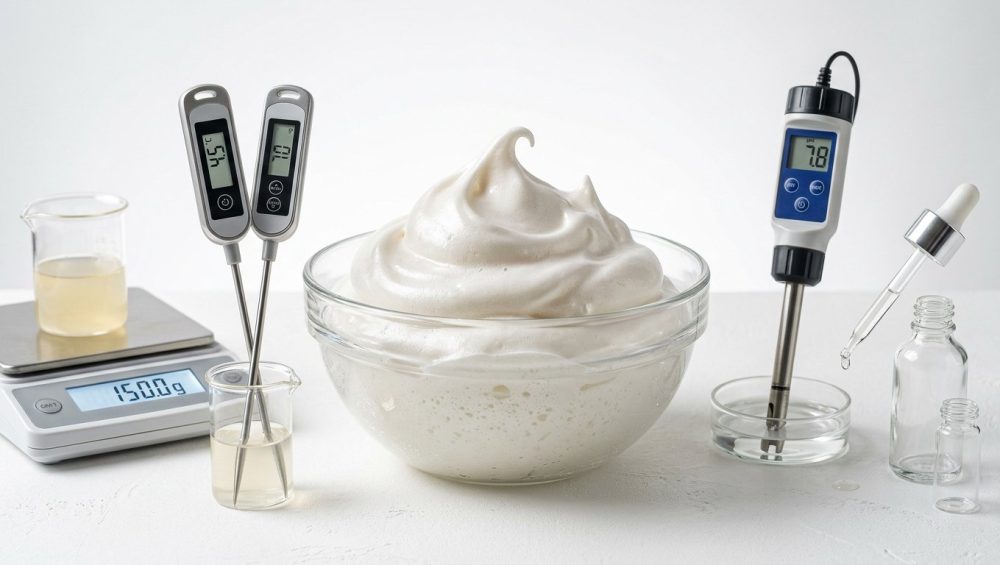
Scientific analyses of aquafaba foaming properties reveal a fascinating thermal quirk: aquafaba actually demonstrates superior stability at elevated temperatures. While egg white proteins weaken and collapse if whipped too warm, the vicilin in aquafaba unfolds more efficiently when slightly warmed. Whipping aquafaba at around 40°C (104°F) results in a significantly more stable foam with reduced drainage compared to whipping it straight out of the refrigerator at 4°C (39°F).
At 40°C, the viscosity of the continuous phase is temporarily lowered, allowing for rapid air incorporation and maximum expansion (overrun). Simultaneously, the thermal energy assists the vicilin proteins in fully exposing their hydrophobic cores, creating a tighter, more resilient interfacial film. If you are struggling with weeping meringues, try gently warming your reduced aquafaba over a double boiler to exactly 40°C before whipping.
Equipment Matters (And Why Toxic Gear is Sabotaging You)
We need to have a serious, brutal talk about your mixing bowls. I have absolutely zero patience for cheap, peeling non-stick bowls or mystery-metal whisks. Not only do these degrade and leach potentially harmful chemicals into your food over time, but they also actively sabotage your baking chemistry.
Plastic bowls are porous and inherently lipophilic (fat-loving). Over time, they absorb microscopic layers of grease and oil from previous meals. No matter how hard you scrub with dish soap, that residual fat remains trapped in the micro-abrasions of the plastic. When you attempt to whip aquafaba in a plastic bowl, those hidden lipids instantly attack your protein network, preventing stiff peaks from ever forming.
You must exclusively use immaculately clean glass, stainless steel, or unlined copper bowls. Upgrading to professional-grade stainless steel is the first step in banishing toxic kitchen gear from your life forever. You do not need a kitchen overflowing with useless gadgets; you just need a few high-quality beginner kitchen tools that perform flawlessly every single time. Before whipping, wipe down your stainless steel bowl and whisk attachment with a paper towel dampened with white vinegar or lemon juice to eliminate any stray lipid molecules.
Acid Tripping: The Role of pH Adjustments
If you take only one piece of scientific data away from this masterclass, let it be this: pH control is entirely non-negotiable. Aquafaba is exquisitely sensitive to the acidity of its environment.
Cream of Tartar vs. Lemon Juice
Unadjusted aquafaba typically has a pH ranging from 6.2 to 6.8, making it slightly acidic to nearly neutral. This is far too alkaline for optimal protein conformation. At a pH above 6.0, the vicilin proteins remain stubbornly folded. They will trap air temporarily, but the resulting film is weak, brittle, and highly prone to rapid collapse.
To force the proteins to unfold and cross-link into a resilient matrix, you must lower the pH. Many amateur recipes suggest a splash of lemon juice or a dash of apple cider vinegar. This is a sloppy approach. Lemon juice varies wildly in its citric acid concentration depending on the fruit, and adding liquid vinegar introduces uncontrolled water dilution into your carefully reduced aquafaba.
The only acceptable acidulant for precision aquafaba baking is cream of tartar (potassium bitartrate). It is a dry, highly stable, powdered acid that reliably lowers the pH without altering the hydration ratio.
Exact pH Thresholds for Maximum Stability
In rigorous laboratory testing, pH emerged as the single strongest predictor of aquafaba foam success. The optimal, mathematically proven window for maximum foam stability is a pH of 5.0 to 5.4.
If you drop the pH too low (below 4.5), you cross the isoelectric point of the proteins. The proteins will lose their net electrical charge, clump together, and precipitate out of the solution before a foam can even form. You will be left with a grainy, separated mess.
To consistently hit that magical 5.0–5.4 window, the standard dosage is precisely 0.15 to 0.20 grams of cream of tartar per 100 grams of aquafaba. If you do not have a jeweler’s scale, this translates roughly to 1/8 to 1/4 teaspoon of cream of tartar per half-cup of aquafaba. Add the cream of tartar at the very beginning of the whipping process, before the proteins have a chance to form unstable bonds.
Sugar’s Structural Role in Aquafaba Emulsions
We tend to think of sugar purely as a sweetener, but in the context of an aquafaba foam, sugar is a vital structural component. Sugar is highly hygroscopic, meaning it attracts and aggressively binds to water molecules.
When sugar dissolves into the continuous liquid phase of the foam, it binds to the free water, drastically increasing the viscosity of the liquid trapped between the air bubbles. This thick, syrupy matrix acts as a physical barrier, preventing the water from draining to the bottom of the bowl and stopping the air bubbles from colliding and bursting.
Granule Size and Dissolution Rates
The size of your sugar crystals matters immensely. Standard granulated sugar has large, heavy crystals that take a long time to dissolve in the low-moisture environment of an aquafaba foam. If the sugar does not fully dissolve, the sharp, undissolved crystals will literally slice through the delicate protein films, popping the air bubbles and deflating the batter. Furthermore, undissolved sugar leads to severe weeping during baking, as the raw sugar melts into syrup in the oven and leaks out of the meringue.
Caster sugar (superfine sugar) is the absolute best choice. Its microscopic crystal size allows it to dissolve rapidly and completely into the foam, ensuring a smooth, glossy, and structurally sound matrix. If you do not have caster sugar, simply pulse standard granulated sugar in a food processor for 30 seconds until powdery. Do not use commercial powdered (confectioner’s) sugar, as brands contain added cornstarch, which can interfere with the protein interactions.
Timing Your Sugar Additions
The timing and rate at which you introduce the sugar are just as critical as the type of sugar you use. If you dump all the sugar into the aquafaba at the beginning, the sheer heavy weight of the sugar will suppress the foaming action, and the proteins will never reach their maximum volume.
You must wait until the aquafaba has reached the “soft peak” stage. The foam should be opaque, white, and hold soft, drooping trails when the whisk is lifted. Only then should you begin adding the sugar.
Add the sugar in a slow, agonizingly gradual rain—no more than one tablespoon at a time. Wait at least 15 to 20 seconds between each addition to allow the previous batch of sugar to fully dissolve. The standard ratio for a perfectly stable, pipeable meringue is between 100g and 135g of sugar per 100g of reduced aquafaba. Whip until the mixture is incredibly thick, glossy, and holds rigid, stiff peaks that defy gravity. You should be able to rub a small amount of the foam between your fingers and feel absolutely no grit.
Baking and Cooling: Preventing the Post-Oven Deflation
You have successfully built a chemically flawless aquafaba emulsion. It is glossy, stiff, and piped beautifully onto your baking sheet. But the danger is not over. The baking and cooling phases are where thermal shock can destroy all your hard work.
Oven Temperatures and Maillard Reactions
Aquafaba foams are acutely sensitive to heat expansion. If you place them into a hot oven (anything above 135°C / 275°F), the air bubbles trapped inside the protein matrix will rapidly expand. The delicate vicilin proteins will stretch beyond their elastic limit, tear, and the entire structure will collapse into a flat, gummy disk.
Aquafaba meringues must be baked exceptionally low and slow. The ideal temperature range is between 94°C (200°F) and 120°C (250°F). At these low temperatures, you are not actually “baking” the meringue; you are systematically dehydrating it. You are slowly evaporating the water from the galactomannan network, leaving behind a rigid, crystalline structure of sugar and denatured proteins. This process takes time—usually 90 minutes to 2 hours.
Because the temperature is so low, you largely avoid the Maillard reaction (the chemical reaction between amino acids and reducing sugars that causes browning). Your meringues will remain pristine and white, rather than developing a toasted, off-white hue.
The Gradual Cooling Method (Avoiding Thermal Shock)
When the baking time is complete, the meringues are fully dehydrated, but their structural matrix is still hot and highly fragile. If you pull the baking sheet out of the oven and expose the hot meringues to the cool ambient air of your kitchen, the sudden drop in temperature causes rapid contraction. The crystalline sugar matrix will crack, and the meringues will sink in the center.
To prevent thermal shock, you must employ the gradual cooling method. Turn the oven off completely. Leave the baking sheet inside, and prop the oven door open slightly (about an inch or two) using the handle of a wooden spoon. Allow the meringues to cool down in the oven for at least one to two hours, or until the oven is completely cold.
Once they are entirely cooled, they will easily release from the parchment paper. If they are slightly stuck, use a reliable bench scraper to gently slide under the base and lift them away without shattering their delicate bottoms. Store them immediately in an airtight container, as the high sugar content is hygroscopic and will instantly begin absorbing moisture from the air, turning your crispy meringues into chewy, sticky blobs.
Practical Applications Beyond Meringues
While meringues are the ultimate litmus test for aquafaba stability, understanding this chemistry unlocks a massive array of advanced culinary applications.
Vegan Butter, Mayonnaise, and Emulsions
Because aquafaba contains both water and powerful natural emulsifiers (saponins and proteins), it is the perfect base for creating stable oil-in-water emulsions. By slowly drizzling liquid oil into aquafaba while blending at high speeds, the saponins coat the microscopic oil droplets, preventing them from coalescing and separating.
This exact chemical mechanism is used to create rich, creamy vegan mayonnaise and solid plant-based butter blocks. It is a foundational technique for developing modern plant-based sauces that refuse to break or split, even when subjected to heat.
Cakes, Brownies, and Quick Breads
In dense batters like cakes and brownies, you do not need to whip the aquafaba into stiff peaks. The liquid aquafaba can be used exactly as you would use a whole liquid egg. The proteins provide binding power, coagulating during the baking process to give the cake crumb its structure, while the galactomannans retain moisture, keeping the baked goods soft and tender for days.
For standard baking substitutions, the golden rule is 3 tablespoons (approx. 45ml) of reduced aquafaba to replace one whole large egg, or 2 tablespoons (approx. 30ml) to replace one egg white. This simple swap is an absolute lifesaver for whipping up simple weeknight dinners when you realize you are completely out of eggs but still desperately want to bake a quick batch of cornbread or a pan of fudgy brownies.
Mastering aquafaba is not about blind luck, and it certainly is not magic. It is about respecting the chemistry of the ingredients. When you understand how vicilin proteins unfold, how saponins reduce surface tension, and how exact pH and temperature thresholds dictate structural integrity, you stop guessing and start controlling the outcome.
You do not need a commercial kitchen to pull this off. You just need patience, an immaculately clean bowl, and a little bit of scientific curiosity. By applying these rigorous, tested methods, you are doing more than just preventing your vegan macarons from collapsing—you are unlocking kitchen creativity on a completely new level. You are taking a byproduct that the rest of the world throws away and transforming it into genuine culinary art. So, the next time you open a can of chickpeas, treat that liquid like gold. Measure your pH, reduce your volume, watch your temperatures, and whip with total confidence. The days of deflated, sad eggless bakes are officially over. Now get in the kitchen, fire up that mixer, and show those proteins who is boss.