Listen up, weekend culinary warriors. We need to have a serious, wine-fueled heart-to-heart about the current state of your dinner parties. You invite your favorite people over, promising them a spectacular evening of food, drinks, and sparkling conversation. But what actually happens in reality? You spend four hours trapped in the kitchen, sweating profusely over four different active burners, frantically trying to time the reduction of a pan sauce while your guests awkwardly sip Pinot Grigio in the living room without you. You are not a short-order cook at a greasy spoon; you are the host. It is time to stop isolating yourself and master the art of effortless hosting. The solution to your culinary martyrdom isn’t prepping harder, chopping faster, or buying a louder kitchen timer; it is changing the entire paradigm of how you feed people.
Enter the induction-safe donabe. It is the holy grail of communal dining, a vessel that seamlessly bridges the gap between ancient culinary tradition and modern thermodynamic convenience. By moving the cooking process out of the kitchen and directly to the center of the dining table, you completely eliminate the host bottleneck. You get to sit down, pour yourself a generous glass of Chablis, and actually interact with the people you invited over. But because we are serious home cooks who demand perfection, we aren’t just throwing random ingredients into a pot of boiling water and calling it a night. We are going to break down the exact materials science, the chemical safety protocols, and the precise temperature controls required to execute a flawless, interactive, and mindful dining experience.
The Physics of the Donabe: Why Ancient Clay Still Reigns Supreme
Before we get into the modern technological upgrades that make table-side cooking safe, we need to thoroughly understand why the traditional Japanese donabe has been the undisputed king of communal hot pot (nabemono) for centuries. If you think a donabe is just a pretty, rustic ceramic bowl designed to look good on your social media feed, you are sorely mistaken. It is a highly engineered piece of thermodynamic equipment.
Traditional donabes are typically crafted from highly specific types of regional Japanese clay, such as Banko-yaki or Iga-yaki. These clays are renowned for their exceptional porosity, structural integrity, and profound heat resistance. The secret to their unparalleled culinary performance lies in their specific heat capacity. Unlike thin aluminum or copper pans that heat up instantly but lose their thermal energy the exact moment you drop a cold piece of meat into them, the thick clay walls of a donabe act as a massive thermal buffer. When you apply heat to the pot, the clay slowly and methodically absorbs the thermal energy. Once it reaches the target temperature, it radiates that heat back into the liquid cooking medium with incredible, unwavering consistency.
This thermal retention in ceramic is exactly what you want for communal dining. When you have four different people constantly dipping cold slices of pork belly, frozen dumplings, and handfuls of Napa cabbage into the broth, a lesser pot would experience massive, immediate temperature fluctuations. It would swing wildly from a violent rolling boil to a tepid, greasy soak. The donabe’s immense thermal mass prevents this entirely, maintaining a gentle, steady simmer that gently cooks proteins without shocking them into turning into tough, rubbery shoe leather. It is functional food science disguised as rustic earthenware, and it is the key to perfectly cooked food over a two-hour meal.
The Toxic Cookware Rant: A Mandatory Detour
Let me be brutally clear about something: I will personally haunt your kitchen if I catch you hosting a hot pot night using a peeling, twenty-nine-dollar electric non-stick skillet from a big-box store. As someone who fiercely advocates for the home cook, I have absolutely zero patience for cheap, disposable, and frankly dangerous kitchenware. If you are going to invest your time and money into your culinary hobby, you must start by banishing toxic kitchen gear from your home forever.
The global cookware landscape is currently undergoing a massive, long-overdue regulatory shift. As of 2026, multiple U.S. states—including Maine, Connecticut, and New Jersey—alongside the European Union’s REACH regulations, have enacted strict bans on PFAS (per- and polyfluoroalkyl substances) in cookware. These “forever chemicals,” which include PTFE (commonly known by the brand name Teflon), are the synthetic compounds used to make those cheap electric skillets non-stick.
Here is the terrifying science that the budget manufacturers don’t want you to think about: while they love to claim that PTFE is inert at room temperature, communal hot pot dining often involves pre-heating the vessel or searing ingredients before adding the broth. When PTFE coatings are subjected to temperatures above 360°C (680°F)—which can happen incredibly fast in an empty or semi-empty pan—they begin to rapidly degrade. This degradation releases perfluoroisobutylene (PFIB) and other highly toxic gases into your dining room. Inhaling these fumes causes a medical condition literally documented as “polymer fume fever” or “Teflon flu,” which is characterized by severe chills, headaches, and respiratory distress. It is so toxic that it routinely kills pet birds kept near the kitchen. Furthermore, when those cheap coatings inevitably scratch and peel from your guests aggressively fishing for noodles with metal ladles, those microplastics migrate directly into your meticulously crafted broth.
We do not serve forever chemicals to our friends. High-quality glazed clay donabes are naturally non-toxic, non-reactive, and entirely free of synthetic coatings. They rely on the physical properties of the glass-like glaze and the liquid cooking medium to prevent sticking, ensuring that your food remains pure, safe, and uncontaminated.
The Induction Revolution: Electromagnetic Sorcery Meets Ancient Earth
Traditional donabes are designed exclusively for open gas flames. In a restaurant setting, or if you are using a portable butane cassette stove on a camping trip, this is perfectly fine. But let’s be realistic about the modern home dining room: portable gas stoves require you to constantly buy and store highly flammable aerosol butane canisters, they emit carbon monoxide, and having an open, invisible blue flame surrounded by reaching arms, trailing sleeves, and wine glasses is a recipe for a disastrous 911 call.
This is exactly where the induction-safe donabe steps in, dragging ancient clay kicking and screaming into the 21st century. Induction cooktops work via the magic of electromagnetism; they generate a rapidly alternating magnetic field that induces eddy currents in ferromagnetic materials, creating heat directly within the metal itself rather than transferring it via ambient air. But wait, clay is a thermal and electrical insulator. It is completely non-magnetic. So, how on earth does an induction hob heat a clay pot?
The engineering behind this is brilliant. Manufacturers of modern induction donabes embed a specialized magnetic heating element—often a high-quality carbon plate, a silver-film glaze, or an encapsulated ferromagnetic disc—directly into the base of the clay pot. When you place the donabe on an induction hob, the magnetic field interacts exclusively with this embedded plate. The plate heats up rapidly and then transfers that thermal energy to the surrounding clay via direct, highly efficient conduction.
This hybrid technology gives you the absolute best of both worlds. You get the unparalleled thermal mass, aesthetic beauty, and material safety of traditional Japanese clayware, seamlessly combined with the precise, hyper-responsive, and flame-free safety of modern induction technology. You can hold a delicate broth at exactly 85°C (185°F) for hours without ever worrying about running out of butane or accidentally setting a napkin on fire.
Smoothing Out the Pulses
There is a hidden, secondary benefit to this pairing. Many affordable portable induction hobs do not have true low-wattage continuous output. Instead, they use “pulse heating”—they achieve a low simmer by blasting 1500 watts of power for two seconds, then turning off for three seconds, repeating this cycle endlessly. If you put a thin stainless steel pot on a pulse-heating hob, your broth will violently boil, then stop, then boil, then stop, ruining your delicate proteins. However, the immense thermal mass of the clay donabe absorbs these harsh, erratic pulses and smooths them out. The clay acts as a thermal shock absorber, converting the jagged energy spikes into a beautiful, continuous, and gentle simmer.
Eradicating Host Bottlenecks Through Scientific Staging
The entire philosophy behind this style of communal dining is to completely eliminate the frantic, last-minute kitchen panic that ruins dinner parties. To achieve this state of zen, we rely heavily on scientific food staging techniques. With a donabe gathering, 95% of the actual “cooking” is just meticulous prep work (mise en place) done hours before the doorbell ever rings.
Your job as the host is to act as the culinary curator and the prep chef, not the sweaty line cook. Hours before your guests arrive, you will wash, trim, and precisely slice your vegetables. You will portion your exotic mushrooms, score your tofu to increase surface area for broth absorption, and arrange your thinly sliced proteins on beautiful, chilled platters. These platters are then tightly covered and held safely in the refrigerator. Your dipping sauces—perhaps a bright, citrusy ponzu and a rich, nutty goma-dare—are whisked together in advance and portioned into individual ramekins.
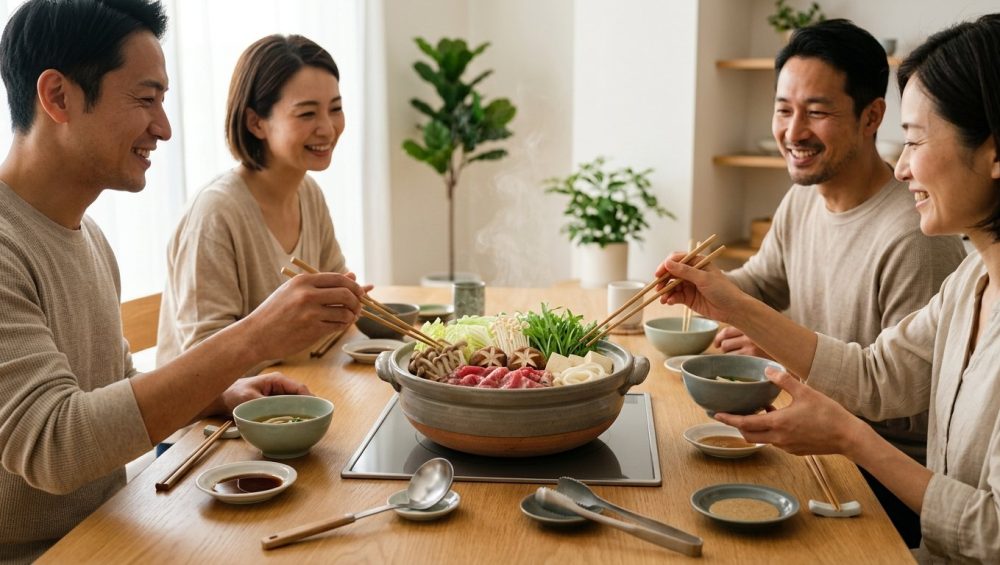
When it is finally time to eat, your only physical task is to carry the gorgeous platters to the table, pour your pre-made broth into the donabe, and press the power button on the induction hob. That is it. You have successfully managed to eliminate kitchen chaos completely. By shifting the active cooking phase to the communal table, the act of cooking transforms from an isolated, stressful chore into a shared, interactive entertainment experience. Your guests become active participants in their own meal, deciding exactly how long they want to poach their beef or simmer their mushrooms, while you get to sit back and accept the compliments.
The Thermodynamic Blueprint for a Mindful Gathering
Executing a flawless communal meal requires a deep understanding of how different ingredients react to heat, water, and enzymes over time. We are not just boiling water here; we are orchestrating a multi-stage, scientifically paced culinary event. Here is your definitive blueprint for success.
The Broth: Building the Glutamate Foundation
The broth is the canvas upon which the entire meal is painted. For a classic mindful gathering, a delicate kombu dashi is unparalleled. Kombu (dried kelp) is absolutely packed with glutamic acid, the amino acid directly responsible for the savory, mouth-watering sensation of umami. However, extracting these glutamates requires strict temperature control. If you aggressively boil kombu, you will extract bitter compounds, harsh tannins, and slimy mucilage, completely ruining the broth. You want to slowly bring the water to about 60°C to 80°C (140°F to 176°F) and hold it there, allowing the glutamates to gently and cleanly release into the water. Remove the kombu just before the liquid reaches a simmer. The induction hob’s precise temperature control makes this delicate extraction process completely foolproof.
The Proteins: Precision and Patience
When dealing with premium, thinly sliced proteins like Kurobuta pork, marbled Wagyu beef, or delicate scallops, high heat is your absolute worst enemy. When muscle fibers are exposed to boiling temperatures (100°C / 212°F), they violently contract, squeezing out all their internal moisture and resulting in tough, dry, unpalatable meat. Instead, you want to employ thermodynamic food holding strategies by keeping the broth at a gentle, rolling simmer (around 85°C to 90°C). At this precise temperature, the connective collagen melts into rich gelatin slowly, and the proteins denature gently. A quick swish (shabu-shabu) of a few seconds is all it takes to cook the meat perfectly while retaining its tender, melt-in-your-mouth texture.
The Vegetables: Texture Management and Enzymatic Breakdown
Vegetables require vastly different cooking times based on their cellular structure and pectin content. Dense root vegetables like daikon radish, lotus root, and carrots should go into the pot first, as their rigid cellular walls require prolonged exposure to heat to break down and become tender. Conversely, delicate leafy greens like spinach, mizuna, or chrysanthemum greens (shungiku) require mere seconds of heat and should be added at the very end to prevent them from turning into unappetizing mush.
Guiding your guests through this progression is a masterclass in the chemistry of flavor pacing. You are actively building complex layers of flavor in the broth as the evening progresses. The vegetables release their natural sugars and earthy aromatics, the mushrooms release their woodsy enzymes, and the proteins release their savory, rendered fats, constantly evolving the depth and complexity of the liquid with every passing minute.
The Shime: The Starch Gelatinization Finale
The greatest tragedy of an amateur hot pot dinner is throwing away the leftover broth at the end of the night. After an hour of simmering premium meats and fresh vegetables, the liquid in the donabe has transformed from a simple dashi into an incredibly rich, complex, concentrated umami-bomb reduction. This brings us to the shime (the closing dish).
You add cooked Japanese short-grain rice or fresh, thick udon noodles directly into the remaining broth. The residual heat facilitates starch gelatinization, causing the carbohydrates to swell and absorb the intensely flavored liquid while simultaneously thickening the broth into a luxurious, glossy, porridge-like consistency (known as zosui). Stir in a beaten egg at the very last second, let the residual heat gently curdle it, and top with fresh scallions. It is the ultimate comfort food and the perfect, grounding finale to the meal.
Curating Your Communal Setup: What to Buy
If you are finally ready to make the leap into intelligent hosting, you need to acquire the right equipment. Do not blindly buy the first rustic-looking ceramic pot you see online; you must meticulously verify that it is explicitly engineered for induction cooktops (often labeled as “IH compatible” by Japanese manufacturers).
One of the most highly regarded modern options in recent years was the Kinto Kakomi IH Donabe. Known for its minimalist aesthetic and an extremely low water absorption rate, it prevented food odors from lingering and was incredibly easy to clean. While Kinto officially discontinued their specific IH line in August 2024, the secondary market and international retailers still carry them, and their brilliant design heavily influenced the current market standard. Today, modern Banko ware artisans produce phenomenal induction-safe donabes—often featuring sophisticated triple-layer base constructions with encapsulated metal-ceramic interiors—that work flawlessly across all heat sources.
When assembling your curated kitchen essentials for this setup, you must pair your donabe with a high-quality, low-profile portable induction hob. Look for a unit that offers granular temperature control (specific degree settings rather than just arbitrary “low, medium, high” buttons) and a quiet internal cooling fan. You do not want to have to shout over the sound of a jet engine while trying to enjoy your dinner conversation.
Setting the Scene: Ergonomics and Aesthetics
A successful communal dining experience requires highly thoughtful table architecture. You cannot just plop a hot pot in the middle of a cluttered table, throw down some napkins, and hope for the best. To successfully host a relaxed dinner party, you must prioritize ergonomics and flow.
First, address the power cord. An induction hob requires electricity, and a tripping hazard will instantly ruin the mindful, relaxed vibe (and potentially send boiling broth flying). Run the cord neatly under a rug or tape it securely to the floor using professional gaffer tape (never use duct tape, which will leave a sticky residue and ruin your hardwood floors).
Second, think about the physical reach of your guests. The donabe sits dead center. Surround it symmetrically with your platters of raw ingredients so that no one has to awkwardly reach across their neighbor’s plate to grab a piece of tofu. Provide everyone with their own set of long cooking chopsticks (saibashi) to handle the raw ingredients, keeping them strictly separate from their personal eating chopsticks for vital food safety. Individual slotted spoons or small wire skimmers are also fantastic additions, allowing guests to easily retrieve their lost mushrooms from the murky depths of the broth without frustration.
The Role of the Nabe Bugyo
In Japanese culture, there is a concept known as the “Nabe Bugyo,” which translates to the Hot Pot Magistrate. This is the person at the table who naturally takes charge of the cooking process, dictating when the cabbage goes in and aggressively policing anyone who tries to overcook the wagyu. As the host, you can either embrace the role of the Bugyo to ensure culinary perfection, or you can graciously delegate it to your most food-obsessed friend, allowing you to completely check out and focus entirely on your wine.
Care and Maintenance: Protecting Your Investment
A high-quality induction donabe is a serious culinary investment, and treating it like a cheap stainless steel saucepan will end in tears, frustration, and cracked clay. Traditional, highly porous donabes require a mandatory seasoning process called medome. This involves simmering a porridge of cooked rice and water in the new pot; the amylose and amylopectin in the short-grain rice break down and form a complex polymeric gel that physically lodges into the microscopic silica pores of the clay. As it cools, it hardens, creating a waterproof barrier that prevents leaks and structural cracking.
However, many modern induction-safe donabes (like the aforementioned Kakomi style or newer high-tech Banko ware iterations) are engineered with advanced glass-like glazes that possess incredibly low water absorption rates. These highly engineered vessels often do not require medome at all and can be gently washed with a neutral detergent right out of the box.
Regardless of the specific brand or glaze, the universal rules of clayware thermodynamics always apply. Never subject the pot to extreme thermal shock. Do not take a cold donabe full of leftovers from the refrigerator and place it directly onto a high-power induction setting, and never, ever rinse a screaming hot donabe with cold tap water. When cleaning, pay special attention to the induction heating element on the bottom. Avoid highly abrasive steel wool; instead, if you encounter stubborn burnt spots on the base, simply simmer a tablespoon of baking soda in water on low heat for a few minutes, let it cool completely, and gently wipe it away with a soft melamine sponge. Ensure the pot is completely, bone-dry before storing it in a dark cabinet to prevent any mold growth.
The Final Word on Mindful Entertaining
Cooking for others should be an act of profound joy and connection, not an exercise in stressful masochism and kitchen isolation. By embracing the brilliant science of thermal mass, firmly rejecting toxic non-stick shortcuts, and shifting the culinary action to the center of the dining table, you reclaim your rightful role as the gracious, present host. You get to curate the beautiful ingredients, set the perfect stage, and then sit back and actually enjoy the fruits of your labor alongside your favorite people.
So, ditch the exhausting, stressful multi-course plating routines that leave you dreading your own parties. Invest in a safe, high-quality induction donabe. Prep your ingredients in the quiet peace of the afternoon, plug in the hob, pour the wine, and lean deeply into the beauty of simple meals for mindful moments. Your sanity—and your incredibly well-fed guests—will thank you.