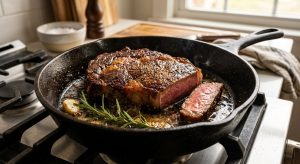
We have all been there. You have spent your evening meticulously searing a beautiful, expensive piece of meat. The fond at the bottom of the skillet is glorious—a deeply browned, caramelized testament to your culinary prowess. The aromatics are perfectly minced. You deglaze the pan with a splash of crisp, dry white wine, scraping up those browned bits, and reduce the liquid down to a syrupy, concentrated elixir. You toss in your butter, swirling it gently, moments away from serving a restaurant-quality meal.
And then, it happens.
Right before your very eyes, your beautiful, glossy sauce violently separates. It devolves into a grainy, watery mess floating pathetically beneath a slick, greasy puddle of pure, unadulterated butterfat. It is a culinary tragedy. It is a heartbreak that has ruined more dinner parties than I care to count. But here is the brutal, honest truth: you did not fail because you lack a fancy culinary degree, and you certainly did not fail because the universe hates you. You failed because you were relying on vague, unhelpful qualitative cues instead of hard, thermodynamic science.
One of the most devastating rookie kitchen mistakes a home cook can make is assuming that cooking is just an intuitive, mystical art form. It absolutely is not. Cooking is applied physics and chemistry. When you are standing over a hot stove, you are a chemist manipulating molecular bonds, thermal energy, and mechanical shear force. If you do not respect the physical limits of the ingredients in your pan, they will betray you without a second thought.
Today, we are putting an end to the greasy puddles of sadness. We are going to completely eradicate the pain point of split, broken pan sauces. We are going to dive incredibly deep into the exact thermal thresholds, the mechanical shear techniques, and the science-backed emulsion mechanics that dictate whether your sauce becomes a velvety masterpiece or a tragic oil slick. Grab your whisk, pay attention, and let’s get down to the science.
The Anatomy of a Sauce Disaster: What Exactly is an Emulsion?
Before we can even talk about heat control, we have to understand what we are actually trying to achieve in that skillet. When you make a pan sauce, you are attempting to force two mortal enemies to hold hands and play nicely: water and fat.
The Aqueous and Lipid Phases: A Hostile Relationship
In the world of food science, we deal primarily with two distinct phases in a sauce: the aqueous phase (water, wine, stock, vinegar) and the lipid phase (butterfat, animal fat, olive oil). On a molecular level, water molecules are polar. They have a slight positive charge on one end and a slight negative charge on the other, meaning they love to bond with other polar molecules (hydrophilic). Fat molecules, on the other hand, are non-polar (hydrophobic). They have absolutely no interest in bonding with water. If you pour oil into water, the water molecules will literally push the oil molecules away so they can bond with each other, forcing the oil to pool together and float to the top.
An emulsion is what happens when you force these two immiscible liquids to coexist in a temporary state of suspension. In a classic pan sauce, we are creating an “oil-in-water” emulsion. This means that microscopic droplets of fat (the dispersed phase) are suspended throughout the water-based liquid (the continuous phase). As long as those fat droplets remain tiny and evenly distributed, the sauce appears thick, opaque, and luxuriously creamy.
But here is the catch: emulsions are inherently unstable. The fat droplets are constantly trying to find each other. When they bump into one another, they merge together in a process called coalescence. If enough droplets coalesce, the fat separates from the water entirely, and your sauce “breaks.”
The Role of Surfactants and Emulsifiers
To prevent coalescence, we need a chemical mediator. We need an emulsifier. Emulsifiers are amphiphilic molecules, meaning they have a split personality. One end of the molecule is hydrophilic (water-loving) and the other end is hydrophobic (fat-loving).
When you introduce an emulsifier into your pan sauce, the hydrophobic tails embed themselves into the microscopic fat droplets, while the hydrophilic heads face outward into the surrounding water. This creates a protective, water-friendly coating around every single droplet of fat. Now, when two fat droplets bump into each other, their protective coatings repel each other, preventing them from merging.
Butter itself is actually a naturally occurring water-in-oil emulsion, consisting of roughly 80% butterfat, 18% water, and 2% milk solids. Those milk solids contain natural emulsifiers that help hold the butter together in its solid state. Heavy cream also contains natural emulsifiers, specifically proteins and lecithin, which is why a splash of cream can help stabilize a stubborn sauce. However, in a standard pan sauce made primarily of reduced stock, wine, and butter, the concentration of natural emulsifiers is incredibly low. This means the stability of your sauce relies almost entirely on your ability to control the physical environment: specifically, the temperature and the mechanical agitation.
The Thermal Death Zone: Why Heat Destroys Your Hard Work
If there is one thing you take away from this masterclass, let it be this: heat is the absolute enemy of a stable emulsion. I cannot stress this enough. The vast majority of broken pan sauces are the direct result of a cook leaving the heat on high while furiously whisking in their butter. You cannot bully a sauce into emulsifying if the thermal dynamics are working against you.
The Boiling Point of Betrayal (Thermal Thresholds)
Let’s look at the exact, scientifically documented thermal thresholds that dictate the life and death of your sauce. When you heat a liquid, you are increasing its kinetic energy. The molecules begin moving faster and faster, bouncing off each other with increasing violence.
In an emulsion, a little bit of kinetic energy is helpful—it keeps the liquid fluid. But once you cross a specific thermal threshold, the kinetic energy becomes so violent that the fat droplets smash through their protective emulsifier barriers and instantly coalesce.
Standard butter, as we established, is an emulsion. If you simply melt butter in a hot pan without whisking it into an aqueous base, that natural emulsion breaks down into separate component parts at exactly 160°F (71°C). The water evaporates, the milk solids sink, and the butterfat separates. Do you think the butter cares about your feelings? It does not. At 160°F, it is packing its bags.
When creating a specialized melted butter emulsion like a beurre monté (where cold butter is whisked into a few tablespoons of hot water), the resulting sauce can technically hold an emulsion up to 180°F to 190°F (82°C to 88°C) if treated with extreme care. However, if that liquid ever reaches a rolling boil (212°F / 100°C), the violent bubbling will physically tear the emulsion apart in seconds.
For delicate, egg-yolk based emulsions like Hollandaise or Béarnaise, the thermal window is even tighter. These sauces must be strictly held at a temperature between 120°F and 130°F (50°C to 55°C). If you push an egg-based emulsion past 140°F, the proteins in the egg yolks will begin to irreversibly coagulate, and the sauce will break. Interestingly, introducing acid (like a white wine or lemon juice reduction) actually raises the coagulation point of the egg yolks to about 190°F (88°C), buying you a bit more thermal leeway.
When you are finishing a standard pan sauce, such as a delicate glaze for pan-seared salmon, the goal is to keep the liquid warm enough to melt the butter, but cool enough to prevent violent kinetic coalescence. The ideal temperature for finishing a butter-mounted pan sauce is between 130°F and 145°F. If your pan is actively simmering or bubbling when you add your butter, you have already lost the battle.
The Butter Factor: Why Cold Butter is Non-Negotiable
Every recipe tells you to mount your sauce with cold butter. They rarely explain why. It is not just a pretentious culinary tradition; it is a vital thermodynamic control mechanism.
When you drop a cube of refrigerator-cold butter (around 38°F) into a hot pan reduction, the butter acts as a thermal heat sink. It rapidly absorbs the excess thermal energy from the liquid, rapidly dropping the overall temperature of the pan down into the safe zone.
Furthermore, because the butter is cold, it melts slowly. This slow melting process is crucial. It gives you the mechanical time needed to whisk the melting fat into the aqueous phase gradually. If you were to use room-temperature or melted butter, it would instantly pool on the surface of the liquid before you ever had a chance to disperse it, immediately resulting in a broken, greasy sauce. By utilizing understanding thermal conductivity, you can predict exactly how your pan will react to the introduction of a cold ingredient, allowing you to ride the thermal edge perfectly.
The Mechanics of Shear Force: Beating Your Sauce into Submission
Temperature control is only half of the equation. The other half is mechanical shear force. Emulsions do not happen passively. You cannot just drop butter into a pan, stare at it, and expect a velvety sauce to materialize. You have to physically rip the fat molecules apart.
Whisking vs. Blending: Choosing Your Weapon
Shear force is the mechanical stress applied to a liquid to break the dispersed phase (the fat) into microscopic droplets. The smaller you can make those fat droplets, the more stable your emulsion will be, and the thicker and creamier your sauce will feel on the palate.
When you use a whisk, you are relying on manual shear force. The tines of the whisk drag through the liquid, creating tiny vortexes and physical impacts that shatter the melting butterfat into smaller and smaller globules. This is why a lazy, half-hearted stir with a wooden spoon will almost always result in a broken sauce. You need vigorous, aggressive, rapid agitation. You are quite literally beating the sauce into submission.
For the home cook, having the right essential kitchen tools is paramount. A proper saucier’s whisk (often called a French whisk) with densely packed, stiff wires is vastly superior to a flimsy balloon whisk for this task. The stiffer wires provide greater mechanical resistance, generating significantly more shear force with every stroke.
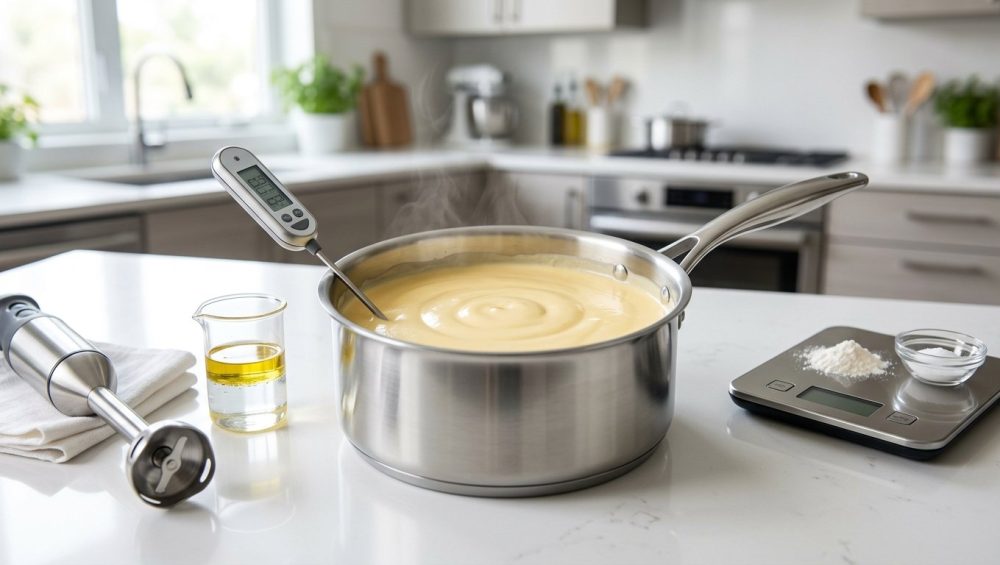
In modern professional kitchens, chefs often cheat by using an immersion blender. The spinning blades of a high-speed blender generate immense hydrodynamic shear, pulverizing the fat droplets into a fraction of the size achievable by hand. This creates an incredibly tight, highly stable emulsion that is significantly more resistant to breaking. While you cannot easily use an immersion blender in a shallow skillet, transferring your reduction to a tall cup and blending in the cold butter is a foolproof, science-backed shortcut for a flawless sauce.
The Science of Droplet Size and Suspension
Let’s talk about why droplet size matters. It all comes down to gravity and buoyancy. Fat is less dense than water, which is why oil floats. In an emulsion, the microscopic fat droplets are constantly trying to float to the top of the sauce (a process called creaming).
However, when you apply enough shear force to break the fat droplets down to a microscopic size (often less than a micrometer in diameter), the droplets become so small that their natural buoyancy is counteracted by the viscosity of the surrounding water and the random thermal motion of the molecules (Brownian motion). They remain perfectly suspended. If your whisking is weak, the droplets remain large, their buoyancy overcomes the suspension, they float to the top, coalesce, and your sauce breaks.
The “No-Go” Rule: Why Your Pan Choice Dictates Your Sauce’s Fate
I am going to take a brief, highly necessary detour here, because I have absolutely zero patience for this specific issue. You can have the best technique in the world, the perfect thermal control, and the wrist stamina of a professional baker, but if you are building your pan sauce in a cheap, toxic, warped non-stick skillet, you are setting yourself up for failure.
The Toxicity of Cheap Non-Stick (A Mandatory Rant)
Let’s get one thing straight: I despise cheap non-stick cookware. If you are using a lightweight aluminum pan coated in mystery polymers that are actively flaking off into your food, you need to throw it in the garbage immediately. Not only are you ruining your food, but you are also ingesting degraded perfluorinated chemicals. You must be committed to banishing toxic kitchen gear from your home if you want to cook seriously.
Beyond the glaring health hazards, non-stick pans are fundamentally terrible for making pan sauces. A pan sauce relies on the foundation of “fond”—the caramelized, sticky proteins that adhere to the bottom of the pan during the searing process. The secret to accelerating the maillard reaction and building complex flavor is allowing those proteins to bond with the metal. Non-stick coatings are specifically designed to prevent this adhesion. No fond means no flavor base, which means your sauce will taste like salty dishwater.
Optimal Metals for Precise Thermal Control
To execute a flawless, thermally controlled emulsion, you need cookware with high thermal mass and rapid thermal responsiveness. You need a pan that holds heat evenly, but also drops in temperature quickly when you pull it off the burner.
Fully clad stainless steel is the gold standard for the home cook. It provides exceptional fond development, it is non-reactive (crucial when reducing acidic wines or vinegars), and it responds predictably to heat adjustments.
If you want to step up to professional-tier thermodynamics, thick copper cookware lined with tin or stainless steel is unmatched. Copper has a thermal conductivity rating nearly twenty times higher than stainless steel, meaning the second you turn the heat down, the pan immediately cools, giving you unparalleled control over the thermal death zone of your sauce.
Alternatively, well-seasoned carbon steel pans offer phenomenal heat retention and fond development, though you must be cautious when reducing heavy acids, as prolonged boiling of wine or vinegar can strip the polymerized seasoning layer.
Modern Stabilizers: Cheating (Scientifically) with Hydrocolloids
If you want to completely bulletproof your sauces and guarantee they will never break, even if you accidentally overheat them or leave them sitting on the stove for an hour, you need to look toward modern food science. We are talking about hydrocolloids.
A hydrocolloid is simply a substance that forms a gel in the presence of water. By adding a microscopic amount of a hydrocolloid to your sauce, you drastically increase the viscosity of the continuous aqueous phase. This thickened water literally traps the fat droplets in a microscopic web, making it physically impossible for them to move around, bump into each other, and coalesce.
Xanthan Gum vs. Polysorbate 80: The Secret Weapons
Xanthan gum is the most accessible hydrocolloid for the home cook. It is produced by the fermentation of sugars by the bacterium Xanthomonas campestris. A tiny dusting of xanthan gum—literally 0.1% of the total weight of your liquid—will transform a fragile emulsion into a robust, velvety sauce that clings beautifully to the back of a spoon. However, xanthan gum has its limits. In intense culinary stress tests, high-fat butter emulsions stabilized solely with xanthan gum have been shown to break at around 140°F (60°C).
If you want an absolutely indestructible sauce, the modernist kitchen relies on Polysorbate 80. Polysorbate 80 is a highly effective, non-ionic emulsifier that works exceptionally well under extreme stress. It is highly resistant to heat, dilution, and high fat concentrations. When a butter emulsion is fortified with just 0.25% to 0.5% Polysorbate 80 by weight, it can withstand temperatures up to a blistering 180°F (82°C) without showing a single sign of separation. It also does not artificially thicken the liquid like xanthan gum does, meaning your sauce retains its natural, fluid mouthfeel.
Gelatin and Collagen: The Traditional Backbone
If you prefer to stick to traditional methods, your best friend is gelatin. This is why professional restaurant sauces always have that incredible, lip-smacking texture that you can never quite replicate at home with a carton of store-bought chicken broth.
Restaurants build their sauces on a foundation of real, homemade stock, simmered for hours with collagen-rich animal bones. As the bones simmer, the collagen breaks down into gelatin. Gelatin is a powerful natural hydrocolloid. When you reduce a gelatin-rich stock in your skillet, you are concentrating that hydrocolloid network. By the time you whisk in your butter, the aqueous phase is so thick with natural gelatin that it effortlessly suspends the fat droplets, creating a highly stable, deeply flavorful emulsion. If you are forced to use boxed broth, you can cheat by blooming a teaspoon of unflavored powdered gelatin in a tablespoon of cold water, and whisking it into your reduction before adding the butter.
Step-by-Step: The Foolproof Workflow for a Bulletproof Pan Sauce
We have covered the physics, the thermal thresholds, and the chemical stabilizers. Now, let us put it into practice. If you follow this exact, rigorous workflow, you will never break a pan sauce again. Having the right beginner kitchen tools makes this process significantly easier, so ensure your whisk is stiff and your pan is heavy.
Phase 1: The Deglaze and Reduction
You have just removed your seared protein from the skillet. The pan is ripping hot, coated in a layer of rendered fat and sticky fond.
- Drain the Excess Fat: Pour off all but roughly one tablespoon of the rendered fat. You need a little fat to sauté your aromatics, but leaving too much raw oil in the pan will overwhelm your final emulsion.
- Sauté Aromatics: Toss in your finely minced shallots or garlic. Let them sweat in the residual heat for 30 seconds to release their volatile flavor compounds.
- Deglaze: Pour in your acidic liquid (wine, vinegar, or citrus juice). The liquid will immediately boil violently. Use a wooden spoon or a stiff spatula to scrape every last microscopic bit of fond off the bottom of the pan.
- Reduce: Add your stock (preferably gelatin-rich). Keep the heat medium-high and let the liquid achieve a rolling boil. You want to reduce this mixture until it is thick, syrupy, and the bubbles begin to stack on top of each other. You are evaporating the excess water and concentrating the flavors and natural stabilizers.
Phase 2: The Thermal Drop
This is the critical moment where most cooks fail. If you want to eliminate kitchen chaos, you must learn to respect the thermal drop.
- Kill the Heat: Completely turn off the burner. Do not just turn it down to low; turn it off.
- Move the Pan: If you are cooking on an electric or induction stove, the glass or coil will retain massive amounts of residual heat. Physically move the skillet to a completely cold, unused burner.
- Wait: Let the bubbling completely subside. The liquid should be steaming, but absolutely still. You have now entered the safe thermal window (roughly 130°F to 145°F).
Phase 3: The Mechanical Emulsification
Now, we apply the shear force.
- Introduce the Heat Sink: Take your heavily chilled, cubed butter straight from the refrigerator. Drop one or two cubes into the hot reduction.
- Agitate: Immediately begin whisking vigorously, or aggressively swirling the pan in a circular motion. The cold butter will slowly melt, dropping the pan temperature further while the mechanical agitation shatters the butterfat into microscopic droplets.
- Incorporate: As soon as the first cubes are nearly melted and incorporated, add the next cubes. Never add all the butter at once, or it will melt too quickly and pool.
- The Finish: Once all the butter is incorporated, the sauce will instantly transform. It will become opaque, glossy, and thick enough to coat the back of a spoon (nappé). Serve it immediately. Emulsions are fragile and do not like to wait around.
Troubleshooting: Can a Broken Sauce Be Saved?
Despite your best efforts, mistakes happen. Maybe the phone rang, maybe the pan was slightly too hot, or maybe you just didn’t whisk fast enough. You look down, and your sauce is a broken, greasy nightmare. Do you throw it away? Absolutely not. You are a culinary scientist, and you can fix this.
The Hot Water Rescue Mission
The most common reason a pan sauce breaks at the very end is an inversion of the emulsion. You accidentally evaporated too much water during the reduction phase, or you added too much butter. The ratio of fat to water became so skewed that the fat became the continuous phase, and the water became the dispersed phase (a water-in-oil emulsion, which looks greasy and split).
To fix this, you simply need to re-establish the aqueous continuous phase.
- In a clean, separate bowl, add exactly one tablespoon of hot (not boiling) tap water.
- Grab your whisk.
- Slowly, drop by drop, whisk the broken, greasy sauce into the clean bowl of hot water.
- The vigorous shear force, combined with the fresh aqueous base, will force the fat droplets back into suspension. The sauce will rapidly re-emulsify into a creamy state.
The Yolk or Cream Intervention
If the hot water trick fails, your sauce might be lacking enough physical emulsifiers to hold the amount of fat you introduced. You need to call in reinforcements.
- Pour a splash of heavy cream into the broken sauce and whisk vigorously. The natural lecithin and proteins in the cream act as a powerful binding agent that can often shock a broken sauce back together.
- Alternatively, for a richer fix, place a single egg yolk in a clean bowl with a splash of water. Whisk it until smooth. Slowly drizzle the warm, broken sauce into the egg yolk while whisking frantically. The massive dose of lecithin from the yolk will instantly bind the fat and water, leaving you with an incredibly rich, albeit slightly different, sauce.
Conclusion: Empowering the Home Cook
Mastering the modern pan sauce is not about innate talent or possessing a magic touch. It is about understanding the fundamental laws of thermodynamics, respecting the molecular hostility between fat and water, and applying the correct mechanical force at the exact right temperature.
When you stop viewing cooking as a series of stressful, unpredictable chores and start viewing it as a controlled scientific process, everything changes. You stop panicking when a sauce looks slightly off, because you know exactly why it is happening and exactly how to fix it. Turning cooking into a peaceful daily habit requires confidence, and confidence comes from knowledge.
So, the next time you find yourself staring down a hot skillet, armed with a splash of wine and a knob of cold butter, remember the science. Control your heat. Whisk with purpose. Respect the emulsion. You do not need a culinary degree to cook like a master—you just need to know the rules of the game. Now get back in the kitchen, grab that stainless steel skillet, and show that butter exactly who is in charge.