Picture this: you’ve just pulled off a culinary miracle. The roast is resting at the perfect internal temperature, the side dishes are beautifully synchronized, and your dining table looks like it belongs in a glossy lifestyle magazine. And yet, your dinner party feels like a chaotic, high-speed sprint. Your guests are awkwardly hovering around your kitchen island, aggressively downing their Pinot Noir simply because they don’t know what else to do with their hands. You are sweating through your apron, frantically trying to plate the food while simultaneously keeping the conversation alive. We’ve all been there, desperately surviving kitchen disasters while our friends politely spectate from the sidelines.
If you want to stop the frantic rushing and actually enjoy the people you invited into your home, you need a mechanism to hit the brakes. You need a functional, historically grounded way to force everyone to sit down, shut up for a second, and be present. Enter the traditional Gongfu tea ceremony.
Let’s get one thing straight right out of the gate: if your idea of making tea involves aggressively dunking a bleached paper bag of low-grade leaf dust into a mug of microwaved tap water, we need to have a serious intervention. The Gongfu tea ceremony—often translated as “Kungfu tea”—has absolutely nothing to do with martial arts. The term “Gongfu” simply translates to “skill acquired through time and effort.” It is not pretentious, mystical magic; it is a highly precise, scientifically grounded method of thermal extraction. If you are serious about transforming your daily cooking into a more intentional practice, you need to apply that same level of respect to how you pace your communal gatherings. This masterclass is going to break down the exact thermodynamics, material sciences, and step-by-step techniques you need to execute a flawless, mind-blowing tea service in your own home.
The Thermodynamics of Extraction: Why Western Brewing is Ruining Your Tea
To understand why the Gongfu method is so superior, we have to look at the chemistry of tea extraction. Western brewing is essentially the slow cooker of the tea world. The international sensory-testing baseline set by ISO 3103:2019 dictates a profoundly stingy ratio: roughly 2 grams of tea leaves per 100 milliliters of boiling water, steeped for a grueling three to five minutes.
What happens during a long, low-ratio steep? You create a flat, one-dimensional cup of tea. Tea leaves contain a complex matrix of highly soluble, volatile aromatic compounds (like amino acids and sweet-smelling esters) and slower-extracting, bitter compounds (like tannins and catechins). When you drown a tiny amount of leaves in a massive vat of water for five minutes, you extract absolutely everything at once. The delicate floral notes are completely bulldozed by the bitter, astringent tannins.
Gongfu brewing flips this entirely on its head. It is a high-heat, high-ratio, flash-extraction method. Instead of 2 grams, you are using 5 to 8 grams of loose leaf tea per 100 milliliters of water. Instead of steeping for five minutes, your initial infusions last mere seconds.
By using a massive amount of leaves and exposing them to water for only 10 to 15 seconds, you are performing a highly controlled chemical extraction. You pull out the sweet amino acids and volatile aromatics instantly, but you drain the water away before the bitter tannins have a chance to dissolve into the liquor. You repeat this process over and over, yielding 8 to 15 distinct micro-steeps from a single batch of leaves. Each steep peels back a different layer of the tea’s flavor profile. It is a dynamic, evolving tasting menu in a cup.
The “No-Go” Rule: Banishing Toxic Gear and Counterfeit Clay
Before we talk about the specific vessels you need, we need to have a very serious conversation about safety. I have a strict, non-negotiable rule about banishing toxic kitchen gear, and that absolutely applies to the equipment you use to boil and steep your beverages.
In the world of Gongfu tea, the legendary Yixing (Zisha) clay teapot is often held up as the holy grail of teaware. However, due to the near-depletion of authentic purple clay reserves, the Yixing local government heavily restricted and prohibited further clay quarrying in 2005. What happened next was entirely predictable: the market was flooded with cheap, dangerous fakes.
Unscrupulous factories began mixing ordinary mud with artificial chemical dyes and heavy metals to mimic the famous purple and red hues of authentic Zisha clay. Because these pots are left unglazed on the inside, boiling water comes into direct contact with the material. Recent X-ray fluorescence (XRF) testing and “steeped water method” analyses have found horrifying levels of cadmium, lead, and other carcinogenic heavy metals in counterfeit pots. The levels of these heavy metals in fake teapots can be hundreds of times higher than safety baselines allow.
Do not buy a twenty-dollar “authentic” clay teapot from a random internet dropshipper. Just don’t. If you cannot independently verify the source, the artist, and the geological purity of the unglazed clay, you have no business pouring boiling water into it. When in doubt, stick to high-fired porcelain or borosilicate glass, which are completely inert and chemically safe.
Material Science: The Thermal Vault vs. The Flavor-Neutral Canvas
If you are ready to invest in safe, high-quality teaware, you have two primary options for your brewing vessel: the porcelain Gaiwan or the authentic Yixing Zisha teapot. Choosing between them isn’t about aesthetics; it is about pure thermal dynamics. A simple digital scale and a high-quality porcelain gaiwan are the only essential tools every beginner needs to execute this process correctly, but let’s break down the science of both.
The Porcelain Gaiwan: The Honest Canvas
A Gaiwan is a traditional three-piece set consisting of a bowl, a lid, and a saucer. Made of high-fired porcelain (fired at temperatures exceeding 1,200°C), a Gaiwan features a non-porous glaze with less than 0.5% water absorption.
Because it is completely inert, the Gaiwan acts as a “flavor-neutral canvas.” It absorbs zero oils and imparts zero flavor. More importantly, thin porcelain has rapid heat dissipation. Lab tests demonstrate that a standard 100ml porcelain Gaiwan will cool from 100°C down to 70°C in just 10 minutes. This rapid cooling makes it the ultimate vessel for delicate, unoxidized teas like high-mountain greens and young white teas. The quick heat dissipation prevents the leaves from essentially cooking in their own residual heat, which protects fragile esters like linalool (the compound responsible for beautiful floral aromas) and preserves up to 15% more vitamin C compared to clay.
The Yixing Zisha Teapot: The Thermal Vault
If the Gaiwan is a sports car, the authentic Yixing teapot is a heavy-duty cast-iron Dutch oven. Crafted from iron-rich Zisha clay and fired at around 1,100°C, authentic Yixing clay develops a highly unique “dual-pore structure”.
First, it features open micropores (measuring 2 to 5 μm) that physically interact with the tea. According to data from the Chinese Academy of Agricultural Sciences, authentic Yixing clay absorbs 2 to 3% of the tea liquor, selectively adsorbing 20% of free tannins while retaining 70% of the sweet amino acids. This literally mellows the bitterness of harsh, aged teas.
Second, it features closed micropores that trap tiny pockets of air. This turns the teapot into a thermal vault. A 150ml Yixing pot will only cool from 100°C to 85°C in 10 minutes. This sustained, intense heat creates a “low-and-slow” extraction environment that is absolutely mandatory for coaxing the deep, complex flavors out of heavily compressed, aged Pu’erh teas or heavily roasted rock oolongs.
The Exact Scientific Parameters: Water, Leaves, and Ratios
You cannot eyeball this process. If you want professional-level results in your home kitchen, you must respect the math. Just like mastering modern recipes requires an understanding of baker’s percentages, brewing Gongfu tea requires an understanding of exact extraction ratios. You will need a digital kitchen scale with 0.1g precision.
The Water-to-Leaf Ratio
The golden rule for standard Gongfu brewing is approximately 1 gram of dry tea leaf for every 15 milliliters of water. If you are using a standard 100ml Gaiwan, you need roughly 6.5 to 7 grams of tea.
However, you must account for the physical swelling of the leaves. When you douse tightly rolled oolong leaves (like a Wuyi Yancha) with hot water, they expand violently. Seven grams of dry, rolled leaves might only occupy 60ml of dry space, but once fully saturated, they need up to 110ml of space to swell completely. If you jam 8 grams of tightly rolled tea into a tiny 70ml pot, the leaves will choke. They won’t have the physical room to unfurl, leading to an uneven, highly astringent extraction.
The Solvent: Water Quality
Water is the solvent that carries the chemical compounds of the tea to your palate. Do not use distilled water. Distilled water is mathematically “hungry”—it lacks minerals completely, which means it will aggressively over-extract the tea leaves, resulting in a flat, lifeless brew. Conversely, incredibly hard tap water contains too much calcium and magnesium, which will act like a chemical blanket, muting the delicate high notes of the tea. You need a clean, high-quality spring water with a balanced, neutral mineral content to achieve the perfect extraction.
The Temperature Guide: Dialing in the Thermal Dynamics
Taking ten minutes to focus on a tactile, sensory process is the best way to cure cooking anxiety before your guests arrive, but only if you get the temperatures right. Temperature controls the kinetic energy of your water. Higher temperatures speed up the extraction rate of all compounds, particularly the bitter tannins.
Green and White Teas: The “Crab-Eye” Stage
For delicate, unoxidized green teas (like Longjing or Sencha) and young white teas, you must keep the temperature low, strictly between 175°F and 185°F (80°C to 85°C). If you use boiling water on a delicate green tea, you will flash-cook the leaves, instantly extracting a massive dose of astringent catechins that will make your mouth pucker. In traditional Chinese tea culture, this temperature is identified visually as “crab-eye water”—the stage where tiny bubbles, roughly 3mm in diameter, just begin to form at the bottom of the kettle.
Oolong Teas: The “Fish-Eye” Stage
Oolongs are semi-oxidized and often tightly rolled into little pellets or twisted strips. They require more kinetic energy to penetrate the leaf structure. Aim for 195°F to 205°F (90°C to 96°C). Visually, this is known as “fish-eye water,” characterized by larger 8mm bubbles and a lower-pitched sizzling sound from the kettle.
Black and Aged Pu-erh Teas: The Rolling Boil
Fully oxidized black teas and post-fermented, aged Pu-erh teas require maximum thermal energy. You need a full, rolling boil at 212°F (100°C). Pu-erh is often sold in densely compressed cakes that have been aged for decades. You need the aggressive heat of boiling water to physically break down the compression and coax out the deep, earthy, oxidized polyphenols.
Executing the Ceremony: A Step-by-Step Guide to Pacing Your Gathering
Mastering the art of the kitchen isn’t just about what happens on the stove; it’s about how you pace the entire evening. When your guests are hovering, sit them down at the table and begin this process. It is functional, beautiful, and demands attention.
Step 1: Thermodynamic Preparation (Warming the Wares)
Never put hot water into cold ceramics. If you pour 200°F water into a 70°F room-temperature Gaiwan, the temperature of the water will immediately plummet by 15 degrees, completely ruining your carefully calculated extraction curve. Begin the ceremony by pouring boiling water into your Gaiwan, your fairness pitcher, and your guests’ tasting cups. Swirl it around to heat the thermal mass of the vessels, then discard the water.
Step 2: Waking the Leaves (The Rinse)
Place your precisely weighed dry leaves into the warmed Gaiwan. Let your guests smell the dry leaves as they hit the hot porcelain—the sudden heat will release an incredible burst of volatile aromatics. Next, pour your temperature-corrected water over the leaves, and immediately pour it out. Do not drink this. This 5-second “rinse” washes away any residual dust from processing and physically opens the cellular structure of the leaves, prepping them for the first real extraction.
Step 3: The Flash Extraction (The Steeps)
Now, the actual brewing begins. Pour your water into the Gaiwan. Crucial technique note from the traditional Chaozhou method: Do not pour a heavy stream of boiling water directly into the dead center of the tea leaves (the “Cha-Dan”). This aggressively bruises the leaves and causes immediate bitterness. Instead, pour the water in a smooth, quick, circular motion around the inside rim of the Gaiwan.
For the first steep, put the lid on to lock in the volatile aromatics, and wait exactly 10 to 15 seconds.
Even if you rely on simple weeknight dinners to survive the Monday-to-Friday grind, your weekend gatherings deserve a slower, more deliberate pace. Add 5 to 10 seconds of steeping time for every subsequent round. A high-quality oolong or Pu-erh can easily yield 8 to 12 distinct, delicious infusions.
Step 4: The Great Equalizer (The Gong Dao Bei)
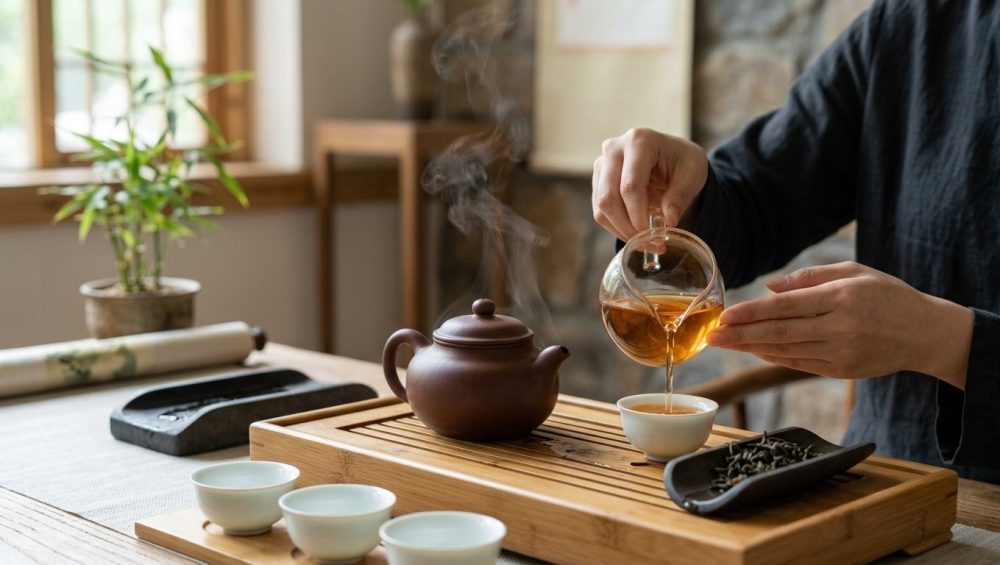
You must never pour tea directly from the Gaiwan into individual guest cups. If you do, the first cup will receive the weakest, under-extracted tea from the top of the Gaiwan, and the last cup will receive the darkest, over-extracted, bitter sludge from the bottom.
Instead, you must decant the entire volume of the Gaiwan into a secondary glass or porcelain pitcher known as a “Gong Dao Bei,” or Fairness Pitcher. This instantly stops the steeping process by separating the water from the leaves, and it homogenizes the liquor so that every single guest receives the exact same flavor profile. From the Fairness Pitcher, you pour the tea into small, 30ml to 50ml tasting cups.
The Psychology of Slowing Down: Mindful Gatherings in Practice
When it comes to hosting mindful gatherings, the goal isn’t to impress people with your frantic multitasking, but to create a shared, grounded experience. This is where the true brilliance of the Gongfu tea ceremony shines.
By utilizing tiny 30ml cups, your guests cannot mindlessly gulp down a massive mug of liquid while staring at their phones. They are forced to take small, intentional sips. Because the steeps only take 15 seconds, there is a constant, rhythmic physical activity happening at the center of the table. You pour, you wait, you decant, you serve.
This rhythm creates natural micro-pauses in the conversation. It eliminates the awkwardness of waiting for the main course to finish roasting. It gives everyone a shared sensory focal point. You can discuss the evolving flavor profile—how the third steep of the Da Hong Pao reveals a deep mineral finish that wasn’t present in the first steep, or how the aroma of the empty cups smells like caramelized honey.
Ultimately, the traditional Gongfu tea ceremony is a masterclass in hospitality. It is a tool for creating meaningful moments together, forcing everyone to put down their modern distractions and actually connect over a meticulously crafted, scientifically perfect beverage. So, put away the bleached tea bags, invest in a good digital scale and a porcelain Gaiwan, and start taking your weekend downtime as seriously as you take your cooking. Your guests—and your sanity—will thank you.