Picture this: You’ve invited six of your closest friends over for a hands-on, communal dumpling night. You’ve romantically envisioned everyone sipping wine, laughing, and effortlessly pinching perfect little pleated crescents of dough while sharing stories. Instead, thirty minutes in, your kitchen looks like a flour-dusted crime scene. Your wrappers are cracking like dry winter skin, the filling is oozing out of the seams, and your guests are nervously staring at mutated lumps of raw pork that look more like biological anomalies than dinner.
We have all been there. I have absolutely been there. I once hosted a dinner where my potstickers turned into a singular, gelatinous “pot-stuck” monolith that I had to chisel out of a cheap pan with a metal spatula. But here is the brutal truth: you don’t need a culinary degree to fold a beautiful dumpling. You just need to understand basic moisture control and structural integrity. It is time to cure cooking anxiety and stop letting a tiny disc of dough intimidate you.
Today, we are diving deep into the definitive, no-fluff, highly researched masterclass on why your dumplings fall apart and how to ensure your next folding night is a flawless, stress-free triumph. Grab your bench scraper and a glass of wine. Let’s get to work.
The Anatomy of a Dumpling Disaster: Why Your Wrappers Betray You
Before we can fix the problem, we have to understand why the dough is betraying you in the first place. A dumpling wrapper is a fragile ecosystem. It relies on a delicate, scientific balance of hydration, gluten development, and ambient temperature. When one of these factors is off, you get the dreaded “blowout,” where the wrapper fractures and spills your precious filling into the cooking water.
The Hydration Hustle
Dough hydration is the ratio of water to flour by weight. If your dough is too dry, it will lack the extensibility required to stretch over a mound of filling. When you go to pleat it, the edges will fracture and snap. If the dough is too wet, it becomes a sticky, unmanageable nightmare that adheres to your fingers, the rolling pin, and the counter, eventually tearing when you try to pick it up. Finding the exact hydration sweet spot is the foundational secret to pliable, forgiving wrappers.
The Airflow Assassination
Let’s talk about the silent killer in your kitchen: ambient air. Dumpling wrappers are incredibly thin. The moment they are exposed to the open air, evaporation begins rapidly. Within minutes, the edges dry out, becoming brittle and impossible to seal. If you’ve ever tried to pinch a store-bought wrapper closed and watched it snap in half, it’s because the dough has lost its moisture to the room. Airflow is your enemy tonight.
The Overstuffing Epidemic
I get it. You made a delicious pork and chive filling, and you want a generous, meaty bite. But greed is the enemy of structural integrity. When you overstuff a dumpling, you are forcing the dough to stretch beyond its tensile limit. Furthermore, as the filling cooks, the fats and liquids expand, creating steam. If there isn’t enough room inside that dough pocket, the steam will violently force its way out, bursting the seams and leaving you with a pot of sad, floating meatballs in a murky dough-water soup.
Sourcing and Prepping Your Wrappers: Store-Bought vs. Homemade
There is absolutely zero shame in using store-bought wrappers, especially when you need to master simple weeknight dinners and time is quite literally money. But you must know how to handle them, because the supermarket aisle is a minefield.
Navigating the Supermarket Aisle
When you hit the Asian market, you will see dozens of wrapper varieties. Wonton wrappers are usually square, thin, and often contain egg (they are meant for boiling in soup). Gyoza wrappers are round and thin, perfect for pan-frying but delicate. Northern-style Chinese dumpling wrappers (often labeled as “shui jiao” or boiled dumpling wrappers) are thicker and chewier. If you are a beginner, go for the thicker wrappers. They are far more forgiving and less prone to tearing.
The biggest issue with store-bought wrappers is that they are usually frozen. When frozen dough thaws, the outer edges often suffer from freezer burn, leaving them dry and prone to cracking. Always inspect the edges before buying; if they look white and chalky, leave them in the freezer. When you bring them home, thaw them slowly in the refrigerator overnight. Never try to pry apart partially frozen wrappers; you will just rip them to shreds and ruin your evening.
The Masterclass on Homemade Dough
If you want to host a truly meaningful dinner party on the weekend, making your own dough is a game-changer. It is infinitely more pliable, tastes drastically better, and stretches like a dream. But you have to respect the chemistry of the water temperature.
There are two primary types of dumpling dough: hot water dough and cold water dough.
Cold water dough is exactly what it sounds like. Mixing flour with room temperature or cold water encourages maximum gluten development. This creates a chewy, highly resilient dough that can withstand the violent rolling boil of a pot of water without disintegrating. If you are boiling your dumplings, cold water dough is mandatory.
Hot water dough, on the other hand, is the secret to perfect pan-fried potstickers and delicate steamed dumplings. When you pour boiling water directly into the flour, you are actively denaturing the proteins and gelatinizing the starches. This prevents the gluten network from becoming too tight and elastic. The result is a dough that is incredibly soft, pliable, and easy to roll out thinly without it snapping back like a rubber band. It yields a tender bite that crisps up beautifully in a pan. For a standard hot water dough, a hydration rate of around 50% to 55% by weight (for example, 100 grams of boiling water to 200 grams of all-purpose flour) is the absolute sweet spot.
The Science of the Filling: Moisture Management is Everything
You can have the most beautifully hydrated, perfectly rolled dough in the world, but if your filling is a soggy, watery mess, your dumplings are doomed. The filling is where most home cooks completely sabotage themselves before the folding even begins.
The Cabbage Catastrophe and Osmosis
Cabbage is a classic dumpling ingredient, providing crunch, sweetness, and bulk. But it is also roughly 92% water. If you chop up raw Napa cabbage, mix it directly with ground pork, and stuff it into a wrapper, you have basically planted a water balloon inside your dough. As the dumpling cooks, the heat breaks down the cabbage’s cell walls, releasing all that water. The wrapper turns to mush from the inside out and disintegrates in the pan.
To prevent this, we must harness the power of cellular osmosis. After finely chopping your cabbage, toss it generously with salt and let it sit in a colander for 15 to 20 minutes. The salt will physically draw the moisture out of the plant cells. Next, take a clean kitchen towel (or your bare hands) and aggressively wring out the cabbage until no more liquid drips out. You will be shocked by how much water you extract. This step is completely non-negotiable if you want intact dumplings.
Fat, Collagen, and the “Wet” Filling Paradox
Here is the paradox of a great dumpling: you want the inside to be explosively juicy, but you need the raw filling mixture to be structurally sound so it doesn’t soak the wrapper before cooking.
Lean meat is your enemy here. If you use 99% lean ground turkey or extra-lean pork loin, your dumplings will taste like dry sawdust pellets. You need fat, and you need collagen. A ratio of 70% lean meat to 30% fat (or at least 80/20) is ideal. Pork shoulder or pork butt is the gold standard. The fat melts during cooking, providing that rich, luxurious mouthfeel, while the collagen breaks down into gelatin, adding body to the juices. If you are feeling ambitious, hand-mincing your pork with a cleaver instead of buying it pre-ground preserves the meat’s texture and prevents it from turning into a dense, bouncy meatball.
The “Da Shui” Technique (Beating Water)
If you want to know the ultimate secrets for kitchen artistry when it comes to Asian dumplings, it is the traditional Chinese technique known as “Da Shui,” which translates to “beating water.”
You actually want moisture in your meat, but it needs to be trapped within the protein matrix, not leaking out loosely into the bowl. To achieve this, you add liquid (water, soy sauce, Shaoxing wine, or ginger-infused chicken broth) to your ground meat in small increments. But here is the crucial part: you must stir the meat vigorously in only one direction.
By stirring rapidly in a single continuous direction, you are unwinding the myosin proteins in the meat. As they unwind, they link together to form a sticky, gelatinous web that traps the liquid and the fat. Keep stirring until the meat looks pale, paste-like, and incredibly tacky. It should hold its shape on a spoon and look almost whipped. This emulsification ensures that the liquid stays locked safely inside the meat while you fold, but bursts into a rich, savory soup when you bite into the cooked dumpling.
Setting Up the Ultimate Stress-Free Folding Station
A dumpling party should be fun, not a frantic race against drying dough. The key to a peaceful daily habit in the kitchen—and especially during a communal dinner party—is “mise en place,” or having everything perfectly staged before the first wrapper is even touched.
The Assembly Line Architecture
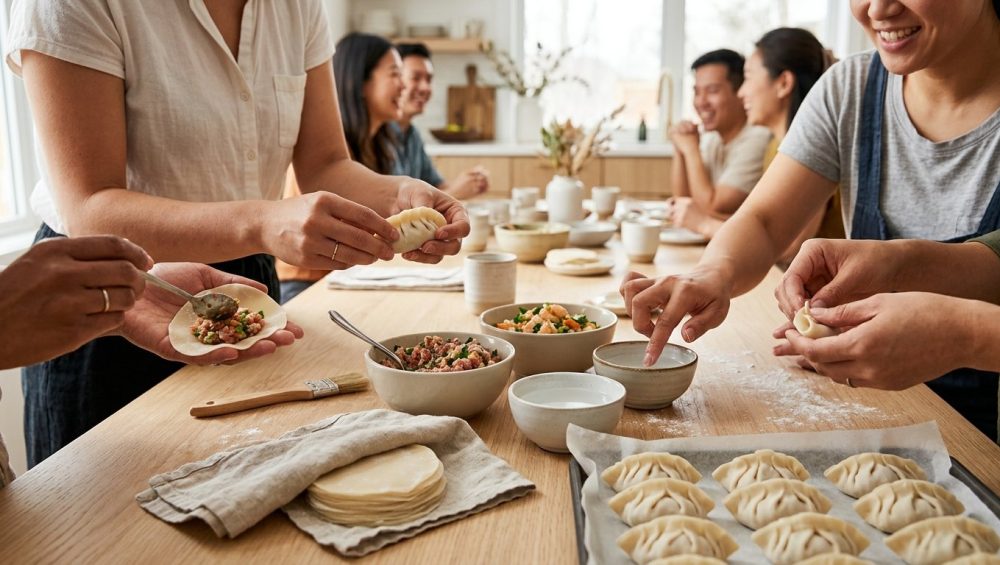
Do not attempt to roll, fill, and fold one dumpling at a time from start to finish. You need an assembly line.
Station 1: The dough rolling (if making from scratch).
Station 2: The filling distribution.
Station 3: The folding and sealing.
If you have guests, put them to work immediately. Give the perfectionist the folding job. Give the heavy-handed guest the filling spoon (and strictly monitor their portions, reminding them of the overstuffing epidemic).
The Damp Towel Directive
This is the single most important rule of the night: Air is the enemy. Whether you are using store-bought wrappers or homemade dough balls, they must be kept under a slightly damp (not soaking wet) paper towel or clean kitchen cloth at all times. Take out only the wrappers you are actively using in that exact moment. As soon as a dumpling is folded, place it on a parchment-lined baking sheet and cover it with another damp towel. If you skip this step, your wrappers will turn into brittle potato chips before the water even boils.
Essential Tools of the Trade
You don’t need a lot of fancy gadgets, but a few beginner kitchen tools will save your sanity. A small wooden dowel rolling pin is far superior to a massive Western-style rolling pin for rolling out individual wrappers. You want the center of the wrapper to be slightly thicker than the edges to support the weight of the filling, and a small dowel gives you the agility to roll just the edges. Additionally, a metal bench scraper is invaluable for portioning dough, dividing your workspace, and scraping sticky flour off your countertops at the end of the night.
The “No-Go” Rule: Banishing Toxic Gear from Your Dumpling Night
Let’s pause the folding for a moment because I need to address a kitchen crime that absolutely makes my blood boil. If you plan on pan-frying your dumplings to make potstickers, we need to have a serious talk about your cookware.
I have a strict “no-go” rule when it comes to cheap, degraded non-stick pans. If you are using a scratched, peeling Teflon (PTFE) skillet that you bought for ten dollars five years ago, you are actively sabotaging your food and your health. I am fiercely passionate about banishing toxic kitchen gear from the home kitchen entirely.
To get a proper, shatteringly crisp skirt on a potsticker, you need medium-high to high heat. Traditional PTFE coatings begin to degrade and release toxic fumes (polymer fume fever is a documented medical reality) when heated past 500°F (260°C). Furthermore, if the coating is scratched, you are embedding flakes of synthetic plastic polymers directly into your beautiful, hand-folded dumplings. It is completely unacceptable.
If you want professional-level results, you must upgrade your gear. A well-seasoned carbon steel skillet is the absolute holy grail for potstickers. It can handle blistering heat, it lasts multiple lifetimes, and once you master the thermodynamics of carbon steel pans, it is naturally non-stick. Alternatively, a heavy-bottomed, multi-clad stainless steel pan is fantastic. Yes, stainless steel has a reputation for sticking, but if you heat the pan properly before adding oil, you can easily prevent food sticking and achieve a glorious, golden-brown crust without a single flake of mystery chemical entering your meal. Quality gear respects the time and effort you put into your food.
Folding Techniques for the Clumsy and Uncoordinated
You do not need to execute a flawless, 18-pleat soup dumpling fold to have a successful dinner party. The goal is a tight seal. That’s it. Stop stressing over making them look like they came out of a restaurant kitchen.
The Half-Moon (The Beginner’s Best Friend)
Place a modest tablespoon of filling in the center of the wrapper. If using store-bought wrappers, dip your finger in a small bowl of water and trace the outer edge of the dough (homemade dough is usually sticky enough to seal without water). Fold the dough over the filling to create a taco shape. Pinch the center closed, then firmly pinch down the sides until you have a smooth, sealed half-moon. Press out any trapped air as you seal—air pockets will expand and burst during cooking.
The Two-Way Pleat
Once you conquer the half-moon, you can step up your game and try pleating. Fold the wrapper in half and pinch just the top center. Then, working down the right side, fold a small pleat of the front wrapper toward the center pinch, pressing it flat against the back wrapper. Repeat this twice more down the right side. Then, do the same on the left side, folding the pleats toward the center. This creates a beautiful, crescent shape that naturally curves and sits flat on its bottom—the optimal geometry for pan-frying.
Sealing the Deal
A quick note on sealing: water is perfectly fine for store-bought wrappers, but some people swear by an elaborate egg wash. Honestly? It’s unnecessary fluff. Plain water acts as a sufficient glue to rehydrate the starchy edges of the wrapper. Just ensure your fingers are completely dry when you are actually pinching the pleats, or the dough will stubbornly stick to you instead of itself, tearing the wrapper.
Cooking the Dumplings Without Ruining the Night
You’ve done the hard work. The dumplings are beautifully folded and resting under a damp towel. Now, do not ruin them at the finish line. The cooking method dictates the final texture, and each method has its own scientific pitfalls.
Boiling (The Float Test and the Cold Water Trick)
Boiling is the traditional method for thicker, Northern-style dumplings. Bring a large pot of water to a rolling boil. Drop the dumplings in gently, and immediately give them a soft stir with the back of a spoon to prevent them from sinking and sticking to the bottom of the pot.
Now, here is the brilliant scientific trick: when the water returns to a furious boil, the dumplings will float to the top. But the dense pork filling inside is likely still raw. If you leave them at a rolling boil, the violent agitation of the bubbles will rip the delicate wrappers apart before the meat cooks. To solve this, pour a half-cup of cold water directly into the pot. This immediately drops the temperature, stopping the violent boil while allowing the ambient heat to continue gently cooking the filling. Wait for the water to return to a boil, and repeat the cold water trick one or two more times. By the third boil, the wrappers will be perfectly translucent, intact, and the filling will be safely cooked.
Pan-Frying / Potstickers
For that irresistible crispy bottom, heat your carbon steel or stainless steel skillet over medium-high heat. Add a generous glug of high-heat oil (like peanut or avocado oil). Place the dumplings in the pan, flat side down. Let them sizzle until the bottoms are deeply golden brown and the Maillard reaction has worked its magic.
Then comes the steam. Pour about a third of a cup of water into the hot pan (stand back, it will aggressively spit and sputter) and immediately clamp a tight-fitting lid on top. Drop the heat to medium-low. The trapped steam will rapidly cook the wrapper and the filling. After about 5 to 7 minutes, remove the lid. Let the remaining water evaporate completely until the dumplings are sizzling in the residual oil once again, re-crisping the bottoms to a shatteringly crunchy texture.
Steaming
Steaming is gentle and elegant, perfect for delicate wrappers. Line your bamboo steamer basket to prevent sticking. You can use perforated parchment paper, but if you want to be resourceful and avoid waste, use the leftover outer leaves of your Napa cabbage. Lay the leaves flat in the steamer and place the dumplings on top. Steam over boiling water for 8 to 10 minutes. The cabbage imparts a subtle, sweet aroma to the dough and guarantees absolutely zero sticking.
Hosting the Dumpling Party: Keeping It Chill
The ultimate goal here is to unlocking kitchen creativity without losing your mind. If you are sweating over a hot stove while your guests are drinking wine in the living room without you, you have failed the assignment.
Delegating Like a Boss
A dumpling party is an interactive sport. Set up the folding station on your dining table. Put on a great playlist. Pour the drinks. Then, hand everyone a damp towel and a stack of wrappers. Teach them the half-moon fold, and let them go to town. Some dumplings will look like abstract art. Some will be downright ugly. That is entirely the point. It is about the communal experience of creating a meal together, not achieving factory-level uniformity.
Staging and Holding
If you are making a massive batch, you will need to hold the folded dumplings before cooking. Heavily dust your baking sheets with cornstarch or potato starch (regular flour can sometimes get absorbed into the wet dough, causing sticking). Space the dumplings out so they aren’t touching—if raw dumplings touch, they will fuse together permanently, and pulling them apart will rip holes in the wrappers. Keep them covered with that trusty damp towel until they hit the pan.
The secret to a stress-free dumpling night isn’t found in a Michelin-starred kitchen; it’s found in understanding the simple mechanics of moisture. Respect the hydration of your dough, salt your cabbage, whip your meat filling until it’s sticky, and protect your wrappers from the dry air. Once you implement these straightforward, scientific techniques, the panic of exploding wrappers will be a thing of the past. You’ll be left with nothing but shatteringly crisp potstickers, perfectly tender boiled dumplings, and the smug satisfaction of knowing you just pulled off the ultimate culinary gathering without breaking a sweat. Now, get out of here, go buy some pork shoulder, and start folding. You’ve got this.