Listen up, people. We need to have a serious, sit-down conversation about how you are entirely ruining your own dinner parties.
I know exactly what you do. You decide to invite a few friends over for a casual Saturday night. But by Thursday, “casual” has mutated into a multi-course tasting menu that requires three trips to specialty grocery stores, an immersion circulator, and ingredients you can’t even pronounce. By the time your guests arrive, you are sweating profusely, your kitchen looks like a culinary war zone, and you are aggressively whisking a broken emulsion while your friends sit in the living room having a fabulous time without you.
You spend the entire evening playing the role of the frazzled, resentful servant in your own home. And for what? A fleeting compliment on your reduction sauce?
I am here to tell you that you do not need a culinary degree to make food that makes people weep with joy. You do not need to sacrifice your sanity to be a good host. As someone who learned to cook through sheer stubbornness, trial, error, and setting off the smoke detector more times than I care to admit, I can promise you this: professional-level results are absolutely achievable in a standard home kitchen, provided you work smart, not hard.
Weekday meals are about ruthless efficiency. Weekend hosting is about smart, strategic preparation. It is time to burn the pedestal of the “perfect dinner party” and embrace the art of the effortless meal. Because at the end of the day, food is just the excuse we use to get the people we love into the same room.
The Myth of the Martyr Host
There is a pervasive, toxic myth in the home cooking community that if you aren’t suffering, you aren’t doing it right. We have been brainwashed by highly edited social media feeds and pretentious lifestyle gurus into believing that hospitality equals exhaustion.
The statistics on this are genuinely depressing. According to a 2024 survey of 2,000 adults, a staggering 57% of people find hosting stressful because they simply cannot relax. The same study revealed that 56% of hosts admit to engaging in a frantic “panic clean” before guests arrive, and 34% suffer from literal “spill-xiety”—a profound fear that a guest is going to ruin their carpet or furniture. In fact, 82% of people exhaust themselves ensuring their home is at its absolute peak cleanliness before the doorbell even rings.
Let me free you from this prison: your friends do not care about your baseboards. If you are inviting people into your home who will judge a stray dust bunny in the hallway, you do not need a better vacuum cleaner; you need better friends.
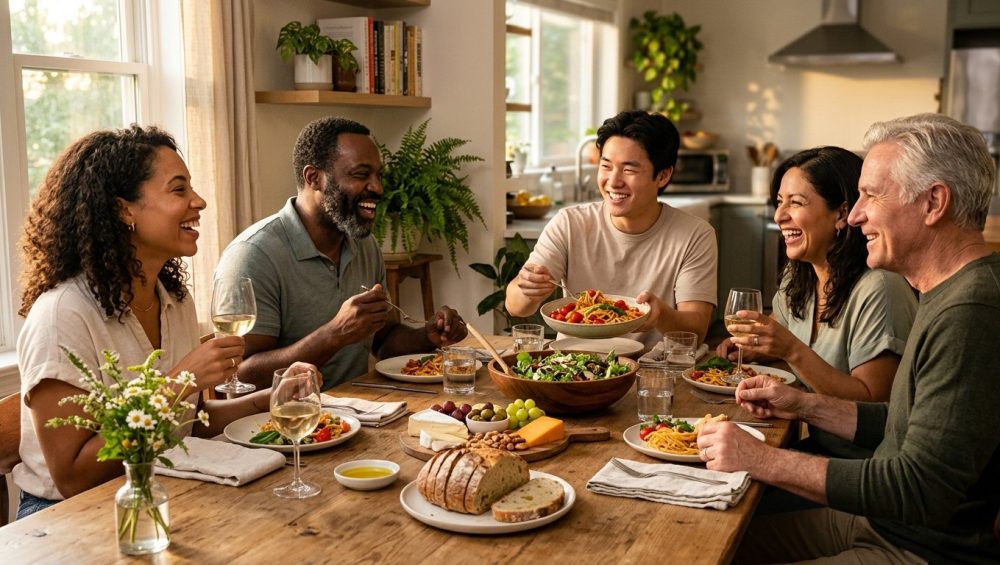
The anxiety we attach to hosting is entirely self-inflicted. We worry about the menu, the timing, the ambiance, and the cleanup. We try to recreate restaurant experiences without restaurant staff, restaurant budgets, or restaurant equipment. Interestingly, that same 2024 study found that 83% of people actually prefer hosting small, intimate groups, with six being the ideal, magic number of guests.
Six people. That is a highly manageable number. That is not a catering gig; that is just dinner. It is time to stop viewing hosting as a theatrical performance where you are the star, the director, and the underpaid stagehand. Your guests are not food critics; they are your friends. They want to see your face, hear your laugh, and drink your wine.
Why We Gather: The Cold, Hard (and Heartwarming) Science
If you need empirical evidence to convince you to stop stressing and start enjoying your guests, let’s look at the actual science of shared meals. The psychological benefits of eating together are so profound that they should be prescribed by doctors.
In the 2025 World Happiness Report, researchers from the Harvard Kennedy School published findings that should fundamentally change how we view dinner. The study revealed that shared meals are as predictive of human happiness as income or employment status. Let that sink in for a moment. Sitting down to share a plate of mediocre pasta with a friend does as much for your subjective well-being as a pay raise. The study analyzed data across 142 countries, adjusting for socio-economic status, gender, and age, and found that the frequency of eating with others is one of the single most consistent factors impacting life satisfaction.
Yet, we are moving in the exact opposite direction. The American Time Use Survey cited in that same 2025 report showed that Americans are spending more time than ever dining apart. In 2023, roughly one in four Americans reported eating every single meal alone the previous day—a devastating 53% increase since 2003. This epidemic of solo dining is hitting young people the hardest, with those aged 18 to 34 eating alone almost 180% more frequently than they did two decades ago.
We are starving for connection. A landmark 2024 study conducted by the University of Minnesota, spanning the United States, Italy, and Germany, found a strong positive correlation between gathering around the table and reduced depressive symptoms, enhanced connectedness, and an overall improvement in mood. Over 65% of global respondents in that study identified dinner as the best meal to share with others.
The Family Dinner Project’s 2025 analysis noted that while 13 shared meals a week is the “sweet spot” for maximum psychological benefit, eating even one meal a week with others creates a measurable increase in emotional well-being, lowering stress, pain, and sadness.
When you overcomplicate the menu and stress yourself out, you are actively destroying the very mechanism that makes shared meals so magical: presence. If you are hyperventilating over a soufflé in the kitchen, you are not connecting. You are not boosting anyone’s happiness, least of all your own. The goal is to get the food on the table with as little friction as possible so the real work—the laughing, the venting, the storytelling, the human connection—can begin.
The “Effortless” Arsenal: Gear That Won’t Poison You or Your Vibe
Before we even talk about food, we need to talk about your equipment. I have a strict, uncompromising “No-Go” rule when it comes to cheap, toxic kitchenware. I absolutely despise mystery metals, flimsy pots that warp when you look at them funny, and above all, toxic non-stick coatings that peel off into your eggs.
If you have a scratched Teflon pan in your kitchen right now, I want you to walk over to your cabinets, take it out, and throw it in the garbage. I am completely serious.
For decades, conventional non-stick cookware has relied on PFAS (per- and polyfluoroalkyl substances), notoriously known as “forever chemicals” because they refuse to break down in the environment or in the human body. The regulatory hammer is finally coming down on this garbage. In April 2024, the EPA finalized a critical rule designating two widely used PFAS—PFOA and PFOS—as hazardous substances under the Superfund law (CERCLA). Yes, Superfund. As in toxic waste sites.
Furthermore, state legislatures are finally stepping up to protect consumers. Minnesota didn’t come to play; starting January 1, 2025, the state’s Amara’s Law explicitly banned the sale of cookware containing intentionally added PFAS. Colorado, California, and several other states have passed similar sweeping legislation phasing out these forever chemicals in cookware between 2025 and 2026.
You do not need toxic chemicals to cook eggs without them sticking. You need proper technique and high-quality, durable gear that will outlive you. Here is the effortless, non-toxic arsenal you actually need to host like a pro:
Enameled Cast Iron
If you are going to invest in one piece of serious cookware for hosting, make it a heavy-duty enameled cast iron Dutch oven (brands like Staub or Le Creuset are the gold standard). Enameled cast iron gives you the insane heat retention of traditional cast iron, but the glass-enamel coating means it is naturally non-toxic, doesn’t require obsessive seasoning, and won’t react to acidic foods like tomatoes or wine. It is the ultimate vessel for the “set it and forget it” braises that make weekend hosting a breeze. Plus, a gorgeous Dutch oven goes straight from the oven to the center of the dining table, acting as a rustic centerpiece and saving you a serving dish to wash.
Carbon Steel
Carbon steel is the best-kept secret of the professional restaurant industry. It is significantly lighter than traditional cast iron, completely non-toxic, and when properly seasoned, it builds a natural, slick patina that rivals any chemical non-stick pan on the market. Brands like Made In and De Buyer produce exceptional carbon steel skillets. They heat up incredibly fast and sear meats beautifully.
High-Quality Tri-Ply Stainless Steel
For everything else, you want fully clad, tri-ply stainless steel. I highly recommend All-Clad’s D3 line, which bonds an aluminum core between layers of stainless steel for flawless, even heat distribution. It is virtually indestructible, oven-safe up to 600 degrees Fahrenheit, and completely non-toxic. It does have a learning curve—you must preheat the pan properly before adding oil to prevent sticking—but once you master it, you will never look back.
Pure Ceramic
If you want absolutely zero metal in your cooking surface, 100% pure ceramic cookware (like the brand Xtrema) is a fantastic, inert, non-reactive option. It won’t leach anything into your food, no matter how high the heat.
Stop buying cheap pans every two years. Invest in safe, high-quality tools. They make cooking easier, faster, and infinitely safer.
Strategy Over Sweat: The Golden Rules of Stress-Free Hosting
Now that your kitchen is free of toxic waste, let’s talk strategy. Hosting should never feel like a restaurant dinner service. If you are cooking a la minute (to order) while your guests are sitting at the table, you have already lost the game. Here are my golden rules for effortless hosting.
1. The “Do Ahead” Rule
Never, under any circumstances, plan a menu where the bulk of the active cooking happens after the doorbell rings. Your menu should be at least 80% complete before your guests even pull into your driveway. Braises, stews, marinated salads, dips, and cold desserts are your best friends. The only thing you should be doing when guests arrive is pulling something out of the oven or tossing a salad with dressing.
2. The “Never Cook Everything on the Stove” Rule
Home kitchens typically have four burners. If your menu requires you to use all four burners simultaneously, you are setting yourself up for a chaotic disaster. A smart menu utilizes different zones of the kitchen. You want one thing in the oven, one thing on the stove, and one or two things that are served at room temperature. This prevents a logistical traffic jam and keeps your kitchen from turning into a sauna.
3. The “Say Yes to Help” Rule
When a guest texts you and asks, “What can I bring?” do not play the martyr and say, “Just yourselves!” That is a rookie mistake. People want to contribute; it makes them feel invested in the gathering. Delegate the things that take up mental bandwidth but require zero cooking skill. Tell them to bring a bag of ice, a specific bottle of wine, or a crusty loaf of bread from the good bakery across town.
4. The “Empty Dishwasher” Rule
We will discuss cleanup in depth later, but this is a pre-game necessity. Ensure your dishwasher is completely empty before you begin cooking, and certainly before guests arrive. You want to be able to seamlessly hide dirty prep bowls and cutting boards out of sight. A clear sink equals a clear mind.
The Menus: Foolproof, Fake-Fancy, and Fast
The secret to a great dinner party menu is choosing dishes that yield a massive return on a minimal investment of effort. I call this “fake-fancy.” It looks like you slaved away for hours, but in reality, you spent 20 minutes chopping and let time and heat do the rest of the work. Here are four bulletproof, low-stress menus guaranteed to foster connection rather than a nervous breakdown.
Menu 1: The “I Woke Up Like This” Brunch
Brunch is notoriously annoying to host because it happens early in the day, meaning you have to wake up at the crack of dawn to prep. Unless, of course, you cheat. The goal here is to avoid standing over a stove flipping individual pancakes or poaching eggs to order while your friends drink mimosas without you.
The Main Event: The Sheet Pan Frittata Frittatas are the ultimate hosting hack because they are infinitely adaptable, can be served hot or at room temperature, and feed an army. Instead of making it in a skillet, bake it on a rimmed baking sheet. Whisk together 12 large eggs, a half-cup of heavy cream (do not use skim milk, we are not punishing ourselves), a generous pinch of kosher salt, and black pepper. The day before, caramelize two large yellow onions until they are deeply sweet and jammy. Spread the cold caramelized onions onto a greased sheet pan, crumble a massive log of good goat cheese over the top, and pour the egg mixture over it. Bake at 350°F for about 15-20 minutes until just set. Cut it into neat squares. It looks incredibly elegant, and you did all the hard work yesterday.
The Side: The Overnight Oats Bar Instead of cooking oatmeal on the stove, set up a DIY overnight oats bar. In a large, beautiful glass bowl, mix rolled oats, almond milk, chia seeds, and a touch of maple syrup the night before. Let it sit in the fridge. In the morning, put the bowl on the table alongside an array of toppings in small ramekins: toasted coconut flakes, sliced almonds, fresh berries, and a jar of high-quality lemon curd. It is interactive, requires zero morning cooking, and looks like a boutique hotel buffet.
Menu 2: The “Mediterranean Mirage” Grazing Feast
Sometimes, the best way to host is to not cook at all. A grazing feast is highly interactive, encourages people to linger at the table, and forces communal sharing, which, as the science tells us, builds trust and cooperation.
The Star: Whipped Feta with Hot Honey Take an 8-ounce block of high-quality sheep’s milk feta (buy it in the brine, not the dry crumbles) and throw it into a food processor with a quarter cup of Greek yogurt, a splash of olive oil, and a squeeze of fresh lemon juice. Blend until it is obscenely smooth and creamy. Spread it into a shallow bowl, creating swoops with the back of a spoon. Drizzle it generously with hot honey (honey infused with chili flakes) and scatter some toasted pistachios on top. It takes four minutes to make and tastes like a $20 appetizer at a trendy wine bar.
The Supporting Cast: Roasted Grapes and Tinned Fish To elevate the board, toss a cluster of red seedless grapes with olive oil, salt, and a few sprigs of fresh rosemary. Roast them at 400°F for 15 minutes until they blister and burst. They become incredibly sweet and complex, pairing perfectly with the salty feta. Next, lean into the tinned fish renaissance. Buy two or three tins of premium, sustainably caught sardines or mackerel packed in olive oil. Serve them right in the tin with wedges of lemon. Surround everything with mountains of warm pita bread, crisp cucumbers, and good olives. You have just created a feast with exactly 15 minutes of actual “cooking.”
Menu 3: The “Set It and Forget It” Braise
When the weather turns cool, nothing makes people feel more cared for than a deeply savory, slow-cooked braise. Braising is the home cook’s best friend because it is entirely front-loaded. You do the work at 2:00 PM, and by 7:00 PM, your house smells like a Parisian bistro and you haven’t lifted a finger in hours.
The Masterpiece: Red Wine Braised Short Ribs This is where your enameled cast-iron Dutch oven earns its keep. Buy bone-in beef short ribs. Season them aggressively with kosher salt. Get a tablespoon of oil screaming hot in your Dutch oven and sear the ribs on all sides until they develop a deep, dark brown crust. This is the Maillard reaction—the chemical reaction between amino acids and reducing sugars that gives browned food its distinctive, complex flavor. Do not rush this step; color equals flavor.
Remove the beef and throw in a classic mirepoix (diced onions, carrots, and celery). Cook until soft, then add two tablespoons of tomato paste. Cook the tomato paste until it turns brick red and starts to stick to the bottom of the pot—this cooks out the raw, tinny flavor. Deglaze the pot with an entire bottle of dry red wine (something you would actually drink, but nothing expensive). Scrape up all the browned bits from the bottom. Add the beef back in, toss in a few sprigs of thyme and a bay leaf, and add beef stock until the meat is halfway submerged.
Put the lid on and slide it into a 300°F oven for 3 to 4 hours. Walk away. Go read a book. Take a shower. When your guests arrive, the meat will be meltingly tender and the liquid will have reduced into an intensely rich sauce. Serve it over a massive bowl of creamy polenta (which takes 10 minutes to whisk together on the stove) or good quality store-bought pappardelle pasta. It is foolproof, fake-fancy perfection.
Menu 4: The “DIY Taco Bar” That Doesn’t Suck
Taco night is a classic, but it often devolves into a messy, stressful affair of frying ground beef and chopping a million garnishes at the last minute. We are going to elevate it and automate it.
The Anchor: Slow Cooker Pork Shoulder Carnitas Take a 4-pound boneless pork shoulder. Rub it down with salt, cumin, dried oregano, and a little smoked paprika. Drop it into a slow cooker (or your trusty Dutch oven on low heat) with the juice of two oranges, one lime, a quartered onion, and a few cloves of smashed garlic. Let it cook on low for 8 hours. It will completely collapse into tender, shreddable perfection.
The Pro-Move: Right before serving, shred the pork, spread it on a carbon steel or stainless steel baking sheet, and broil it for 5 minutes until the edges get crispy and caramelized.
The Acid: Quick Pickled Red Onions Rich pork needs acid to cut through the fat. Slice a red onion as thin as you possibly can. In a bowl, mix a cup of hot water, a half-cup of apple cider vinegar, a tablespoon of sugar, and a heavy pinch of salt. Pour it over the onions and let it sit on the counter for an hour. They will turn a stunning, vibrant neon pink and add a necessary bright, acidic crunch to the tacos.
Serve the pork and onions with a stack of warm corn tortillas, fresh cilantro, crumbled cotija cheese, and a bowl of good salsa. The interactive nature of building your own taco breaks down social barriers and gets people talking.
The Art of the Shortcut: Store-Bought is Fine (And Frequently Better)
I need you to internalize a very important culinary philosophy: nobody cares if you made the puff pastry from scratch. Unless you are competing on a televised baking show, making everything from scratch for a dinner party is an exercise in pure, unadulterated masochism.
Ina Garten has been telling us for years that “store-bought is fine,” but I am going to take it a step further: store-bought is frequently better. You have a finite amount of time and energy. Spend it where it actually matters.
Bread: Do not bake your own bread for a dinner party unless baking bread is your specific, passionate hobby. Go to a local artisan bakery, buy a gorgeous, naturally leavened sourdough boule, warm it in the oven for five minutes, and serve it with good, room-temperature salted butter. Your guests will be thrilled.
Salad Greens: Buy the pre-washed, triple-washed boxed greens. Washing and drying delicate lettuces is a tedious, space-consuming chore that makes a mess of your counters. Buy the box, dump it in a beautiful wooden bowl, and spend your energy making a vibrant, punchy homemade vinaigrette (olive oil, dijon mustard, lemon juice, shallot, salt, pepper) instead.
Dessert: This is where hosts lose their minds. After cooking a beautiful main course, the last thing you want to do is stress over a temperamental cake or a tart that refuses to set. The chicest, easiest dessert in the world requires zero baking. Buy a pint of ultra-premium, high-butterfat vanilla bean ice cream. Scoop it into small, elegant bowls. Drizzle it with a high-quality, peppery extra-virgin olive oil and sprinkle it with flaky Maldon sea salt. It is sophisticated, hits the perfect salty-sweet balance, and takes exactly 45 seconds to prepare.
Setting the Mood Without Losing Your Mind
Ambiance matters, but it shouldn’t require a glue gun or a trip to a craft store. The goal is to create a warm, inviting environment that makes people feel instantly at ease.
1. Kill the Overheads: Nothing kills a dinner party vibe faster than the sterile, interrogation-room glare of overhead kitchen lighting. Turn them off. Rely entirely on lamps, under-cabinet lighting, and candles. Dim, warm lighting makes the food look better, makes your guests look better, and immediately signals to the brain that it is time to relax.
2. Scent Control: Do not place heavily scented floral or synthetic candles anywhere near the dining table. The sense of smell is inextricably linked to the sense of taste. If your guests are smelling “Midnight Jasmine” while trying to eat braised short ribs, it will ruin their palate. Stick to unscented taper candles on the table, and let the smell of the food be the primary aroma.
3. The Playlist: Music is the great social lubricant. It fills the awkward silences while people are settling in. Create a playlist that is upbeat but unobtrusive—think instrumental jazz, lo-fi beats, or classic soul. Keep the volume at a level where people can comfortably hear each other without shouting.
The Cleanup Strategy: Because Nobody Wants to Scrub Pans at Midnight
The dread of the post-party cleanup is often what stops people from hosting in the first place. You envision yourself standing in a dark kitchen at 1:00 AM, chipping hardened cheese off a baking dish while questioning your life choices. This does not have to be your reality.
First, refer back to the “Empty Dishwasher” rule. Because your dishwasher is empty when you start cooking, you can practice the sacred art of “Cleaning As You Go.” Every time you finish using a prep bowl, a measuring cup, or a cutting board, it goes immediately into the dishwasher. By the time you sit down to eat, the only dirty dishes in your kitchen should be the ones currently holding the food.
Second, embrace the soak. When dinner is over and you clear the plates, do not start violently scrubbing pots and pans while your guests are still drinking wine in the living room. It makes them feel guilty and rushed. Instead, take the heavy cookware—your enameled Dutch oven or your roasting pan—fill it with hot water and a squirt of dish soap, and leave it on the stove. Load the dinner plates into the dishwasher, hit start, and walk away. Return to your guests. The hot, soapy water will do 90% of the scrubbing work for you overnight. Tomorrow morning, that baked-on fond will wipe away with a gentle sponge.
Conclusion: Burn the Pedestal, Not the Roast
Hosting a gathering in your home is an act of extreme vulnerability. You are inviting people into your private space, feeding them from your own hands, and hoping they enjoy themselves. It is completely natural to want everything to be perfect.
But perfection is a cold, sterile concept. It belongs in operating rooms and aerospace engineering, not in a home kitchen. The most memorable, meaningful meals are the ones where the host is actually present, laughing loudly, spilling a little wine, and enjoying the fruits of their own minimal labor.
Remember the science: the sheer act of sharing a meal with people you care about is actively improving your mental health and theirs. It is fighting back against an epidemic of isolation. It is building a community.
So throw away your toxic pans. Stop apologizing for your slightly messy house. Buy the good store-bought ice cream, braise a piece of meat until it falls apart, dim the lights, and pour the wine. You are not a martyr; you are a host. Act like it, and go have some fun.