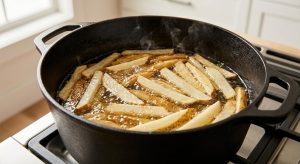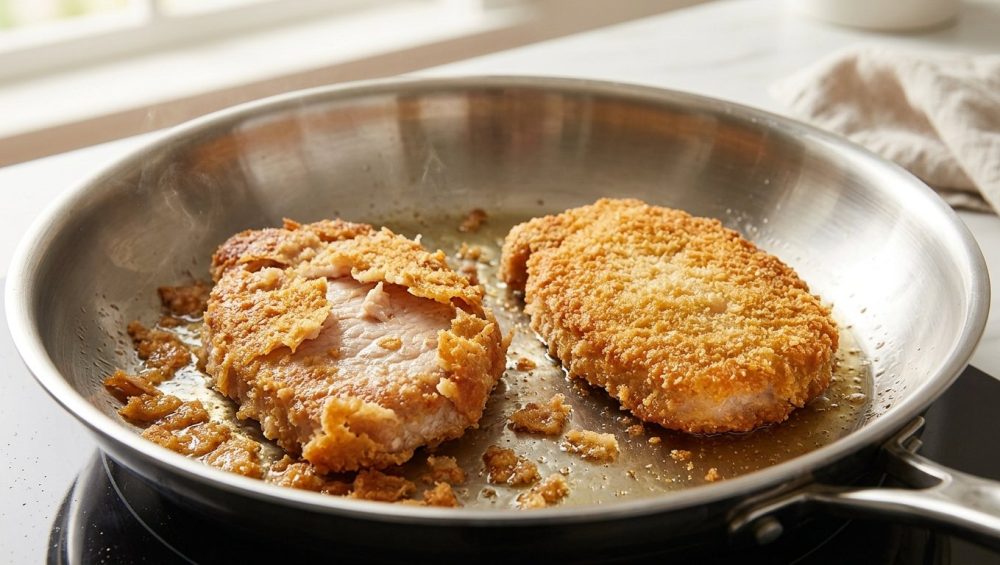
We have all been there, and I know exactly how frustrating it is. You spend your hard-earned money on beautiful, thick-cut pork chops or gorgeous chicken breasts. You meticulously set up your little assembly line of shallow dishes. You dip, you dredge, you coat, and you gently lower the meat into a sizzling skillet of oil. For a brief, glorious moment, you feel like a culinary genius. The crust looks perfectly golden and earth-shatteringly crispy. But then, the absolute worst happens. The moment you take your tongs to flip the meat, or the second you slice into it on your cutting board, the entire beautiful breadcrumb shell slides right off in one sad, greasy, soggy sheet. You are left staring at a naked, pale piece of meat surrounded by a life raft of detached breading.
Listen to me, my weekend culinary warriors: you are not cursed, and you do not need a degree from Le Cordon Bleu to fix this. I am your sassy sous-chef, and I have ruined enough chicken parmesan in my lifetime to know exactly why your crust is abandoning ship. It all comes down to physics, chemistry, and a little bit of patience. I firmly believe that absolutely anyone can cook like an expert in a standard home kitchen, provided they understand the fundamental food science behind what they are doing. We are going to stop relying on blind luck and start cooking with intention. It is time to eliminate kitchen chaos once and for all.
Today, we are diving deep into the microscopic world of standard breading procedures, the treacherous physics of steam barriers, and the absolute magic of starch hydration. I am going to teach you how to lock that crust onto your meat so tightly that you would need a chisel to get it off. Grab a glass of wine, pull up a stool, and let’s get to work.
The Anatomy of a Breading Disaster
To understand why your breading is falling off, we first have to understand what breading actually is and why we do it in the first place. When we coat a piece of meat before pan-frying, we are not just doing it because it tastes good—though, let’s be honest, a crispy fried crust is one of the greatest joys in human existence. We do it to protect the meat. Frying oil is incredibly hot, usually hovering around 350°F (175°C) to 375°F (190°C). If you drop a naked, unbreaded chicken breast directly into hot oil, the intense, direct heat will aggressively seize the proteins, violently squeeze out the moisture, and leave you with a tough, rubbery hockey puck.
The breading acts as an insulator. It takes the brunt of the extreme heat, browning and crisping up via the Maillard reaction, while gently allowing the ambient heat to penetrate and cook the delicate protein inside. When you mess up this delicate balance, it is one of the most common mistakes ruining your dinners on a regular basis.
The Standard Breading Procedure (SBP) Explained
In professional kitchens, we use something called the Standard Breading Procedure, or SBP. It is a rigid, three-step process, and you cannot skip a step without inviting disaster.
First, there is the Flour stage. The raw meat is dredged in seasoned all-purpose flour. This is your primer. Just like you wouldn’t paint a wall without priming it first, you cannot bread meat without flour. The flour wicks away residual surface moisture and creates a dry, textured microscopic surface for the next layer to grip onto.
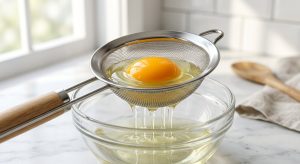
Second, the Egg Wash stage. The floured meat is dipped into beaten eggs (often thinned with a splash of water, milk, or buttermilk). This is your binder. The proteins in the egg act as a culinary glue. They cling to the dry flour layer on the inside and provide a wet, sticky surface on the outside.
Third, the Crumb stage. The sticky, egg-coated meat is firmly pressed into breadcrumbs, panko, cornmeal, or whatever crunchy coating you desire. This is your armor. The crumbs adhere to the sticky egg proteins, creating the final insulating layer that will eventually become your crispy crust.
When your breading falls off, it means there has been a catastrophic failure at one of the bonding sites between these three layers. Either the flour didn’t stick to the meat, the egg didn’t stick to the flour, or the crumbs didn’t stick to the egg. Let’s break down exactly why these bonds fail and how to bulletproof them.
The Steam Barrier Betrayal: Why Wet Meat is Your Enemy
If I could stand in every home kitchen in America and shout one rule from the rooftops, it would be this: dry your meat. Moisture is the absolute, undisputed enemy of a crispy, adhered crust. If you pull a chicken breast or a pork chop straight out of its vacuum-sealed plastic packaging, give it a quick shake, and toss it directly into your flour dredge, you have already failed. Your breading is guaranteed to fall off.
Let’s talk about the physics of frying. Meat is essentially a biological sponge filled with water. When you drop that meat into 350°F oil, the surface temperature of the meat rapidly skyrockets. Here is the crucial scientific fact: water boils and turns to steam at 212°F (100°C). When water converts into steam, it expands to roughly 1,700 times its original liquid volume.
If you do not thoroughly dry the surface of your meat before breading it, a microscopic layer of water remains trapped between the meat and the flour primer. When that trapped water hits the hot oil, it instantly flashes into steam. Because the steam expands so rapidly and violently, it acts like a microscopic explosive charge. It creates a literal balloon of vapor underneath your breading, pushing the crust entirely away from the meat. The breading literally blows off from the inside out.
If you have ever wondered why your chicken won’t brown or why your crust is patchy, excess surface moisture is almost always the primary culprit. You must aggressively pat your meat dry with paper towels before it ever touches the flour. I am talking bone-dry. If you think it is dry enough, pat it down one more time just to be safe.
If you are a weekend perfectionist with some time to spare, the absolute best way to ensure a dry surface is to leave the meat uncovered on a wire rack in your refrigerator for a few hours, or even overnight. The circulating cold air in the fridge is incredibly dry and will naturally dehydrate the very outer millimeter of the protein. Not only does this guarantee that your flour will stick perfectly, but it also concentrates the flavor and helps ensure that your chicken always turns out dry on the outside, but incredibly juicy on the inside.
The Secret Weapon: Starch Hydration and Resting
Alright, so you have perfectly dried your meat, you have floured it, egged it, and crumbed it. You are ready to fry, right? Wrong. Put the tongs down and step away from the stove. This is the step that 90% of home cooks skip because they are impatient, and it is the exact reason their crust slides off like a bad toupee in a windstorm.
You must let your breaded meat rest.
When you dredge a piece of meat in flour, you are coating it in raw, un-hydrated starch granules. When you subsequently dip it in the egg wash, you are introducing moisture to those starches. But here is the catch: hydration is not instantaneous. It takes time for the liquid from the egg to fully penetrate and be absorbed by the dry flour layer.
If you immediately take a freshly breaded pork chop and throw it straight into hot oil, those starch granules in the flour layer are still mostly dry powder underneath the egg wash. What happens to dry powder when it gets hit with the steam escaping from the cooking meat? It turns into a slippery, dusty paste, and the entire outer crust just glides right off.
However, if you let that breaded meat rest on a wire rack for 15 to 30 minutes before frying, culinary magic happens. This process is known as starch gelatinization and hydration. During this resting period, the moisture from the egg wash slowly and thoroughly absorbs into the flour. The microscopic starch granules swell, hydrate, and unravel, turning from a dusty powder into a sticky, cohesive, glue-like gel.
This hydrated starch gel creates an unbreakable, interlocking chemical bond between the surface of the meat, the flour, the egg proteins, and the outer breadcrumbs. They fuse together into a single, unified matrix. Once this matrix is set, you could practically throw the meat at the wall and the breading wouldn’t fall off.
To properly execute this, arrange your freshly breaded items in a single layer on a wire cooling rack set over a baking sheet. Do not put them on a flat plate, or the bottom will get soggy. Place the whole tray in the refrigerator for at least 15 minutes. The chill of the fridge helps solidify the fats and proteins, further setting the crust. This single, simple step of resting your breading is the ultimate secret weapon to transform your daily meals from amateur hour to absolute restaurant-quality perfection.
Skillet Mechanics and Temperature Control
You have perfectly dry meat. You have a flawlessly executed Standard Breading Procedure. You have patiently allowed the starches to hydrate and set. You are now holding a piece of structurally sound, perfectly breaded meat. Do not ruin it at the finish line by making a rookie mistake in the skillet. How you handle the pan and the oil is just as critical as how you handle the food.
Banish the Toxic Non-Stick Pans
Let us get one thing straight: I have absolutely zero patience for cheap, peeling, scratched-up non-stick pans. If you are trying to pan-fry a beautiful, crispy chicken cutlet in a lightweight aluminum pan coated in mystery Teflon that has more scratches than a cat’s scratching post, we need to have an intervention. You are not only ruining your food; you are actively eating toxic chemical flakes.
You must ditch toxic kitchen gear immediately. Cheap non-stick pans are terrible for pan-frying breaded meats because they lack thermal mass. They are too thin to hold heat. The second you drop a cold piece of meat into them, the temperature of the pan plummets, and your food ends up stewing in its own juices rather than frying.
If you want to cook like an expert, you need to invest in essential beginner kitchen tools that actually perform. You need a heavy-bottomed skillet that retains heat beautifully. A high-quality tri-ply stainless steel skillet, a well-seasoned cast iron pan, or a professional-grade carbon steel skillet are your best friends here. These materials hold onto heat like a vault, ensuring that the oil temperature remains stable when the food hits the pan, which is absolutely vital for setting a crust instantly.
The Cardinal Sin of Pan Crowding
The fastest way to turn a perfectly breaded piece of meat into a soggy, greasy disaster is by overcrowding the pan. I know you are hungry, and I know you want to get dinner on the table quickly, but cramming four massive pork chops into a single 10-inch skillet is culinary self-sabotage.
When you heat up a pan of oil, that oil holds a specific, limited amount of heat energy. When you introduce food into the pan, the food absorbs that heat energy, causing the temperature of the oil to drop. If you are frying one or two pieces of meat in a heavy pan, the heat source can quickly recover and keep the oil hovering around that crucial 350°F sweet spot.
But if you overcrowd the pan, the thermal shock is too massive. The temperature of the oil plummets drastically, dropping from a frying temperature of 350°F down to a warm, greasy 250°F. When this happens, the crust does not instantly sear and seal. Instead, the breadcrumbs act like tiny little sponges, eagerly soaking up all that lukewarm oil. The breading becomes incredibly heavy, dense, and soggy. The structural integrity of the starch gel breaks down under the weight of the grease, and the breading sloughs off into the pan. You must fry in batches. Leave at least an inch of space between each piece of meat in the skillet.
The Science of Sticking and Flipping
Once the meat is in the hot oil, step back and leave it alone. Do not poke it. Do not prod it. Do not try to lift it up to peek underneath after thirty seconds. If you try to flip breaded meat before the crust has properly set and browned, the breading will physically bond to the metal of the pan and rip right off the meat.
This comes down to understanding the thermodynamics of carbon steel and cast iron, or mastering the Leidenfrost effect if you are using stainless steel. When the wet, protein-rich egg wash and starches first hit the hot metal, they want to form chemical bonds with the pan. However, as the intense heat triggers the Maillard reaction—the complex chemical process that browns the food and creates flavor—the proteins coagulate, the starches crisp up, and the moisture evaporates.
Once this crust is fully formed and hardened, it will naturally release its grip on the pan. If you feel resistance when you try to slide your spatula underneath the meat, it is the pan’s way of telling you that the crust is not ready yet. Stop forcing it. Give it another minute or two. Learning how to properly utilize heat to naturally prevent protein adhesion is a hallmark of a confident home cook. When the crust is perfectly golden brown, it will lift away effortlessly.
Weekday Hacks vs. Weekend Perfection
I am a realist. I know that my philosophy of aggressive patience doesn’t always align with the chaotic reality of a Wednesday evening after a long day at the office. Time is money, and sometimes you just need to get food on the table before you resort to ordering takeout. But that doesn’t mean you have to sacrifice the structural integrity of your dinner. Here is how we adapt the science for your schedule.
The Weekday Hustle
When you are short on time and need to master simple weeknight dinners, you have to prioritize efficiency without breaking the rules of physics.
First, pound your meat thin. Thick chicken breasts take far too long to cook through. The longer they sit in the pan, the more steam they generate internally, and the higher the risk of the breading blowing off. By pounding your chicken or pork into thin, half-inch cutlets, they will fry in just two or three minutes per side. The crust sets perfectly, the meat cooks instantly, and the steam doesn’t have time to build up and ruin your hard work.
Second, if you absolutely do not have 15 minutes to let the traditional SBP rest in the fridge, use the mayonnaise hack. Mayonnaise is fundamentally an emulsion of egg yolks, oil, and a little acid. It is thick, sticky, and incredibly cohesive. Skip the flour and the egg wash entirely. Pat your thin cutlets bone-dry with a paper towel, smear a very thin, even layer of mayonnaise all over the meat, and press it firmly into your panko breadcrumbs. The thick mayo clings to the dry meat instantly, and the breadcrumbs embed deeply into the mayo. Because it is an emulsion rather than a watery egg wash, it requires far less resting time to hydrate the starches. It fries up beautifully golden and stays stuck to the meat.
The Weekend Perfectionist
On a Sunday, when you have the luxury of time, you owe it to yourself to go all out and be an absolute perfectionist. This is when you elevate a simple breaded cutlet into a transcendent culinary experience.
Start by dry-brining your meat the night before. Liberally salt the chicken or pork and leave it uncovered on a wire rack in the fridge for 24 hours. The salt will penetrate deeply, seasoning the meat all the way to the center, while the dry fridge air will completely desiccate the surface, guaranteeing an impenetrable bond for your flour.
When it comes time to bread, use the double-dredge method for extra crunch. Flour, egg, flour again, egg again, and finally, the breadcrumbs. It creates a phenomenally thick, shatteringly crisp shell. Once breaded, let it rest in the fridge for a full 30 minutes to achieve maximum starch gelatinization. When you fry, use a digital instant-read thermometer to monitor your oil temperature, ensuring it never drops below 325°F or spikes above 375°F. Yes, it is meticulous. Yes, it requires dirtying a few extra dishes. But when you slice into that cutlet and the crust stays perfectly intact, echoing with a loud, satisfying crunch, you will know that every single second of effort was worth it.
The Final Bite
Cooking is not magic, and it is certainly not a talent reserved for people in tall white hats. It is just applied physics, basic chemistry, and the willingness to pay attention to the details. The next time you find yourself staring down a package of chicken breasts, remember the rules. Pat that meat aggressively dry. Respect the three stages of the breading procedure. Keep one hand wet and one hand dry so you don’t bread your own fingers. Give the starches the time they need to hydrate and build their glue. And for the love of all things culinary, do not crowd your skillet.
If you follow the science, your breading will never abandon you again. You will pull golden, crispy, picture-perfect cutlets out of the pan every single time. Now, go banish those peeling non-stick pans to the trash, grab a roll of paper towels, and show your dinner who is boss. You’ve got this.