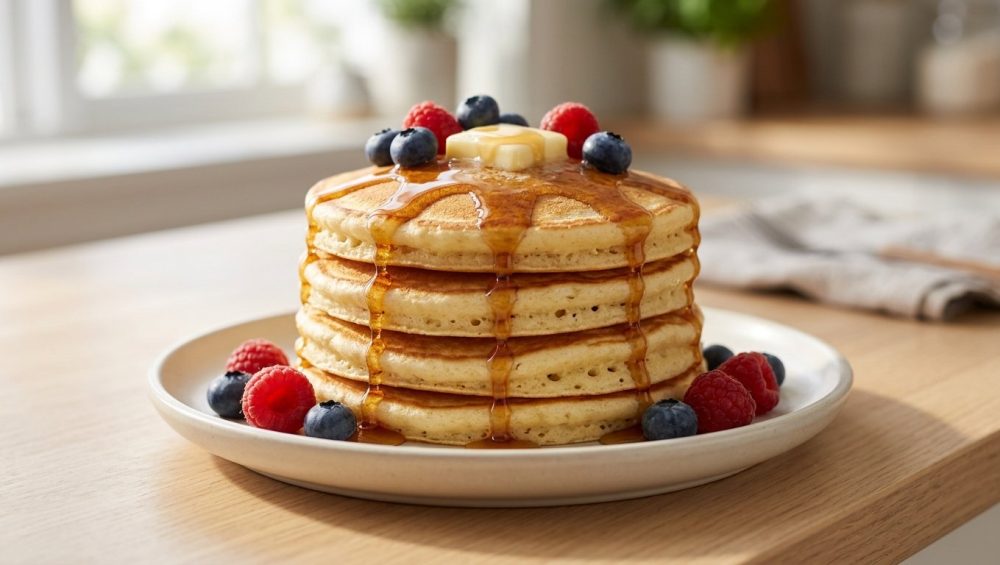
Listen up, weekend warriors. We have all been there. It is Sunday morning, you have a craving for a towering stack of diner-style breakfast perfection, and you decide to whip up a batch of homemade pancakes. You furiously mix the batter to obliterate every single lump, immediately ladle it onto a hot pan, and… congratulations. You have just cooked a batch of sad, rubbery, flat discs that look less like a fluffy breakfast dream and more like a set of edible coasters.
I am not going to bore you with a long, rambling story about how my grandmother used to forage for wild wheat in the old country. You are here because you want to know how to fix your breakfast, so let us get straight into the food science. The secret to perfectly fluffy, melt-in-your-mouth pancakes does not require a culinary degree, expensive imported flour, or a fancy stand mixer. It requires exactly zero effort and costs absolutely nothing.
The secret is time. Specifically, a brief, glorious pause before you start cooking.
The Anatomy of a Pancake Disaster: Why Your Flapjacks Fall Flat
If your pancakes are constantly turning out dense and chewy, I need you to understand that you did not fail because you lack natural talent in the kitchen. You failed because you were impatient. One of the most common rookie kitchen mistakes is treating pancake batter like a race against the clock. Most home cooks operate under the false assumption that the moment the wet ingredients touch the dry ingredients, a countdown timer starts, and the batter must be rushed to the skillet before it “dies.”
This frantic rush leads to two critical errors. First, it encourages aggressive over-mixing. When you are rushing to get the batter into the pan, you tend to whisk it violently to break down the dry pockets of flour. Second, it completely skips the crucial hydration phase. When you pour freshly mixed, unrested batter onto a griddle, you are essentially cooking raw, unhydrated flour suspended in a thin, watery liquid. The liquid immediately spreads out across the pan, creating a thin, sad little crepe instead of a robust, lofty pancake. The heat hits the unhydrated flour too quickly, locking the starches into a dense, rigid structure before they ever have a chance to swell and create that tender crumb we all crave.
The Science of the Rest: What Actually Happens in That Bowl?
To understand why a simple pause is so transformative, we have to look at the chemistry happening inside your mixing bowl. I have absolutely zero patience for pretentious recipe jargon, but we do need to talk about the microscopic reality of wheat flour and chemical leaveners.
Starch Hydration: Giving Flour a Drink
Flour is bone dry. When you dump milk, buttermilk, and eggs into a bowl of dry ingredients, those little powdery starch granules do not instantly absorb the moisture. They need time to physically drink it in. During a resting period, the liquid slowly penetrates the hard outer shell of the flour particles. As the starches absorb the liquid, they begin to swell and expand.
This hydration process naturally thickens the batter without requiring you to add any extra flour. A thicker, hydrated batter is structurally superior. When you ladle it onto the griddle, it holds its shape and stands tall, rather than running all over the pan like spilled milk. Furthermore, fully hydrated starches gelatinize much more evenly when exposed to heat, which is what gives a perfect pancake its soft, cake-like interior. If you skip the rest, you are denying the flour the moisture it needs to bloom.
Gluten Relaxation: Sending Your Batter to the Spa
Wheat flour contains two specific proteins: glutenin and gliadin. The moment these proteins come into contact with water and are physically agitated by your whisk, they link together to form a complex, elastic web known as gluten. Gluten is a beautiful thing if you are baking a crusty loaf of artisan sourdough bread or tossing a pizza dough. It provides chew, structure, and pull.
However, gluten is the absolute enemy of a tender pancake. You do not want your breakfast to be chewy. You want it to be delicate and airy. Even if you are careful not to over-mix your batter, the simple act of combining the ingredients will inevitably develop some gluten strands. Resting the batter acts as a mandatory spa treatment for these tense proteins. As the batter sits undisturbed, the elastic gluten network begins to relax and slacken. This relaxation ensures that when the pancake cooks, it offers a tender, melt-in-your-mouth bite rather than a tough, rubbery resistance.
The Leavening Magic: Trapping the Bubbles
Pancakes get their signature lift from chemical leaveners, primarily baking powder. Most commercial baking powder used today is “double-acting,” which means it facilitates two distinct chemical reactions to give your baked goods lift. The first reaction occurs the exact second the baking powder is moistened by your wet ingredients; one of the acid salts in the powder reacts with the sodium bicarbonate, immediately producing carbon dioxide gas.
When you allow the batter to rest, this initial reaction has time to fully develop, creating a network of tiny gas bubbles throughout the bowl. Because the resting time also allows the starches to hydrate and thicken the batter, this newly thickened matrix is perfectly capable of trapping and holding onto those bubbles. If the batter was thin and unrested, the bubbles would simply float to the surface and pop. The second leavening reaction is triggered by heat; when that rested, bubble-filled batter hits your hot skillet, the gas cells rapidly expand, causing the pancake to rise beautifully.
How Long Should You Actually Rest Pancake Batter?
So, we have established that resting is non-negotiable. But exactly how long are we talking? The ideal resting time depends heavily on your schedule, your ingredients, and your patience levels.
The 10-Minute Minimum: The Impatient Cook’s Hack
We all know that time is money, especially during the week. When you are trying to pull off simple weeknight dinners or a rushed Tuesday morning breakfast for the family, you do not have an hour to stand around staring at a bowl of batter. Fortunately, food science is on your side.
Culinary authorities like America’s Test Kitchen and Cook’s Illustrated specifically mandate a 10-minute resting period in their master pancake recipes. This precise 10-minute window is the ultimate sweet spot. It is just long enough to allow the flour to properly hydrate and the initial leavening reaction to establish a network of bubbles, but short enough that you don’t exhaust the baking powder’s potency. You will see a noticeable thickening of the batter after just ten minutes, resulting in a significantly loftier pancake.
The 30-Minute Sweet Spot: Weekend Perfection
If it is a lazy Sunday morning and you have the luxury of time, a 30-minute rest at room temperature is the gold standard for pancake perfection. At the 30-minute mark, the flour is maximally hydrated. The bran in the flour has softened completely, and the gluten strands are completely relaxed. The batter will look distinctly bubbly, almost spongy, and will hold its shape beautifully on the ladle. Just be sure not to aggressively stir the batter after this 30-minute rest; you want to gently scoop it so you do not deflate all the precious carbon dioxide bubbles you just spent half an hour cultivating.
The Overnight Chill: Prepping for a Crowd
Can you mix your batter on Friday night to cook on Saturday morning? Yes and no. If you leave a standard, chemically leavened pancake batter in the refrigerator for 12 hours overnight, the baking powder will completely exhaust its first chemical reaction. By the time morning rolls around, the batter will have gone completely flaccid, and you will be left with dense, lifeless flapjacks.
If you truly want to prep overnight, you have two options. The first is to mix all of your dry ingredients in one bowl, mix all of your wet ingredients in a separate container, and store them separately until morning. The second option is to pivot entirely to a yeast or sourdough discard recipe. Sourdough pancake batters actually thrive on a long, slow cold fermentation. The natural acids develop incredible flavor overnight, and you simply whisk in a bit of baking soda right before cooking to trigger an explosive, tenderizing chemical reaction.
The Ingredient Factor: How Different Flours and Liquids React
Not all pancake batters are created equal. The specific ingredients you choose will drastically alter how your batter behaves during its resting phase. Understanding these interactions is the key to mastering the weekend brunch.
Buttermilk vs. Regular Milk: The Acid Test
There is a reason diner pancakes taste so incredibly distinct, and it usually comes down to buttermilk. Just like your savory dinner actually needs acid to balance its flavor profile, your pancake batter thrives on the acidic tang of cultured dairy.
Buttermilk is highly acidic. When you use buttermilk in your batter, recipes will almost always call for baking soda in addition to baking powder. Baking soda is a pure base. When the acidic buttermilk meets the alkaline baking soda, it triggers an immediate, aggressive chemical reaction that produces a massive amount of carbon dioxide. Resting a buttermilk batter for 10 to 15 minutes is absolutely critical to allow this specific acid-base reaction to reach its peak before the heat of the pan locks the structure in place. If you do not have buttermilk, you can make a quick substitute by adding a tablespoon of lemon juice or white vinegar to regular milk and letting it curdle, though the resulting batter will be slightly thinner.
Whole Wheat and Alternative Flours: Needing Extra Time
If you are trying to be healthy and swapping out all-purpose flour for whole wheat flour, you need to adjust your resting expectations. Whole wheat flour contains the bran and the germ of the wheat berry. The bran acts like thousands of microscopic razor blades, physically slicing through the gluten strands as you mix. Furthermore, whole wheat flour absorbs liquid at a much slower rate than refined white flour.
If you cook a whole wheat pancake batter immediately, it will be incredibly gritty and dry. You must rest whole wheat batter for a minimum of 20 to 30 minutes to give that tough bran enough time to soften and fully hydrate. The same rule applies to alternative flours like oat flour, almond flour, or complex gluten-free blends. They lack the structural integrity of traditional wheat, so they rely heavily on the resting phase to allow their unique starches and binders (like xanthan gum) to fully activate and gel.
The Gear: What You’re Cooking On Matters (A Sassy Sous-Chef PSA)
We need to take a brief intermission from the chemistry of the batter to talk about the physics of your cookware. You can mix the most scientifically perfect, optimally rested batter in the world, but if you pour it onto garbage equipment, you are going to get a garbage breakfast.
Ditch the Toxic Non-Stick: The “No-Go” Rule
Here comes my absolute biggest pet peeve. If you are pouring your beautifully rested batter onto a cheap, peeling, scratched-to-hell non-stick pan, we need to have a serious talk. I am a fierce advocate for banishing toxic kitchen gear from your home entirely.
A comprehensive 2020 study conducted by the Ecology Center tested a variety of cooking and baking pans to identify their chemical coatings. The findings were frankly infuriating. They discovered that a staggering 79% of the tested non-stick cooking pans were coated with PTFE (polytetrafluoroethylene), the polymer form of PFAS best known by the brand name Teflon. Even more deceptively, researchers found that product packaging was often highly misleading; many pans proudly labeled ‘PFOA-free’ were still heavily coated with PTFE without disclosing it to the buyer.
When these cheap, toxic coatings inevitably scratch, flake, or degrade, they can leach harmful microplastics and forever chemicals directly into your food. Furthermore, when heated above 500°F—a temperature easily reached if you accidentally leave a pan preheating on a high burner—PTFE breaks down and releases toxic fumes into your kitchen. Stop gambling with your health just to save a few minutes on dishwashing. Throw out the flaking pans.
The Beauty of Carbon Steel and Cast Iron
Instead of relying on toxic synthetic coatings, you should invest in high-quality carbon steel cookware or a reliable cast iron skillet. These materials offer incredible thermal mass.
Why does thermal mass matter for pancakes? When you pour a quarter-cup of cold, wet batter onto a thin, cheap aluminum pan, the temperature of the pan plummets instantly. The pan struggles to recover its heat, resulting in a pale, blonde, greasy pancake that absorbs the cooking oil rather than frying in it. Heavy carbon steel and cast iron hold onto their heat tenaciously. When the cold batter hits the metal, the temperature remains perfectly stable, immediately triggering the Maillard reaction (the chemical process responsible for browning and flavor) and giving you those highly coveted, perfectly crispy, golden-laced edges.
Step-by-Step: The Ultimate Fluffy Pancake Blueprint
Now that you understand the science of the rest and the importance of your equipment, let us put it all together into a foolproof, step-by-step masterclass.
Step 1: The Dry and Wet Divide
Always mix your dry ingredients (flour, sugar, baking powder, baking soda, salt) in one large bowl, and your wet ingredients (milk, eggs, melted butter, vanilla) in a separate container. Do not combine them until your skillet is sitting on the stove and you are fully prepared to start the resting clock. Keeping them separated prevents the baking powder from activating prematurely.
Step 2: The Gentle Fold (Lumps Are Your Friends)
Pour the wet mixture into the dry mixture all at once. Take a spatula or a whisk and gently fold the batter together. Stop mixing the exact second the last streak of dry flour disappears. The batter should look ugly. It should be lumpy, bumpy, and uneven. Those lumps are tiny pockets of dry flour that will hydrate during the resting phase. If you whisk the batter until it is perfectly smooth, you have already overworked the gluten, and your pancakes are doomed to be tough.
Step 3: The Crucial Pause
Walk away. Leave the bowl on the counter. Do not cover it, do not put it in the fridge, and do not poke at it. Let it sit completely undisturbed for a minimum of 10 minutes, or up to 30 minutes. During this time, the starches will drink up the liquid, the gluten will take a nap, and the baking powder will fill the batter with trapped carbon dioxide bubbles.
Step 4: The Sizzle and Flip
While the batter rests, preheat your carbon steel or cast iron skillet over medium heat. You need a properly preheated surface to prevent food from sticking and to instantly activate the second stage of the baking powder. Lightly grease the pan with butter or oil.
Gently scoop the rested batter (do not stir it to deflate the bubbles) and pour it onto the skillet. Wait until the edges look set and dry, and the bubbles forming on the top surface begin to pop and leave little open craters. Slide a thin spatula underneath and flip it confidently. Cook for another 60 to 90 seconds until the bottom is golden brown.
Troubleshooting Your Pancake Woes: The Q&A
Even with the science on your side, the kitchen can be an unpredictable environment. To eliminate kitchen chaos, just follow these simple troubleshooting rules when things go sideways at the stove.
Why is the first pancake always a disaster?
The sacrificial first pancake is a known culinary phenomenon. It usually happens because your pan has not yet achieved an even heat distribution, or because the porous surface of the pan has not yet absorbed the initial layer of cooking fat. Do not panic. Eat the ugly first pancake while standing over the stove (chef’s privilege) and proceed with the rest of the batch.
Why are my pancakes raw in the middle?
If the outside of your pancake is dark brown or burnt, but the inside is a gooey, raw mess of wet batter, your heat is simply too high. The exterior cooked and sealed before the interior had a chance to set. Turn your burner down to medium-low. Just like figuring out why your baking sheets keep warping in the oven, diagnosing pancake problems almost always comes down to managing extreme temperature fluctuations.
Can I rest the batter too long?
Yes. If you leave a standard baking powder batter sitting on the counter for two hours, the chemical leaveners will completely die out. The bubbles will pop, the batter will deflate, and you will be left with dense pucks. Stick to the 10 to 30-minute window for optimal results.
What if my batter is too thick after resting?
If you used a particularly thirsty brand of flour, or if you accidentally measured your flour by scooping it out of the bag (which packs it down and adds way too much volume) rather than weighing it, your rested batter might turn into cement. If it is too thick to pour, gently fold in one tablespoon of milk at a time until it reaches a thick, but scoopable, consistency.
Conclusion: Reclaiming Your Weekend Brunch
You do not need to settle for mediocre breakfasts, and you certainly do not need to spend twenty dollars on a plate of brunch at a crowded restaurant. Armed with a basic understanding of starch hydration, gluten development, and chemical leaveners, you can out-cook any diner in town from the comfort of your own kitchen.
Consider this your essential kitchen survival guide for the most important meal of the week. Stop rushing the process, throw away your peeling toxic pans, and give your batter the ten-minute rest it deserves. Your weekend mornings will never be the same. Now get in the kitchen, embrace the lumps, and go make some mind-blowing pancakes.