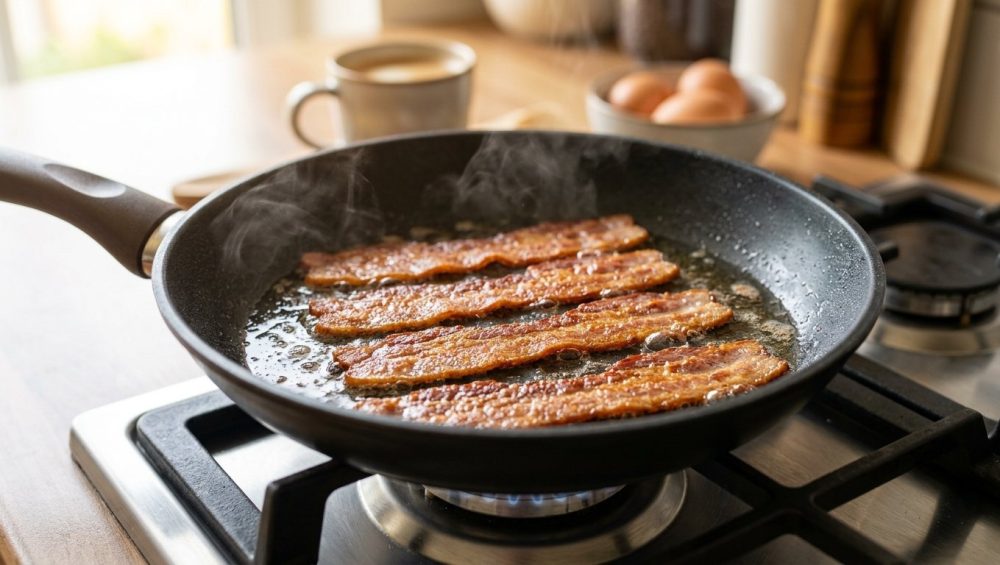
The Great Breakfast Betrayal: Why Your Bacon Refuses to Lay Flat
We have all been there. It is a beautiful Saturday morning, you have a fresh pot of coffee brewing, and you are dreaming of a diner-style breakfast. You pull a pristine, beautifully marbled package of thick-cut bacon from the fridge. You lay those gorgeous, uniform strips into a hot skillet, anticipating the glorious sizzle and the intoxicating aroma of smoked pork.
But then, the betrayal happens.
Within seconds, the meat violently seizes up. The edges ripple, the center bows upward, and before you know it, your beautiful, flat strips of pork belly have contorted themselves into mangled, three-dimensional curly-cues that look more like aggressive modern art sculptures than breakfast food. Because the meat is now warped, only a fraction of the surface area is actually touching the pan. The parts making contact burn into a bitter, blackened crisp, while the elevated sections remain flabby, pale, and unappetizingly rubbery.
You poke at it. You try to flatten it with the back of your spatula, playing a futile game of culinary Whac-A-Mole as one end pops up the second you press the other end down. Eventually, you surrender, serving a plate of shriveled, unevenly cooked disappointment.
Listen to me: this is not your fault. You do not lack culinary talent, and you do not need an expensive culinary degree to fix this. You are simply losing a battle against the fundamental laws of thermodynamics and biology. Bacon curling is not a curse; it is a highly predictable physical reaction caused by the differential contraction rates of rendering fat and cooking muscle fibers.
As a home cook, your kitchen is your domain, and you should never let a piece of cured pork dictate the terms of your morning. Today, we are going to break down the exhaustive, no-nonsense culinary science of why bacon warps, shrinks, and buckles. More importantly, we are going to equip you with the foolproof, stress-free techniques to stop it. If you’ve ever wondered why so many culinary experts tell you to start it in water, this is the exact scientific reason why. Grab a cup of coffee, because class is in session.
The Biological Anatomy of a Bacon Strip
To understand why bacon behaves like a petulant toddler in a hot pan, we first have to look at what bacon actually is. Bacon, in its most common American form, is cured and smoked pork belly. If you look closely at a raw strip, you will immediately notice that it is not a homogenous piece of meat. It is a distinct, striped mosaic of two completely different biological tissues: adipose tissue (fat) and myofibrillar proteins (lean muscle).
These two tissues have entirely different physical structures, different chemical compositions, and—most importantly for our purposes—completely different reactions to heat.
Adipose Tissue (The Fat)
The white sections of your bacon strip consist of pork fat. Fat is relatively simple. It does not contain a rigid, fibrous cellular structure that tightens when exposed to heat. Instead, when pork fat is heated to around 130°F to 140°F (54°C to 60°C), it simply begins to melt, or “render”. As the fat transitions from a solid to a liquid, it gently softens and slowly loses volume. It does not aggressively seize up; it simply relaxes and melts away into the pan, creating that beautiful liquid gold we use to fry our eggs.
Myofibrillar Proteins (The Lean Muscle)
The pink or red sections of your bacon strip are the lean muscle fibers. This is where the trouble starts. Muscle tissue is incredibly complex. It is composed of bundles of protein fibers (primarily myosin and actin) that are tightly wrapped in sheaths of connective tissue known as collagen (specifically Type I and Type III collagen). Furthermore, lean pork muscle is packed with moisture. Even before any processing, raw pork naturally consists of roughly 30% water.
When you apply heat to muscle fibers, a violent chemical transformation occurs. Starting at around 140°F to 150°F (60°C to 66°C), the collagen network begins to denature. The proteins aggressively unravel and then rapidly contract, shrinking tightly. As the temperature climbs toward 150°F to 163°F (66°C to 73°C), the actin proteins also denature, squeezing the muscle fibers like a sponge and violently expelling their internal moisture. When you understand how muscle fibers interact with hot metal, you can effectively prevent protein adhesion and keep your meat completely intact.
The Culinary Physics of the Curl: A Thermal Tug-of-War
Now, let us put these two opposing biological forces together in a hot skillet.
Imagine you take a strip of bacon and toss it into a pan preheated to 350°F. The moment the meat hits the hot metal, a massive thermal shock occurs. The heat rapidly transfers into the bacon strip, and the two different tissues begin to react simultaneously, but in completely completely different ways.
The fat layers immediately begin to soften and render, gently melting and losing a little bit of volume. Meanwhile, the lean muscle layers hit that critical 140°F to 150°F threshold almost instantly. The collagen denatures, the actin seizes, and the muscle fibers violently contract, shrinking rapidly as their internal moisture turns to steam and escapes.
This creates a literal physical tug-of-war within the single slice of meat. You have layers of muscle that are rapidly shrinking and pulling tight, attached directly to layers of fat that are simply softening and melting. Because the lean muscle shrinks significantly more—and significantly faster—than the rendering fat, the muscle pulls the fat along with it. The tension across the strip becomes wildly uneven. The side of the strip with more lean muscle pulls tighter, causing the entire slice of bacon to bow, cup, and curl inward on itself.
It is pure physics. The muscle fibers are winning the tug-of-war against the fat, and your breakfast is the collateral damage.
The Grocery Store Sabotage: The Moisture Problem
If the natural biology of the pig wasn’t enough to fight against, we also have to contend with the modern commercial food industry. The severity of your bacon’s curl is heavily influenced by how the pork belly was cured before it ever reached your kitchen.
Historically, bacon was “dry-cured.” The pork belly was rubbed with salt, sugar, and curing salts (nitrates/nitrites), and left to sit for weeks. The salt naturally drew the moisture out of the meat, preserving it and concentrating its flavor. Because dry-cured bacon has a significantly lower moisture content, it experiences far less shrinkage and curling when it hits the pan.
However, time is money, and the modern commercial meat industry does not like to wait weeks for bacon to cure. Today, the vast majority of standard supermarket bacon is “wet-cured” or “pumped”. In this highly industrialized process, the pork bellies are injected with a liquid brine solution using massive arrays of needles. This drastically accelerates the curing process from weeks down to mere hours.
The side effect? It pumps the meat full of excess water. By law in many jurisdictions, commercial bacon can retain up to 10% added water weight from this pumping process. When you buy cheap, wet-cured supermarket bacon, you are essentially buying a water balloon made of pork.
When that water-logged bacon hits a hot skillet, the excess moisture rapidly boils and turns to steam. This massive, sudden evaporation exacerbates the shrinking of the muscle fibers, causing an even more violent contraction and a much more dramatic curl. The water rushes out, the proteins tighten up, and your bacon shrivels into a fraction of its original size. Cheap pans are notorious for losing their slip when exposed to the high, fluctuating temperatures of frying water-logged bacon, making the cleanup an absolute nightmare.
The “No-Go” Rule on Toxic Kitchenware
Before we dive into the techniques to fix this, we need to have a brutally honest conversation about your equipment. As your resident Sassy Sous-Chef, I have a strict, non-negotiable rule: we do not cook with toxic, peeling, deeply degraded kitchenware.
If you are trying to fry bacon in a lightweight, scratched-to-hell aluminum pan with a flaking Teflon coating, you are actively sabotaging your food and your health. High-heat searing and rendering require heavy, durable cookware that can hold and distribute thermal energy evenly. Flimsy non-stick pans create intense hot spots that will scorch your bacon unevenly, causing one end to burn while the other remains raw. Furthermore, using aerosol sprays is a surefire way of ruining your nonstick pans because the propellants bake into the surface and create a sticky, impossible-to-remove residue.
I have zero patience for cheap equipment, which is why I am constantly banishing toxic kitchen gear from my cabinets. For bacon, you need thermal mass. You should be using a heavy cast iron skillet, a professional-grade carbon steel pan, or a thick, multi-clad stainless steel skillet. These materials absorb heat slowly and radiate it evenly across the entire surface of the meat, which is critical for rendering fat without shocking the proteins.
If your poorly maintained skillet leaves black specks on your pristine breakfast meat, you need to strip and re-season it immediately. Clean your heavy cookware properly with a chainmail scrubber to preserve that beautiful polymerized seasoning, and treat your pans with respect. Now that your gear is sorted, let us fix your bacon.
Method 1: The Cold-Pan Start (Your Weekday Savior)
The most common mistake home cooks make is treating bacon like a steak. You preheat the pan until it is screaming hot, and then you drop the meat in to get a hard sear. This is the absolute worst thing you can do to bacon. As we discussed, dropping cold bacon into a hot pan causes immediate thermal shock, forcing the collagen to seize and the strip to curl violently.
The easiest, lowest-effort weekday hack to prevent curling is the Cold-Pan Start.
How to Execute the Cold-Pan Start:
- Lay your bacon strips flat in a completely cold, unheated skillet. Do not crowd the pan; the strips can touch slightly, but they should not overlap significantly.
- Place the skillet on the stove and turn the burner to medium-low.
- Let the pan and the bacon heat up together gradually.
The Science Behind the Hack:
By starting in a cold pan, you eliminate the thermal shock. As the temperature of the metal slowly rises, it gently warms the bacon. The fat reaches its rendering temperature (130°F to 140°F) long before the muscle fibers reach their denaturing and contracting temperature (150°F+).
This means that by the time the pan is hot enough to actually crisp the meat, a significant portion of the fat has already melted away into a liquid pool. The structural integrity of the fat layer has been weakened, meaning it can no longer pull against the muscle fibers. The muscle fibers eventually contract, but because the fat has already rendered, the tension is broken. The bacon cooks slowly in its own rendered fat, remaining beautifully flat and evenly crisped.
Method 2: The Water-Simmer Technique (The Holy Grail of Flat Bacon)
If you want absolutely flawless, perfectly flat, shatteringly crisp yet tender bacon, you need to employ the Water-Simmer method. It sounds completely counterintuitive. We have all been taught that water and hot oil are mortal enemies that will cause violent, dangerous splattering. But in this specific application, water is your greatest culinary ally.
How to Execute the Water-Simmer Method:
- Place your bacon strips in a cold skillet.
- Pour just enough cold water into the pan to coat the bottom and slightly submerge the bacon (about a quarter cup to a half cup, depending on your pan size).
- Turn the heat to medium-high and bring the water to a vigorous simmer.
- Let the water boil completely away. Once the water evaporates, immediately drop the heat to medium-low.
- Allow the bacon to fry in its own rendered fat until it reaches your desired level of crispness, flipping occasionally.
The Science Behind the Hack:
This method is a masterclass in thermodynamic control. Liquid water cannot exceed 212°F (100°C) at sea level; any additional heat energy simply causes the water to undergo a phase change and turn into steam.
By submerging the bacon in water, you are effectively capping the maximum temperature of the pan at 212°F for the first several minutes of cooking. This creates a gentle, highly controlled thermal environment. At 212°F, the temperature is high enough to thoroughly and rapidly render the stubborn pork fat, but it is gentle enough to prevent the muscle fibers from burning or violently seizing. Furthermore, the boiling water plumps the meat fibers slightly, keeping them tender.
By the time the water fully evaporates, the fat has almost entirely rendered out into the pan. The bacon is now sitting in a pool of its own liquid fat. As the water disappears, the temperature of the pan is finally allowed to rise above 212°F, climbing up past 300°F where the Maillard reaction (the chemical process responsible for browning and crisping) can occur. Because the fat structure has already been broken down during the water-simmer phase, the meat fries evenly without curling. You are left with perfectly flat strips that are delightfully crisp on the edges but retain a luxurious, meaty tenderness in the center.
Method 3: The Oven-Baking Strategy (For Weekend Perfectionists)
When I am hosting a weekend brunch and I need to cook a massive pound of bacon without standing over a stove dodging grease splatters, I turn to the oven. The oven method is the undisputed champion of batch-cooking, and it naturally prevents bacon from curling.
How to Execute the Oven Method:
- Preheat your oven to 400°F (200°C).
- Line a heavy-duty, rimmed half-sheet pan with aluminum foil (for easy cleanup). Thin, cheap metal is exactly why your baking sheets warp in the oven and send hot grease pooling into the corners, so use a commercial-grade aluminum pan.
- Place a wire cooling rack inside the baking sheet.
- Lay your bacon strips flat across the wire rack.
- Bake for 15 to 25 minutes, depending on the thickness of the bacon and your desired crispness.
The Science Behind the Hack:
When you cook bacon in a skillet, the heat is entirely unidirectional. The thermal energy is transferring through conduction directly from the bottom of the pan into the bottom of the meat. This means the bottom of the strip cooks, renders, and shrinks faster than the top of the strip, creating uneven tension that exacerbates curling.
The oven, however, utilizes ambient convection heat. The hot air entirely surrounds the bacon strips on the wire rack, cooking them evenly from the top, bottom, and sides all at the exact same time. Because the thermal energy is distributed uniformly, the fat renders and the muscle fibers contract at a synchronized rate across the entire strip. There is no uneven tension, which means there is no curl. The bacon stays perfectly flat, and the wire rack allows the excess grease to drip away, resulting in an incredibly crisp texture.
Method 4: The Structural Scoring Hack (When You’re in a Rush)
Sometimes, you just don’t have the time to wait for a cold pan to heat up, you don’t want to mess with boiling water, and you certainly don’t want to wait 25 minutes for the oven. You need bacon, and you need it right now. If you must drop bacon into a hot pan, you can physically engineer the strip to prevent it from curling.
How to Execute the Scoring Hack:
- Lay your raw bacon strips on a cutting board.
- Take a pair of sharp kitchen shears or a paring knife.
- Make small, shallow vertical cuts (about a quarter-inch deep) directly into the white fat edge of the bacon, spacing the cuts about one inch apart down the entire length of the strip.
- Fry as usual.
The Science Behind the Hack:
Remember the culinary tug-of-war? The curl happens because the shrinking muscle fibers are pulling against the continuous, unbroken band of fat. By snipping the fat edge at regular intervals, you are physically breaking the line of tension.
When the muscle fibers seize and contract in the hot pan, they no longer have a solid anchor of fat to pull against. The tension is released through the small incisions you made. The cuts will widen slightly as the meat cooks, but the strip itself will remain entirely flat against the surface of the skillet.
To Press or Not to Press? Evaluating Bacon Weights
Walk into any professional diner kitchen, and you will see line cooks throwing heavy iron plates on top of cooking bacon. The commercial bacon press is a staple of the restaurant industry, designed to physically force the meat flat against the griddle to ensure rapid, even cooking.
Do you need one in your home kitchen?
Honestly, no. If you utilize the cold-pan start, the water-simmer method, or the oven-baking strategy, your bacon will lay perfectly flat without any heavy machinery. I am a firm believer in minimizing single-use kitchen gadgets that clutter up your drawers.
However, if you are a traditionalist who insists on pan-frying over medium-high heat, and you refuse to use the water method, you absolutely need a vented chef’s press to physically force the meat flat.
If you choose to buy one, absolutely avoid the cheap, lightweight glass presses or the flimsy aluminum ones. You need serious gravitational weight to counteract the contracting muscle fibers. Look for a heavy, pre-seasoned cast iron press, preferably one with vents or holes. Solid presses can trap the escaping steam generated by the moisture in the meat, inadvertently steaming your bacon rather than frying it. A vented press allows the steam to escape while providing the brutal, uncompromising weight needed to keep the strip pinned to the skillet.
The Flip and The Finish: Preserving the Liquid Gold
Regardless of which method you choose, the final moments of cooking are critical. Bacon contains a high concentration of sugar (both naturally occurring and added during the curing process). Once the moisture has evaporated and the temperature of the rendered fat exceeds 300°F (150°C), the Maillard reaction accelerates rapidly. The bacon will transition from a beautiful golden brown to a bitter, scorched black in a matter of seconds. You must remain vigilant.
When flipping delicate or warped proteins, a flexible fish spatula is the absolute best tool for the job. Its thin, angled edge easily slides under the bacon without tearing the fragile, rendered meat, and the wide slots allow the hot grease to drain right back into the pan.
Once your bacon has reached your preferred level of crispness, immediately transfer it to a plate lined with paper towels. The paper towels will wick away the excess surface oil, preventing the bacon from becoming greasy and soggy as it cools.
Finally, do not you dare throw that rendered fat away. You have just spent 15 minutes carefully melting down liquid culinary gold. Let the grease cool slightly in the pan, then carefully strain it through a fine-mesh sieve into a heat-proof glass jar. Store it in your refrigerator. You can use it to fry eggs, roast potatoes, sear steaks, or build the base of a rich pan sauce. It is the ultimate flavor enhancer, and it is your reward for executing a flawless, scientifically sound breakfast.
Master the Meat, Don’t Let It Master You
Cooking is not magic; it is applied physics, chemistry, and biology. When you blindly throw a piece of wet-cured pork belly into a screaming hot pan, you are setting yourself up for failure. You are allowing the meat to dictate the outcome.
But when you understand the differential contraction rates of fat and muscle, when you understand how thermal shock impacts collagen, and when you utilize temperature-capping techniques like the water-simmer method, you reclaim your power in the kitchen. You can absolutely achieve professional, diner-quality, perfectly flat bacon on a standard Tuesday morning without breaking a sweat.
Stop fighting the curl. Outsmart it. Now go make yourself a BLT worthy of your newfound expertise.