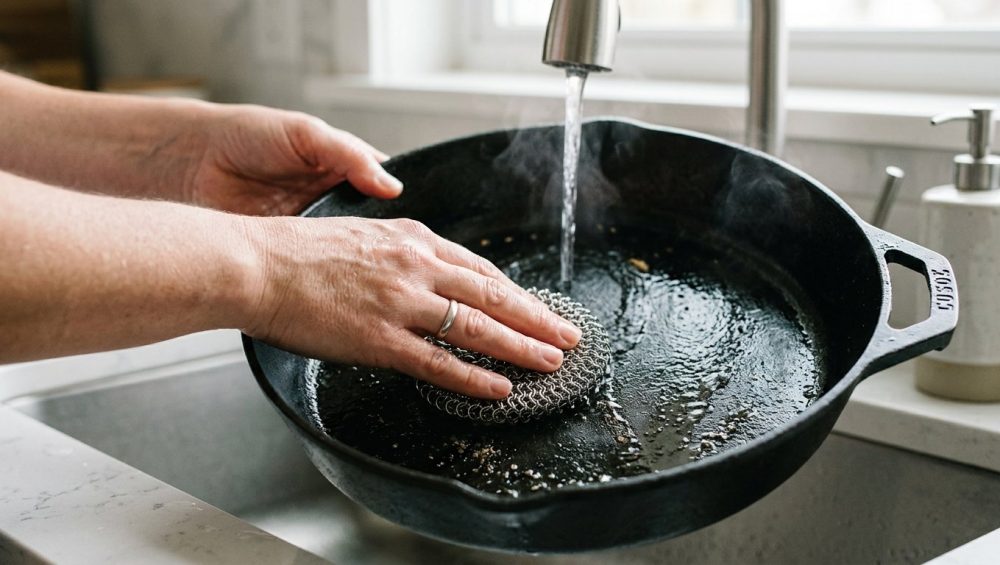
Let’s get one thing straight right out of the gate: cast iron pans are the absolute drama queens of the culinary world. People inherit a beautiful, heavy-duty skillet from their grandmother and immediately start treating it like a fragile, unexploded bomb. The internet is absolutely saturated with terrifying, contradictory advice about what you can and cannot do to this supposedly delicate metal. We are told to never let water touch it, to only wipe it with the tears of a unicorn, and to perform a full-moon ritual every time we want to fry an egg.
It is exhausting, it is pretentious, and frankly, it is ruining the joy of cooking. You are a busy home cook. You do not have the time or the patience to spend forty-five minutes babying a frying pan on a random Tuesday night when you just want to eat your dinner and go to sleep.
The truth is, cast iron is quite literally a hunk of solid iron. It survived the Oregon Trail; it can survive your kitchen. The only real problem is the cleaning process. You cook a beautiful, hard-seared steak, and now you are left with a pan covered in carbonized, welded-on fond. You scrub it with a regular kitchen sponge, and the sponge instantly shreds into useless green confetti. You leave it in the sink to soak, and by morning, it is covered in a horrifying layer of bright orange rust.
This is the exact moment when most beginner cooks give up, shove the heavy skillet into the dark recesses of their lower cabinets, and go back to ordering expensive, lukewarm takeout. But you are not going to do that. You are going to learn the actual science of your cookware, and you are going to invest in the single greatest, most ruthlessly efficient cleaning tool ever invented for the home kitchen: the culinary-grade stainless steel chainmail scrubber.
The Science of Cast Iron Seasoning: What Exactly Are We Protecting?
Before we talk about how to clean your pan, we have to talk about what we are actually trying not to destroy. When culinary snobs talk about a pan’s “seasoning,” they are not talking about salt, pepper, or garlic powder. They are talking about a highly specific chemical reaction called polymerization.
The Microscopic Landscape of Iron
If you were to look at the surface of a brand-new, unseasoned cast iron skillet under a high-powered microscope, you would not see a smooth, flat surface. You would see a jagged, porous landscape filled with microscopic peaks, valleys, craters, and crevices. This rough texture is a natural byproduct of the sand-casting process used to manufacture the pans. If you try to fry an egg on this raw, jagged surface, the liquid proteins will flow directly into those microscopic valleys, physically locking themselves into the metal as they cook. The result is an impossibly stuck, torn-up egg and a nightmare of a cleaning job.
The Magic of Polymerization
To fix this, we apply seasoning. When you rub a thin layer of polyunsaturated fat (like flaxseed, grapeseed, or canola oil) onto the iron and heat it past its smoke point—typically between 400°F and 500°F—the fat molecules begin to decompose. The intense heat breaks the oil down, releasing free radicals that rapidly cross-link with one another and bond directly to the iron substrate.
This process transforms the liquid oil into a hard, slick, glass-like plastic matrix. It is no longer oil; it is a highly durable, polymerized carbon layer that fills in all the microscopic valleys of the iron, creating a perfectly smooth, naturally non-stick surface. This layer is tough, but it is not invincible. If you attack it with the wrong cleaning tools, you will physically shatter and chip this hard-earned polymer matrix. If you have ever been frustrated because your cast iron leaves black specks all over your scrambled eggs, you are looking at the tragic results of a damaged, flaking seasoning layer.
The Toxic Alternative: Why We Don’t Just Use Cheap Non-Stick
At this point, you might be asking yourself: “If cast iron requires an understanding of molecular chemistry just to fry an egg, why don’t I just buy a cheap, lightweight non-stick pan from the supermarket?”
The Dark Side of Convenience
As a home cook who values both health and financial efficiency, I have a strict, zero-tolerance policy for mystery metals and peeling chemical coatings. I am a massive advocate for banishing toxic kitchen gear from your home entirely. The vast majority of cheap non-stick pans are coated with Polytetrafluoroethylene (PTFE), commonly known by the brand name Teflon.
While these pans offer incredible convenience right out of the box, they are essentially disposable products masquerading as durable goods. The non-stick coating is incredibly fragile. The moment you use a metal spatula, stack them incorrectly in your cupboards, or scrub them with the wrong sponge, the coating inevitably scratches and begins to peel. This is exactly why those cheap pans end up losing their non-stick slip after just a few months of standard weeknight cooking.
Polymer Fume Fever and the 500°F Limit
But the real danger lies in the thermodynamics. PTFE begins to structurally break down and degrade when exposed to temperatures above 500°F (260°C). If you preheat an empty non-stick pan on a high-output gas burner, it can reach this dangerous threshold in a matter of minutes. When the coating degrades, it releases toxic, invisible fumes into your kitchen air.
Inhaling these fumes causes a documented medical condition known as “polymer fume fever” (colloquially called the Teflon Flu), which induces severe chills, fever, coughing, and body aches. These same fumes are notoriously lethal to pet birds kept in the same household. Cast iron, on the other hand, is a completely natural, non-toxic heirloom material. It can easily withstand searing temperatures of 600°F to 800°F without batting an eye, off-gassing zero chemicals into your dinner. It just requires the right maintenance tools.
Enter the Chainmail Scrubber: Medieval Armor for Modern Kitchens
If abrasive sponges destroy your seasoning, and soaking the pan causes massive rust, how are you supposed to get the concrete-like, burnt-on food out of your skillet? The answer looks like a prop stolen from a medieval fantasy movie.
What is a Chainmail Scrubber?
A chainmail scrubber is a small, flexible pad made entirely out of hundreds of interlocking, machine-soldered stainless steel rings. It is a purely analog, manual cleaning device designed specifically for heavy-duty cookware. It requires no electricity, uses no harsh chemical solvents, and will easily outlast every other cleaning implement in your entire house.
The Physics of Mechanical Friction
To understand why this bizarre tool is the ultimate kitchen hack, we have to look at the physics of mechanical friction. Before you ever start aggressively scrubbing a dirty pan, you should always try turning burnt bits into sauce by deglazing the hot pan with a splash of wine, broth, or even water. Deglazing uses rapid steam expansion to lift the caramelized fond off the metal, saving you immense time and effort.
However, when deglazing isn’t an option—like when you’ve accidentally carbonized a sugary marinade into a thick, black tar—the chainmail scrubber steps in. Because the stainless steel rings are perfectly round and completely smooth, they act like a series of microscopic, blunt snowplows. When you press the chainmail into the pan and rub it in circular motions, the rounded edges of the steel rings catch the raised edges of the burnt food and mechanically shear them off the surface.
Crucially, because the rings are large and perfectly smooth, they cannot physically dig down into the microscopic valleys of the iron where your polymerized seasoning lives. They knock the food off the top without ever scratching the protective plastic-like layer underneath. It is the perfect balance of ruthless aggression and gentle preservation.
The “Bad Idea” Graveyard: Why Traditional Cleaning Methods Fail
To truly appreciate the brilliance of the chainmail scrubber, we must take a brief tour through the graveyard of terrible cast iron cleaning advice that has plagued home cooks for generations.
The Abrasive Sponge and Steel Wool
Your standard green-and-yellow kitchen sponge might feel relatively soft to your hand, but that dark green scouring pad is actually embedded with microscopic, highly abrasive minerals. When you scrub a cast iron pan with a scouring pad or a wad of industrial steel wool, those jagged abrasives act like sandpaper. They slice directly into your polymerized oil layer, leaving thousands of micro-abrasions that eventually cause the seasoning to fail, flake, and expose the raw iron beneath.
The Kosher Salt Scrub Method
A very popular piece of internet advice is to pour a half-cup of coarse kosher salt into your dirty pan, grab a wad of paper towels, and aggressively rub the salt around to grind away the stuck-on food. Does this work? Technically, yes. The salt acts as a mild abrasive that absorbs grease and scrubs away debris.
But as a home cook who prioritizes efficiency, I absolutely despise this method. It is incredibly messy, often resulting in greasy salt crystals flying all over your stovetop and floor. More importantly, it is a massive waste of expensive kosher salt. Time is money, and wasting pantry ingredients to clean a pan is the opposite of smart cooking.
The Overnight Soak
If you leave a cast iron pan submerged in a sink full of soapy water overnight, you are asking for a chemical disaster. Cast iron is highly reactive. When exposed to prolonged moisture and oxygen, the iron rapidly oxidizes, forming iron oxide—better known as rust. Even a well-seasoned pan has microscopic pinholes in the polymer layer. An overnight soak will force water into those pinholes, rusting the pan from the inside out and forcing you to spend your weekend stripping and re-seasoning the entire skillet.
The “Never Use Soap” Myth
This is the most pervasive, annoying myth in all of the culinary arts. You have absolutely heard someone say, “Never let soap touch your cast iron, or you’ll ruin the seasoning!” This is scientifically false, and it stems from a historical misunderstanding of chemistry.
In the 1800s and early 1900s, people made their own soap by boiling animal fat (tallow or lard) with wood ash lye (sodium hydroxide). Lye is a highly caustic, alkaline chemical. If you wash a cast iron pan with raw lye, it will absolutely strip the polymerized seasoning right off the metal. In fact, vintage cast iron restorers intentionally use lye baths today to strip heavily rusted, abused antique pans back down to the bare metal.
However, modern liquid dish soap (like Dawn or Palmolive) does not contain any lye. Modern dish soaps are formulated with gentle, synthetic surfactants that are designed to bind to loose grease and wash it away. Because your pan’s seasoning is a cross-linked polymer—and not just a layer of wet grease—modern dish soap cannot dissolve it. You can, and absolutely should, wash your cast iron with modern dish soap to remove rancid surface oils and lingering food bacteria.
How to Actually Use a Chainmail Scrubber (A Step-by-Step Guide)
Now that we have banished the myths, let’s walk through the exact, highly efficient, time-saving weekday routine for cleaning your cast iron with a chainmail scrubber.
Step 1: Let the Pan Cool (Beware of Thermal Shock)
When you finish cooking, remove the food and set the skillet on a cool burner. Do not immediately carry a 500°F pan to the sink and blast it with freezing cold water. Metals expand when heated and contract when cooled. If you rapidly cool a screaming hot iron pan with cold water, the severe temperature differential will cause a physical phenomenon called thermal shock. The iron will violently contract unevenly, causing the bottom of the pan to permanently warp (so it spins like a top on your stove) or, worse, crack straight down the middle. Let the pan cool until it is just warm to the touch.
Step 2: Warm Water and a Drop of Soap
Once the pan is warm, bring it to the sink. Run warm water over it and add a single drop of modern liquid dish soap. You do not need a massive lather; you just need enough surfactant to break up the loose, unpolymerized surface grease.
Step 3: The Gentle Scrub
Take your chainmail scrubber and lay it flat against the surface of the pan. Press down lightly with your palm or fingers, and move the scrubber in small, overlapping circles. Do not grind it into the metal like you are trying to sand a hardwood floor. Let the heavy weight of the stainless steel rings do the mechanical work for you. You will feel the rings catch on the burnt-on food, and within seconds, the pan will feel entirely smooth. Dump the dirty water and rinse the pan clean.
Step 4: Rinse and Dry Completely
This is the most critical step to prevent rust. Towel-dry the pan to remove the bulk of the surface moisture. Then, place the pan back on your stovetop over medium-low heat for about three to five minutes. The heat will forcefully evaporate any microscopic moisture trapped in the porous surface of the iron.
Step 5: The Maintenance Wipe
Once the pan is bone dry and still warm, turn off the heat. Add a drop of neutral oil (like canola or grapeseed) about the size of a dime to the center of the pan. Take a clean paper towel and aggressively buff the oil all over the interior surface, wiping it away as if you made a terrible mistake and are trying to remove it completely. You only want a microscopic sheen left behind.
Do not use aerosol cooking sprays for this step. Aerosol sprays contain chemical propellants and emulsifiers (like soy lecithin) that burn at low temperatures and leave a sticky, gummy residue on your pan. This gummy buildup is exactly why cooking spray is the enemy of a pristine, slick seasoning layer. Stick to pure, liquid oil.
Choosing the Right Chainmail Scrubber: Don’t Buy Cheap Garbage
Because chainmail scrubbers have become incredibly popular, the market is now flooded with cheap, low-quality knockoffs. If you buy a badly manufactured scrubber, it will rust, fall apart, and actively scratch your cookware. Here is exactly what you need to look for to ensure you are buying a lifetime tool.
The Metallurgy: 316 vs. 304 Stainless Steel
Always check the manufacturer’s specifications for the grade of stainless steel. You will generally see two numbers: 304 and 316.
Grade 304 stainless steel is the standard alloy used in most basic kitchen appliances. It contains chromium and nickel, which provide decent rust resistance. However, it is susceptible to corrosion if exposed to highly acidic environments or heavy salt over long periods.
Grade 316 stainless steel, often referred to as marine-grade stainless, is significantly superior. It contains an additional element called molybdenum, which drastically increases its resistance to pitting, chemical corrosion, and rust. If you want a scrubber that will literally outlive you, always pay the extra few dollars for 316 stainless steel. It is entirely rust-proof, even if you accidentally leave it sitting in a puddle of water at the bottom of your sink.
Machine-Soldered Rings
Look closely at the individual links of the chainmail. On cheap, low-quality scrubbers, the rings are simply bent closed, leaving a microscopic gap where the two ends of the wire meet. These open gaps act like tiny razor blades that will snag on your seasoning and scratch your pan. High-quality scrubbers feature rings that are machine-soldered or welded completely shut, ensuring a perfectly smooth, continuous circle of steel.
The Silicone Insert vs. The Flat Cloth
Chainmail scrubbers generally come in two form factors: a flat, floppy square of mesh, or a three-dimensional sponge shape built around a flexible silicone core.
While the flat cloths are perfectly fine, I highly recommend buying a model with a silicone insert. The silicone core gives the scrubber the familiar, ergonomic feel of a traditional kitchen sponge, making it vastly easier to grip tightly when your hands are wet and covered in soapy grease. Furthermore, unlike a traditional cellulose sponge, the food-grade silicone core is completely non-porous. It will not absorb dirty dishwater, it will not harbor foul-smelling bacteria, and it will never take on that horrific, mildewy “old sponge” smell. When you are done cleaning, you can simply toss the entire silicone-core chainmail scrubber straight into the dishwasher to sanitize it.
Beyond the Skillet: Other Brilliant Uses for Your Chainmail
While it is marketed primarily for cast iron, your chainmail scrubber is actually an incredibly versatile multi-tasker that will save you time across your entire kitchen.
Carbon Steel Woks and Griddles
Carbon steel is the lighter, thinner cousin of cast iron. It requires the exact same polymerization seasoning process, and it suffers from the exact same cleaning vulnerabilities. If you love making high-heat stir-fries in a traditional carbon steel wok, your chainmail scrubber will effortlessly strip away the scorched soy sauce and burnt garlic without damaging the wok’s delicate, hard-earned patina.
Stainless Steel Cookware
Stainless steel pans do not have a polymerized seasoning layer, which means they are notoriously prone to severe food sticking if you do not manage your temperatures perfectly. If you are currently practicing making stainless steel actually non-stick, you will inevitably make mistakes along the way and scorch a chicken breast directly to the metal.
Ideally, before you add your protein, you should always be using the water drop test to ensure the pan has reached the exact temperature required to trigger the Leidenfrost effect (where water instantly beads up and glides across the surface like mercury, indicating the pan is ready to sear without sticking). But when you misjudge the heat and end up with a pan full of cemented, burnt proteins, the chainmail scrubber is your savior. It will aggressively plow the burnt food off the stainless steel much faster than a sponge, and because the rings are rounded, it will not leave the ugly, deep scratch marks that harsh steel wool pads leave behind.
Glassware and Ceramics (A Stern Warning)
I must issue a very strict warning here: do not let the versatility of the chainmail scrubber make you overconfident. You must never, under any circumstances, use a chainmail scrubber on glass baking dishes, Pyrex, enameled cast iron (like a Le Creuset Dutch oven), or ceramic bakeware.
While the smooth rings will not scratch raw iron or steel, glass and enamel are entirely different materials. The hard stainless steel rings will leave permanent, cloudy micro-scratches all over your expensive enameled pots, permanently ruining their glossy finish and compromising their structural integrity. Keep the chainmail strictly reserved for bare, heavy metals.
Troubleshooting Cast Iron Nightmares
Even with the best tools, cast iron ownership comes with a learning curve. If your pan is currently in a state of disaster, your chainmail scrubber can actually help you reset it.
Dealing with Flash Rust
If you accidentally left your pan wet and it developed a thin, bright orange layer of surface rust, do not panic. You do not need to throw the pan away. Simply take your pan to the sink, add a splash of white vinegar (the acetic acid helps dissolve the iron oxide), and scrub it firmly with your chainmail. The rings will easily knock the surface rust loose. Rinse it thoroughly with cold water, immediately dry it on the stove, and apply a fresh layer of maintenance oil.
Just remember that moisture is the ultimate enemy of the kitchen. Just like how ambient humidity makes your spices turn into hard bricks in your pantry, leaving a wet pan out will cause instant oxidation. Always dry your iron with heat.
Removing Sticky, Gummy Oil
Sometimes, you might accidentally apply way too much oil during the maintenance phase, or you might fail to heat the pan past the oil’s smoke point. When oil is heated but fails to fully polymerize, it turns into a thick, sticky, amber-colored resin. Your pan will feel tacky to the touch, and lint will stick to it.
To fix this, place the pan in the sink with very hot water and a generous amount of dish soap. Scrub it aggressively with the chainmail. The mechanical friction of the rings combined with the hot, soapy water will help break up and shear off the half-polymerized, gummy sludge, taking you back down to a smooth surface.
Scraping Off Cemented Food
If you are cooking on a massive, flat cast iron griddle or a large outdoor flat-top, a small scrubber might not cover enough surface area quickly. For massive food removal on flat surfaces, you should invest in a bench scraper to quickly bulldoze the bulk of the grease and debris into a drip trough before going in with the chainmail for the detailed cleaning.
Whatever you do, never yield to the temptation of using your chef’s knife to scrape burnt food off the bottom of a pan. Scraping a delicate, finely honed blade against a rock-hard iron skillet is exactly why your knives get dull so fast. Knives are for cutting food; chainmail is for cleaning metal. Respect your tools, and they will respect you.
Final Thoughts from the Sassy Sous-Chef
Cooking should be an empowering, creative, and deeply satisfying experience. It should not end with you standing over a sink for thirty minutes, sweating, cursing, and destroying your fingernails while trying to chip burnt bacon grease off a skillet.
You do not need a culinary degree to cook like a professional, and you certainly do not need a degree in metallurgy to maintain a cast iron pan. All you need is a basic understanding of how polymerization works, a willingness to ignore the pretentious, outdated myths passed down by internet purists, and the right tools for the job.
Throw away the toxic, peeling non-stick pans that are poisoning your indoor air quality. Stop wasting your money on disposable green sponges that fall apart after three uses. Invest twenty dollars in a high-quality, 316 stainless steel chainmail scrubber with a silicone core. Treat your heavy-duty cookware with the ruthless, efficient respect it deserves, and buy yourself the time to actually sit down, pour a glass of wine, and enjoy the incredible food you just cooked.