We have all been there. You walk into the grocery store on a Sunday morning with the best of intentions. You are going to be healthy this week. You are going to eat antioxidant-rich breakfasts. You are going to master that elaborate French fruit tart for your upcoming weekend baking project. So, you drop eight dollars on a pristine, jewel-like pint of organic raspberries and another seven on a carton of plump blackberries. You bring them home, place them gently on the top shelf of your refrigerator, and go about your busy week. Forty-eight hours later, you reach for your healthy snack, only to discover that your beautiful, expensive berries have transformed into a fuzzy, gray, terrifying science experiment.
It is the universal tragedy of every home cook who just wants to enjoy fresh produce without feeling like they are literally setting their hard-earned cash on fire. You did not do anything wrong. You refrigerated them immediately. You did not crush them. Yet, they spoiled faster than a gallon of milk in the July sun.
Listen, I love you, but we need to have a serious talk about food waste and kitchen efficiency. As a weekend culinary hobbyist who relies on clever, time-saving weekday hacks to survive, I have zero patience for throwing away good food. You do not need a culinary degree to fix this problem; you just need a little bit of high school chemistry and a bottle of cheap white vinegar. It is time to master the magic of the vinegar bath, a science-backed prep method that will absolutely revolutionize your grocery budget, eliminate costly food waste, and drastically extend the shelf life of your delicate produce.
The Arch-Nemesis: Meet Botrytis Cinerea
To understand exactly why your berries mold with such aggressive, heartbreaking speed, we have to meet the enemy. Grab your safety goggles, because it is science time.
The gray fuzz that suddenly appears on your strawberries and raspberries is a necrotrophic fungus known as Botrytis cinerea, commonly referred to as gray mold. In the agricultural world, this pathogen is legendary for the sheer volume of economic devastation it causes. It is a ubiquitous fungus, meaning its microscopic spores are floating around in the air, resting in the soil, and waiting on the surfaces of almost every plant outside.
Here is the brutal truth about your grocery store berries: they are already infected before you even put them in your shopping cart. Botrytis cinerea has a brilliant and insidious life cycle. The fungus overwinters as hardened masses called sclerotia. When the weather warms up, it produces millions of asexual spores called conidia, which are easily dispersed by the wind and rain. These spores land on the delicate blossoms of berry plants in the spring. Rather than destroying the flower immediately, the fungus often establishes a latent infection. It quietly hides inside the plant tissue, waiting patiently for the fruit to ripen.
As the berry matures, its sugar content spikes and its cellular walls soften. This is the exact moment the dormant fungus wakes up and goes to work. Furthermore, the harvesting process itself creates microscopic wounds on the fragile skin of the fruit. When berries are picked, packed, shipped across the country, and stacked under the fluorescent lights of your local supermarket, they are covered in millions of invisible Botrytis spores just waiting for the perfect environment to germinate. Because berries have incredibly thin skins and exceptionally high water content, they offer zero natural defense against this fungal onslaught once they are harvested.
The Refrigerator Is Not Your Friend (Well, Not Entirely)
You might think that tossing that plastic clamshell of fruit directly into the fridge is the best way to protect it. After all, cold temperatures slow down biological decay, right? Yes, but if you want to stop throwing away sad veggies and expensive fruits, you need to understand the flawed microclimate of your refrigerator.
Refrigerators are designed to remove heat through a compressor and evaporator coil system. In the process of cooling the air, they also pull moisture out of it, creating a very dry environment. To counter this, appliance manufacturers created the crisper drawer, which is designed to trap humidity so your lettuce does not turn into a dry, withered husk.
However, when you place a tightly packed plastic clamshell of berries into a high-humidity environment, you create a botanical death trap. As the temperature inside the fridge fluctuates—which happens every single time you open the door to stare blankly at the shelves—condensation forms on the inside of the plastic packaging. This condensation drips down onto the tightly packed berries.
Botrytis cinerea requires free moisture to germinate. The spores literally cannot grow without water. By leaving your unwashed berries in their original, poorly ventilated plastic packaging, you are providing the exact temperature and moisture conditions the mold spores need to thrive. The cold air might slow the mold down by a day or two, but the trapped condensation guarantees its eventual victory. We need an active, aggressive intervention to neutralize the spores before they can sprout.
The Chemistry of the Soak: How Acetic Acid Destroys Spores
This is where the magic happens. We are going to alter the surface pH of the fruit to create an environment so hostile that the mold spores simply cannot survive. Our weapon of choice is standard, dirt-cheap, distilled white vinegar.
White vinegar is an aqueous solution consisting of roughly 5% acetic acid and 95% water. Acetic acid is a weak organic acid, but do not let the word “weak” fool you—it is a lethal biological weapon against microorganisms.
When you submerge your berries in a diluted vinegar bath, you rapidly lower the pH on the surface of the fruit. Mold spores generally prefer a neutral to slightly acidic environment to germinate, but a sudden plunge into a highly acidic bath shocks their system. But the real magic lies in what scientists call the “weak-acid preservative theory.”
Because acetic acid is a weak acid, a significant portion of its molecules remain undissociated (meaning they hold onto their hydrogen protons) when dissolved in water. These undissociated, neutrally charged acetic acid molecules are lipophilic—they can easily slip right through the lipid bilayer of the fungal spore’s cell membrane.
Once the acetic acid molecule crosses the membrane and enters the neutral, water-based cytoplasm inside the fungal cell, it is forced to dissociate. It drops its hydrogen proton. This sudden release of protons causes the internal pH of the mold spore to plummet. The spore goes into a complete physiological panic. Its internal enzymes denature, its metabolic pathways shut down, and it is forced to expend all of its cellular energy (ATP) desperately trying to pump the invading acid back out. The spore exhausts itself and dies before it can ever produce the germ tube required to infect your beautiful raspberry.
And before you ask: no, your berries will not taste like a sharp vinaigrette. Acetic acid is highly volatile, meaning it evaporates quickly, and we are going to rinse the fruit anyway. You get all the fungal-destroying benefits with absolutely zero flavor contamination.
The Sassy Sous-Chef Masterclass: The Perfect Vinegar Bath Method
Do not just dump a bottle of vinegar into your sink and hope for the best. Weekday meal prep requires efficiency, and weekend culinary projects require perfection. Follow this protocol exactly, and you will buy yourself up to two full weeks of pristine, mold-free berries.
Step 1: The Ruthless Cull
Before a single berry touches the water, you must sort them. Empty the container onto your counter and inspect the fruit. If you see a single berry with even a microscopic speck of gray fuzz, a soft mushy spot, or a weeping wound, throw it in the compost immediately. One infected berry is a biological time bomb that will spread spores to the rest of the batch. Be ruthless. Only the strong survive to make it to the bath.
Step 2: The Magic Ratio
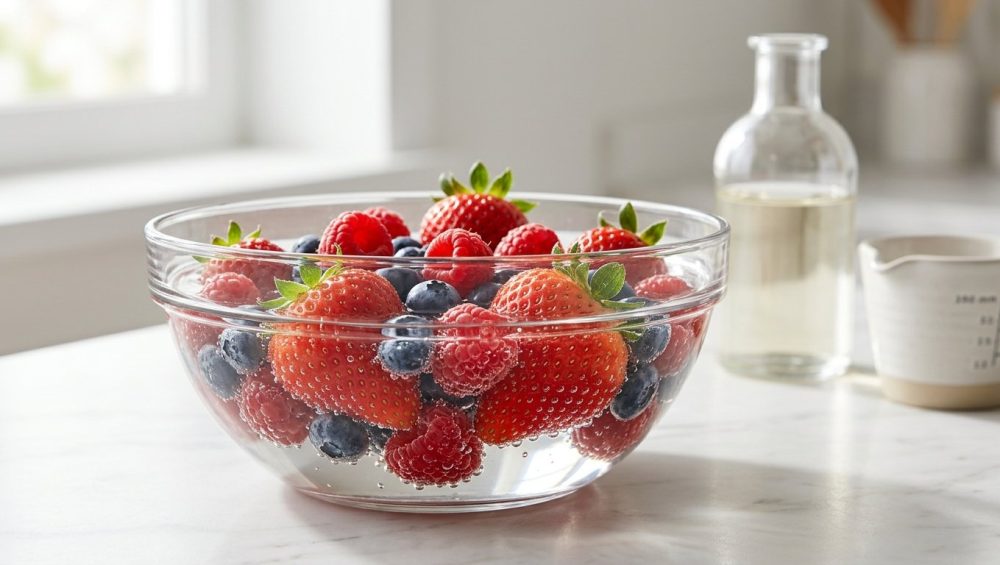
You do not need to waste a whole bottle of vinegar for this. The scientifically optimal ratio is one part white vinegar to three parts cold water. If you are washing a standard pint of strawberries, one cup of vinegar and three cups of water in a large mixing bowl is plenty. Always use cold water. Never use warm or hot water. While commercial agricultural facilities sometimes use thermotherapy (hot water dips) to kill spores, trying to regulate exact water temperatures in a home kitchen is a gamble that usually results in partially cooked, mushy fruit. Stick to cold water and let the acid do the heavy lifting.
Step 3: The Timed Soak
Gently submerge the sorted berries into the acidic bath. Give them a very gentle swirl with your hand to ensure the solution penetrates all the crevices, especially around the leafy calyx of strawberries where spores love to hide.
Set a timer for five to ten minutes. Do not walk away and start answering emails. If you leave delicate berries submerged in an acidic solution for thirty minutes, the acid will begin to break down the pectin in the fruit’s cellular walls, ruining the texture. Ten minutes is the absolute maximum time required to achieve a 98% reduction in viable Botrytis spores.
Step 4: The Crucial Rinse
Once the timer goes off, carefully lift the berries out of the bath. Do not just dump the bowl into a strainer, as the heavy water flow can crush the fruit at the bottom. Transfer them to a colander and rinse them thoroughly under cold, gently running tap water for about thirty seconds. This step washes away the dead spores, removes any residual field dirt, and flushes away the remaining acetic acid so your fruit does not taste sour.
Step 5: The Desert-Dry Protocol
This is the single most important step in the entire masterclass. If you skip this step, the entire vinegar bath is completely useless. Moisture is the enemy. If you put wet berries into the fridge, they will rot, regardless of the vinegar.
To eliminate kitchen chaos and streamline your prep, invest in a high-quality salad spinner. Line the basket of the spinner with two layers of clean paper towels. Place the sturdy berries (like strawberries and blueberries) inside in a single layer, and spin them gently. The centrifugal force will pull the water off the skins, and the paper towels will absorb it.
If you are dealing with fragile berries, or if you refuse to buy a salad spinner, lay out a clean, lint-free kitchen towel on your counter. Place a layer of paper towels over it. Spread the rinsed berries out in a single, uncrowded layer. Let them air dry completely. You can gently pat the tops with another paper towel, but they must be bone dry before they move to the next stage. Depending on your kitchen’s humidity, this could take an hour. Let them sit.
Berry-Specific Nuances: Know Your Fruit
Not all fruit is created equal, and treating a delicate raspberry the same way you treat a robust strawberry is a rookie mistake. You have to understand the specific anatomy of what you are washing.
Strawberries: The Sturdy Survivors
Strawberries have a relatively thick, resilient epidermis. They can easily handle a full ten-minute soak and a vigorous spin in the salad spinner. Just make sure you leave the green leafy tops (the calyx) intact until you are ready to eat them. Cutting the tops off exposes the fleshy, unprotected interior of the fruit to the air and accelerates oxidation and spoilage.
Blueberries: The Waxy Wonders
If you look closely at a fresh, high-quality blueberry, you will notice a pale, silvery, dusty coating on the skin. This is not pesticide residue; it is the “bloom,” scientifically known as epicuticular wax. This wax is a complex mixture of hydrophobic lipids, very long-chain fatty acids, and triterpenoids naturally produced by the plant. It acts as a waterproof shield, preventing the berry from losing its internal moisture while physically blocking fungal spores from attaching to the skin.
Because the epicuticular wax is highly non-polar (hydrophobic) and the vinegar bath is mostly water (polar), a gentle soak will not dissolve this protective shield. However, aggressive mechanical scrubbing will wipe it right off. When washing blueberries, swirl them very gently in the bath, and do not aggressively rub them dry.
Raspberries and Blackberries: The Fragile Divas
These aggregate fruits are made up of dozens of tiny, juice-filled sacs called drupelets, all clustered around a hollow core. They are incredibly porous, highly fragile, and practically dissolve if you look at them wrong. We want to stop eating mushy veggies and bruised fruits, so you must handle these divas with the utmost respect.
Do not soak raspberries or blackberries for ten minutes. Three to five minutes is the absolute maximum. Do not put them in a salad spinner under any circumstances, as the centrifugal force will crush the drupelets and turn your expensive fruit into a tragic puree. Lay them out on a thick layer of paper towels and let ambient air circulation dry them completely.
The Storage Solution: Ditch the Clamshell
Let’s be brutally honest for a second. If you are still storing your pristine, freshly bathed berries in those flimsy, single-use plastic clamshells from the supermarket, we need to have an intervention. Not only do those cheap plastic containers stay greasy and harbor microscopic bacteria in their scratched surfaces, but they offer absolutely zero climate control.
I have a strict “no-go” rule on toxic kitchen gear, and that includes mystery plastics that leach chemicals into your food over time. If you want professional-level results in a home kitchen, you need to invest in high-quality, non-toxic glass storage containers. Glass is non-porous, easy to sanitize, and does not retain odors or chemical residues.
To create the ultimate microclimate for your dry berries, line the bottom of a wide, shallow glass container with a dry paper towel. The paper towel will act as a moisture-wicking safety net, absorbing any ambient humidity that manages to sneak in. Place your bone-dry berries on top of the paper towel in a single layer. Do not stack them three inches high; the weight of the top berries will crush the ones on the bottom, creating wounds that invite spoilage.
Finally, do not seal the lid completely tight. Botrytis loves trapped humidity, and berries still respire (breathe in oxygen and release carbon dioxide and moisture) even after they are picked. If you lock them in an airtight vault, they will choke in their own respiration moisture. Leave the glass lid slightly cracked, or invest in premium produce containers that feature adjustable ventilation sliders. This allows excess ethylene gas and moisture to escape while protecting the fruit from the aggressively dry air of the refrigerator compressor.
Debunking the Myths: Baking Soda, Hot Water, and Ozone
Because the internet is a chaotic wasteland of terrible culinary advice, you have probably seen influencers peddling alternative methods for washing fruit. Let’s debunk the nonsense right now so you do not ruin your groceries.
The Baking Soda Fallacy
Some people swear by soaking berries in water and baking soda (sodium bicarbonate). While baking soda is an excellent, mildly abrasive compound for lifting surface dirt and breaking down certain acidic pesticide residues, it is alkaline (pH of around 8.3). Botrytis cinerea is highly susceptible to acidic environments, not alkaline ones. An alkaline bath does not trigger the rapid cytoplasmic pH drop inside the fungal spore that acetic acid does. If your goal is strictly neutralizing mold spores, vinegar is vastly superior to baking soda.
The Thermotherapy Gamble
Commercial agricultural processors sometimes use hot water dips (around 125°F to 140°F for a few seconds) to kill surface pathogens on fruit before shipping. While this science is sound, attempting this in a standard home kitchen is a recipe for disaster. Without commercial-grade thermal regulators, you are highly likely to accidentally cook the surface of your delicate berries, instantly turning them into a mushy, weeping mess. Stick to the cold vinegar bath.
The Ozone Generator Scam
Do not waste your money on those expensive, countertop ozone-generating fruit washers. Yes, ozone gas is a powerful oxidizing agent that kills bacteria and fungi, but those cheap consumer gadgets rarely produce enough ozone to be effective, and the ones that do are needlessly expensive and potentially respiratory irritants. A three-dollar jug of white vinegar achieves the exact same spore-killing results safely and efficiently.
The Economics of the Vinegar Bath
If you are wondering whether taking ten minutes out of your Sunday to bathe your fruit is actually worth the effort, let’s look at the cold, hard math.
The average cost of a premium pint of organic raspberries in the United States is currently hovering around $6.99. A pint of organic blueberries is often $5.99. If you are a health-conscious weekend warrior, you are likely buying at least two pints of berries a week. If you skip the vinegar bath and rely on the flawed plastic clamshell, you are almost guaranteed to throw away at least half a pint of moldy fruit by Thursday.
Throwing away just $3.50 worth of ruined berries every week equates to $182 a year tossed straight into the garbage. Over five years, that is nearly a thousand dollars of food waste.
Meanwhile, a standard gallon of distilled white vinegar costs about $3.50. A single vinegar bath uses roughly one-quarter of a cup of vinegar. That means a single treatment costs you less than six cents. The return on investment is absolutely astronomical. By simply adopting this ten-minute Sunday prep routine, you are effectively buying yourself the time and financial freedom to build a beautifully organized dream kitchen stocked with high-quality, durable equipment that will last a lifetime. Time is money, and saving your groceries from the compost bin is the ultimate weekday efficiency hack.
Beyond Berries: What Else Benefits from the Bath?
Once you witness the sheer shelf-life-extending power of acetic acid, you will be tempted to dunk every piece of produce you own into a bowl of vinegar. Restrain yourself. This technique is highly specific to delicate, thin-skinned fruits that are highly susceptible to surface mold.
You can absolutely use the 1:3 vinegar bath on cherries and grapes. Both of these fruits suffer from similar fungal pathogens and have skins that easily tolerate the acidic soak. Just ensure you dry them completely before storing them.
However, do not use this method on thick-skinned fruits like oranges, bananas, or avocados. Their thick rinds naturally protect the edible flesh from mold spores, making a vinegar soak entirely unnecessary. A quick rinse under tap water is fine.
Similarly, do not soak your delicate leafy greens or fresh herbs in vinegar. The acid can damage the fragile cellular structure of the leaves, causing them to wilt and degrade prematurely. Just like you hate it when your expensive herbs turn to slime in the crisper drawer, a vinegar bath will only accelerate that tragic process. Stick to washing greens in plain cold water, spinning them dry, and storing them properly.
For hearty vegetables like carrots, celery, and bell peppers, the vinegar bath is overkill. These vegetables are far more susceptible to moisture loss and enzymatic breakdown than they are to rapid Botrytis mold growth. Wash them normally, dry them, and make sure you are storing them in high-quality glass food storage containers to maximize their lifespan.
The Final Verdict
You do not need to be a professionally trained chef to achieve professional-level results in your home kitchen. You just need to stop accepting food waste as an inevitable part of grocery shopping.
The next time you bring home a gorgeous, expensive haul of fresh summer berries, do not just lazily toss them into the refrigerator and hope for the best. Take ten minutes. Mix up a cold vinegar bath. Shock those microscopic mold spores into submission, dry your fruit with the obsessive care of a pastry chef, and store them in a proper, ventilated glass container.
When you open your fridge on a Thursday evening and find your raspberries looking just as plump, vibrant, and perfectly pristine as they did on Sunday morning, you will realize that you have officially outsmarted the system. You will have saved your money, salvaged your weekday breakfasts, and bought yourself the peace of mind to focus on what really matters: cooking incredible, mind-blowing food. Now go wash your fruit.