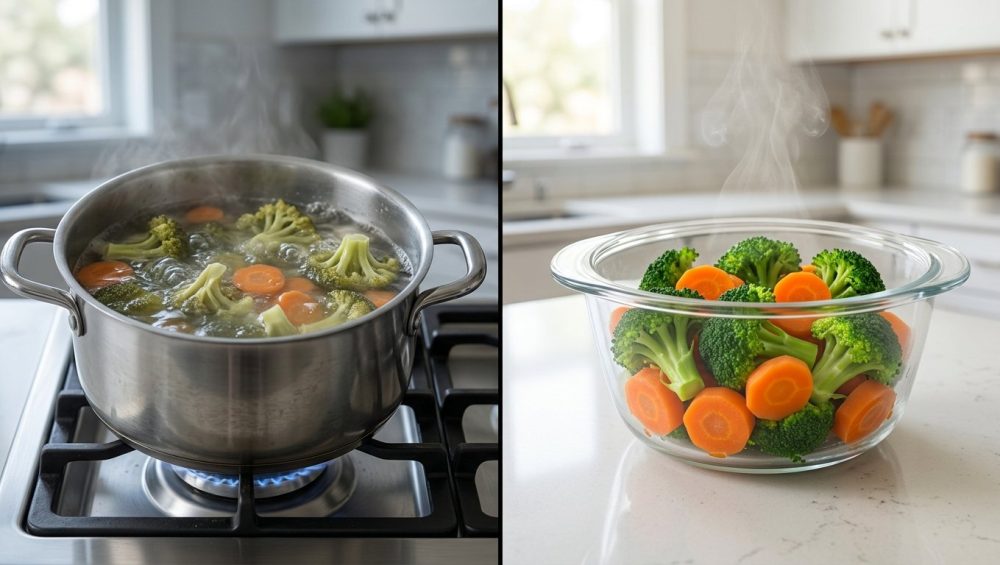
Listen to me very carefully. If I walk into your kitchen on a Tuesday night and see a massive pot of water rolling at a furious boil on your stove, and you are standing there holding a beautiful, crisp head of broccoli, I will physically intervene. We need to have a serious, sit-down conversation about what you are doing to your side dishes.
For generations, we have been conditioned to believe that the only way to cook a vegetable is to drown it. Our grandparents boiled Brussels sprouts until they were the color of military canvas and smelled like sulfur. Our parents steamed green beans until they had the structural integrity of a wet noodle. And now, you are continuing this cycle of culinary abuse. It stops today.
I am a realist. I know you are busy. I know that when you are staring down the barrel of a Wednesday evening, the last thing you want to do is spend forty-five minutes babysitting a multi-tier bamboo steamer basket just to get some greens on the plate. When it comes to mastering simple weeknight dinners, time is money. You need efficiency, you need speed, and most importantly, you need the food to actually taste good so you aren’t tempted to order a pizza.
This is where the most misunderstood appliance in your kitchen comes in: the microwave.
Yes, I said it. The microwave. That rectangular box you currently only use to reheat sad coffee and explode oatmeal is actually the ultimate secret weapon for achieving perfect, restaurant-quality, tender-crisp vegetables in under five minutes. I know the pretentious culinary gatekeepers will scoff at this. Let them. They can spend their evenings scrubbing burnt pots while we enjoy vibrant, perfectly cooked meals.
It is time to debunk the myths, understand the science, and learn exactly why the microwave is your best friend when it comes to vegetable preparation.
The Crime Scene: Why Boiling Is Ruining Your Dinners
Before we can embrace the solution, we have to understand the problem. Submerging vegetables in a massive volume of boiling water is one of the most common rookie kitchen mistakes that home cooks make, and it completely destroys both the texture and the nutritional profile of your food.
The Generational Curse of the Boiling Pot
Why do we even boil vegetables in the first place? It stems from a bygone era of culinary history where food safety and preservation methods were highly questionable. Before modern refrigeration and advanced agricultural supply chains, vegetables were often stored in root cellars for months, becoming tough, fibrous, and bitter. Boiling the absolute life out of them was a functional necessity to make them palatable and safe to chew.
We no longer live in the 19th century. We have access to vibrant, crisp, farm-fresh produce year-round. Yet, we are still applying pioneer-era cooking techniques to modern ingredients. It is a generational curse that has taught millions of people to hate vegetables. If your only experience with Brussels sprouts is the sulfurous, waterlogged nightmare of your childhood holidays, it is no wonder you avoid them.
The Science of the Mush: Pectin Breakdown
To understand why boiled vegetables turn to mush, we have to look at plant biology. Vegetables get their firm, crisp texture from their cell walls, which are primarily composed of cellulose, hemicellulose, and pectin. Think of pectin as the biological mortar that holds the plant’s cellular bricks together.
When you drop vegetables into water that is 212°F (100°C), thermal degradation begins immediately. As the temperature rises, the pectin starts to dissolve into the surrounding water. The longer the vegetable sits in the boiling water, the more the “mortar” dissolves, until the cell walls completely collapse. This is why over-boiled asparagus goes limp and broccoli turns to a watery pulp. You aren’t just cooking the vegetable; you are structurally dismantling it.
Leaching: Your Drain Is Eating Better Than You Are
If the textural destruction wasn’t enough to deter you, let’s talk about nutrition. Vegetables are packed with water-soluble vitamins, most notably Vitamin C and the B-vitamin complex. “Water-soluble” means exactly what it sounds like: these nutrients readily dissolve in water.
When you boil a vegetable, the hot water acts as a solvent. The nutrients leach out of the plant cells and bleed directly into the cooking water. According to a comprehensive 2018 study published in the National Institutes of Health, boiling causes the greatest loss of Vitamin C compared to any other cooking method, sometimes destroying or extracting over 50% of the vegetable’s total vitamin content.
Furthermore, Harvard Medical School has noted that boiling broccoli causes it to lose a significant amount of glucosinolate, the sulfur-containing compound widely studied for its cancer-fighting properties.
So, when you boil your vegetables and then dump that green-tinted water down the sink, you are literally pouring the vast majority of the nutritional value down the drain. Your plumbing is getting a fantastic dose of antioxidants, while you are left chewing on the depleted, fibrous remains. If you are serious about wanting to transform your daily meals into something actually healthy, you have to stop drowning your produce.
Enter the Microwave: The Misunderstood Kitchen Hero
Now that we have established that boiling is a culinary crime, let’s talk about the hero of our story. To understand why the microwave is the superior tool for cooking vegetables, we need to strip away the pretentious chef-speak and look at the actual physics of how this appliance works.
Dielectric Heating for Dummies
A microwave oven operates using a component called a magnetron. This device takes electricity from your wall outlet and converts it into electromagnetic waves, specifically in the microwave frequency range (usually around 2.45 gigahertz).
When you place a bowl of broccoli in the microwave and press start, these waves flood the cooking chamber. The waves are highly selective; they primarily interact with molecules that are electrically asymmetrical, meaning they have a positive charge on one end and a negative charge on the other. Water molecules are the prime example of this.
As the microwaves hit the water molecules inside the broccoli, the molecules rapidly flip back and forth to align with the alternating electromagnetic field. They do this millions of times per second. All of this molecular thrashing creates an immense amount of friction, and just like rubbing your hands together on a cold day, friction generates heat.
This process is called dielectric heating. Unlike a traditional oven that heats the air around the food, or boiling water that heats the food from the outside in, dielectric heating generates heat directly inside the food itself. The moisture naturally present inside the vegetable’s cells heats up and turns to steam, essentially cooking the vegetable from the inside out in a matter of minutes.
Why This Preserves Texture and Nutrients
Because microwaves cook food so rapidly and utilize the vegetable’s internal moisture, you only need to add a tiny splash of water to the bowl to create a perfect steaming environment.
Remember the two enemies of nutrient retention: high volumes of water and long cooking times. The microwave eliminates both. Dr. Anthony Komaroff, a professor of medicine at Harvard Medical School, has explicitly stated that because microwave cooking times are exceptionally short, it is actually the least likely appliance to damage the chemical structure of nutrients.
A 2018 study evaluating various cooking methods confirmed that microwaving vegetables like spinach, carrots, and broccoli resulted in a Vitamin C retention rate of over 90%, vastly outperforming boiling and even traditional stovetop steaming. You get perfectly tender-crisp texture because the pectin isn’t sitting in a hot bath long enough to dissolve, and you keep the vitamins because there is no massive pot of water for them to leach into. It is a scientifically superior method.
Debunking the Tinfoil Hat Myths
I know what some of you are thinking. You’ve read the fear-mongering blogs. You’ve heard the rumors from your eccentric aunt. You are worried about “zapping” your food. Let’s clear the air and address the absolute nonsense surrounding microwaves, because I have zero patience for anti-science hysteria in the kitchen.
“But What About the Radiation?”
The word “radiation” sounds scary. It conjures images of hazmat suits and glowing green sludge. But in physics, radiation simply refers to the emission of energy as electromagnetic waves.
There are two types of radiation: ionizing and non-ionizing. Ionizing radiation (like X-rays, gamma rays, and high-frequency ultraviolet light) carries enough energy to knock electrons out of atoms, which can alter DNA and cause cancer.
Microwaves, however, use non-ionizing radiation. They have relatively low energy—just enough to make water molecules vibrate and generate heat, but absolutely not enough to alter the chemical or molecular structure of your food. According to the Cancer Council and the FDA, the non-ionizing radiation used by microwave ovens is completely safe and does not make your food radioactive. It is physically impossible. You are exposed to more dangerous radiation standing in the sun for ten minutes than you are eating a microwaved carrot.
“Microwaves Destroy the Nutrients”
We already covered this, but it bears repeating because the myth is so pervasive. The idea that microwaves “nuke” the vitamins out of food is categorically false. Heat degrades certain nutrients, regardless of the source of that heat. Because microwaves heat food faster than a conventional oven or a stovetop, they actually preserve more nutrients. The science is settled. Moving on.
The “No-Go” Rule: Keep Your Toxic Plastics Out of My Microwave
Now, while the microwave itself is perfectly safe, what you put inside the microwave is an entirely different story. This brings us to my absolute strictest rule, and if you ignore everything else I say, pay attention to this.
I absolutely despise cheap, toxic kitchenware. I am on a lifelong crusade against it. If you are currently taking your beautiful, organic vegetables, tossing them into a flimsy, scratched plastic takeout container, and nuking them on high for five minutes, you are making a massive mistake. If you are serious about banishing toxic kitchen gear from your home, the microwave is the very first place you need to audit.
The Dangers of Cheap Gear
When plastic is heated, especially cheap or degraded plastic, the chemical additives used to make it flexible and durable can leach directly into your food. We are talking about Bisphenol A (BPA), phthalates, and per- and polyfluoroalkyl substances (PFAS). These are known endocrine disruptors that can interfere with your hormones and cause a host of metabolic and reproductive issues.
Even if a cheap plastic container slaps a “BPA-Free” sticker on the label, manufacturers often just replace BPA with BPS or BPF, which have been shown to exhibit the exact same toxic behaviors. Furthermore, heating food in the thin plastic bags they are sold in at the grocery store (unless specifically engineered and rigorously tested for steaming) is a recipe for microplastic contamination.
If you notice that your plastic storage containers are warped, stained orange from old pasta sauce, or if they taste like soap no matter how many times you scrub them, throw them in the recycling bin immediately. They are degrading, and you are eating that degradation.
What You Should Be Using Instead
To cook safely and efficiently, you need to invest in high-quality, durable vessels. These are the non-negotiable kitchen essentials every beginner needs for safe microwave use.
Your absolute best option is tempered borosilicate glass. Brands that produce heavy-duty borosilicate bowls can withstand rapid temperature changes without shattering or leaching chemicals. High-quality, lead-free ceramics and stoneware are also excellent choices, as they are inherently microwave-safe and hold heat beautifully.
When it comes to covering your vegetables to trap the steam, do not use plastic wrap. Instead, use a tempered glass lid, a heavy ceramic plate rested on top of the bowl, or a dedicated food-grade, high-heat silicone microwave cover.
The Masterclass: How to Actually Steam Vegetables in the Microwave
Alright, class is in session. We have covered the science, debunked the myths, and thrown away your toxic plastics. Now it is time to actually cook.
The goal here is tender-crisp vegetables. We want them cooked through, vibrantly colored, and still retaining a slight snap when you bite into them. This is not about boiling them into submission; it is about controlled, rapid steaming.
The Core Technique
The technique for microwave steaming is universal, regardless of the vegetable:
- Prep Uniformly: Cut your vegetables into even, uniform pieces. Microwaves generally penetrate the outer 1 to 1.5 inches of food. If you have giant, thick chunks mixed with tiny slivers, the small pieces will turn to mush before the large pieces are even warm.
- The Splash of Water: Place the prepped vegetables into your heavy glass or ceramic bowl. Add exactly two to three tablespoons of water to the bottom of the bowl. Do not add more. You are not making soup; you just need enough moisture to generate steam.
- The Seal and Vent: Cover the bowl with a glass lid, a ceramic plate, or a high-quality silicone cover. Crucial step: You must leave a tiny gap or vent for excess steam to escape. If you seal it completely airtight, the built-up pressure will blow the lid off the bowl and you will spend your evening scrubbing broccoli shrapnel off the ceiling.
- The Cook and Rest: Microwave on high. Cooking times will vary based on the wattage of your microwave and the density of the vegetable. Once the timer goes off, carefully remove the bowl (use oven mitts, the glass will be screaming hot) and leave the lid on for one more minute. The residual trapped steam will finish the cooking process gently.
The Cheat Sheet for Everyday Veggies
Here is your foolproof guide to the most common weeknight sides. Note: These times are based on a standard 1000-watt microwave. If you have a weaker model, you may need to add 30 to 60 seconds.
Broccoli and Cauliflower
- Prep: Cut into bite-sized florets. Peel and slice the stems (don’t throw them away, they are delicious).
- Water: 2 tablespoons.
- Time: 2.5 to 3 minutes.
- Visual Cue: The broccoli should turn a vibrant, shocking emerald green. If it turns olive green, you have gone too far.
Carrots and Root Vegetables
- Prep: Peel and slice into uniform 1/4-inch thick coins. Root vegetables are dense and require a bit more time.
- Water: 3 tablespoons.
- Time: 4 to 5 minutes.
- Visual Cue: A fork should pierce the center of the largest coin with just a slight resistance.
Green Beans and Asparagus
- Prep: Trim the woody ends. Leave whole or cut in half.
- Water: 2 tablespoons.
- Time: 2 to 3 minutes.
- Visual Cue: Bright green and slightly pliable, but not limp. They should still hold their shape when picked up by one end.
Brussels Sprouts
- Prep: Trim the woody base and slice them in half vertically.
- Water: 2 tablespoons.
- Time: 3 to 4 minutes.
- Visual Cue: Bright green and tender. (Pro-tip: Toss them in a hot skillet with bacon fat for 60 seconds after microwaving to get a quick sear without the long oven roasting time).
Zucchini and Summer Squash
- Prep: Slice into half-moons. These have an incredibly high water content naturally.
- Water: 1 tablespoon (barely any).
- Time: 1.5 to 2 minutes.
- Visual Cue: Translucent edges but a firm center. Do not overcook these, or they will turn into soup.
Leafy Greens (Spinach, Swiss Chard, Kale)
- Prep: Wash thoroughly and remove tough stems.
- Water: None. The residual water clinging to the leaves from washing is more than enough to steam them.
- Time: 60 to 90 seconds.
- Visual Cue: Fully wilted but still bright green.
Potatoes and Sweet Potatoes (The Quick Bake)
- Prep: Wash thoroughly and pierce the skin multiple times with a fork. This is non-negotiable unless you want a potato bomb to detonate in your appliance.
- Water: None. Place directly on the glass turntable or a ceramic plate.
- Time: 5 to 7 minutes per potato, flipping halfway through.
- Visual Cue: A fork easily glides all the way to the center with zero resistance.
Troubleshooting: When Things Go Wrong
Even with a foolproof method, microwaves can be finicky beasts. If you find your vegetables are coming out rubbery or dry, you likely didn’t add enough water, or you cooked them for too long, causing the natural moisture to completely evaporate.
If they are cooking unevenly (hot on the edges, raw in the middle), your pieces are not uniform, or your microwave has severe hot spots. Stop the microwave halfway through the cooking time, give the bowl a good stir to redistribute the vegetables, and then finish the cycle.
And please, if you find a forgotten, slightly wilted bell pepper in the back of your crisper drawer, do not toss it. You can easily bring them back to life by trimming the bad spots and utilizing this exact microwave steaming method. The rapid heat and moisture will soften the wrinkles and make it perfectly acceptable for a quick weeknight side.
Flavoring Your Perfectly Cooked Veggies (Because Plain is Boring)
Congratulations. You have successfully steamed a bowl of vegetables without destroying their cellular structure or leaching their vitamins into the local water supply. But we are not eating plain, unseasoned steamed vegetables like we are recovering in a hospital ward.
The beauty of microwave steaming is that it gives you a perfectly cooked, blank canvas. Because the vegetables haven’t been waterlogged, they are primed and ready to absorb actual flavor.
The Holy Trinity: Fat, Acid, and Salt
As soon as your vegetables come out of the microwave and you have carefully removed the lid, drain off any tiny amount of residual water at the bottom of the bowl. While the vegetables are still piping hot, you need to hit them with the holy trinity of flavor.
1. Fat: Vegetables need fat to carry their fat-soluble vitamins (like Vitamin A and K) into your bloodstream, and to coat the palate. Toss your hot broccoli with a generous knob of high-quality grass-fed butter, a drizzle of robust extra-virgin olive oil, or even a spoonful of toasted sesame oil.
2. Acid: This is the secret weapon that separates home cooks from professionals. If your food tastes flat or heavy, it doesn’t always need more salt; often, your dinner actually needs acid to brighten it up. Squeeze half a fresh lemon over your green beans, or toss your carrots with a splash of apple cider vinegar or a high-quality balsamic glaze. The acid cuts through the fat and makes the natural sweetness of the vegetables pop.
3. Salt and Crunch: Finish with a generous pinch of flaky sea salt. The large crystals provide a satisfying crunch and bursts of salinity. If you want to elevate the dish further, add toasted slivered almonds, toasted panko breadcrumbs, or a sprinkle of grated Parmigiano-Reggiano.
If you want to take it a step further, make a compound butter. Take room temperature butter and mash it with minced garlic, chopped fresh herbs, and a pinch of salt. Roll it in parchment paper and keep it in the fridge. Drop a slice of this onto your hot, microwaved vegetables and let it melt into a luxurious sauce. Alternatively, toss warm vegetables in a sharp Dijon mustard vinaigrette; the hot cell walls will absorb the punchy flavors beautifully.
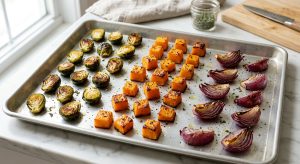
If you are frustrated by cheap, flimsy sheet pans that constantly buckle in the oven and ruin your roasted vegetable attempts, stop suffering. Figure out what to buy instead (hint: heavy-gauge aluminized steel), but in the meantime, rely on your microwave. It is faster, more reliable, and requires significantly less cleanup.
The Bottom Line
Cooking does not have to be a grueling, time-consuming chore, especially on a Tuesday night when you are exhausted and contemplating ordering Thai food for the third time this week. If you want to succeed at ditching takeout, you have to work smarter, not harder.
The microwave is not a crutch for lazy cooks; it is a highly efficient, scientifically sound tool for preserving the nutritional integrity and texture of your produce. Stop boiling your vegetables into a gray, lifeless pulp. Stop fearing non-ionizing radiation. Invest in some safe, heavy-duty glass bowls, master the two-tablespoon water rule, and start eating vegetables that actually taste like vegetables.
Your palate, your health, and your precious free time will thank you. Now get out of my kitchen and go microwave some broccoli.