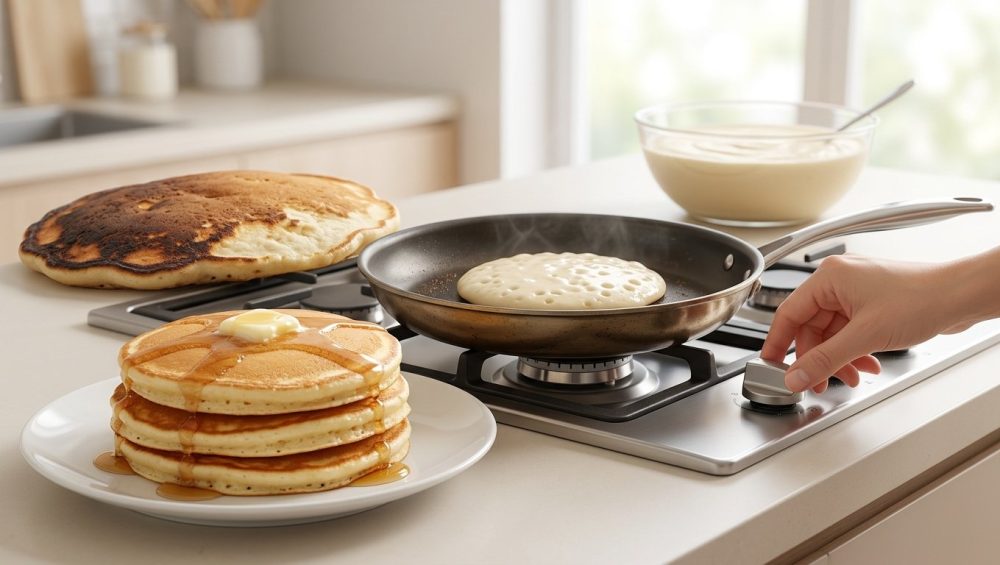
Listen, we’ve all been there. It’s Sunday morning. You’ve got the coffee brewing, the bacon sizzling, and you’re ready to execute the perfect weekend breakfast. You mix the batter, pour it into the pan, and wait for those little bubbles to appear. You flip it, and what do you get? A charred, blackened disk on the outside that somehow, defying all laws of logic and physics, oozes raw, wet batter from the center when you cut into it. It’s a culinary tragedy. It’s the kind of betrayal that makes you want to throw your spatula across the room and order a bagel.
But you don’t have to live like this. As someone who has spent years surviving kitchen disasters and setting off the smoke detector more times than I care to admit, I’m here to tell you that achieving perfectly fluffy pancakes is entirely within your grasp. You don’t need a culinary degree, and you certainly don’t need to be a professional chef. You just need to understand a little bit of practical science and stop making the same beginner cooking mistakes.
When it comes to weekday meals, my philosophy is simple: time is money. I rely heavily on efficiency, shortcuts, and clever hacks to get dinner on the table without losing my mind. But the weekend? The weekend is sacred. That is when we have the luxury of time to be absolute perfectionists. And if you are going to dedicate your precious Sunday morning to making pancakes from scratch, you owe it to yourself to do it right. We are going to dive deep into the practical science of pan heat retention, sugar caramelization rates, and starch gelatinization. Don’t panic—I promise I won’t bore you with pretentious chef-speak. We are going to keep it real, keep it snarky, and get you cooking like an expert.
The Physics of the Pan: Why Your Skillet is Betraying You
Let’s start with the hard truth: your equipment matters. If you are trying to cook a delicate, temperamental batter in a flimsy, five-dollar grocery store pan, you are setting yourself up for failure before you even crack an egg. I have a strict “no-go” rule when it comes to cheap, toxic kitchenware. I absolutely despise those lightweight aluminum pans with peeling non-stick coatings. Not only are they a nightmare for even heat distribution, but nobody wants mystery chemicals flaking off into their breakfast. Seriously, banishing toxic kitchen gear is the first step to becoming a better cook.
To understand why your pancakes are burning on the outside while remaining raw on the inside, we need to talk about thermal mass and thermal conductivity. Thermal mass refers to a material’s ability to absorb and hold onto heat. Thermal conductivity is how fast that material transfers heat to whatever is sitting on top of it.
When you pour cold (or room temperature) batter onto a hot pan, the temperature of the pan immediately drops. A thin, cheap pan has very little thermal mass. The moment the wet batter hits it, the surface temperature plummets. Your stove’s burner then has to work overtime to reheat the pan, causing violent spikes in temperature. This fluctuation blasts the exterior of the pancake with intense, uncontrolled heat, scorching the surface long before the gentle, consistent heat required to cook the interior can penetrate the batter.
This is why you need a pan with substantial heft. Cast iron, carbon steel, or a high-quality, heavy-bottomed multi-clad stainless steel skillet are the essential tools every beginner needs for consistent results. A thick cast iron griddle or skillet takes a long time to heat up, but once it gets there, it holds that temperature beautifully. When you drop your batter onto cast iron, the temperature barely budges. It delivers a steady, unwavering blanket of heat that gently cooks the pancake all the way through without aggressively torching the outside. If you are serious about your breakfast game, understanding the thermodynamics of carbon steel pans or cast iron skillets will change your life. And please, if your old non-stick pans are scratched and warped, throw them in the trash where they belong.
The Chemistry of the Batter: Sugar, Starch, and Patience
Now that we have sorted out your hardware, let’s talk about the software: the batter. Cooking is just applied chemistry, and pancakes are a perfect example of this. There are three major chemical reactions happening when batter meets a hot pan, and if they are out of sync, you end up with a burnt, gooey mess.
The Caramelization Conundrum
First, let’s look at sugar. Most pancake recipes contain at least a little bit of granulated sugar, and many people add even more because they have a sweet tooth. Table sugar, or sucrose, is highly reactive to heat. According to food science data, sucrose begins to caramelize rapidly at around 320°F (160°C). Caramelization is a beautiful thing—it gives your pancakes that gorgeous golden-brown color and complex, nutty flavor. But it is a double-edged sword.
If your pan is too hot (say, pushing 400°F or higher), that sugar isn’t just going to caramelize; it’s going to carbonize. It will burn black before the rest of the pancake even knows what hit it. Furthermore, the proteins and sugars in the batter undergo the Maillard reaction, another browning process that occurs at high heat. While accelerating the Maillard reaction is great for searing a steak, it is the enemy of a thick, fluffy pancake if it happens too quickly. You need to manage the heat so the exterior browns at the exact same rate the interior cooks.
Starch Gelatinization: The Secret to the Fluff
While the outside is busy browning, the inside of the pancake needs to undergo a crucial transformation called starch gelatinization. Wheat flour is composed of roughly 70% starch. In its raw form, this starch is chalky, dense, and unpalatable. But when exposed to heat and moisture, the starch granules absorb water, swell up, and eventually burst, forming a stable, fluffy, web-like structure.
Here is the kicker: starch gelatinization in wheat flour typically occurs between 140°F (60°C) and 158°F (70°C). This means the internal temperature of your pancake must reach at least 150°F to fully cook the raw batter into a spongy, delightful crumb. If your pan is blasting at 425°F, the outside of the pancake will reach 320°F and burn black in less than a minute, while the inside is still languishing at 90°F. The heat simply doesn’t have enough time to conduct through the batter to trigger that vital starch gelatinization. The result? Burnt outside, raw inside.
The Mandatory Batter Rest
If there is one hill I am willing to die on as a snarky culinary blogger, it is this: you must let your pancake batter rest. I know, I know. You are hungry, you are uncaffeinated, and you want to eat right now. But remember our weekend rule: we are perfectionists.
When you mix flour with wet ingredients, two things happen. First, you activate gluten, the protein network that makes dough chewy. You do not want chewy pancakes; you want tender ones. Resting the batter for 15 to 30 minutes gives that gluten time to relax. Second, and more importantly, resting gives the starch granules time to fully hydrate. Flour is like a microscopic sponge. It takes time for it to absorb the milk and eggs. If you cook the batter immediately, the liquid is just sitting around the flour, resulting in a thin, runny batter that spreads out into sad, flat disks.
When you let it rest, the starches swell, the batter thickens considerably, and it holds onto the leavening gases (from your baking powder or soda) much better. A thicker, hydrated batter rises taller in the pan and cooks more evenly, providing better insulation so the inside can gelatinize before the outside burns. Mix the batter, walk away, drink a cup of coffee, and let science do the heavy lifting.
The Heat Management Masterclass: Dialing in the Temperature
Alright, we have a heavy pan and a well-rested batter. Now we arrive at the most critical variable in the entire equation: heat management. The number one reason home cooks end up with burnt-yet-raw pancakes is impatience. They crank the stove dial to “High” or “Medium-High,” hoping to speed up the process. This is a catastrophic error.
The Illusion of “Medium-High”
Stove dials are liars. “Medium” on my gas range might be 300°F, while “Medium” on your electric coil might be 450°F. You cannot rely on the arbitrary numbers printed on your stove. You have to rely on temperature and visual cues.
The optimal temperature for cooking pancakes on a griddle or skillet is right around 350°F to 375°F (175°C to 190°C). At this sweet spot, the heat is gentle enough to allow the interior of the pancake to reach the 150°F needed for starch gelatinization, but hot enough to slowly coax out the Maillard reaction and sugar caramelization on the exterior over the course of 2 to 3 minutes per side.
Preheating and the Water Drop Test
You must preheat your pan thoroughly. If you are using cast iron or heavy stainless steel, place it on medium-low heat for at least 5 to 10 minutes before you even think about adding batter. You want the heat to saturate the entire pan evenly, eliminating any hot or cold spots.
How do you know when it’s ready without a fancy infrared thermometer? You use the water drop test. Flick a few drops of water onto the surface of the pan. If the water just sits there and slowly bubbles away, the pan is too cold. Your pancakes will be pale, greasy, and rubbery. If the water instantly shatters into tiny micro-beads and vaporizes violently in a fraction of a second, the pan is way too hot. Your pancakes will burn on contact.
What you are looking for is the magical middle ground. When the water drops hit the pan, they should sizzle, form distinct beads, and happily “dance” or skitter across the surface for about two to three seconds before evaporating. This phenomenon is a mild application of the Leidenfrost effect. While mastering the Leidenfrost effect is usually reserved for searing proteins without sticking, recognizing its early stages is the ultimate visual cue that your pan is perfectly heated to around 350°F.
Riding the Dial
Even with a heavy pan, cooking multiple batches of pancakes requires active heat management. As you add cold batter, the pan cools slightly. As it sits empty between batches, it heats up. You cannot just set the dial and walk away. You have to “ride the dial.” If the first batch cooks perfectly, but the second batch browns too quickly, turn the heat down slightly. If you notice the pan smoking at any point, pull it entirely off the burner for a minute to let it recover. Cooking is an active sport; pay attention to what the pan is telling you. This active engagement is exactly how I stopped burning dinner every night.
The Flip Mechanics: When, How, and With What
The flip is the moment of truth. Flip too early, and you have a splattered, misshapen mess. Flip too late, and you are eating charcoal.
The Bubble Myth vs. The Edge-Set Reality
We have all been taught the golden rule of pancakes: “Flip when you see bubbles on the surface.” This is only half true, and relying on it blindly is why your pancakes are raw inside.
Yes, bubbles will form as the baking powder reacts to the heat and releases carbon dioxide. However, if your pan is too hot, the bottom will burn long before the bubbles ever reach the top surface. Conversely, if your batter is very thick (which it should be, because you rested it, right?), the bubbles might struggle to pop through the surface, leading you to wait too long and burn the bottom.
The true indicator of readiness is the edges. Watch the perimeter of the pancake. When the batter hits the pan, the edges will be glossy and wet. As the heat conducts upward, those edges will begin to dry out, turning matte and setting into a firm structure. When the edges look dry and set about half an inch inward, and the bubbles that have popped remain open (rather than immediately filling back in with wet batter), it is time to flip.
The Spatula Requirement
Do not come crying to me when your thick, chunky plastic spatula mangles your beautiful pancake. You need the right tool for the job. A thin, flexible, wide spatula—ideally a fish turner or a silicone-edged turner—is mandatory. You need a tool that can slide effortlessly under the delicate crust without tearing it. When you flip, do it with confidence. A hesitant, sloppy flip results in folded edges and deflated batter. Get under it, lift, and turn it over in one swift, decisive motion.
Fat and Friction: The Butter vs. Oil Dilemma
Let’s address the grease. You need fat in the pan to prevent sticking and to encourage even browning, but choosing the wrong fat is a surefire way to ruin your breakfast.
Many home cooks grease their pan with a generous pat of whole butter. Butter is delicious, but whole butter contains milk solids and water. Those milk solids have a very low smoke point—around 300°F. Remember our optimal pancake temperature? 350°F to 375°F. If you use whole butter, those milk solids are going to scorch and turn black in the pan before your first pancake is even flipped. That burnt, acrid flavor will transfer directly to your food.
If you want the flavor of butter without the burnt black specks, you need to use clarified butter or ghee. In clarified butter, the milk solids have been removed, raising the smoke point to a robust 450°F. Alternatively, use a neutral oil with a high smoke point, such as avocado oil, grapeseed oil, or even regular canola oil.
Here is another pro-tip: do not deep-fry your pancakes. You only need a microscopic layer of fat. Add a small amount of oil or ghee to the preheated pan, and then take a folded paper towel and wipe it completely out. The pan should look practically dry, with just a slight sheen. This prevents the pancakes from developing a mottled, greasy, leopard-spotted appearance and encourages a smooth, uniformly golden-brown crust. Between batches, take that same oily paper towel and quickly wipe the pan down again to clear out any stray crumbs that might burn.
Troubleshooting Other Common Pancake Disasters
If you have mastered the pan, the heat, and the batter rest, but you are still encountering issues, let’s run through a quick diagnostic checklist.
1. Your Pancakes are Tough and Chewy
You overmixed the batter. When you combine the wet and dry ingredients, you should mix them just until the dry streaks of flour disappear. Lumps are completely fine! In fact, lumps are good. As the batter rests, those lumps will hydrate and smooth themselves out. If you beat the batter until it is perfectly smooth, you will develop too much gluten, and your pancakes will have the texture of a rubber tire. Step away from the whisk.
2. Your Pancakes are Flat and Dense
Check the expiration date on your leavening agents. Baking powder and baking soda lose their potency over time. If your baking powder has been sitting in the back of your pantry since the last presidential election, throw it away. You can test it by dropping a spoonful into hot water; if it doesn’t immediately fizz and bubble vigorously, it’s dead.
3. Your Pancakes are Still Raw Inside Despite Low Heat
Your batter might simply be too thick, or you might be pouring them too large. A massive, thick pancake takes exponentially longer for heat to penetrate to the center. Stick to pouring about 1/4 cup to 1/3 cup of batter per pancake. This yields a manageable size that cooks through evenly before the exterior dries out.
Final Thoughts from the Sous-Chef
Cooking the perfect pancake isn’t magic, and it doesn’t require a commercial flat-top griddle. It requires patience, observation, and a fundamental respect for how heat interacts with ingredients. Ditch the toxic, flimsy pans. Let your batter rest so the starches can hydrate. Stop cranking your stove to high heat and expecting a miracle. Take the time to preheat your skillet properly, manage your temperature actively, and use a cooking fat that won’t burn.
Weekdays are for rushing, for shortcuts, and for getting food on the table by any means necessary. But the weekend? The weekend is your time to shine. Pour yourself another cup of coffee, embrace the science of the kitchen, and show that batter who is boss. You’ve got this. Now go make some mind-blowing breakfast.