Let’s set the scene. You just dropped fifty bucks on a brand-new, top-of-the-line non-stick skillet. You bring it home, wash it gently, and the next morning, you experience the absolute culinary bliss of watching a fried egg glide across the surface like an Olympic figure skater on fresh ice. You feel like a kitchen genius. You tell yourself that this time, things will be different. This time, you are going to take perfect care of your cookware.
Fast forward exactly three months. You are standing over the stove, furiously hacking at a scrambled egg that has inexplicably fused itself to the exact center of that very same pan. The non-stick coating hasn’t just lost its slip; it has seemingly transformed into a high-grade industrial adhesive. You stare at the pan, bewildered. You didn’t use metal utensils. You never put it in the dishwasher. You even hand-washed it with the soft side of the sponge. So, what on earth happened?
You probably blamed the manufacturer. You probably assumed you bought a dud, or that all non-stick pans are just an expensive scam designed to break your heart and drain your wallet. But as a seasoned home cook who has ruined more pans than I care to publicly admit, I am here to deliver some tough love. The pan didn’t fail you. You failed the pan. And the culprit is sitting right there in your pantry, masquerading as a harmless, calorie-saving convenience.
I am talking about that innocent-looking aerosol can of non-stick cooking spray.
Yes, the very product marketed specifically to make your pans “non-stick” is the exact chemical agent responsible for permanently destroying them. It is a brilliant, infuriating irony. If you are tired of throwing away expensive skillets and want to stop making the same rookie kitchen mistakes over and over again, it is time to sit down and have a serious talk about the chemistry of your cookware. We are going to break down exactly what is inside that aerosol can, the sneaky scientific mechanism that bakes an invisible layer of glue into your pans, and the absolute best ways to protect your kitchen investments moving forward.
The Great Non-Stick Betrayal: Why Your Pans Keep Dying
To understand why your cookware is failing, we first have to understand the fragile nature of a non-stick surface. Whether your pan is coated in traditional PTFE (Polytetrafluoroethylene, commonly known by the brand name Teflon) or a modern sol-gel ceramic coating, the fundamental principle remains the same. The surface is engineered to have an incredibly low coefficient of friction. At a microscopic level, the molecules in the coating are packed so tightly and are so unreactive that food proteins and sugars simply cannot find anything to grab onto.
When you cook, you are essentially facilitating a series of complex chemical reactions. Proteins unfold and bond with surfaces, sugars caramelize and harden, and starches gelatinize. A pristine non-stick coating acts as an impenetrable shield against these reactions, allowing you to sear, scramble, and sauté with minimal added fats.
However, this shield is highly vulnerable to two specific threats: physical abrasion and chemical buildup. Physical abrasion is obvious; if you take a metal fork to a Teflon pan, you are going to scratch the coating and expose the reactive bare metal underneath. But chemical buildup is much more insidious because it is entirely invisible to the naked eye.
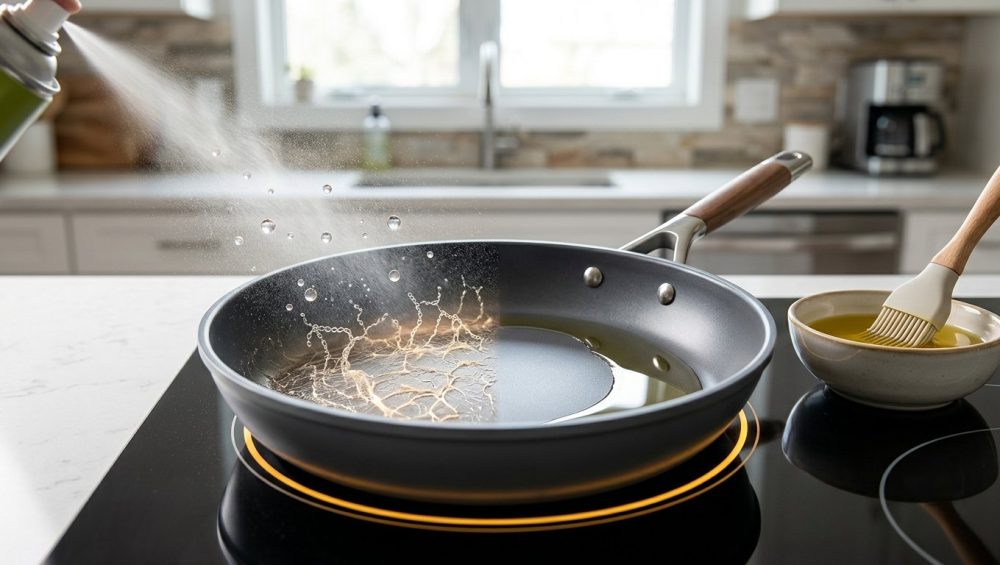
When you spray a cold non-stick pan with an aerosol cooking spray and then apply heat, you are not just greasing the pan. You are initiating a microscopic chemical reaction that bonds a foreign substance directly into the pores of your non-stick coating. Over time, this substance accumulates, layer by microscopic layer, until it forms a sticky, gummy, polymerized shell over the entire cooking surface. Your pan isn’t losing its non-stick coating; the coating is simply being buried alive under a layer of baked-on chemical gunk.
Deconstructing the Aerosol Can: What Are You Actually Spraying?
To grasp the magnitude of the problem, we need to look at the ingredient list on the back of your favorite cooking spray. The marketing department wants you to believe that you are simply spritzing a light, healthy mist of pure olive oil or canola oil. But if you actually read the fine print, you will realize that the oil itself often accounts for only twenty to thirty percent of the can’s total volume. The rest of the canister is filled with a cocktail of industrial chemicals designed purely to make the aerosol mechanism function.
Let’s break down the anatomy of what you are actually spraying onto your food and your cookware.
The Illusion of Pure Oil
The primary functional ingredient is, of course, oil. Canola, soybean, and vegetable blends are the most common, though premium brands will use avocado or olive oil. The oil is there to provide lubrication and facilitate heat transfer from the pan to the food. If the can contained nothing but oil, we wouldn’t be having this conversation. But pure oil cannot magically propel itself out of a nozzle in a perfectly uniform, micro-fine mist. It requires chemical assistance.
The Propellants: Hydrocarbons in Your Kitchen
To force the liquid out of the can at high velocity, manufacturers use propellants. If you look closely at the label, you will likely see ingredients like butane, isobutane, and propane. Yes, you read that correctly. The exact same highly flammable hydrocarbon gases used to fuel your backyard barbecue grill and your disposable cigarette lighters are being used to propel oil onto your breakfast skillet.
While the FDA classifies these propellants as “Generally Recognized as Safe” (GRAS) for incidental food contact because they largely dissipate into the air upon leaving the nozzle, their presence highlights just how highly processed these sprays are. You are essentially creating a tiny, highly flammable gas cloud in your kitchen every time you make a grilled cheese sandwich.
Anti-Foaming Agents: Dimethyl Silicone
When oil is forced through a tiny nozzle at high pressure, it naturally wants to foam and sputter. To prevent your cooking spray from coming out looking like shaving cream, manufacturers add anti-foaming agents. The most common is dimethyl silicone (also known as polydimethylsiloxane). This is a synthetic, food-grade silicone polymer that reduces the surface tension of the oil, ensuring it sprays in a smooth, even mist and doesn’t violently pop and splatter when it hits a hot pan. While deemed safe for consumption in trace amounts, it is yet another synthetic additive baking into your pan.
The Real Culprit: Soy Lecithin
Finally, we arrive at the villain of our story. Because oil, liquid propellants, and silicone do not naturally want to stay perfectly mixed together inside a pressurized metal tube, the formula requires an emulsifier. Emulsifiers are molecules that have one water-loving (hydrophilic) end and one oil-loving (lipophilic) end, allowing them to bind disparate ingredients together into a stable, uniform mixture.
In almost all commercial cooking sprays, the emulsifier of choice is soy lecithin. Soy lecithin is a naturally occurring fatty substance extracted as a byproduct during the refining of soybean oil. In the food industry, it is a miracle ingredient, used to keep chocolate smooth, prevent salad dressings from separating, and give baked goods a tender crumb.
But when soy lecithin is sprayed onto a non-stick pan and subjected to the intense heat of a stovetop burner, it undergoes a radical transformation. And this transformation is exactly what is destroying your cookware.
The Chemistry of Disaster: How Soy Lecithin Destroys Non-Stick Coatings
To understand why soy lecithin is the mortal enemy of your non-stick skillet, we have to talk about a chemical process called polymerization. I promise to keep the pretentious chef-speak to a minimum, but understanding this basic chemistry is the key to protecting your kitchen investments and ditching toxic kitchen gear for good.
What is Polymerization?
Polymerization is a chemical reaction in which small, individual molecules (monomers) link together to form a large, complex, interconnected, three-dimensional network (a polymer). When certain fats and oils are exposed to high heat and oxygen, their molecular structures break down and recombine, cross-linking into a hard, plastic-like substance.
When you spray soy lecithin onto a cold pan and turn on the heat, the water and propellants evaporate, leaving behind a concentrated layer of oil and lecithin. As the temperature of the pan rises, the soy lecithin begins to break down. Instead of simply burning away or remaining a slippery liquid, the lecithin molecules begin to cross-link and polymerize. They form an incredibly stubborn, resinous matrix that adheres fiercely to whatever surface it is resting on.
The Cast Iron Paradox
What makes this chemical reaction so fascinating—and so confusing for home cooks—is that polymerization is actually a highly desirable process in other areas of the kitchen. If you own a raw cast iron skillet or a carbon steel wok, you actively want polymerization to occur.
When you rub a thin layer of unsaturated oil onto bare cast iron and heat it past its smoke point, the oil polymerizes, bonding with the porous iron to create a slick, hard, naturally non-stick layer. This is the exact scientific mechanism behind seasoning cast iron skillets.
But here is the crucial difference: cast iron is a highly porous, reactive metal that needs a polymerized barrier to prevent rust and prevent food from sticking. A PTFE or ceramic non-stick pan already has a barrier.
The Microscopic Battlefield of PTFE and Ceramic
When soy lecithin polymerizes on a non-stick pan, it doesn’t create a helpful seasoning layer. Instead, it creates a microscopic disaster.
While a high-quality PTFE or ceramic coating feels perfectly smooth to the touch, under a microscope, it actually possesses a very fine, subtle texture. When the soy lecithin heats up and begins to cross-link, it seeps into these microscopic textural valleys before it hardens. It essentially anchors itself into the non-stick coating.
Because the polymerized lecithin is a sticky, resinous substance, it drastically increases the surface friction of the pan. The next time you try to cook an egg, the proteins in the egg whites hit that sticky, baked-on layer of lecithin resin and bond to it instantly. You assume the non-stick coating has worn off, but the truth is actually the opposite: something has been added on top of it. You have effectively “seasoned” your non-stick pan with a layer of invisible glue.
The “Scrubbing Delusion”: Why You Can’t Just Wash It Off
Once you realize that your pan is covered in polymerized soy lecithin, your first instinct is probably to roll up your sleeves, grab a heavy-duty scrubbing pad, and forcefully evict the gunk from your cookware. This is where the trap snaps shut. This is the Catch-22 of non-stick maintenance.
Polymerized fats are incredibly resilient. They are chemically designed to withstand heat, moisture, and mild detergents. A gentle wipe with a soapy sponge—the only cleaning method you should ever use on a non-stick pan—will do absolutely nothing to break the chemical bonds of polymerized lecithin. The sticky residue will laugh at your standard dish soap.
To actually remove polymerized resin, you need extreme abrasive force or highly caustic chemicals. You would need to use scouring powder, steel wool, or heavy-duty degreasers. But here is the fatal flaw in that plan: the PTFE or ceramic coating underneath the resin is incredibly delicate.
If you apply enough abrasive force to successfully scrape away the baked-on soy lecithin, you will inevitably scrape away the non-stick coating right along with it. You cannot scrub off the glue without destroying the pan. You are left with a miserable choice: keep cooking on a pan that is permanently sticky, or scrub it aggressively and ruin the coating forever. This frustrating cycle is exactly why so many people struggle with mastering simple weeknight dinners—it is impossible to cook smoothly when you are constantly fighting your own equipment.
The Sassy Sous-Chef’s Non-Negotiable Rule: Banishing Toxic Gear
At this point, you might be looking at your sticky, degraded, heavily scrubbed non-stick pan and wondering if you can just power through and keep using it. As your resident culinary advocate, I am invoking my absolute, non-negotiable “No-Go” rule: If your non-stick pan is heavily scratched, peeling, or permanently degraded, you must throw it in the garbage immediately.
I have zero patience for pretentious kitchen gadgets, but I have even less patience for toxic cookware. We need to have a very serious conversation about what happens when non-stick coatings fail.
The Danger of Scratched PTFE
Traditional non-stick pans are coated with PTFE. Historically, the manufacturing process for PTFE involved a chemical called PFOA (Perfluorooctanoic acid), which belongs to a larger class of compounds known as PFAS (per- and polyfluoroalkyl substances), often referred to as “forever chemicals.” These chemicals are notorious for their inability to break down in the environment or the human body, and they have been linked to a myriad of severe health issues.
While PFOA was largely phased out of cookware manufacturing in the 2010s, modern PTFE pans are still made using various other PFAS compounds. When a non-stick pan is intact and used at moderate temperatures, it is generally considered safe and inert. However, when you aggressively scrub a pan to remove polymerized cooking spray, or when you use metal utensils to pry off stuck food, you gouge the coating.
Once a PTFE coating is scratched and compromised, it begins to flake off into your food. You do not want to be ingesting flakes of synthetic fluoropolymers with your morning omelet. Furthermore, a compromised coating is more susceptible to thermal degradation, meaning it can begin to off-gas toxic fumes at lower temperatures than an intact pan.
The Regulatory Reckoning of 2025 and 2026
If you think I am overreacting about the dangers of degraded non-stick coatings, just look at the massive legal reckoning currently sweeping the globe. Governments are finally waking up to the environmental and health hazards of forever chemicals in consumer goods.
Starting on January 1, 2025, the state of Minnesota implemented Amara’s Law, officially banning the sale and distribution of cookware containing intentionally added PFAS. This was a watershed moment in the culinary industry. As of 2026, Maine has enacted similar blanket bans on PFAS in cookware, with states like Connecticut, New Jersey, and California aggressively pushing forward with their own stringent restrictions.
Across the Atlantic, the European Union is currently finalizing its REACH regulation proposals, which aim to universally restrict over 10,000 PFAS compounds, effectively phasing out traditional PTFE non-stick cookware entirely by the end of the decade.
The era of cheap, disposable, chemically laden non-stick pans is rapidly coming to an end. The industry is being forced to pivot toward safer, non-toxic alternatives. So, if you are currently hoarding a cabinet full of scratched, sticky, cooking-spray-ruined Teflon pans, consider this your official permission to throw them away. You cannot salvage them, and trying to do so is a risk to your health. It is time to start fresh, invest in safe equipment, and learn how to use the essential beginner kitchen tools correctly.
Safe, Pan-Saving Alternatives to the Aerosol Can
Now that we have established that aerosol cooking sprays are the ultimate enemies of your cookware, how are you supposed to grease your pans? If you are trying to cut back on calories or simply want a light, even coating of oil without pouring a heavy glug from a bottle, you need a safe alternative.
Fortunately, you do not need to rely on propellants and soy lecithin to achieve a perfect sear. Here are the most effective, pan-saving methods to lubricate your cookware and ensure you survive the kitchen without ruining another expensive skillet.
The Glass Pump-Action Oil Mister
This is, without a doubt, the greatest upgrade you can make to your cooking routine. A high-quality, refillable oil mister (like the popular EVO sprayer or a pressurized glass pump bottle) gives you the exact same convenience as an aerosol can, but with zero toxic additives.
You simply fill the bottle with your preferred cooking oil—whether that is a high-quality extra virgin olive oil, avocado oil, or grapeseed oil. The mechanical pump mechanism forces air into the chamber, building pressure so that when you pull the trigger, the pure oil is dispensed in a wide, ultra-fine mist. You get the calorie control and the even surface coverage of a commercial spray, but the only ingredient hitting your pan is 100% pure fat. No butane, no silicone, and most importantly, no polymerizing soy lecithin.
The Classic Paper Towel Wipe
If you don’t want to buy another kitchen gadget, the simplest and cheapest method requires nothing more than a bottle of oil and a paper towel. This is the technique used in professional kitchens around the world.
Simply pour a dime-sized drop of oil into the center of your cold non-stick pan. Take a folded paper towel and gently wipe the oil across the entire surface, buffing it into a microscopic, perfectly even layer. This method ensures that there are no pools of excess fat, giving you a flawless, low-calorie non-stick surface. It takes exactly four seconds, costs absolutely nothing, and completely eliminates the risk of chemical buildup.
High-Quality Silicone Basting Brushes
For baking sheets, muffin tins, and heavily textured grill pans, a basting brush is your best friend. Pour a tiny amount of melted butter or oil into a ramekin and brush it evenly over the surface.
However, a quick word of caution regarding silicone kitchenware: always ensure you are buying high-grade, food-safe platinum silicone. Cheap silicone tools can absorb odors and dish soap over time, which is why you might find yourself needing a guide on replacing soapy silicone spatulas. Invest in good tools once, and they will protect your cookware for a lifetime.
Understanding Smoke Points
Regardless of how you apply your fat, you must choose the right oil for the job. Every cooking fat has a smoke point—the temperature at which it stops shimmering and starts burning, breaking down into acrid smoke and free radicals.
If you use extra virgin olive oil (which has a relatively low smoke point) to aggressively sear a steak, the oil will burn and polymerize, creating the exact same sticky residue as a cooking spray. For high-heat cooking, always reach for fats with high smoke points, such as avocado oil, clarified butter (ghee), or refined grapeseed oil. Reserve your delicate, expensive olive oils for low-heat sautéing or finishing dishes off the heat.
A Masterclass in Non-Stick Pan Preservation
Ditching the aerosol can is the most critical step in saving your cookware, but it is not the only rule you need to follow. If you want your non-stick pans to last for years rather than months, you need to fundamentally change how you treat them. Transforming your chaotic, pan-ruining habits into a peaceful daily habit requires strict adherence to a few basic principles of thermodynamics and material science.
Temperature Control is Everything
Non-stick pans are not designed for high-heat cooking. Period. The delicate PTFE or ceramic matrix begins to degrade, warp, and break down when subjected to extreme thermal stress.
You should never turn your stove dial past “medium” when using a non-stick skillet. These pans are engineered for gentle tasks: scrambling eggs, sweating onions, cooking delicate fish fillets, and making pancakes. If you want to blast a piece of meat with maximum heat to achieve a dark, crusty Maillard reaction, you are using the wrong tool. For high-heat applications, you must learn the techniques for stick-free searing on bare stainless steel or cast iron. Save the non-stick for the gentle work.
Furthermore, never preheat an empty non-stick pan. Without food or oil to absorb the thermal energy, the surface temperature of an empty pan will skyrocket in seconds, instantly degrading the coating and potentially releasing harmful fumes. Always add your fat before you turn on the burner.
Utensil Discipline
This should go without saying, but it bears repeating: metal utensils have absolutely no place near a non-stick pan. Even a seemingly harmless metal whisk or a gentle scrape with a standard dinner fork can create microscopic lacerations in the coating. Once the integrity of the surface is breached, the pan will inevitably begin to flake and fail.
You must strictly enforce a “wood and silicone only” policy in your kitchen. Wooden spoons, bamboo spatulas, and heat-resistant silicone turners are the only tools allowed to make contact with your delicate cookware.
The Dishwasher is a Torture Chamber
I know the box said “Dishwasher Safe.” The box lied to you.
Dishwashers rely on two things to clean your plates: violently high water temperatures and highly caustic, abrasive detergents. Dishwasher pods contain enzymes, bleaches, and micro-abrasives designed to literally sandblast baked-on food away.
When you put a non-stick pan in the dishwasher, that caustic detergent attacks the microscopic structure of the coating, drying it out and wearing it down. A pan that might have lasted five years with gentle hand-washing will be stripped of its non-stick properties in less than a year of dishwasher cycles.
Cleaning a properly maintained non-stick pan should take exactly ten seconds. Let the pan cool completely to room temperature (running cold water over a hot pan will cause thermal shock and permanently warp the metal). Then, simply wipe it out with a soft sponge, warm water, and a drop of mild dish soap. If you have to scrub, you have already done something wrong.
Storage Solutions That Don’t Scratch
The final indignity most non-stick pans suffer happens when they aren’t even being used. You wash your pan perfectly, dry it gently, and then violently shove it into a crowded cabinet, stacking heavy stainless steel pots and cast iron skillets directly on top of the fragile cooking surface.
The metal-on-metal friction during storage is responsible for a massive percentage of cookware damage. If you must stack your pans to save space, you have to create a buffer. Buy a set of cheap felt pan protectors, or simply place a thick paper towel or a clean dishcloth inside the pan before nesting another piece of cookware on top of it. Treat the surface like the delicate, engineered instrument that it is.
The Sassy Sous-Chef’s Final Verdict
Cooking should be a joy, not a stressful battle against your own equipment. There is nothing more demoralizing than watching a beautiful, expensive piece of salmon tear itself to shreds because your supposedly “non-stick” pan has betrayed you. But the good news is that you now hold the power to stop this cycle of destruction.
You don’t need a culinary degree to cook like an expert, and you certainly don’t need to rely on industrial aerosol chemicals to fry an egg. By understanding the sneaky, polymerizing nature of soy lecithin, acknowledging the dangers of degraded Teflon, and switching to pure oils and proper heat management, you can drastically extend the lifespan of your cookware.
Throw away that sticky, ruined pan. Forgive yourself for the mistake. Toss the aerosol can into the recycling bin, buy a refillable glass oil mister, and step into a new era of clean, stress-free cooking. Once you eliminate the invisible chemical gunk from your cookware, you will be amazed at how much easier it becomes, finally conquering weeknight cooking anxiety and reclaiming your kitchen. Now go make yourself an omelet—and this time, watch it slide right onto the plate.