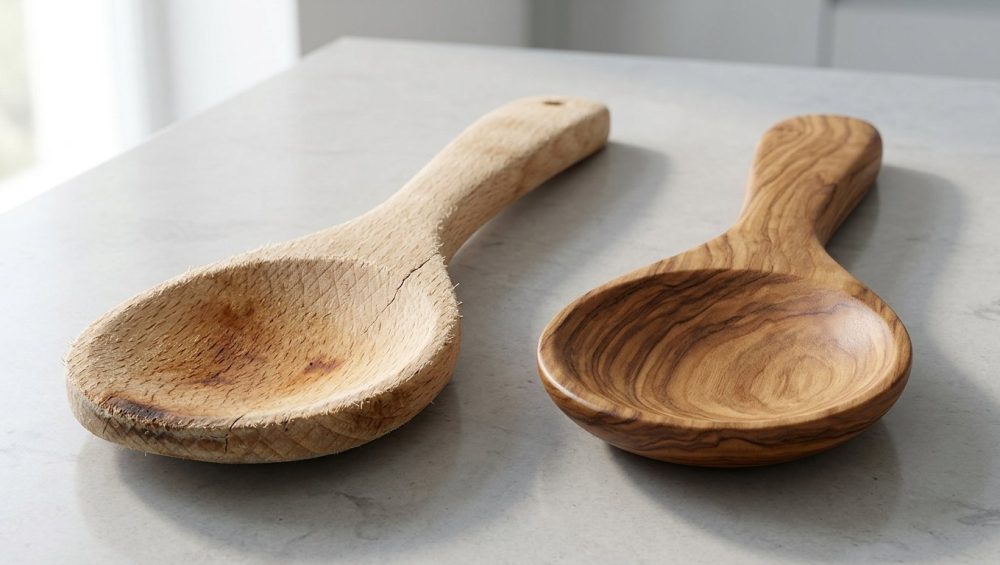
We need to have a serious, sit-down conversation about that wooden spoon you are currently using to stir your pasta sauce. Yes, that one. The one sitting in your utensil crock right now. The one that looks like it was chewed on by a teething golden retriever, features a jagged crack running straight down the bowl, and has developed a weird, fuzzy texture on the handle.
You know exactly which spoon I am talking about. You probably bought it in a shrink-wrapped three-pack from a big-box grocery store for the price of a fancy latte. You have used it to stir simmering stews, scrape the fond off the bottom of your carbon steel skillets, and fold thick, heavy batters. And in return for its loyal service, you have likely tossed it into the dishwasher a hundred times, watched it slowly warp, and ignored the fact that it occasionally leaves tiny, fibrous splinters in your mashed potatoes.
As a home cook, you deserve better. More importantly, your food deserves better. I have spent years watching weekend culinary hobbyists sabotage their own magnificent meals because they refuse to throw away degraded, unsanitary kitchen equipment. I am here to tell you that it is not your fault that your spoons keep cracking, splintering, and smelling like last week’s garlic. You have simply been buying the wrong wood.
Today, we are going to dive deep into the fascinating, slightly gross, and highly practical science of culinary wood. We are going to explore why cheap wooden utensils fail, the hidden microscopic dangers lurking inside those cracks, and exactly what you should be buying instead. Upgrading your gear and investing in the right beginner kitchen tools is the first step toward cooking with genuine confidence. Let us banish the fuzzy, splintery spoons for good.
The Science of the Splinter: Why Cheap Wooden Spoons Fail
To understand why your wooden spoons are falling apart, we have to look at the anatomy of wood itself. When you hold a wooden spoon, you are essentially holding a dried bundle of microscopic, organic straws.
The Anatomy of Wood Grain: Open vs. Closed
In a living tree, water and nutrients are transported from the roots to the leaves through a complex network of vascular tissue, primarily made up of xylem tubes. When the tree is harvested, dried, and carved into a spoon, those microscopic tubes remain. The size, distribution, and density of these tubes determine whether a wood is classified as “open-grain” or “closed-grain.”
Open-grain woods, such as red oak or ash, have large, visible pores. If you look closely at an oak board, you can actually see the deep striations and tiny holes where the vascular tubes were. Closed-grain woods, like hard maple or cherry, have pores that are tightly packed and microscopic. The surface feels completely smooth to the touch.
When you buy a cheap wooden spoon, it is almost always manufactured from fast-growing, highly porous, open-grain wood. Because the pores are so large, the wood acts like a rigid sponge. The moment you dip that cheap spoon into a pot of boiling soup, capillary action takes over, drawing hot liquid deep into the core of the utensil.
The Moisture Tug-of-War: Swelling and Shrinking
Wood is a hygroscopic material, meaning it constantly absorbs and releases moisture depending on its environment. When your open-grain wooden spoon absorbs water from your cooking or from sitting in a wet sink, the cellular walls of the wood fibers physically swell. The spoon literally expands.
When the spoon eventually dries out, those same fibers shrink back down. This continuous, violent cycle of expanding and contracting places immense mechanical stress on the cellular structure of the wood. Over time, the rigid bonds of the cellulose and lignin (the natural polymers that hold wood together) begin to break down. The fibers snap, separate, and fray. This is why cheap spoons develop that dreaded “fuzzy” texture and eventually split right down the middle.
The Dishwasher Death Sentence
If there is one thing I want you to take away from this masterclass, it is this: putting a wooden spoon in the dishwasher is an act of culinary vandalism.
A modern dishwasher is a torture chamber for organic materials. During a standard cycle, your spoon is subjected to prolonged exposure to water, extreme heat (often reaching 185°F or 85°C), and highly alkaline chemical detergents. The harsh detergents are designed to dissolve baked-on grease, but they cannot tell the difference between bacon fat and the natural, protective lipids inherent in the wood.
The dishwasher aggressively strips away all of the wood’s natural oils, leaving it completely parched. The extreme heat then force-dries the wood too rapidly, causing the exterior to shrink faster than the interior core. This uneven drying creates massive internal tension, which is abruptly released in the form of a loud pop and a deep, unfixable crack. If you want your utensils to survive, keep them far away from the dishwasher.
The Hidden Danger: What’s Lurking in Your Cracked Spoon?
A cracked spoon is not just an aesthetic annoyance; it is a legitimate biological hazard. Food safety experts consistently warn against the use of damaged wooden utensils, and the science behind their warnings is enough to make you lose your appetite.
Bacterial Breeding Grounds and Biofilms
There is a persistent myth that wood is magically “self-sanitizing” and will actively kill off all pathogens on contact. Let me be brutally honest: while some dense hardwoods do possess mild natural properties that inhibit bacterial growth better than scratched plastic, wood is not a chemical sanitizer. It will not miraculously neutralize raw chicken juice. In fact, one of the most common rookie kitchen mistakes is thinking soap fixes everything without properly inspecting the physical condition of the tool.
When a wooden spoon cracks, it creates a deep, dark, microscopic canyon that your dish sponge cannot possibly reach. Research has shown that dangerous pathogens, such as Listeria monocytogenes and Salmonella, can crawl into these crevices and form what is known as a biofilm. A biofilm is a resilient colony of bacteria that secretes a protective, slimy matrix around itself, allowing it to survive and flourish deep within the grain of the wood.
While these bacteria might stay trapped inside the wood for a while, the danger peaks when the spoon is used again. The physical friction of stirring, combined with the heat of the food, can cause the degraded wood to flex, peel, or splinter. When this happens, the built-up reservoir of bacteria is released directly into the meal you are preparing. If your spoon has a split or a crack, it belongs in the garbage, not in your stockpot.
The “Flavor Ghost” Phenomenon
Have you ever used a wooden spoon to stir a delicate vanilla custard, only to find that your dessert inexplicably tastes like cumin, onions, and regret? I call this the “Flavor Ghost.”
Because cheap, porous woods absorb liquids so readily, they also absorb the volatile aromatic compounds from your food. The essential oils from garlic, chili powder, and curry paste seep into the open grain and take up permanent residence. This is incredibly similar to how cheap plastic containers stay greasy and hold onto tomato sauce stains for all eternity. Once a porous wooden spoon absorbs a strong odor, it is nearly impossible to completely eradicate it, resulting in cross-contamination of flavors across your dishes.
Toxic Finishes and Mystery Glues
To make cheap, low-quality wood look appealing on store shelves, manufacturers often coat their utensils in a thick layer of glossy, synthetic varnish or polyurethane. These chemical coatings are rarely designed to withstand the high heat of a frying pan.
The moment you use a varnished spoon to scrape a hot skillet, that shiny chemical layer begins to melt, blister, and flake off directly into your food. You are unknowingly seasoning your dinner with microplastics and synthetic resins. When it comes to toxic kitchen gear, cheap lacquers are public enemy number one. A high-quality wooden spoon should never look like it was painted with clear nail polish; it should have a natural, matte finish that is maintained solely with food-grade oils.
The Culinary Wood Hierarchy: Woods to Avoid Like the Plague
Not all timber is destined for the kitchen. Before we talk about the best materials, we need to identify the absolute worst offenders. To do this, we rely on the Janka Hardness Scale.
Invented in 1906 by an Austrian wood researcher named Gabriel Janka, this scale measures the exact density and durability of a wood species. The test determines the pounds-force (lbf) required to press an 11.28mm steel ball exactly halfway into a plank of wood. For kitchen utensils, we are looking for a “Goldilocks zone” between 1,000 and 1,500 lbf. Anything lower is too soft and will dent; anything higher is excessively heavy, brittle, and prone to dulling tools.
Pine and Softwoods: The Mushy Mess
Softwoods like pine, cedar, and fir score abysmally low on the Janka scale, often falling well below 600 lbf. These woods are fantastic for building structural frames for houses, but they have absolutely no business in your kitchen. They dent easily, splinter under minimal pressure, and are so porous that they act like absolute sponges for water and bacteria. If you ever see a wooden spoon that feels suspiciously light and smells faintly of a Christmas tree, run the other way.
Bamboo: The Deceptive “Wood”
Bamboo has enjoyed a massive surge in popularity due to its rapid growth rate and eco-friendly marketing. However, bamboo is not actually wood; it is a type of grass. Because a blade of grass cannot be carved into a solid spoon, manufacturers must slice the bamboo into thin strips, soak them in chemical resins and formaldehydes, and glue them together under immense pressure.
The problem is that the heat and moisture of cooking quickly degrade these glues. The utensil will begin to delaminate, fray at the edges, and leave sharp, needle-like splinters in your food. Furthermore, bamboo is incredibly rich in natural silica, which makes it abrasively hard. Just like how cheap boards are ruining your knives by rolling the delicate steel edges, bamboo spoons can actually scratch the protective seasoning right off your carbon steel pans.
Red Oak and Ash: The Open-Grain Offenders
Oak and ash are undeniably hard and durable woods, scoring well on the Janka scale. However, they are strictly open-grain woods. As we discussed earlier, those massive vascular pores are a liability in the kitchen. While an oak spoon might not snap in half, it will aggressively absorb water, harbor bacterial biofilms, and trap food odors. Save the oak for your dining room table, not your stirring spoons.
The Holy Grail of Kitchen Utensils: What to Buy Instead
Now that we have purged the garbage from your utensil crock, it is time to talk about the good stuff. The ideal culinary wood is a closed-grain hardwood that falls perfectly into the Janka sweet spot. These woods are dense enough to resist moisture, smooth enough to prevent splintering, and durable enough to last a lifetime with proper care.
Hard Maple: The Unsung American Hero
If you walk into any high-end professional kitchen or culinary academy, you will see an abundance of hard maple. Also known as sugar maple, this wood is the undisputed gold standard for culinary applications.
Hard maple boasts a Janka hardness rating of around 1,450 lbf, placing it right at the top of our ideal range,. It features an exceptionally tight, closed-grain structure that naturally repels water and resists the absorption of food odors. Because the pores are so minuscule, bacteria struggle to find a foothold, making it one of the most sanitary options available. It is light in color, smooth to the touch, and tough enough to scrape the most stubborn fond from a cast-iron skillet without sustaining a dent. It is the ultimate pragmatic choice.
Olive Wood: The Mediterranean Masterpiece
If you are looking for aesthetic kitchen upgrades that actually serve a functional purpose, look no further than authentic olive wood. Sourced from the Mediterranean, olive wood is prized for its dramatic, swirling grain patterns and rich, contrasting colors.
With a Janka hardness of 1,390 lbf, olive wood is incredibly dense and durable. What truly sets it apart, however, is its high concentration of natural oils. These inherent lipids make the wood exceptionally hydrophobic (water-resistant) and provide naturally occurring antimicrobial properties that actively inhibit bacterial growth,. An olive wood spoon feels substantial and luxurious in the hand, and as it ages, it develops a stunning, burnished patina. It is a tool that doubles as functional art.
Walnut and Cherry: The Aesthetic Powerhouses
For those who prefer darker, warmer tones in their kitchen, black walnut and American cherry are phenomenal choices.
Walnut sits comfortably at 1,010 lbf on the Janka scale. It is a highly dependable, closed-grain hardwood that resists shrinking and warping. Its deep, chocolate-brown coloration naturally hides food stains, making it an excellent choice for stirring vibrant, turmeric-heavy curries or rich tomato sauces that would normally stain lighter woods.
Cherry wood, with a Janka rating of 950 lbf, is slightly softer but still highly effective. It has a remarkably smooth, fine texture and is famous for its ability to darken and deepen in color as it is exposed to light and age. Both woods offer a perfect balance of knife-friendly softness (if used as cutting boards) and structural integrity (if used as spoons).
Beechwood: The Affordable Workhorse
If you are on a strict budget but refuse to compromise on safety, European beechwood is your best friend. Scoring a solid 1,300 lbf on the Janka scale, beech offers an even, tight grain pattern and excellent durability for daily cooking. While it may lack the dramatic visual flair of olive wood or the sheer density of hard maple, beechwood is a massive step up from cheap pine or bamboo. It is the workhorse of the European kitchen and a fantastic entry-level upgrade.
Beyond the Spoon: Modern Alternatives for the Pragmatic Cook
While I am a staunch advocate for high-quality wooden utensils, I am also a realist. Sometimes, you need a tool that can handle the dishwasher, withstand blistering heat, and flex to the exact contour of your mixing bowl.
High-Quality Silicone
Silicone has revolutionized the modern kitchen, but you must be incredibly careful about what you buy. Cheap silicone is filled with plastic fillers that degrade under heat. When these fillers break down, they release chemical odors; otherwise they will taste like soap and ruin your delicate sauces.
If you are buying silicone spatulas or stirring spoons, demand 100% platinum-grade silicone with a solid stainless steel or fiberglass core. These tools are completely non-porous, heat-resistant up to 600°F, and inherently sanitary. They are the perfect companion to your wooden spoons, specifically excelling at folding egg whites, scraping down batter bowls, and handling raw meats where you want an easily sanitizable surface.
Fiberglass and Composite Materials
Another brilliant modern alternative is composite material, famously utilized by brands like Epicurean. These utensils are made by taking layers of FSC-certified paper or wood fiber and baking them together with food-safe resins under extreme heat and pressure. The result is a tool that looks and feels like wood, but is completely non-porous, knife-safe, and miraculously dishwasher safe. If you absolutely refuse to hand-wash your tools, composite utensils are the ultimate compromise.
The Sassy Sous-Chef’s Guide to Spoon Maintenance (Yes, It’s a Thing)
You have finally invested in a gorgeous, $25 hard maple or olive wood spoon. Congratulations. Now, you have to take care of it. Wood is a natural, once-living material, and it requires a minimal but non-negotiable amount of maintenance to survive. Do not roll your eyes at me; this takes less than two minutes a month.
The Holy Trinity of Cleaning: Hand Wash, Dry, Repeat
The absolute golden rule of wooden utensils is that they must be washed by hand, immediately after use. Do not let your spoon sit submerged in a sink full of murky, soapy dishwater overnight. Prolonged soaking forces water into the grain, causing it to swell, warp, and breed bacteria.
Wash the spoon with hot water, a mild dish soap, and a sponge. Once it is clean, do not just toss it wet into a dark drawer. Towel it off thoroughly, and let it air dry completely in a well-ventilated crock. Bacteria require moisture to multiply; by keeping your wood dry, you are eliminating their primary life source.
Conditioning 101: Mineral Oil vs. Beeswax
Over time, the heat of cooking and the soap from washing will slowly strip the natural oils out of your hardwood spoons. If the wood begins to look chalky, dull, or feels dry to the touch, it is screaming for hydration. You must condition it.
Do not use olive oil, vegetable oil, or any other cooking fat to condition your wood. These are dietary fats, and over time, they will undergo oxidation and turn violently rancid. Your spoon will end up smelling like a dirty deep fryer.
Instead, use 100% food-grade mineral oil. Mineral oil is an inert, petroleum-derived product that will never spoil, go rancid, or support bacterial growth. Simply apply a generous coat of oil to the dry wood, let it soak in overnight, and buff off the excess in the morning. For an even more durable finish, look for a “board butter” or wood conditioner that blends mineral oil with natural beeswax. The oil penetrates deep into the grain to hydrate the core, while the beeswax creates a protective, water-repellent seal on the surface.
The Sandpaper Trick
Even high-quality woods can occasionally develop a slightly rough or “fuzzy” texture after heavy use, especially if they have been used to stir highly acidic foods like tomato sauce, which can raise the grain. Do not panic; the spoon is not ruined.
One of my favorite simple kitchen fixes is taking a piece of 400-grit fine sandpaper and giving the dry spoon a quick, gentle rubdown. A few seconds of light sanding will instantly shear off the raised fibers, restoring the spoon to a glass-like smoothness. Wash it, oil it, and it will look brand new.
Knowing When to Finally Toss the Spoon
No tool lasts forever. Even the finest hard maple spoon will eventually reach the end of its lifespan. You must be ruthless in your kitchen audits. If a spoon develops a deep structural crack, if the bowl begins to chip and splinter, or if it has permanently absorbed the foul odor of a burnt curry, it is time to say goodbye. Curating your organized dream kitchen means throwing away the trash and only making room for tools that actively help you cook better food.
A Final Word to the Home Cook
Cooking should not be an exercise in frustration. You do not need a degree from Le Cordon Bleu to make mind-blowing food, but you do need tools that aren’t actively sabotaging your efforts. A warped, splintery, bacteria-laden spoon is not a badge of honor; it is a liability.
By understanding the basic science of wood density, porosity, and moisture absorption, you can break the cycle of buying cheap, disposable gear. Invest in closed-grain hardwoods like maple, olive, or walnut. Respect them enough to keep them out of the dishwasher. Condition them when they are thirsty.
When you stir a simmering pot of homemade marinara with a beautifully crafted, perfectly smooth olive wood spoon, you aren’t just cooking; you are engaging in a centuries-old culinary tradition. Take pride in your equipment, refuse to settle for toxic, peeling plastics, and remember that truly mastering the art of the kitchen means respecting your tools just as much as your ingredients. Now, go throw away that fuzzy wooden spoon. You know it’s time.