The Death of the Dull Chef’s Knife: Why You Need a Dedicated Prep Blade
Let us paint a familiar, tragic picture. You have just walked through the door after a grueling nine-hour workday. You are staring down a cutting board piled high with carrots, onions, and an aggressively large butternut squash. You reach for that heavy, dull, suspiciously coated mystery-metal chef’s knife you bought in a panic at a big-box store half a decade ago. You attempt to slice a tomato and end up squishing it into a sad, pulpy, bruised mess. You try to chop the squash, and the blade wedges itself halfway through, forcing you to violently wrestle with a root vegetable just to get dinner on the table. Stop it. Just stop. As a home cook, your time is your most valuable asset, and wrestling with inadequate, blunt tools is a completely voluntary form of kitchen torture.
I have zero patience for pretentious, gatekeeping chef-speak, but I have even less patience for kitchen gear that actively fights against your efforts. If you are serious about banishing toxic kitchen gear from your life, you need to start by addressing the most critical piece of equipment in your entire kitchen: the blade. We have been culturally conditioned to believe that a massive, curved, eight-inch Western chef’s knife is the only tool we will ever need. While a versatile chef’s knife is undeniably useful, using it for high-volume vegetable prep is like using a sledgehammer to hang a picture frame. It works, but it is clumsy, exhausting, and highly inefficient. If you want to stop bruising your produce, eliminate prep fatigue, and start cutting like a seasoned culinary professional without needing a culinary degree, it is time to talk about the Japanese Nakiri.
What Exactly is a Nakiri?
In Japanese, the word Nakiri (菜切り) literally translates to “leaf cutter” or “vegetable cutter”. Historically developed for household use in Japan, where vegetable-forward cooking forms the foundational backbone of daily meals, the Nakiri is a highly specialized, task-specific instrument. At first glance, it looks slightly intimidating—like a miniature, rectangular meat cleaver. However, its visual profile is entirely deceptive. This is not a heavy, brute-force hacking tool meant for breaking down poultry bones or splitting ribs. It is a refined, laser-thin, precision instrument engineered for the sole purpose of obliterating vegetable prep bottlenecks.
Unlike the traditional Japanese Usuba, which is a single-beveled blade typically reserved for highly trained professional sushi chefs, the Nakiri features a double-beveled edge. This means the blade is sharpened on both sides, making it incredibly approachable, intuitive, and perfectly suited for both right-handed and left-handed home cooks. The blade typically ranges from 5.5 to 7 inches in length, providing the perfect balance of nimble control and sweeping board coverage. When you start building a functional, efficient culinary space, you will quickly find that a dedicated vegetable knife is one of those tools you actually need to slice efficiently through your weekday meal plans. It is not an unnecessary luxury; it is a fundamental workflow upgrade.
The Physics of Blade Geometry: Flat Profiles and the End of the “Accordion Cut”
To truly understand why the Nakiri is a geometric masterpiece, we must first critically examine the flaws of the standard Western chef’s knife. Western knives feature a pronounced, sweeping curved “belly” that tapers up to a sharp point. This curvature was specifically designed to facilitate “rock chopping”—a rhythmic, see-saw motion where the tip of the knife remains anchored to the cutting board while the heel lifts up and down.
The mechanical problem with rock chopping is that the curved geometry dictates that only a tiny fraction of the blade’s edge actually makes contact with the cutting board at any given millisecond. Have you ever rapidly sliced a bell pepper, a cucumber, or a row of celery, only to drag the vegetables away and discover that all the pieces are still stubbornly connected at the bottom by a microscopic, un-severed thread of skin? That infuriating phenomenon is known in the culinary world as the “accordion cut.” Leaving your produce attached by a thread is one of those rookie kitchen mistakes that completely ruins your prep rhythm and forces you to waste time pulling the vegetables apart by hand.
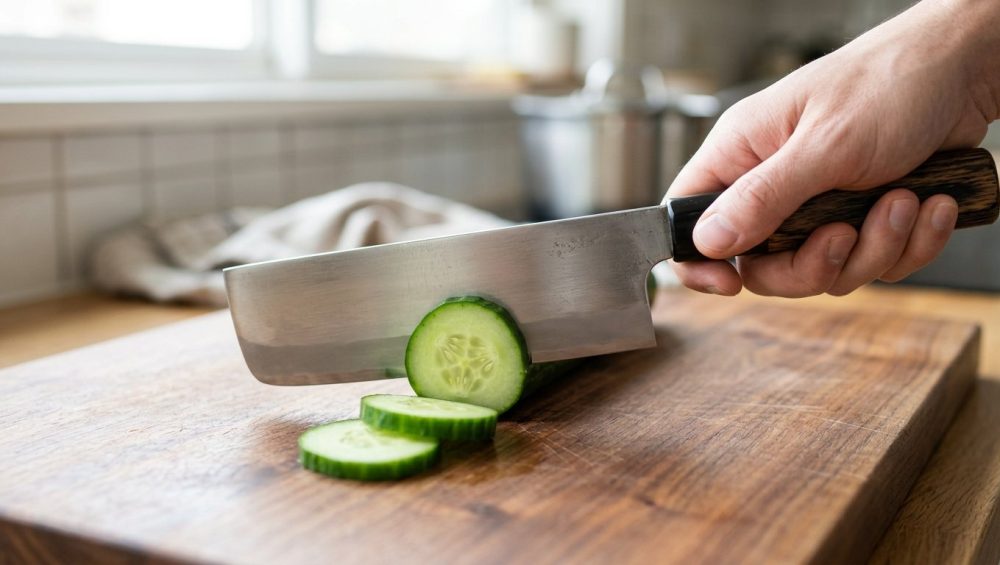
The Nakiri solves this physics problem by entirely eliminating the belly. The blade profile is almost completely flat from the heel all the way to the squared-off tip. Because there is no curvature, the entire length of the cutting edge meets the cutting board simultaneously upon impact. There is no pivot point, no accidental rocking arc, and no microscopic gaps between the steel and the wood. When a Nakiri comes down, it goes straight through the dense cellular structure of the vegetable, severing the skin cleanly against the board. This guarantees uniform, fully separated slices every single time, drastically reducing the need for double-taps or tedious re-cutting.
Kinematics and Ergonomics: Saving Your Wrists from Prep Fatigue
The flat geometry of the Nakiri demands a complete shift in your cutting kinematics. Because you cannot rock a flat blade, you must utilize the “push cut” or the “tap chop”. The push cut involves lifting the blade, bringing it down at a slight forward angle, and pushing the edge vertically through the ingredient and slightly away from your body.
While this might sound like a trivial adjustment, the ergonomic implications for your joints are massive. When you rock-chop with a heavy, curved Western knife, you are constantly engaging in ulnar and radial deviation—meaning you are repeatedly rotating and twisting your wrist joint. Over the course of breaking down a mountain of dense root vegetables for a Sunday meal prep session, that repetitive rotational torque leads directly to severe wrist strain, forearm fatigue, and a general hatred of cooking. The flat profile and push-cut kinematics of the Nakiri completely eliminate this rotational strain. You rely on the natural, linear biomechanics of your arm, dropping the blade in a straight, vertical motion that utilizes the larger, more stable muscles of your upper arm and shoulder. Switching your technique to this ergonomic, linear motion will literally transform your daily meals by saving you precious time and physical energy.
Furthermore, the rectangular shape gives the Nakiri an exceptionally tall blade height, typically ranging from 45mm to 55mm. This height acts as a massive physical barrier between the razor-sharp edge and your guiding hand, providing unparalleled knuckle clearance. Your guiding fingers can rest securely against the wide, flat face of the blade, allowing you to chop with blinding speed and absolute safety. As an added bonus, that broad, flat surface acts perfectly as a bench scraper, allowing you to scoop up vast quantities of minced garlic or diced onions and transfer them directly to the skillet without spilling them all over the floor.
Metallurgy Masterclass: The Science of Japanese Steel
Let us get brutally analytical for a moment, because understanding what actually makes a knife perform requires a brief lesson in metallurgy. Most cheap, mass-produced supermarket knives are stamped out of incredibly soft, generic stainless steel alloys. These mystery metals typically register around a 54 or 56 on the Rockwell Hardness Scale (HRC)—the universal metric used to measure the indentation resistance of steel. Because the steel is so soft, the microscopic apex of the edge rolls over, flattens, and dulls almost immediately upon contact with a hard cutting board.
Traditional Japanese Nakiris, conversely, are forged from high-carbon steels and advanced powdered metallurgy stainless alloys that regularly achieve a staggering 60 to 65 HRC. This extreme, uncompromising hardness allows the Japanese blacksmith to grind the blade to an acutely thin angle—often 15 degrees or less per side, compared to the clunky 20 to 25-degree angles found on Western knives. A thinner edge means less wedging, less cellular damage to your ingredients, and a blade that glides through a sweet potato like it is made of warm butter. Understanding the authentic Aogami Super steel and other alloys used in these blades is crucial to making an informed investment.
The Purist’s Choice: Shirogami and Aogami Carbon Steels
If you want to experience the absolute pinnacle of traditional Japanese sharpness, you look to high-carbon steels, specifically the legendary steels produced by Hitachi Metals: Shirogami (White Paper Steel) and Aogami (Blue Paper Steel).
Shirogami is celebrated for its extreme purity. It contains almost no alloying elements aside from iron and a very high concentration of carbon. Because of its fine grain structure, White Steel can be sharpened to a surgical, terrifyingly keen edge that easily pushes past 61 HRC. However, it is highly reactive; it will oxidize, develop a patina, and outright rust if you leave it wet on the counter.
Aogami (Blue Steel) takes that pure White Steel base and adds precise amounts of Tungsten and Chromium. These additions allow the steel to form hard carbides during the heat treatment process, massively increasing the blade’s wear resistance and edge retention. Aogami Super, the highest tier of this family, can be hardened to 64-65 HRC, meaning it will hold its razor edge through months of aggressive vegetable prep.
The Modern Marvels: VG-10 and SG2 Powdered Metallurgy
I understand that not every home cook wants to baby a highly reactive carbon steel blade. We have jobs, we have kids, and sometimes we forget to dry our knives immediately. This is where premium Japanese stainless steels enter the chat.
VG-10 (V Gold 10) is the undisputed workhorse of the Japanese knife industry. Formulated with 1% Carbon, 15% Chromium, and a touch of Cobalt, VG-10 offers a brilliant balance of high hardness (usually 60-61 HRC), excellent corrosion resistance, and relative ease of sharpening. It is the perfect entry point for cooks who want Japanese performance without the demanding maintenance of raw carbon steel.
For the uncompromising gear researchers, there is SG2 (also known as R2). SG2 is an ultra-premium powdered metallurgy steel. Instead of melting and pouring the steel into an ingot, the molten alloy is atomized into a microscopic powder, then fused together under immense heat and pressure. This eliminates structural imperfections and allows for a massive concentration of hardening elements like Vanadium and Molybdenum. The result? A perfectly uniform, fine-grained steel that hits 63-64 HRC, is entirely stainless, and boasts edge retention that borders on the absurd.
Anatomy of the Grip: Wa Handles vs. Yo Handles
A masterfully forged blade is useless if it feels awkward and unbalanced in your hand. The handle of a Nakiri dictates the overall balance point of the knife, which directly influences how the tool moves through physical space. Choosing a proper handle is one of the essential tools every beginner needs to understand before buying a high-end piece of cutlery. Japanese knives generally feature two distinct handle paradigms: the traditional Wa handle and the Western Yo handle.
The Traditional Wa Handle
The Wa handle is the quintessential Japanese design. It features a hidden tang construction, where the metal of the blade is heated and burned securely into a lightweight wooden handle, often carved from porous woods like magnolia, ho wood, or dense ebony. Because the handle is so light, the center of gravity drastically shifts forward into the blade itself.
This blade-heavy balance is an absolute dream for the Nakiri. It allows the natural weight of the steel to do the downward cutting work for you, drastically reducing the amount of downward force you need to exert. Wa handles are typically carved into octagonal, D-shaped, or oval profiles. The geometric facets of an octagonal handle lock perfectly into the creases of your fingers, providing phenomenal tactile feedback and preventing the knife from rolling in your grip, even if your hands are wet with tomato juice. Furthermore, the lack of a heavy metal bolster encourages you to choke up on the blade using a “pinch grip”—where your thumb and index finger pinch the actual metal of the blade just ahead of the handle. This grip provides maximum agility and precise steering control.
The Western Yo Handle
If you are transitioning from heavy German knives and prefer a more robust, familiar feel, the Yo handle is your answer. Yo handles feature a full tang—meaning the steel runs the entire length of the handle—secured by metal rivets and flanked by contoured scales made of stabilized wood, micarta, or resin.
Because of the extra metal in the tang and the inclusion of a thick bolster, a Yo-handled Nakiri is heavier, and the balance point shifts backward, resting squarely in the center of the knife right where your hand grips it. This neutral balance provides a feeling of sturdy, grounded control. While it may cause slightly more fatigue over an eight-hour commercial kitchen shift compared to a featherweight Wa handle, for the weekend hobbyist tackling a thirty-minute dinner prep, the ergonomic comfort and sheer durability of a Yo handle are incredibly satisfying.
The “No-Go” Rule: Why Toxic, Cheap Knives Are Ruining Your Food
As a culinary blogger and an unapologetic advocate for the home cook, I must enforce my strict “No-Go” rule on toxic, disposable kitchen gear. The market is currently flooded with cheap, gimmick-driven Nakiri imitations stamped out of flimsy sheet metal. These abominations are often slathered in synthetic, chemical “non-stick” paints or cheap Teflon coatings designed to mask the fact that the steel itself is garbage.
Here is the brutal truth: when you chop dense vegetables with a coated knife, the friction inevitably causes that toxic coating to micro-flake off directly into your food. Furthermore, dull, cheap steel does not cut your food; it crushes it. When you crush the cellular walls of an onion rather than cleanly slicing through them, you release excessive amounts of syn-propanethial-S-oxide—the volatile chemical gas that makes you cry. When you crush delicate herbs, they immediately oxidize, turn black, and bleed their flavorful essential oils onto your cutting board instead of into your dish. If you want to eliminate kitchen chaos for good, stop buying cheap plastic knives that actively sabotage your ingredients. Investing in a high-carbon or powdered metallurgy Nakiri is not just an upgrade in speed; it is an investment in the chemical integrity, flavor, and safety of the food you feed your family.
Time is Money: Maximizing Prep Efficiency
Weekdays are chaotic. Between meetings, commuting, and attempting to maintain a semblance of a social life, nobody wants to spend an hour meticulously dicing vegetables. Time is money, and efficiency is the ultimate currency of the home kitchen. The Nakiri is a dedicated prep-time annihilator.
Because the flat blade profile guarantees full board contact, and the extreme sharpness prevents wedging, your prep speed will naturally skyrocket. You will no longer find yourself sawing back and forth through a stubborn sweet potato. You will simply align the blade, push down, and experience the immensely satisfying thwack of the steel cleanly hitting the board. You can blast through a mountain of scallions, uniformly julienne carrots for a stir-fry, and effortlessly chiffonade delicate basil leaves without bruising them. Mastering the push cut is one of the simple steps to culinary artistry that absolutely anyone can learn in an afternoon, yielding immediate, tangible results in your daily cooking workflow.
Care and Maintenance: Respecting the Blade
A high-performance Japanese Nakiri is a precision instrument, and it demands a modicum of respect. First and foremost: the dishwasher is a strict, non-negotiable ban. The prolonged exposure to scalding water, highly abrasive alkaline detergents, and the violent rattling against ceramic plates will instantly destroy the micro-apex of the edge, warp the steel, and crack the wooden handle. When it comes to surviving kitchen disasters, a chipped or rusted Japanese blade is a completely preventable tragedy.
Wash your Nakiri by hand with warm water and mild dish soap immediately after use, and dry it completely with a microfiber towel. If you opted for a reactive carbon steel blade (like Shirogami or Aogami), you must be vigilant about wiping the blade down during use, especially when cutting highly acidic ingredients like tomatoes, lemons, or onions, which can force a rapid, ugly oxidation. Before storing a carbon steel blade, apply a micro-thin layer of food-safe mineral oil or Tsubaki (camellia) oil to create a barrier against ambient humidity.
Finally, banish those awful pull-through carbide “v-notch” sharpeners from your home. They aggressively rip chunks of metal away from the blade and will ruin the delicate 15-degree edge geometry of a Japanese knife. Invest in a high-quality ceramic water stone (a 1000/3000 grit combination stone is perfect for maintenance) and learn the meditative art of whetstone sharpening.
Conclusion: Step Up to the Cutting Board
You do not need a degree from Le Cordon Bleu to produce mind-blowing food in your own home. What you do need, however, are tools that empower your capabilities rather than hinder them. The Nakiri is the ultimate equalizer for the home cook. Its flat blade geometry eliminates sloppy, connected cuts; its push-cut kinematics save your wrists from agonizing fatigue; and its unparalleled metallurgical hardness ensures that you are cleanly slicing your ingredients rather than brutally crushing them.
Throw away the dull, toxic, peeling mystery-metal blade that has been making your prep work a miserable chore. Embrace the flat edge, learn the push cut, and watch your prep time get slashed in half. Taking control of your tools is exactly how I stopped burning dinner and started actually enjoying the rhythmic, peaceful process of building a meal. Equip yourself properly, respect the steel, and get back to the cutting board. Your vegetables don’t stand a chance.