Listen, we need to have a serious talk about your weeknight chili. And your Sunday bolognese. And that desperate, last-minute pasta sauce you throw together when you are too exhausted to even think about ordering takeout. If you have ever tasted your homemade food and thought, “Why does this taste vaguely like a rusty penny?” I have some hard truths for you. It is your tomato paste. More specifically, it is how you are treating your tomato paste.
I get it. You are a busy professional. Time is money, and when it is 6:30 PM on a Tuesday, the temptation to just aggressively squeeze a tube of tomato paste directly into a pool of simmering broth is overwhelmingly strong. But I am here to tell you that you absolutely must stop dumping raw tomato paste directly into your liquids. You are doing yourself, your dinner, and your sanity a massive disservice.
I firmly believe that anyone can cook like an absolute expert without spending four years and a small fortune at culinary school. You just need to understand a few fundamental rules of kitchen science. Today, we are going to master one of the most transformative, zero-effort, high-reward techniques in the culinary world: toasting your tomato paste.
Grab a glass of wine, pull up a stool, and let’s talk about how a mere three minutes in a hot skillet can completely alter the DNA of your everyday meals.
The Science of the Can: Why Raw Paste Tastes Like Pennies
Before we can fix the problem, we have to understand why the problem exists. Have you ever actually tasted tomato paste straight out of the can? Go ahead, try it next time. It is startlingly metallic, aggressively tart, and leaves a sharp, astringent coating on your tongue. It tastes raw, underdeveloped, and tinny.
There is a highly specific, scientifically documented reason for this, and it has everything to do with industrial food processing.
First, consider the sheer concentration of the product. It takes roughly twenty whole tomatoes to yield enough reduced pulp to fill one of those tiny six-ounce cans. You are dealing with an intensely concentrated matrix of raw lycopene, natural sugars, and plant acids. But the real culprit behind that harsh flavor profile is the canning process itself.
Tomatoes are generally considered a high-acid food, naturally hovering somewhere between 4.3 and 4.9 on the pH scale. However, in the world of commercial canning, a pH above 4.6 is the danger zone where Clostridium botulinum (the bacteria that causes botulism) can thrive. To ensure that their products are completely shelf-stable and safe for the masses, manufacturers aggressively acidify tomato paste, usually by pumping it full of commercial citric acid to force the pH safely below that 4.6 threshold.
Furthermore, during the intense thermal processing required for canning, the natural ascorbic acid (Vitamin C) in the tomatoes degrades and transforms into pyroglutamic acid. When you combine massive amounts of naturally occurring plant acids, industrially added citric acid, and the chemical byproducts of thermal sterilization, you get a product that is incredibly hostile to your tastebuds in its raw form. This extreme acidity is exactly why your tomato sauce tastes metallic when you skip the crucial step of cooking the paste out.
The French Secret: What the Hell is Pincé?
Professional chefs have known about this acidic dilemma for centuries, and they solved it with a technique known as pincé (pronounced pahn-say).
If you watch high-end cooking shows, you will inevitably hear a pretentious chef casually drop this term while adjusting their pristine white apron. Do not let the culinary jargon intimidate you. In French, the verb pincer literally translates to “to pinch” or “to stiffen,” but in the culinary context, it simply means browning a vegetable puree—almost exclusively tomato paste—in hot fat before adding any liquids to the pan.
That is it. That is the big, fancy secret. You fry the paste.
But while the action is remarkably simple, the chemical transformation occurring in your skillet is nothing short of miraculous. By subjecting the raw paste to direct, dry heat in a pool of fat, you are forcing it through a gauntlet of complex chemical reactions that fundamentally rewrite its flavor profile.
The Chemistry of Flavor: Caramelization, Maillard, and Umami
Let’s put on our lab coats for a second, because understanding the chemistry of your food is the fastest way to stop relying on rigid recipes and start cooking with pure intuition. When you drop a dollop of tomato paste into hot oil, three distinct scientific phenomena occur simultaneously.
The Umami Explosion
Umami is the elusive “fifth taste”—a deep, savory, mouth-watering richness that makes meat taste meaty and mushrooms taste earthy. The chemical compound responsible for umami is glutamic acid, or glutamate. Tomato paste happens to be one of the most highly concentrated sources of free glutamates in the entire plant kingdom. When you apply high heat to the paste, the remaining water evaporates, hyper-concentrating those glutamates and unlocking a savory depth that can make a simple vegetarian ragu taste like it has been simmering with a pork shoulder for three days.
Caramelization of Natural Sugars
Tomatoes are fruits, and like all fruits, they contain natural sugars (fructose and glucose). In the wet, raw environment of the can, these sugars are completely masked by the overwhelming citric acid. But when you subject the paste to the dry heat of a frying pan, those sugars begin to melt, break down, and caramelize. This creates a natural, complex sweetness that beautifully balances out the harsh, metallic acidity, entirely eliminating the need to dump a handful of refined white sugar into your pasta sauce (a rookie mistake I see far too often).
The Maillard Reaction
This is the holy grail of cooking. The Maillard reaction is a complex chemical interaction between amino acids and reducing sugars that gives browned food its distinctive flavor. It is what makes a seared steak taste infinitely better than a boiled steak, and what makes a toasted marshmallow superior to a raw one.
Here is the catch: the Maillard reaction generally only begins to occur at temperatures above 285°F (140°C). Water boils at 212°F (100°C). This means that if you squeeze raw tomato paste directly into a simmering soup, stew, or braising liquid, the temperature will never get high enough to trigger the Maillard reaction. The paste will simply dissolve, taking its harsh, raw, tinny flavor with it. You must fry it in fat, which can easily reach the required temperatures, to unlock this reaction. Think of it like your spice cabinet. Just as you would never dream of eating raw cumin without blooming them in oil first to release their fat-soluble compounds, you must treat tomato paste with the exact same respect.
The Masterclass: How to Properly Toast Tomato Paste
Now that you understand the science, let’s get down to the actual execution. Toasting tomato paste is incredibly easy, but it requires your undivided attention for roughly three to five minutes. This is not the time to walk away and check your emails.
Step 1: The Aromatic Foundation
You will almost always perform the pincé technique right after you have sautéed your aromatics. Whether you are sweating down a classic French mirepoix (onions, carrots, celery), a Cajun holy trinity (onions, celery, bell peppers), or just a mountain of garlic and shallots, wait until the vegetables are soft, translucent, and have released their moisture.
Step 2: Clearing the Deck
Using your wooden spoon or spatula, push all of your beautiful, softened vegetables to the outer edges of the pan, creating an empty clearing in the dead center. This gives the tomato paste direct contact with the heat source.
Step 3: The Fat Factor
Tomato paste needs fat to fry properly. If your pan is looking a little dry after sautéing the vegetables, do not hesitate to add an extra splash of high-quality olive oil, a knob of butter, or a spoonful of rendered bacon fat directly into the center of the pan. Fat is a magnificent conductor of heat, and it will trap the fat-soluble flavor compounds released by the paste. Drop your measured amount of tomato paste directly into the hot fat.
Step 4: Smear and Sear
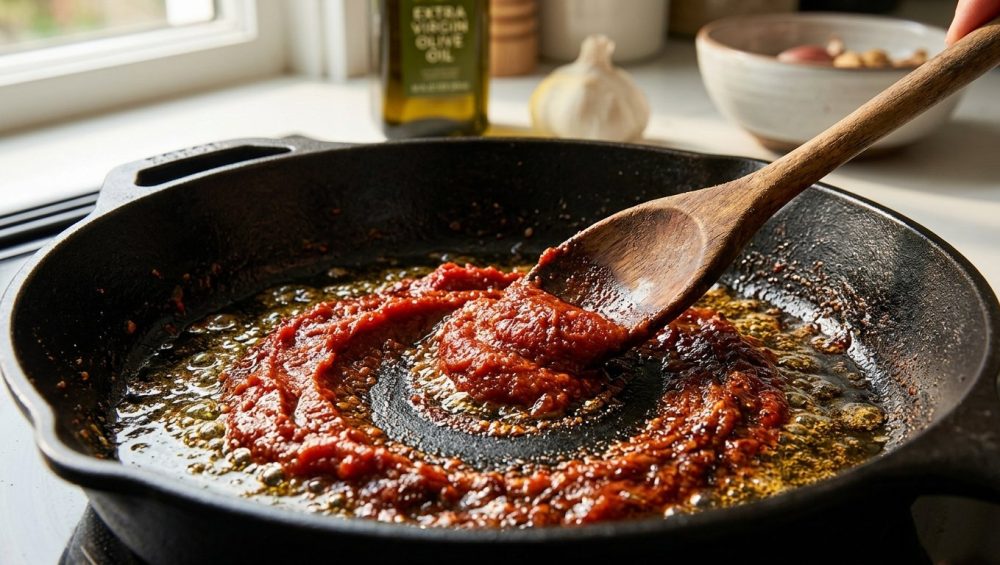
Use the back of your spoon to aggressively smear the tomato paste into the pan, maximizing its surface area. You want as much of the paste touching the hot metal as possible. Let it sit undisturbed for about 30 seconds, then scrape it up, stir it around, and smear it down again.
Step 5: Visual and Olfactory Cues
How do you know when it is done? You are looking for two massive shifts: color and aroma.
- The Color: Raw tomato paste is a bright, vibrant, almost artificial-looking crimson. As it toasts, the sugars will caramelize and the color will deepen dramatically. You are looking for a dark rust, brick-red, or deep burgundy hue.
- The Aroma: Lean over the pan (safely). The sharp, acidic, ketchup-like smell of the raw paste will suddenly vanish, replaced by a deep, savory, sweet, and incredibly rich aroma. It should smell like a sauce that has been simmering on an Italian grandmother’s stove for eight hours.
Step 6: The Deglaze
Once the paste has reached that perfect brick-red color, it is going to start sticking to the bottom of the pan, leaving a dark, sticky film. This is culinary gold. Immediately hit the pan with your liquid—a splash of dry red wine, a cup of beef broth, or even just pasta water. As the liquid violently bubbles and steams, use your wooden spoon to scrape every last bit of that caramelized paste off the bottom. This rapid deglazing is the ultimate secret to turning burnt bits into sauce, ensuring that all of that hard-earned flavor ends up in your food, not stuck to your cookware.
The Anti-Toxic Gear Rant (Do Not Ignore This)
We need to pause the cooking lesson for a moment because I have a strict “No-Go” rule in my kitchen, and if you are going to follow my advice, you need to hear this.
You absolutely cannot perform a proper pincé in a cheap, scratched, toxic non-stick pan. I have zero patience for flimsy Teflon cookware, and you should too.
Let’s look at the facts: you are taking a highly acidic ingredient (tomato paste), dropping it into hot oil over medium-high heat, and aggressively scraping it into the bottom of the pan with a spatula. If you do this in a low-quality non-stick skillet with a degrading coating, you are essentially creating a chemical soup. The acid and heat will break down the damaged polymers, leaching PFAS (forever chemicals) and mystery heavy metals directly into your beautiful, lovingly prepared dinner. It is disgusting, it is dangerous, and it completely defeats the purpose of cooking wholesome meals at home.
It is time to get serious about banishing toxic kitchen gear from your life forever. You do not need a culinary degree, but you do need equipment that won’t poison you.
For a technique like this, you should be using a heavy-bottomed stainless steel skillet, a beautifully seasoned carbon steel pan, or an enameled cast-iron Dutch oven. These materials are non-reactive, incredibly durable, and can handle the high heat required for the Maillard reaction without breaking a sweat. If you are terrified of your food sticking to stainless steel, you simply haven’t learned how to control your heat. Take five minutes to learn the water drop test to properly preheat your pan, and your stainless steel will perform like a dream, leaving you with a glorious, non-toxic fond to deglaze.
Rookie Mistakes That Will Ruin Your Pincé
Even though the technique is simple, there are a few common pitfalls that can instantly ruin your dish. Avoid these rookie mistakes at all costs.
Mistake 1: Scorching the Paste
There is a very fine, treacherous line between beautifully caramelized and bitterly burnt. Because tomato paste is packed with natural sugars, it can go from a lovely brick-red to a blackened, acrid nightmare in a matter of seconds if your heat is too high. Keep your burner on medium. If you smell anything resembling burnt toast or acrid smoke, you have gone too far. Unfortunately, burnt tomato paste is irredeemable. You cannot mask the bitterness; you have to throw it out and start over.
Mistake 2: Starving the Pan of Fat
I see home cooks trying to be overly health-conscious by omitting the oil when toasting their paste. This is a culinary tragedy. Without fat, the paste will simply dry out, instantly weld itself to the bottom of the pan, and scorch. The fat is non-negotiable. It regulates the heat and carries the flavor. Embrace the olive oil.
Mistake 3: Adding Liquids Too Early
Patience is a virtue in the kitchen. If you drop the tomato paste into the pan and immediately pour in your chicken stock or wine, you have completely aborted the mission. The introduction of liquid immediately drops the temperature of the pan below the 285°F (140°C) threshold required for browning. The paste will just dissolve into a tinny, acidic broth. Let it fry until the color changes.
Mistake 4: Timing the Tomatoes
Understanding when to add acidic ingredients to a dish is crucial, especially when you are cooking things like dried beans or tough root vegetables. Acid hardens the pectin in plant cell walls, which means adding tomatoes too early can permanently prevent your beans or potatoes from softening, no matter how long you boil them. Always ensure your starches are fully tender before you introduce your toasted tomato paste and deglazing liquids to the pot.
Mistake 5: Crowding the Pan with Meat
If your recipe calls for browning ground beef or sausage before adding the tomato paste, make sure you are actually searing the meat, not boiling it in its own juices. If you dump two pounds of cold ground beef into a small skillet, the temperature plummets, the meat releases all its water, and you will quickly discover why your ground beef steams instead of forming a crust. You cannot toast tomato paste in a puddle of grey meat water. Sear the meat in batches, drain the excess water, leave a few tablespoons of the rendered fat in the pan, and then toast your paste in that glorious animal fat.
Weeknight Shortcuts vs. Weekend Projects
I am a massive advocate for the home cook, which means I understand that your culinary reality on a Tuesday night is vastly different from your reality on a lazy Sunday afternoon. The beauty of the pincé technique is that it scales perfectly to fit your schedule.
The Weekday Hustle
When time is money, efficiency is your best friend. For quick weeknight meals—like a 30-minute turkey chili or a rapid skillet pasta—you do not have time to slowly render artisanal pork fat. Instead, rely on the convenience of tomato paste in a tube. Once your onions are soft and your ground turkey is cooked, squeeze a generous tablespoon of the paste directly into the pan. Stir vigorously for just two to three minutes until it darkens, splash in a little chicken broth to deglaze, and you are done. You have just added eight hours of simmered flavor to a 30-minute meal with practically zero extra effort.
The Weekend Perfectionist
When the weekend arrives and you have the luxury of time, you can turn this simple technique into a masterclass of flavor building. If you are making a traditional Sunday ragu or braising beef short ribs, take your time. Slowly render the fat from diced pancetta or guanciale over low heat until crispy. Remove the pork, leaving the liquid gold in the pan. Sauté your finely diced mirepoix in the pork fat until deeply caramelized. Then, add a whole can of tomato paste. Let it fry over medium-low heat for a full five to seven minutes, smearing and scraping patiently until it turns the color of a dark mahogany desk. Deglaze with a heavy pour of good dry red wine, reducing it until the alcohol burns off and the sauce is thick and syrupy.
Take your time emulsifying the fats and liquids during this reduction phase. If you rush a delicate sauce by blasting it with heat or dumping in freezing cold ingredients, you will quickly see why your pan sauce separates into a greasy, broken mess. Treat the ingredients with respect, control your heat, and the resulting depth of flavor will absolutely blow your mind.
Storage Hacks (Because Nobody Uses a Whole Can)
Let’s address the elephant in the room: almost no recipe on earth calls for a full six-ounce can of tomato paste. You usually need one or two tablespoons, leaving you with a frustratingly mostly-full can of paste that inevitably gets shoved to the back of the fridge, where it will slowly grow a luxurious coat of green mold over the next three weeks.
Stop wasting food and money. You have two options here.
Option 1: Embrace the Tube.
Yes, tomato paste in a metal tube is slightly more expensive by volume than the canned stuff. Buy it anyway. It is the ultimate time-saving weeknight hack. Because the tube prevents the paste from being exposed to oxygen, it will last in your refrigerator for months. It is incredibly convenient to just squeeze out exactly what you need, right into the pan, without dirtying a measuring spoon.
Option 2: The Freezer Hack.
If you stubbornly refuse to buy the tube, or if you are making a recipe that requires buying multiple cans, you must freeze the leftovers. But do not just throw the whole can in the freezer, or you will be hacking at a frozen block of red ice with a butter knife next week.
Instead, line a small baking sheet with a piece of parchment paper. (And please, just use parchment paper—stop ruining your nonstick pans and baking sheets by coating them in sticky, impossible-to-remove aerosol cooking sprays). Use a measuring spoon to scoop out individual tablespoon-sized dollops of the leftover tomato paste onto the parchment. Place the baking sheet in the freezer for a few hours until the dollops are rock solid. Then, peel them off the paper, toss them into a ziplock freezer bag, and keep them in the freezer. The next time you are making a soup or sauce, you can just grab a frozen flavor-bomb of tomato paste and drop it directly into your hot skillet to toast.
Real-World Applications: Where to Use This Hack
Once you master the quick toast, you will start finding excuses to sneak it into almost everything you cook. Here is a quick cheat sheet of dishes that will instantly benefit from a spoonful of caramelized tomato paste:
- Chili: Whether it is a Texas-style beef chili or a weeknight white bean chicken chili, toasting a tablespoon of paste with your chili powder and cumin will add a dark, robust, umami-rich backbone that elevates the entire pot.
- Braised Meats: Pot roasts, short ribs, and lamb shanks rely on deep, savory liquids. Frying tomato paste before deglazing with wine or stout beer creates a restaurant-quality braising liquid.
- Vegetarian and Vegan Cooking: Plant-based meals often lack the natural glutamates found in meat. Toasting tomato paste is the ultimate cheat code for injecting massive amounts of savory, meaty depth into lentil stews, mushroom bourguignon, and vegetable curries.
- Pan Sauces: After searing a steak or pork chop, fry a tiny dab of tomato paste in the residual pan drippings before deglazing with wine. It will thicken the resulting pan sauce and give it a gorgeous, glossy, mahogany finish.
The Final Word
Cooking does not have to be an anxiety-inducing chore, and you do not need to rely on expensive, store-bought, pre-made sauces full of preservatives to make a decent meal. The difference between a bland, amateurish dinner and a mind-blowing, restaurant-quality dish usually comes down to mastering a few simple, foundational techniques.
Toasting your tomato paste is the perfect example of this philosophy. It costs you zero extra dollars. It requires no special equipment (other than a safe, non-toxic pan). It takes exactly three minutes of your time. But by simply respecting the chemistry of the ingredients—by allowing the heat to caramelize the sugars, trigger the Maillard reaction, and awaken the dormant umami—you are completely transforming the profile of your food.
So, the next time you pop the top off a can of tomato paste, resist the urge to just dump it into the pot. Take a breath, heat up some olive oil, and give it the respect it deserves. Your tastebuds, your dinner guests, and your weeknight sanity will thank you. Now get out of here and go make a ragu that doesn’t taste like a tin can. You’ve got this.