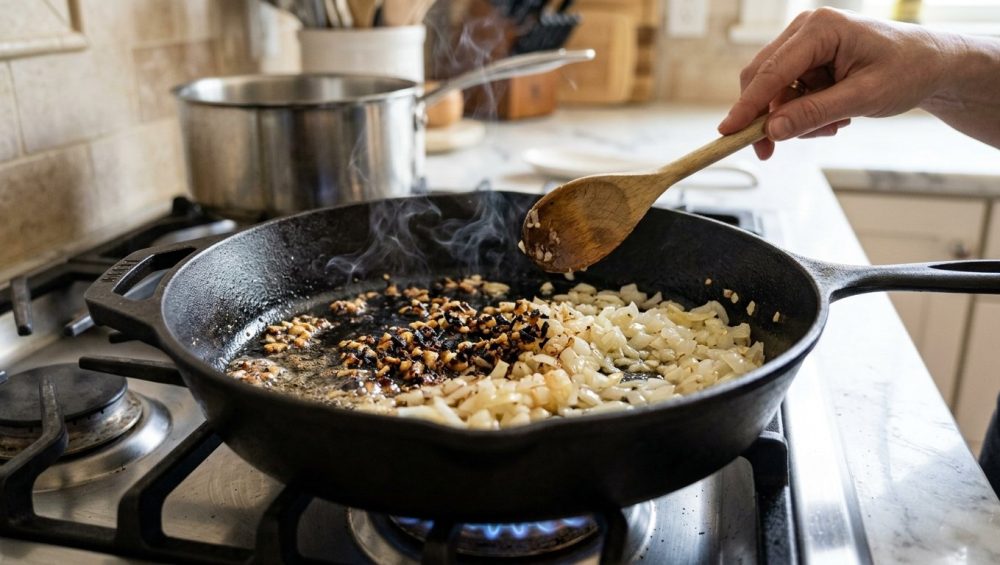
Picture this: It is 6:30 PM on a random Tuesday. You are exhausted from a long day of meetings, you are ravenously hungry, and you are currently staring down a cutting board covered in a chaotic, uneven pile of roughly chopped yellow onions and aggressively minced garlic. You heat a generous glug of olive oil in your favorite skillet, grab your bench scraper, and confidently shove the entire mountain of raw alliums into the pan at the exact same time.
For about twelve glorious seconds, your kitchen smells like an Italian grandmother’s dream. You feel like an absolute culinary genius. You pour yourself a glass of wine and give the pan a little shake. But then, tragedy strikes. The gentle, rhythmic sizzle turns into a harsh, angry spit. That warm, savory, mouth-watering aroma abruptly morphs into something that smells suspiciously like harsh chemicals and burnt tires. You frantically grab a wooden spoon and start stirring, but the damage is already done. Your garlic has rapidly transformed into tiny, black, acrid specks of charcoal, while your onions are still pale, watery, and completely raw in the middle.
If this scenario sounds intimately familiar, I need you to take a deep breath and give yourself some grace. You are not a bad cook. You lack neither talent nor potential. You have simply fallen victim to one of the most pervasive, lazily written recipe lies in the entire history of food media.
For decades, poorly tested recipes and pretentious food blogs have instructed home cooks to “sauté the onions and garlic until translucent, about 8 minutes.” I have absolutely zero patience for this kind of physically impossible chef-speak. It is a thermodynamic impossibility to cook a watery, chunky onion and a dry, finely minced clove of garlic in the exact same pan for eight minutes without creating a bitter, scorched disaster. Blindly tossing everything into the skillet at once is one of those classic beginner cooking mistakes that will haunt your palate and ruin your weeknight meals before the protein even hits the pan.
As a home cook who learned by trial, error, and setting off the smoke detector more times than I care to admit, I firmly believe that anyone can produce mind-blowing, professional-level food in a standard home kitchen. You do not need a culinary degree. You do not need a commercial stove. What you do need is a fundamental understanding of how heat interacts with your ingredients. Today, we are going to translate the complex heat-transfer science of aromatics into a practical, foolproof timing rule. We are going to permanently eliminate harsh, burnt flavors from your cooking repertoire, and we are going to start by respecting the profound differences between an onion and a clove of garlic.
The Anatomy of a Flavor Base: Why Aromatics Matter
Before we dive into the microscopic chemistry of why your dinner tastes like a burnt matchstick, we need to understand what we are actually trying to achieve when we heat onions and garlic in fat.
In the culinary world, practically every great savory dish begins with a foundation of aromatics cooked in fat. The French have their mirepoix (onions, carrots, and celery cooked in butter). The Italians rely on their soffritto (onions, carrots, and celery cooked in olive oil) or a battuto (which often includes garlic and parsley). Cajun and Creole cooking leans heavily on the “Holy Trinity” of onions, bell peppers, and celery. Notice a common denominator? The onion is the undisputed king of the flavor base. Garlic is the potent, highly volatile crown prince.
The goal of sautéing these aromatics is not merely to make them hot. The goal is to fundamentally alter their chemical structure. We want to soften their rigid cell walls, evaporate their excess water, tame their harsh, sulfurous bite, and coax out their deep, natural sweetness through the magic of the Maillard reaction and caramelization.
When you build a flavor base correctly, you create a complex, sweet, umami-rich foundation that elevates every single ingredient that follows it into the pot. When you rush the process, or when you ignore the basic laws of physics, you end up with a harsh, bitter undertone that no amount of salt, butter, or heavy cream can mask. Understanding the specific biology of your ingredients is the exact reason why your garlic always burns while your onions remain stubbornly raw.
The Science of the Onion: A Watery Behemoth
To understand why onions and garlic are mortal enemies when dropped into a hot pan simultaneously, we must first look at the onion.
An onion is, for all culinary intents and purposes, a delicious, tightly layered water balloon. According to recent botanical and food science analyses, a standard yellow onion is made up of anywhere from 70% to 90% water [1]. This massive hydration level is the defining characteristic of how an onion behaves when it is introduced to heat.
When you drop a cup of diced onions into a hot skillet, you are introducing a massive amount of cold water to your cooking environment. The thermal energy from your stove, which was previously keeping your oil screaming hot, is suddenly hijacked. The heat energy is immediately diverted away from browning the food and is instead consumed by the monumental task of evaporating the onion’s water content.
The Evaporative Cooling Effect
This phase of cooking is known as “sweating.” As the onions hit the pan, they release their cellular water. As this water turns to steam and evaporates, it creates an evaporative cooling effect [1]. As long as there is liquid water actively evaporating on the surface of the onions, the localized temperature of the food will not significantly exceed 212°F (100°C)—the boiling point of water.
This is a hard, unbreakable law of thermodynamics. You cannot brown, sear, or caramelize food in the presence of liquid water. The Maillard reaction—the complex chemical reaction between amino acids and reducing sugars that gives browned food its distinctive, savory flavor—does not begin in earnest until surface temperatures reach roughly 280°F to 300°F (138°C to 149°C) [4]. Therefore, your onions are trapped in a 212°F steam bath until they have shed the vast majority of their 90% water weight [1].
Depending on the size of your pan, the power of your burner, and the volume of onions you are cooking, this evaporation phase can take anywhere from five to fifteen minutes. If you want to stop eating mushy veggies and actually develop deep, sweet, golden-brown flavors in your aromatics, you have no choice but to patiently wait out this watery purgatory.
The Science of Garlic: Fructans, Allicin, and Fire
Now, let us turn our attention to the garlic clove. If the onion is a watery behemoth, the garlic clove is a dense, dry, highly reactive little firecracker.
While onions are swimming in up to 90% water, garlic contains significantly less moisture, typically hovering around 65% water [1]. But the lack of water is only half the story. The real danger of garlic lies in its carbohydrate structure and its volatile chemical defense mechanisms.
The Fructan Factor
Garlic is incredibly high in a specific type of carbohydrate called fructans [2]. Fructans are essentially long chains of fructose (fruit sugar) molecules. While fructans do not taste intensely sweet to the human palate in their raw form (which is why raw garlic tastes spicy and pungent rather than sugary), they behave exactly like sugars when exposed to heat [2].
Because garlic has a low water content and a high concentration of these easily browned fructans, it undergoes the Maillard reaction at a terrifyingly rapid pace [4]. Once garlic hits that magical 300°F (149°C) threshold, it begins to brown almost instantly.
The Allicin Clock
Furthermore, raw garlic doesn’t actually taste or smell like “garlic” until you physically damage it. A whole, unbroken clove is relatively odorless. It contains an amino acid derivative called alliin and an enzyme called alliinase. When you crush, mince, or slice the clove—rupturing its cell walls—these two compounds mix and instantly create allicin [3].
Allicin is the highly volatile, sulfur-based compound responsible for that pungent, spicy, signature garlic bite [3]. But allicin is incredibly sensitive to temperature. Above 140°F (60°C), it begins to break down and decompose rapidly [3]. By the time your cooking oil hits 300°F (149°C), the half-life of allicin drops to under 12 seconds [3].
The Pyrolysis Danger Zone
Here is where the science turns deadly for your dinner. While the Maillard reaction makes garlic taste sweet, nutty, and complex, there is a very fine line between browning and burning. At roughly 355°F (180°C), garlic crosses the threshold from the Maillard reaction into pyrolysis—the chemical term for burning [4].
When garlic undergoes pyrolysis, it doesn’t just change color; it chemically degrades. The fructans carbonize, and the delicate sulfur compounds pyrolyze into harsh, toxic-tasting byproducts like furfural and hydroxymethylfurfural [3]. This chemical degradation is exactly what makes food bitter and completely ruins the foundation of your dish. Once those pyrolyzed sulfur polymers are released into your cooking oil, they taint every single ingredient that touches the pan.
The Catastrophe of the Simultaneous Dump
Now that we understand the extreme biological differences between these two ingredients, let us revisit the chaotic Tuesday night scenario where you dumped minced garlic and diced onions into a hot skillet at the exact same time. Let’s look at the physics of this specific culinary car crash.
When the massive, watery onion pieces hit the hot oil, they immediately drop the temperature of the pan and begin releasing their water. The environment plunges to 212°F (100°C) as the onions begin to sweat [1].
Meanwhile, your finely minced garlic is sitting right next to them. Because you minced the garlic, you have created a massive amount of surface area with very little internal mass. Because garlic only contains 65% water, the tiny minced pieces evaporate their internal moisture in a matter of seconds [1].
As the cooking process continues, the onions eventually shed enough water to allow the pan’s temperature to rise. The skillet creeps up to 250°F, then 280°F, then 320°F. The onions, being large and dense, are just barely starting to turn a pale golden color. They are finally beginning their Maillard reaction.
But the tiny, dry, fructan-rich garlic pieces have no water left to protect them. As the pan temperature spikes to brown the onions, the garlic is instantly thrust past the 300°F Maillard zone and violently shoved into the 355°F pyrolysis zone [4]. Within 45 to 60 seconds, the garlic carbonizes [3].
While you are standing there, waiting for your onions to soften and turn translucent like the recipe promised, your garlic is actively burning, turning black, and flooding your expensive olive oil with acrid, bitter sulfur compounds. You have essentially flavored your entire meal with the culinary equivalent of battery acid, all because you followed a poorly written recipe instruction.
The “No-Go” Rule: Stop Using Toxic Cookware for Aromatics
As your dedicated, sassy sous-chef, I cannot in good conscience teach you the delicate science of heat transfer without addressing the elephant in the room: the actual pan you are using.
You know my strict “No-Go” rule. I absolutely despise cheap, toxic, poorly manufactured kitchenware. If you are trying to execute a precise, temperature-sensitive aromatic base in a lightweight aluminum pan coated in a peeling, scratched, mystery-metal non-stick surface that you bought on clearance seven years ago, you are actively sabotaging your own dinner.
Non-stick pans (specifically those coated in traditional PTFE/Teflon) are notoriously terrible for building a flavor base. First and foremost, they are designed to be slick, which means the natural sugars and proteins from your onions and garlic cannot adhere to the bottom of the pan to create fond—those glorious, deeply caramelized browned bits that form the backbone of pan sauces.
More importantly, cheap, thin non-stick pans have abysmal thermal mass. They heat up wildly unevenly, creating aggressive hot spots that will scorch your garlic on one side of the pan while leaving your onions raw on the other. And let’s not forget the toxicity factor: when thin non-stick pans are heated over medium-high heat to properly sauté vegetables, the coatings can degrade, off-gas, and leach potentially harmful chemicals into your food and the air.
Banishing toxic kitchen gear is the absolute first step to cooking like a confident expert. If you want to control heat like a professional, you need cookware with serious thermal mass and safe, durable surfaces.
What You Should Be Using Instead:
- Tri-Ply Stainless Steel: A heavy-bottomed stainless steel skillet is the gold standard for building a flavor base. It heats evenly, it responds quickly to temperature changes, and it eagerly grabs onto caramelized sugars to build a beautiful fond.
- Carbon Steel: A well-seasoned carbon steel skillet offers the perfect middle ground. It provides a naturally slick surface without synthetic chemicals, and it can handle the high heat required to properly brown onions without warping.
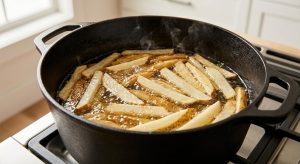
- Enameled Cast Iron: If you are building a base for a soup, stew, or braise, an enameled cast-iron Dutch oven is unparalleled. It retains heat beautifully, ensuring that your onions cook down into a sweet, jammy consistency without wild temperature fluctuations.
The Foolproof Timing Strategy for Weeknight Cooks
Time is money, especially when you are trying to get dinner on the table on a busy weeknight. I am a fierce advocate for efficiency, but efficiency does not mean throwing everything into the pot at once and praying for the best. Proper sequencing is the ultimate time-saving hack, because it prevents you from having to throw a ruined, bitter meal into the trash and order expensive takeout.
Here is the definitive, scientifically backed, Sassy Sous-Chef method for sequencing your aromatics. This timing trick is the absolute secret to mastering simple weeknight dinners without spending hours hovering anxiously over the stove.
Step 1: Prep with Prejudice
Do not chop your onions and your garlic into the same pile on your cutting board. Keep them strictly separated. Dice your onions to a uniform size so they cook evenly. Mince your garlic, but leave it in its own isolated zone on the board.
Step 2: Heat the Pan and the Fat
Place your high-quality stainless steel or carbon steel skillet over medium heat. Let the dry pan heat up for a minute or two. Add your fat—whether it is olive oil, butter, or a neutral high-temp oil like avocado or grapeseed. Let the fat heat until it shimmers and glides easily across the surface of the pan.
Step 3: The Onion Solo Act
Add the onions to the pan all by themselves. You should hear a satisfying, immediate sizzle. Toss them to coat them in the fat, and then let them do their thing. Depending on the recipe, you will cook them until they are translucent and sweaty (usually 5 to 7 minutes) or until they are deeply golden and caramelized (which can take 15 to 30 minutes). Season them with a pinch of salt early on; the salt draws out the moisture, accelerating the evaporation phase and helping them soften faster.
Step 4: The 60-Second Garlic Window
Once your onions have reached their absolute perfect, final stage of doneness, it is time for the garlic to make its entrance. Use your spatula to push the onions to the outer edges of the skillet, creating a cleared “hot spot” in the center of the pan.
Drop your minced garlic directly into this hot spot. You will immediately smell that incredible, pungent aroma as the allicin hits the heat. Stir the garlic constantly. You are only going to cook it for 30 to 60 seconds. You are looking for it to turn a pale, fragrant, golden blonde. Do not wait for it to turn brown. Do not walk away to check your phone. Do not turn your back on the pan.
Step 5: The Temperature Drop (Deglazing)
The moment you see the garlic hit that pale golden hue, you must immediately halt the cooking process by dropping the temperature of the pan. You do this by adding a liquid or a high-water-content ingredient.
Pour in a splash of white wine, a ladle of chicken broth, a can of crushed tomatoes, or even just a quarter cup of tap water. The liquid will immediately boil, dropping the surface temperature of the pan back down to 212°F and saving your garlic from the dreaded pyrolysis zone. As the liquid bubbles, use your wooden spoon to scrape the bottom of the pan. When you do it right, you can deglaze the pan beautifully, turning burnt bits into sauce that tastes like a million bucks.
Advanced Aromatic Tactics: Size, Shape, and Heat
Now that you have mastered the basic sequencing, we can level up your technique. The way you physically cut your garlic drastically alters how it behaves in the pan. Just like understanding how a simple velvety baking soda marinade transforms your stir-fries by altering the pH of the meat, understanding the geometry of your aromatics gives you total, uncompromising control over the final flavor of your dish.
The Micro-Mince (High Risk, High Reward)
When you finely mince or grate garlic using a microplane, you are inflicting maximum cellular damage. This releases a massive amount of alliinase, creating a huge surge of spicy allicin. Minced garlic provides an aggressive, punchy garlic flavor that permeates the whole dish. However, because the pieces are microscopic, they have zero thermal defense. Minced garlic will burn in hot oil in less than 30 seconds. It must be added at the very last possible moment before deglazing.
The Thin Slice (The “Goodfellas” Method)
Slicing garlic into thin little chips (famously depicted with a razor blade in the movie Goodfellas) causes less cellular damage than mincing. The flavor is slightly milder and sweeter. Sliced garlic takes slightly longer to burn—usually 1 to 2 minutes in hot oil. This is the perfect cut for aglio e olio, where you want the garlic to gently toast in the olive oil and provide a textural crunch.
The Smashed Whole Clove (The Safety Net)
If you are deeply terrified of burning your garlic, or if you want a subtle, mellow, background garlic essence without the harsh bite, use the smash method. Take a whole, peeled clove of garlic and lay the flat of your knife over it. Give it a firm whack with the heel of your hand just to gently crack it open.
Because the clove is mostly intact, it has a massive amount of thermal mass compared to a minced piece. You can actually add a smashed, whole clove of garlic to the cold oil before you even turn on the stove. As the oil slowly heats up, the garlic will gently infuse its fat-soluble flavor compounds into the oil. Once the oil is hot and the clove is golden brown on the outside, use tongs to fish the whole clove out of the pan and discard it. You are left with beautifully perfumed garlic oil, and absolutely zero risk of burning anything when you subsequently add your onions.
A Note on Pre-Minced Jarred Garlic
As your biggest culinary cheerleader, I must ask you a personal favor: please stop buying jars of pre-minced garlic floating in mysterious liquid. While I am all for time-saving weeknight shortcuts, jarred garlic is an abomination. To make it shelf-stable, manufacturers soak the garlic in harsh acids (like citric or phosphoric acid) and pasteurize it. This completely destroys the delicate allicin compounds. Jarred garlic does not taste like garlic; it tastes like sour, metallic preservatives. Furthermore, because it is waterlogged in acid, it spits violently when it hits hot oil and burns incredibly fast. Take the extra thirty seconds to smash and peel a fresh clove. Your palate will thank you.
Troubleshooting: Rescuing the Unrescuable
Look, we are all human. The baby cries, the dog barks, the doorbell rings, and suddenly you realize you left your minced garlic in the hot oil for ten seconds too long. What do you do?
First, you need to execute the smell test. Lean over the pan. Does it smell warm, toasted, and savory? Or does it smell sharp, acrid, and reminiscent of a chemical fire?
If the garlic has turned pitch black and the smoke is stinging your eyes, you must be brutally honest with yourself. Throw it away. Dump the contents of the pan into the trash, wipe the skillet out with a paper towel, and start over. I know it hurts to throw away food, but do not succumb to the sunk-cost fallacy. If you proceed with the recipe, those pyrolyzed sulfur polymers will taint the entire dish. You will end up ruining thirty dollars worth of organic chicken breast and heirloom tomatoes just to save thirty cents worth of burnt garlic.
However, if you catch it just as it borders on the edge—when the garlic is dark brown but not quite black, and the smell is aggressive but not totally acrid—you can pivot and salvage the meal.
When garlic is slightly over-toasted, it becomes highly alkaline and bitter. To neutralize bitterness in cooking, you must introduce its chemical opposite. If you accidentally push the garlic a little too far, remember that your dinner actually needs acid to balance out those harsh notes. A generous squeeze of fresh lemon juice, a splash of white wine vinegar, or a spoonful of robust tomato paste will immediately lower the pH of the dish, cutting through the bitterness and bringing the flavor profile back into harmony. You can also add a tiny pinch of sugar or a drizzle of honey; sweetness is a fantastic masking agent for mild bitterness.
The Final Stir
Cooking is not about blindly following a list of arbitrary instructions written by someone who isn’t standing in your kitchen. Cooking is about observing, reacting, and understanding the basic physical properties of the food in front of you.
When you respect the fact that a watery, dense onion needs time to sweat, and a dry, volatile clove of garlic needs to be protected from extreme heat, you unlock a completely new level of culinary control. You stop being a passive participant in your kitchen and start acting like the confident, capable chef you are.
Trust me, I learned this the hard way while surviving kitchen disasters in my own tiny, poorly ventilated apartment kitchen years ago. You do not need professional training to make food that makes people close their eyes and sigh with happiness. You just need good, safe cookware, a little bit of patience, and the absolute, unwavering commitment to never, ever add your garlic first. Now go pour yourself another glass of wine, turn on the stove, and show those onions who is boss.