Let’s set the scene. You’ve spent the last three hours slow-braising a phenomenal pork shoulder. You’ve minced the cilantro with the precision of a brain surgeon. Your homemade salsa verde is singing with just the right amount of acidity. You are ready to assemble the ultimate taco, the kind of culinary masterpiece that makes angels weep. You scoop that glorious, juicy meat onto a corn tortilla, pick it up, and—snap. The bottom blows out like a cheap tire, dumping your hard-earned carnitas directly onto your lap.
Welcome to the tragic, infuriating reality of the brittle corn tortilla.
Listen to me carefully: taco night is supposed to be a joyous, communal gathering, not a high-stakes balancing act where you pray your food doesn’t disintegrate before it reaches your mouth. If you want to prevent your tortillas from tearing, you need to stop treating them like an afterthought. You don’t need a culinary degree to make mind-blowing food in a standard home kitchen, but you do need to understand the basic science of what you’re working with.
Store-bought corn tortillas are often stiff, flavorless discs that shatter the moment they encounter a slight breeze. But making them from scratch? It’s a completely different ballgame. When done correctly, a homemade corn tortilla is incredibly supple, deeply aromatic, and strong enough to carry a mountain of fillings without breaking a sweat. Today, we are going to dive deep into the simple science of masa hydration, temperature control, and the crucial resting techniques required to make perfect tortillas every single time.
The Anatomy of a Taco Tragedy: Why Your Tortillas Keep Breaking
To fix a broken tortilla, you first have to understand why it’s breaking. Unlike wheat flour, which contains gluten—a magical pair of proteins that form an elastic, stretchy network when mixed with water—corn contains absolutely zero gluten.
When you make a flour tortilla, that gluten network acts like a microscopic rubber band, holding the dough together and allowing it to stretch without tearing. Corn tortillas, on the other hand, rely entirely on a complex carbohydrate called starch to hold their structure.
When starch dries out, or when it gets cold, it undergoes a chemical process called retrogradation. The starch molecules recrystallize and form a rigid, brittle structure. This is exactly why cold, store-bought tortillas crack right down the middle when you try to fold them. The starch has quite literally turned into a stiff crystalline wall. To make a corn tortilla flexible, you need to introduce two things to those starches: adequate moisture and adequate heat.
Cracking happens when the exterior of the tortilla loses moisture faster than the interior, creating a brittle shell around a still-pliable core. Therefore, the secret to a flawless taco night isn’t about finding a magical brand of masa; it’s about mastering the physics of hydration and heat so that your starches remain relaxed, swollen, and pliable.
The Ancient Science of Nixtamalization (No Culinary Degree Required)
You cannot make corn tortillas out of regular cornmeal. If you try, you will end up with a gritty, crumbly mush that refuses to bind together. To make a tortilla, you need masa, and to get masa, you need to understand an 11,000-year-old Mesoamerican scientific process called nixtamalization.
I promise I’ll keep the pretentious chef-speak to a minimum, but this is important. Nixtamalization is the process of soaking and cooking dried field corn in an alkaline solution—usually water mixed with calcium hydroxide, also known as food-grade slaked lime or cal.
This alkaline bath performs three absolute miracles on the corn. First, it breaks down the hemicellulose in the corn’s cell walls, dissolving the hard outer hull (the pericarp) so it can be washed away. Second, it unlocks bound nutrients, specifically niacin (Vitamin B3), making the corn significantly more nutritious and historically preventing diseases like pellagra.
But the third miracle is the one we care about for taco night: the alkaline soak triggers partial starch gelatinization and protein denaturation. This chemical alteration allows the starches to act like a glue. When the nixtamalized corn is ground up, it forms a cohesive, extensible dough that actually holds its shape without crumbling.
When you buy a bag of masa harina at the grocery store, you are buying nixtamalized corn that has been ground into a dough and then industrially dehydrated. Your job, as the home cook, is to rehydrate that flour perfectly so those starches wake back up and do their job.
The Hydration Equation: The Secret to a Pliable Dough
The number one reason your homemade tortillas are cracking is that your dough is too dry. I don’t care what the instructions on the back of your bag of masa harina say—they are lying to you. “Add water until it sticks together” is dangerously vague advice.
If you want to achieve professional-level results, you need to weigh your ingredients. A digital kitchen scale is one of the few beginner kitchen tools you actually need to guarantee consistency. The ideal hydration ratio for masa harina is typically between 1.5 to 1.7 times the weight of the masa in water. So, if you are using 200 grams of masa harina, you will likely need anywhere from 300 to 340 grams of water.
The Temperature Trap: Why Cold Water is the Enemy
Here is the ultimate insider secret that will instantly elevate your weekend cooking projects: stop using cold tap water to hydrate your masa.
During the industrial drying process used to create masa harina, the corn is subjected to high heat (often between 75°C and 90°C). This causes the amylose starches in the corn to retrograde and re-crystallize, which drastically reduces their ability to absorb water at room temperature. If you mix cold water into your masa harina, the water just sits on the surface of those crystalline starches. The dough might feel wet to the touch, but structurally, it is bone dry.
To properly hydrate the dough, you need to use hot water. Specifically, water that is around 75°C (167°F). The heat from the water actively continues the starch gelatinization process, melting those crystals and allowing the water to fully penetrate the starch granules. This creates a deeply cohesive, slightly tacky dough that acts as its own glue.
The “Play-Doh” Texture Test
Once you’ve added your hot water, you need to knead the dough vigorously for a few minutes. You are not developing gluten; you are simply forcing the water into the starches.
How do you know when it’s perfectly hydrated? It should feel exactly like fresh Play-Doh. It should be cool, smooth, and slightly tacky, but it should not leave a sticky, wet residue on your fingers.
To run the ultimate quality assurance test, pinch off a golf ball-sized piece of dough and roll it into a sphere. Press it flat between your palms. Look closely at the edges of the flattened disc. If the edges are jagged, cracked, or splitting, your dough is under-hydrated. Put it back in the bowl, add a tablespoon of hot water, knead it in, and test again. You want the edges to be perfectly smooth.
The Crucial Resting Phase (Patience is a Virtue)
We are all busy professionals, and during the week, time is money. I am all for time-saving cooking hacks when you just need to get dinner on the table. But making tortillas from scratch is a weekend project, and you cannot rush the chemistry.
Once your dough passes the Play-Doh test, you must let it rest. Cover the bowl with a damp, lint-free linen cloth (do not use terry cloth, or you’ll be eating fuzz) and let it sit at room temperature for 20 to 30 minutes. Do not put it in the refrigerator, as cold temperatures will stiffen the starches.
Skipping this resting phase is one of the most common ways to ruin a batch of tortillas. If you are serious about fixing rookie kitchen mistakes, respect the rest. During this half-hour, the starches are acting like microscopic sponges, slowly and evenly absorbing the water you just kneaded into them. If you try to press the tortillas immediately after mixing, the moisture won’t be evenly distributed, leading to dry spots that will inevitably crack on the griddle.
Banishing Toxic Gear and Choosing Your Arsenal
Before we get to pressing and cooking, we need to have a serious talk about your equipment. I absolutely despise cheap, toxic kitchenware. If you want to cook like an expert, you need to banish toxic kitchen gear from your life immediately.
The Tortilla Press
Do not try to roll out corn tortillas with a rolling pin. Because there is no gluten to give the dough elasticity, rolling it will just push the dough apart and create a crumbly mess. You need a tortilla press.
Avoid those flimsy, lightweight aluminum presses or the cheap plastic ones. They do not have enough mass to flatten the dough evenly, and they have a tendency to snap at the hinge when you apply real pressure. Invest in a heavy-duty cast iron tortilla press. The sheer weight of the cast iron does 90% of the work for you, ensuring a perfectly even, paper-thin disc every time.
The Comal (Griddle)
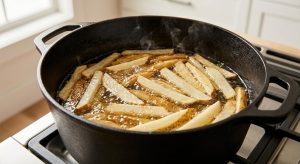
The traditional cooking vessel for a tortilla is a comal, a flat, heavy griddle. If you are using a cheap, lightweight frying pan with a peeling non-stick coating, throw it in the trash right now.
To cook a tortilla properly, you need high, sustained heat. Heating a cheap non-stick pan to 500°F is a fantastic way to release toxic forever-chemicals into your kitchen air, effectively ruining your nonstick pans and your lungs in the process.
You must use a heavy cast iron skillet, a cast iron comal, or traditional carbon steel cookware. These materials have incredible thermal mass. They absorb heat, hold onto it, and radiate it evenly into the dough, which is exactly what we need to achieve the legendary tortilla “puff.”
The Pressing Technique: Getting It Paper-Thin
Now that your dough is rested and your heavy-duty press is ready, it’s time to shape the tortillas.
You cannot put the masa directly against the cast iron plates of the press; it will stick like cement. You need a liner. Many beginners reach for parchment paper, but this is a mistake. Parchment paper absorbs moisture from the dough and wrinkles under pressure, leaving you with a weirdly textured, dried-out tortilla.
The best liner is a heavy-duty plastic zip-top freezer bag. Take a pair of scissors, cut off the zipper, and cut down the side seams so you are left with two square sheets of thick, smooth plastic.
Place one sheet of plastic on the bottom plate of the press. Roll a 50-gram ball of your perfectly hydrated masa and place it slightly off-center, closer to the hinge (the leverage is stronger there). Place the second sheet of plastic on top.
Close the press and push down on the lever with firm, even pressure. Don’t put your entire body weight into it, or you’ll squeeze the tortilla so thin it becomes translucent. Open the press, peel back the top plastic, and inspect. To guarantee perfectly even thickness, rotate the tortilla (still on the bottom plastic) 180 degrees, replace the top plastic, and give it one more gentle press.
To remove the tortilla, flip the whole plastic-and-dough sandwich onto your open palm. Carefully peel the top plastic off. Then, flip the bare dough onto your other hand and peel the second piece of plastic away. You should now have a flawless, smooth, un-cracked disc of masa ready for the fire.
The Thermodynamics of the Perfect Cook
Cooking the tortilla is where the magic happens. It is a delicate dance of thermal dynamics, and it requires your full attention.
Dialing in the Heat
Your cast iron or carbon steel comal needs to be hot. Not just warm—hot. The sweet spot for cooking corn tortillas is a surface temperature between 480°F and 510°F.
If you are unsure of your burner’s output, you might be tempted to use a cheap infrared gun, but be warned that a low-quality meat thermometer is lying to you if it isn’t calibrated for the emissivity of cast iron. Instead, trust your senses. Flick a tiny drop of water onto the pan; it should immediately dance and evaporate.
If the pan is too cold, the tortilla will sit there and slowly bake. All the moisture will evaporate out of the dough, leaving you with a stiff, cracked cracker. If the pan is too hot, the outside will scorch and burn before the heat can penetrate to the center, leaving the inside raw and gummy. Medium-high heat is usually the winner here.
The 3-Flip Method and the Legendary Puff
There is a very specific cadence to cooking a corn tortilla. It is known as the 3-flip method, and it is non-negotiable.
Flip 1: The Seal. Gently lay the raw tortilla onto the hot comal. Do not throw it, or it will fold over on itself. Just lay it down flat. Wait exactly 10 to 15 seconds. You are not trying to cook this side; you are simply searing the exterior to create a seal. The moment the very edges of the tortilla begin to lift slightly away from the pan, use a thin, odor-free silicone spatula (or your brave fingertips) to flip it over.
Flip 2: The Bake. Now that the first side is sealed, let the tortilla cook on the second side for about 30 to 45 seconds. You are waiting for the underside to develop beautiful, toasted brown spots (not black char). The dough will begin to look opaque and dry on top.
Flip 3: The Puff. Flip the tortilla back over to the original side. This is the moment of truth. If your hydration was correct, your resting time was sufficient, and your pan temperature is perfectly dialed in, the tortilla will begin to puff up like a balloon.
Why does this happen? When you sealed the first side and baked the second side, you created two impermeable crusts. As the intense heat penetrates the center of the dough, the moisture inside turns into steam. Because the steam cannot escape through the sealed exterior, it expands, physically pushing the top and bottom layers of the tortilla apart.
This puff is the ultimate indicator of a perfect tortilla. It means the interior is fully cooked, light, and airy. If it doesn’t puff on its own, you can give the center of the tortilla a very gentle tap with your spatula or fingertips to encourage the steam to separate the layers. Once it puffs, leave it for just 10 more seconds, then remove it from the heat.
The Spa Treatment: Why Resting Cooked Tortillas is Mandatory
Here is a hard truth: if you take a perfectly puffed tortilla off the comal and try to eat it immediately, it will still probably crack.
Straight off the heat, the exterior of the tortilla is dry, and the starches are rigid from the intense thermal shock. To achieve that legendary, mind-blowing pliability, the tortilla needs a spa treatment.
The moment the tortilla comes off the pan, it must go directly into a tortilla warmer lined with a thick, clean kitchen towel. If you don’t have a dedicated warmer, a heavy Dutch oven lined with a towel works perfectly.
As you stack the hot tortillas on top of each other and wrap them in the towel, they continue to release steam. Because they are enclosed, that steam is trapped. It permeates back into the dried exterior of the tortillas, rehydrating the crust and deeply relaxing the starches. This post-cook steaming process is what transforms a stiff disc of cooked corn into a supple, foldable, incredibly soft tortilla that will never tear, no matter how much salsa you load into it.
You must let the tortillas steam in their towel for at least 5 to 10 minutes before serving. Consider this mandatory.
Orchestrating a Mindful Taco Night
Now that you possess the sacred knowledge of masa hydration and thermodynamics, it’s time to put it to use. But remember my core philosophy: cooking should not be an isolating, stressful chore.
When you host a taco night, you shouldn’t be trapped sweating over a 500-degree cast iron comal while your guests are in the other room drinking margaritas and having all the fun. If you want to master the art of effortless hosting, you need to turn the tortilla-making process into a collaborative, mindful group activity.
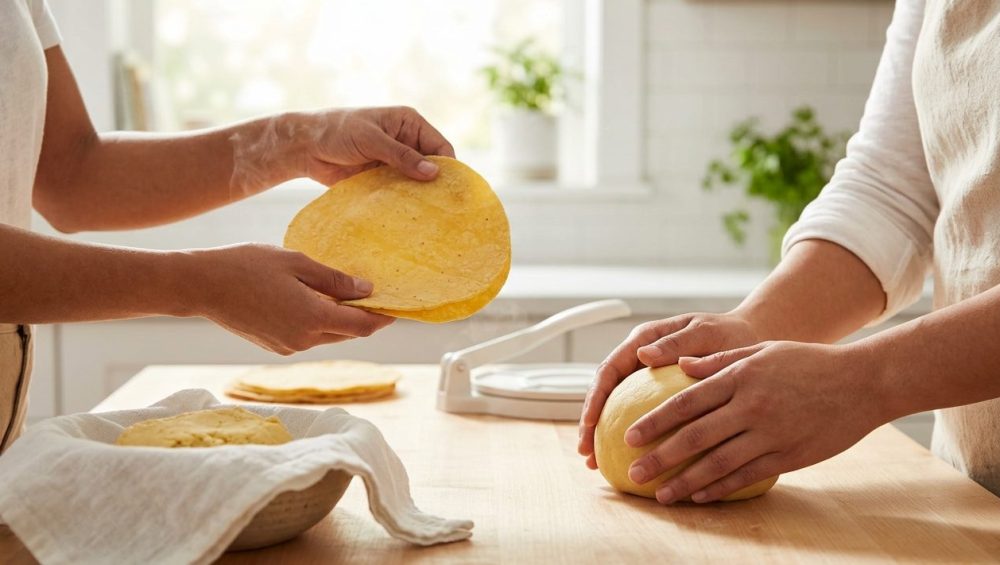
Bring the tortilla press out to the kitchen island or the dining table. Set up a station. Teach one of your friends how to do the Play-Doh texture test and let them handle the pressing. Teach another friend the 3-flip method and let them manage the comal. You can be the conductor, sipping your wine, overseeing the spa treatment in the tortilla warmer, and making sure the braised pork is piping hot.
When you invite people into the process, the kitchen stops being a high-stress production zone and transforms into a space of connection. It is the absolute best way to host a relaxed dinner party. Your guests will have a newfound appreciation for the food they are eating, and the tacos will taste exponentially better because they helped build them from scratch.
The Final Bite
Making homemade corn tortillas that don’t crack is not magic, and it doesn’t require decades of professional restaurant experience. It simply requires a little bit of respect for the ingredients.
By understanding the science of nixtamalization, committing to proper hydration with hot water, utilizing heavy-duty equipment, and respecting the resting and steaming phases, you can eliminate brittle tortillas from your life forever. You will create food that is deeply authentic, structurally sound, and absurdly delicious.
So throw away those stale, store-bought cardboard discs. Get yourself a bag of high-quality masa harina, fire up that cast iron comal, and go make some tacos that are actually worth eating. You’ve got this.