The Frisbee Effect: Why Your Crepes Are Bouncing Off the Floor
Welcome to the weekend, my culinary hobbyists. From Monday to Friday, we are all about sheer survival. When you are focused on conquering weeknight cooking anxiety, you rely on fast, efficient shortcuts, clever meal prep, and one-pan wonders to get dinner on the table before you collapse onto the couch. But the weekend? The weekend is entirely different. The weekend is sacred. It is your dedicated time to slow down, pour yourself a ridiculously large cup of coffee, and channel your inner Parisian pastry chef.
Today, we are talking about crepes.
But let’s be brutally honest for a second: most home-cooked crepes are an absolute tragedy. You step into the kitchen envisioning a delicate, lacy, paper-thin masterpiece that melts in your mouth. Instead, you end up aggressively chewing on a pale, rubbery Frisbee that tastes suspiciously like a yoga mat. You immediately blame yourself. You assume you lack the “magic touch,” or that you need a culinary degree and a commercial kitchen to make it work.
Nonsense. You do not need a culinary degree. You just need to understand the fundamental science of the batter, the thermodynamics of your pan, and how to set up a stress-free environment. Today, we are going completely scorched-earth on bad brunch habits. We are going to eliminate the frustration of failed batches, decode the chemistry of the perfect batter, and build the ultimate, mindful crepe bar for your next weekend gathering.
The Culinary Science of the Batter: Why They Turn Rubbery
The biggest lie the culinary world ever told you is that crepe batter is just slightly thinned-out pancake batter. It is not. Treating crepe batter like pancake batter is the exact reason you are chewing on rubber.
Let’s break down the chemistry of hydration and gluten. When you mix flour, eggs, milk, water, and melted butter, you are triggering a massive cascade of molecular reactions. You don’t need to be a professional chef, but having the right beginner kitchen tools—like a sturdy balloon whisk or even an immersion blender—makes homogenizing the liquids and starches infinitely easier. You have to mix the batter vigorously to eliminate stubborn dry lumps.
But here is the catch: aggressive mixing develops gluten. Gluten is the complex protein network formed when gliadin and glutenin (the proteins in wheat flour) bind together in the presence of water. In a rustic sourdough baguette, a tight, chewy gluten network is divine. In a delicate crepe, chewiness is a culinary felony. If you whisk your batter into a frenzy and immediately pour it into a hot pan, those tightened gluten strands will seize up like a coiled spring under the sudden heat. The result? A tough, rubbery texture that violently fights back when you try to cut it with a fork.
Furthermore, let’s look at the liquid ratio. A classic, foolproof batter uses equal parts whole milk and water. Why water? Because using 100% milk adds too many milk proteins and sugars to the batter, which makes the crepe heavy and causes it to burn before the center cooks through. The water lightens the batter, allowing it to spread rapidly across the pan to create those highly coveted, crispy, lacy edges.
The Non-Negotiable Rule of Resting
To fix the rubbery texture, you must respect the rest period. Resting the batter is not a polite suggestion for culinary overachievers; it is a hard, scientific requirement. Do not skip this step.
During the resting phase, two critical microscopic events occur. First, the overworked gluten network completely relaxes, ensuring a tender, melt-in-your-mouth texture. Second, the starch granules in the flour fully hydrate. Flour absorbs liquid incredibly unevenly at first. Giving it time allows the amylose molecules to soak up the milk and water, thickening the batter naturally and preventing those microscopic dry clumps that cause the crepe to tear apart when you attempt to flip it.
So, exactly how long do you need to wait? Peer-reviewed food science indicates that a 30-minute rest at room temperature is the absolute bare minimum to allow trapped air bubbles to dissipate and starches to hydrate properly. If you cook it before the 20-minute mark, the batter will splatter, cook unevenly, and look like a piece of Swiss cheese.
However, for the absolute best flavor, texture, and structural integrity, I highly recommend making your batter the night before and letting it rest in the refrigerator. Chilling the batter overnight slows down enzymatic activity and promotes a slight, natural fermentation. This cold-conditioning gives the finished crepe a wonderfully complex, subtly tangy flavor profile. Just remember one crucial rule: let the chilled batter sit on the counter for about 20 minutes before cooking. Pouring ice-cold batter into a hot pan will drastically drop the surface temperature, ruining your thermal momentum and completely destroying your first batch.
The “No-Go” Rule: Ditching Toxic Cookware
Before we even talk about the physical technique of swirling the batter, we need to have a serious, uncomfortable conversation about your gear. I have a very strict rule about banishing toxic kitchen gear from my house, and you need to adopt this philosophy immediately.
I have absolutely zero patience for cheap, peeling, synthetic non-stick pans. If you are cooking your weekend brunch on a deeply scratched Teflon skillet that is actively flaking mystery black specks into your food, you are consuming degraded forever chemicals. It is gross, it is fundamentally unsafe, and it is actively ruining the quality of your food. Throw it in the trash. Right now. I’ll wait.
Furthermore, cheap non-stick pans are almost always stamped from incredibly thin, low-grade aluminum. They possess zero thermal mass, meaning they cannot hold a steady temperature. When you pour room-temperature batter onto a paper-thin aluminum pan, the surface temperature plummets instantly. The crepe steams rather than sears, resulting in a gummy, blonde, unappetizing mess. If you’ve ever wondered why your cheap baking sheets keep warping in the oven, it is the exact same extreme thermal shock that ruins a flimsy aluminum skillet. You need mass. You need reliable heat retention. You need real, heavy-duty metal.
The Undisputed Champion: Carbon Steel
If you want to make professional-level, awe-inspiring crepes at home without tearing your hair out, you need a carbon steel pan. Period.
Carbon steel is the absolute undersung hero of the restaurant industry. Composed of roughly 99% iron and 1% carbon, it offers the incredible, relentless heat retention of cast iron, but it is stamped into a much thinner, significantly lighter profile. This lightweight nature is absolutely crucial because making crepes requires you to constantly lift, tilt, and rotate the pan to swirl the liquid batter. Try doing that wrist-flick fifty times in a row with a massive, heavy cast-iron skillet, and you will be scheduling a physical therapy appointment for your wrist by Monday morning.
The true magic of carbon steel is that it becomes naturally, safely non-stick without relying on any synthetic, toxic chemical coatings. It rewards you with a beautifully slick, glass-like surface once you understand the simple science of seasoning carbon steel cookware. Through a chemical process called polymerization, heated cooking oils bond directly to the molecular structure of the raw iron, creating a hard, slick patina that allows delicate, paper-thin crepes to glide right off the surface.
What about stainless steel? While I usually advocate for stick-free searing on stainless when I am cooking a weeknight chicken breast or a thick steak, it is incredibly unforgiving for delicate batters. Stainless steel requires absolute, perfect temperature control to utilize the Leidenfrost effect. Because crepe batter has a high sugar and protein content, it is highly prone to microscopic sticking on stainless surfaces. Save your sanity. Stick to carbon steel.
Mastering Thermal Kinetics: The Perfect Pan Temperature
The second biggest reason your crepes fail—right after skipping the resting period—is improper heat control. Crepes live or die by thermal transfer efficiency.
If your pan is too cold (anything below 310°F), the batter will simply steam and boil. It will fail to form that crucial dry-surface cohesion, meaning it will glue itself to the metal and tear into a shredded, frustrating mess when you try to flip it.
If your pan is too hot (anything above 350°F), the proteins in the eggs and milk will violently coagulate the exact millisecond the batter hits the metal. You will not have the time to physically swirl the batter to the edges, resulting in a thick, lumpy, uneven pancake with brittle, burnt edges that crack when you try to fold them.
The absolute sweet spot for the everyday home cook is exactly 325°F to 340°F (163°C to 171°C). If you do not have an infrared surface thermometer in your kitchen drawer, you need to rely on the classic butter sizzle test. Drop a tiny, dime-sized sliver of butter into the center of the preheated pan. It should immediately foam and sizzle gently, emitting a nutty aroma. It should not instantly smoke, violently pop, or turn dark brown. If it smokes, your pan is way too hot. Take it off the heat for a full minute to recover before you even think about pouring the batter.
Essential Tools for the Crepe Station
Aside from your well-seasoned carbon steel pan, you only need a few highly specific tools. Do not fall for the late-night infomercial gimmick of massive, single-use electric crepe makers that will just collect dust and take up half your cabinet space. You are a home cook, not a commercial food truck operator.
You need a small ladle. A standard 1/4 cup measure is usually the exact perfect volume of batter for an 8-inch to 10-inch skillet. You also need a long, incredibly thin, flexible offset spatula for flipping.
A quick, serious warning on your spatulas: use high-quality, heat-resistant, medical-grade silicone or flexible metal. Don’t use cheap plastic that melts at high heat. If you’ve ever wondered why your silicone spatulas taste like soap, it is because you bought a cheap product packed with degraded synthetic fillers that absorb dish detergent and leach those soapy chemicals directly into your food.
If you are feeling particularly traditional, you can use a wooden rozell (that little T-shaped spreader tool used in French creperies). Just treat it with the respect it deserves. Hand-wash your wooden crepe spreader; if your wooden spoons keep cracking, it is because the dishwasher is actively destroying the natural grain of the wood with harsh, abrasive detergents and extreme heat cycles.
The Technique: Pour, Swirl, Wait, Flip
Cooking a crepe is not a chaotic scramble; it is a rhythm. It is a highly repeatable dance. Once you nail the muscle memory, you will be churning these out like a machine.
- Lift and Pour: Lift the preheated pan entirely off the burner. This buys you a crucial, necessary second of time so the batter doesn’t immediately set. Pour your 1/4 cup of rested batter directly into the center of the pan.
- The Wrist Swirl: Immediately tilt and rotate the pan in a smooth, circular motion, utilizing gravity to force the batter to run out to the edges in a thin, even layer. Once the bottom is coated, set the pan firmly back onto the heat source.
- The Waiting Game: Do not touch it. Do not poke it. Do not lift the edges to peek. A widespread, damaging myth is that flipping early prevents sticking, but premature flipping actually interrupts the protein cross-linking at the pan interface. Watch the surface of the batter. The glossy, wet sheen will slowly turn dull and matte. The very edges of the crepe will begin to brown, turn lacy, and gently curl away from the sides of the pan. This usually takes exactly 60 to 90 seconds.
- The Flip: Slide your thin offset spatula under the curled edge, lift it slightly, and grab the edge with your fingertips (be careful, it is hot, but you will build calluses eventually). Gently and confidently flip the crepe over. The second side only needs about 30 seconds to finish cooking.
Slide the finished crepe onto a warm plate, wipe the pan with a lightly oiled paper towel to maintain the seasoning, and repeat the process.
Designing the Mindful Crepe Bar for Weekend Gatherings
Now that you have mastered the batter and the technique, let’s talk about the art of hosting. The restaurant industry statistics for 2026 show a massive, undeniable shift in brunch trends. The $52 billion brunch market is rapidly moving away from chaotic, rushed, bottomless buffets. Diners are now prioritizing intimate social gathering (which currently drives 67% of all brunch occasions), exploring global flavors, and seeking out “better-for-you comfort” food. People want a leisurely, highly interactive experience where they can actually connect over their food, rather than standing in a frantic buffet line.
This is exactly why a DIY, collaborative crepe bar is the ultimate weekend entertaining hack. The absolute secret to mastering effortless hosting is doing all the messy, stressful work before your guests even wake up.
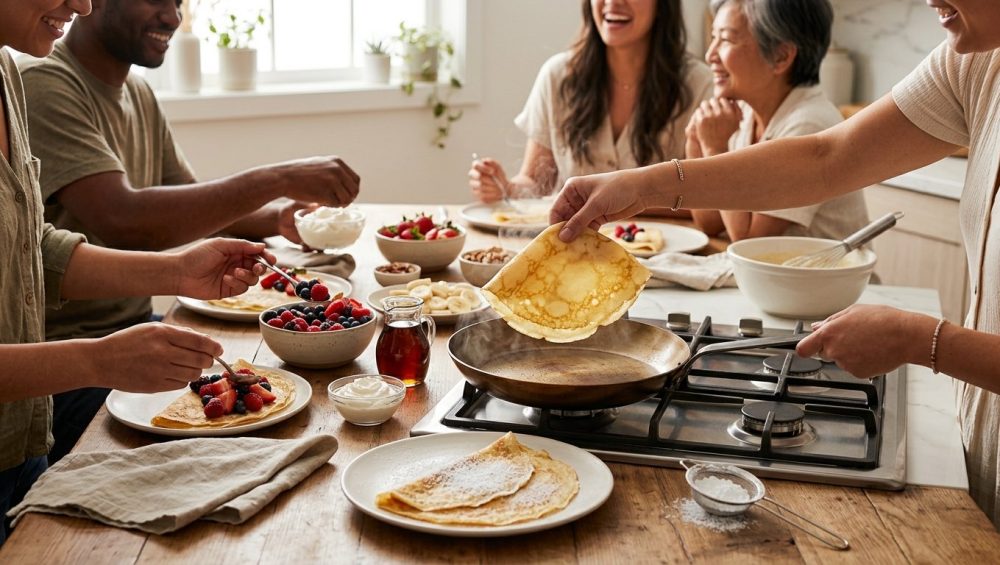
Because your batter is resting safely in the fridge overnight, your morning prep is practically zero. You can stand at the stove with a cup of coffee, casually swirling and flipping crepes, while your friends and family gather around the kitchen island. It is interactive, it is slow-paced, and it completely removes the intense, sweaty pressure of trying to serve a plated, hot meal to eight people simultaneously.
To keep the cooked crepes warm without drying them out, place a ceramic plate in an oven preheated to 200°F (93°C). As you finish each crepe, slide it onto the plate and cover the stack with a slightly damp, clean kitchen towel. The ceramic holds the thermal mass, and the damp towel prevents the delicate edges from turning into brittle crackers.
Curating the Fillings: Sweet and Savory
A proper, mindfully designed crepe bar should have distinct, well-thought-out zones for both sweet and savory flavor profiles. Do not just throw random ingredients onto a table; curate the experience.
The Savory Station: The Galette Inspiration
Look toward the traditional Breton galettes of France for savory inspiration. Offer high-quality shredded Gruyere or Emmental cheese, paper-thin slices of prosciutto or Black Forest ham, sautéed garlic butter mushrooms, and fresh baby spinach.
If you want to lean into the massive 2026 brunch trends, offer a shakshuka-inspired spiced tomato and bell pepper compote. The beauty of the savory crepe is that the residual heat of the freshly cooked batter will perfectly melt the cheese as your guests fold their creations into neat little triangles. For an extra touch of luxury, keep a non-stick skillet on the side to quickly fry up some sunny-side-up eggs. A savory crepe topped with a perfectly runny egg yolk is a culinary revelation.
The Sweet Station: Beyond Basic Syrup
Move far beyond the basic, depressing squeeze bottle of generic chocolate syrup. Offer a homemade, bright lemon curd, lightly toasted slivered almonds for textural crunch, and freshly whipped cream. When making the cream, whip it only to soft, billowing peaks, rather than stiff peaks, so it glides smoothly and seamlessly over the warm crepe.
Fruit is absolutely essential, but please, do not just dump raw, unseasoned fruit into a bowl. Macerate your strawberries. Toss quartered fresh strawberries with a spoonful of granulated sugar and a tiny splash of lemon juice, and let them sit for thirty minutes. Through the biological process of osmosis, the sugar will draw out the cell-bound water and natural fruit acids, creating a vibrant, glossy, naturally sweet syrup that acts as a built-in sauce.
And a quick, vital pro-tip: if you want to make fresh berries last long enough for your Sunday brunch without turning into a fuzzy, moldy disaster in the fridge, keep them completely dry and unwashed until the exact morning of the party. Moisture is the ultimate enemy of fresh produce.
Troubleshooting Your Crepe Tragedies
Even with the absolute best preparation, the kitchen can occasionally throw you a curveball. Do not panic. Here is exactly how to diagnose and fix the most common crepe issues on the fly:
Why is my batter lumpy?
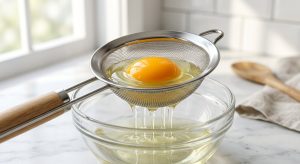
You either didn’t whisk it thoroughly enough, or you dumped all the liquid into the flour at once, creating a flood. Next time, add the milk gradually to the dry ingredients to form a thick, smooth paste before thinning it out with the rest of the liquid. For today, don’t stress. Just pour the lumpy batter through a fine-mesh sieve into a clean bowl. Problem solved.
Why are my crepes tearing when I try to flip them?
There are two distinct culprits here. Either your batter didn’t rest long enough (meaning the starches didn’t fully hydrate and the gluten is still tense), or your pan is way too cold. A cold pan causes the batter to steam and securely stick to the microscopic pores of the metal. Turn the heat up slightly, wait a minute, and ensure the pan is fully preheated before pouring your next batch.
Why are the edges brittle, cracking, and burning?
Your pan is too hot, causing the proteins in the batter to seize and dry out instantly. Alternatively, you are using way too much butter in the pan, which is essentially deep-frying the edges of the crepe. You only need a microscopic, nearly invisible sheen of fat to prevent sticking on a carbon steel pan. Wipe the pan out vigorously with a paper towel to remove the excess butter, turn the heat down a notch, and try again.
Why do my crepes taste like flour?
You didn’t cook them long enough, or you forgot the salt. Salt is not just for savory dishes; it is a flavor enhancer that makes the vanilla and sugar in a sweet batter pop. Always add a generous pinch of kosher salt to your batter. Furthermore, ensure you are waiting for those lacy brown edges to form before flipping. Color equals flavor.
Final Thoughts on the Mindful Brunch
Cooking should never be a source of stress, especially on the weekend. By ditching the highly toxic gear, investing in a proper, durable carbon steel pan, and respecting the hard, undeniable science of starch hydration and temperature control, you can absolutely eliminate the rubbery, frustrating crepes of your past.
Hosting a mindful crepe bar is the perfect, necessary antidote to the chaotic, hyper-fast modern world. It forces you to slow down, to actually engage with your ingredients, and to share a genuinely beautiful, interactive meal with the people you care about. It transforms the act of eating from a rushed necessity into a memorable, shared event.
So go whisk your batter right now. Put it in the fridge, cover it tightly, and go pour yourself a glass of wine. Relax. You have done the hard work. Tomorrow morning is going to be absolutely spectacular.