Listen, we need to have a serious talk about what I like to call “Sweaty Host Syndrome.” You know exactly what I’m talking about. It’s that tragic phenomenon where you invite your favorite people over for a beautiful, intentional evening, only to spend 90% of the night hyperventilating over a sputtering stove while your guests awkwardly sip Pinot Grigio in the living room without you. By the time you finally sit down, your hair smells like aerosolized bacon grease, your nerves are completely fried, and you’re too exhausted to even taste the food you just spent six hours making.
It doesn’t have to be this way. You do not need a Michelin star, a brigade of line cooks, or a commercial kitchen to pull off a flawless, stress-free gathering. What you need is a fundamental understanding of thermodynamics. Yes, we are talking about physics today, but stick with me. Mastering the thermal properties of your food and your cookware is the ultimate cheat code for curing your cooking anxiety. When you understand how heat moves, how moisture migrates, and how to weaponize the thermal mass of your servingware, you eliminate the logistical bottleneck of last-minute cooking. You get to actually sit down, drink your wine, and be present.
The Thermodynamics of Hot Holding: Science, Not Magic
To hold food successfully—meaning it stays hot, safe, and texturally perfect for hours—you have to understand that heat is not a static state; it is a relentless, moving energy. Heat always seeks equilibrium. If your food is hotter than the ambient air, the air is going to steal that heat. Your job as a host is to build a thermal fortress around your meal.
The FDA Danger Zone and the Culinary Sweet Spot
Let’s get the pesky, non-negotiable food safety science out of the way first. The FDA defines the “Danger Zone” as the temperature range between 40°F and 140°F (4°C to 60°C). This is the cozy, lukewarm resort where foodborne pathogens like Salmonella, E. coli, and Staphylococcus aureus thrive and multiply exponentially. Leaving a beautiful, expensive roast sitting out on a room-temperature platter for three hours isn’t just a culinary tragedy; it’s a gastrointestinal liability.
However, holding food at a blistering 180°F just to be “safe” will completely obliterate its cellular structure, turning your gorgeous medium-rare beef into shoe leather and your vibrant vegetables into gray, sulfurous mush. The thermodynamic sweet spot for hot holding most savory dishes is a tightly controlled window between 145°F and 160°F. At this range, bacterial growth is completely halted, but the thermal energy isn’t aggressive enough to continue actively denaturing proteins or rapidly boiling off internal moisture.
Carryover Cooking: The Invisible Heat Wave
If you’ve ever pulled a perfectly pink steak off the grill, sliced into it ten minutes later, and found a tragic, gray, overcooked disaster, you have been victimized by carryover cooking. Understanding this phenomenon is one of the most critical steps in avoiding common beginner cooking mistakes.
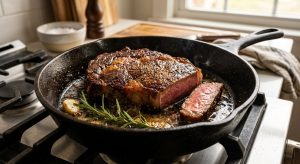
Carryover cooking is basic heat transfer. When you roast or sear a piece of meat, the exterior surface absorbs massive amounts of thermal energy, becoming significantly hotter than the center. When you remove the food from the oven, that surface heat doesn’t just vanish into the ether. It continues to migrate inward, seeking equilibrium with the cooler core. For dense, high-moisture proteins cooked at high temperatures, this internal heat wave can cause the core temperature to spike by an astonishing 10°F to 22°F (5°C to 12°C) after it has been removed from the heat source.
If you plan to hold a roast for two hours before serving, you must mathematically account for this thermal momentum. You need to pull your proteins from the oven well before they reach their target temperature, allowing the carryover heat to gently coast the meat to its final doneness while it rests in your holding vessel.
Material Science: The Thermal Batteries of Your Kitchen
You cannot master food holding if you are serving your meals in cheap, paper-thin, heat-hemorrhaging vessels. The material you use to hold and serve your food dictates how quickly that food will plummet into the Danger Zone. We need to talk about specific heat capacity and thermal mass.
Enameled Cast Iron: The Heavyweight Champion
There is a reason your grandmother’s vintage French Dutch oven weighs as much as a small boulder, and there is a reason professional chefs revere them. Cast iron is the undisputed heavyweight champion of heat retention.
In physics, “specific heat capacity” measures how much energy it takes to raise the temperature of a material. Cast iron has a specific heat capacity of roughly 460 J/kg-K. While this number is actually lower than aluminum, cast iron is incredibly dense. An average enameled cast iron braiser holds a massive reservoir of thermal energy—upwards of 91 kJ at 150°C. More importantly, cast iron has a relatively low thermal conductivity (around 52 W/m-K) compared to aluminum (237 W/m-K).
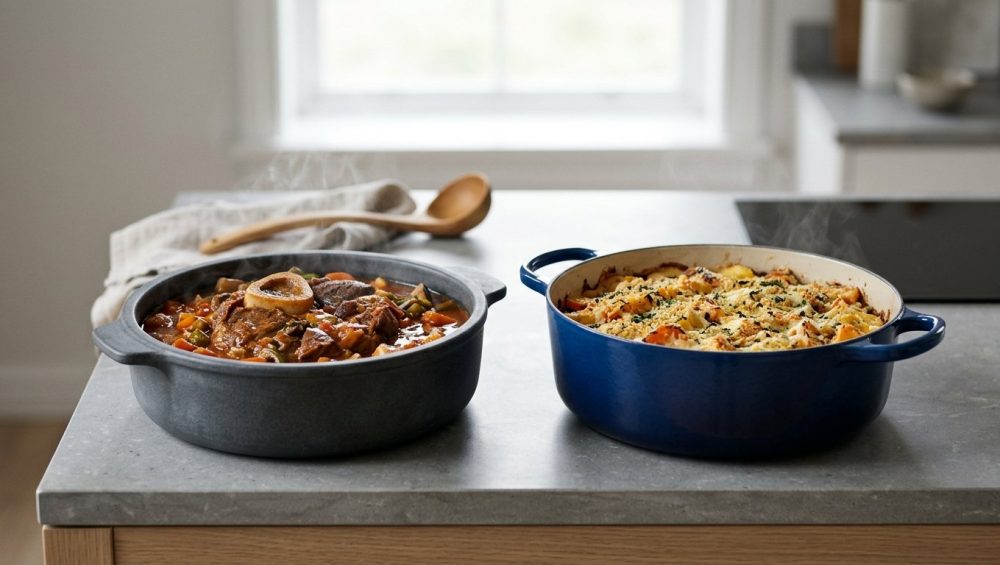
What does this mean in plain English? It means that it takes a long time for cast iron to get hot, but once it is hot, it stubbornly refuses to give that heat up. It acts as a massive thermal battery. If you pre-heat an enameled cast iron vessel with boiling water, dry it, and place your hot food inside with the heavy lid on, that vessel will radiate gentle, consistent heat back into the food for well over an hour, completely unassisted.
High-Fired Stoneware and Clay: The Elegant Insulators
If enameled cast iron is a heavy-duty thermal battery, high-fired stoneware and ceramic clay are your elegant, slow-release insulators. Clay has a specific heat capacity of around 878 J/kg-K. It can store up to three or four times more heat per gram than iron, but it distributes that heat incredibly slowly.
When you bake a gratin or a casserole in a dense stoneware dish, the walls of the dish absorb the oven’s ambient heat. Because ceramics are fantastic insulators (meaning they have very low thermal conductivity), they trap the heat inside the food rather than rapidly venting it out into the cooler dining room air. Serving your side dishes in pre-warmed, thick-walled stoneware is a non-negotiable strategy for stress-free hosting.
The “No-Go” Rule: Banishing Toxic Junk
Since we are discussing the physics of heat and materials, I am going to use this soapbox to aggressively remind you to stop serving and cooking your food in toxic, chemical-leaching garbage. Ditching toxic kitchen gear is the most important favor you can do for your health and your palate.
I have absolutely zero patience for cheap, lightweight aluminum pans coated in peeling, scratched layers of polytetrafluoroethylene (PTFE). When these cheap non-stick coatings are subjected to high heat, they can thermally degrade, releasing highly toxic polymer fumes and per- and polyfluoroalkyl substances (PFAS)—infamous “forever chemicals”—directly into your beautiful meal. Furthermore, serving highly acidic foods (like a slow-simmered tomato ragù) in reactive, uncoated aluminum or mystery-metal pans will literally strip the metal molecules into your food, resulting in a harsh, metallic, tinny flavor that ruins hours of hard work.
Invest in enameled cast iron, high-fired stoneware, heavy-gauge stainless steel, and tempered glass. They are safe, they are chemically inert, and their thermodynamic properties are empirically superior.
Moisture Control: The Enemy of Crispy, the Savior of Succulent
Temperature is only half the battle. The other half is moisture. You can keep a batch of perfectly fried chicken at exactly 150°F for two hours, but if you trap it in a sealed plastic container, you will serve your guests hot, flabby, soggy sponges.
The Physics of Condensation and Evaporative Cooling
When hot food sits, internal moisture continuously migrates to the surface and evaporates into the surrounding air. This evaporation requires energy, which it steals from the food itself, causing rapid evaporative cooling. This is why uncovered food gets cold so incredibly fast.
To stop the food from cooling, our instinct is to tightly cover it with a lid or foil. However, when you trap that evaporating moisture, the relative humidity inside the vessel skyrockets to 100%. The vapor hits the slightly cooler lid, condenses back into liquid water, and rains directly down onto your food. If you are holding a braised short rib, this “thermoisturization”—a term you might encounter when translating pretentious recipe jargon—is wonderful, as it keeps the meat succulent and tender. If you are holding roasted potatoes or a seared crust, condensation is your absolute worst enemy.
Venting Strategies: When to Breathe and When to Seal
The golden rule of moisture control is this: If it was cooked in liquid (braises, stews, mashed potatoes, creamy gratins), seal it tight. If it was cooked with dry heat to achieve a crust (roasted vegetables, seared meats, fried foods), it must breathe.
For dry-heat foods, you need to employ strategic venting. If you must cover a roasted chicken to keep it warm, do not wrap it tightly in foil. Create a loose “foil tent” that reflects radiant heat back down toward the bird while leaving the bottom edges open to allow the steam to escape. Alternatively, hold crispy items in a warm oven (around 170°F) on a wire rack set inside a baking sheet. The wire rack prevents the bottom of the food from sitting in its own expelled juices, which would instantly destroy the crust.
Empirically Validated Holding Techniques for the Home Kitchen
Now that we understand the physics of heat retention and moisture migration, let’s look at how to practically apply these concepts in a standard home kitchen without dropping three grand on a commercial holding cabinet.
The Faux-Cambro Hack
Caterers and professional barbecue pitmasters use heavy, insulated plastic boxes called Cambros to hold massive quantities of hot food at safe temperatures for up to six hours. You can easily replicate this thermodynamic miracle using a standard, high-quality camping cooler.
To build a “Faux-Cambro,” take a clean, hard-sided insulated cooler and fill the bottom with two inches of boiling water. Close the lid and let it sit for ten minutes. The boiling water will rapidly transfer its thermal energy into the thick insulated walls of the cooler. After ten minutes, dump the water out and quickly wipe the inside dry. Line the bottom with a thick, clean bath towel. Place your tightly wrapped, hot food (like a rested brisket or a covered Dutch oven of pulled pork) onto the towel, cover it with another thick towel to eliminate empty air space, and latch the lid shut.
The heavy insulation prevents thermal transfer to the outside environment, while the pre-heated walls and towels create a micro-climate that will safely hold your food well above the 140°F Danger Zone for three to four hours. This frees up your oven entirely, allowing you extra time to focus on beautiful food plating techniques before your guests arrive.
Pre-Heating Your Hardware
I cannot stress this enough: putting hot food onto cold servingware is a rookie thermodynamic disaster. If you spend an hour perfectly executing a quick pan-seared salmon, and then immediately transfer those delicate fillets onto a 68°F ceramic platter, the massive thermal mass of the cold platter will instantly suck the heat right out of the fish. Within five minutes, your masterpiece is lukewarm.
You must pre-heat your serving platters, bowls, and even your guests’ dinner plates. You can do this by stacking them in a 150°F oven for twenty minutes before serving, or, if your oven is occupied, by running them under scorching hot tap water for a minute and quickly drying them. This simple step fundamentally changes the dining experience, ensuring the food stays hot from the kitchen to the last bite.
The Water Bath (Bain-Marie) Mastery
For delicate items that are prone to scorching or breaking—like a hollandaise sauce, a silky potato purée, or a rich gravy—direct heat is too aggressive. The solution is a makeshift bain-marie, or water bath.
Water is an incredible thermal buffer. It cannot exceed 212°F (100°C) at sea level, no matter how much heat you apply. By placing your food in a heat-safe bowl, and setting that bowl over a saucepan of gently simmering (not boiling) water, you are using the steam to provide a gentle, conductive, and highly controlled heat source. This keeps your sauces perfectly fluid and hot without ever risking a burnt bottom or a separated emulsion.
Specific Food Categories and Their Thermodynamic Needs
Not all foods react to heat and holding in the same way. You have to tailor your thermodynamic strategy to the molecular structure of the dish you are serving.
Proteins: Resting Without Ruining
Meat is essentially a complex matrix of water, fat, and tightly coiled protein fibers. When exposed to heat, these protein fibers contract, squeezing water out of their cellular structure. If you slice into a roast immediately after removing it from the oven, those tightly coiled fibers haven’t had time to relax, and the pressurized, highly mobile juices will bleed out all over your cutting board, leaving the meat dry and stringy.
Resting meat is a critical phase of the cooking process. As the meat rests and the temperature gradients equalize, the protein fibers relax and reabsorb the internal juices. To hold large proteins like a prime rib or a roasted turkey, pull them from the oven 10°F to 15°F below your target temperature. Tent them loosely with foil to manage the carryover cooking, and let them rest on a wire rack for at least 30 to 45 minutes. They will retain their heat beautifully due to their massive internal water content and thermal mass.
Starches and Grains: Preventing the Starch-Glue
Holding starches—like mashed potatoes, risotto, or macaroni and cheese—presents a unique chemical challenge known as starch retrogradation. When starches are cooked in water, the amylose and amylopectin molecules swell and gelatinize, creating a creamy texture. However, as they sit and slowly cool, these molecules begin to realign and crystallize, forcefully expelling water in a process called syneresis. This is why leftover mashed potatoes turn into a dense, weeping block of glue.
To successfully hold starches, you must maintain a temperature high enough to prevent retrogradation (above 140°F) while tightly sealing the vessel to prevent surface evaporation. For mashed potatoes, hold them in a pre-warmed, heavy-bottomed pot with a tight lid, or in a slow cooker set to the “Warm” function, with a thin layer of melted butter poured over the surface to act as an impermeable fat barrier against evaporation.
Vegetables: Halting the Enzymatic Mush-Fest
Vegetables are the most difficult items to hold because their cellular walls are highly susceptible to thermal degradation. Prolonged exposure to heat breaks down pectin and cellulose, turning vibrant, crisp green beans into sad, olive-drab mush.
The best strategy for vegetables is to bypass long holding times entirely through a technique called blanching and shocking. Hours before your guests arrive, boil your vegetables in heavily salted water until they are just barely tender, then immediately plunge them into an ice-water bath. This rapid thermal shock instantly halts the cooking process and deactivates the enzymes that cause color loss. Leave them in the fridge. Right before serving, you only need to flash-sauté them in a hot pan with butter for two minutes to bring them up to serving temperature.
Orchestrating the Mindful Gathering: A Timeline
Understanding the science is useless without a strategic execution plan. The goal of all this thermodynamic manipulation is to allow you to be a relaxed, engaging host. Here is how you orchestrate the timeline to ensure you spend your evening making memories, not frantically whisking gravy.
The Day Before: Strategic Pre-loading
Your stress levels are inversely proportional to your prep work. Elevating your daily cooking routine means learning to compartmentalize tasks. The day before your gathering, do all of your heavy lifting. Chop every onion, wash every green, and measure out your dry ingredients. Make your salad dressings, assemble your cold appetizers, and prepare any braises or stews. Dishes like short ribs or chili actually taste exponentially better on the second day because the flavor compounds have had 24 hours to deeply penetrate the meat matrix.
Two Hours Prior: The Thermal Shift
Two hours before your guests arrive is when you initiate your thermal strategies. This is when the large roasts go into the oven. This is when you build your faux-Cambro if you are using one. This is also the time to completely clean your kitchen counters. Use a versatile bench scraper to aggressively clear away all the vegetable scraps, flour dust, and debris from your cutting boards. A clean, empty workspace is a massive psychological advantage when you are doing final preparations.
At the 90-minute mark, move your heavy stoneware serving dishes into a low oven to begin their slow, steady heat absorption. Set up your bain-marie on the back burner, ready to receive your sauces.
Showtime: Pouring the Wine and Actually Drinking It
Thirty minutes before the doorbell rings, your active cooking should be entirely finished. Your roast is resting under a foil tent, safely coasting through its carryover cooking phase. Your starches are tightly sealed in heavy cast iron, maintaining their creamy gelatinized state. Your vegetables are blanched, shocked, and sitting in a pan, waiting for a two-minute flash heat.
Because you have weaponized the thermal mass of your cookware and understood the exact temperature thresholds of your ingredients, your food is completely stable. It is not drying out. It is not getting cold. It is not breeding bacteria.
When your guests arrive, you do not need to apologize for the mess or frantically shoo them out of the kitchen. You can greet them at the door, take their coats, and hand them a drink. The true secret to hosting a relaxed dinner is realizing that the food is only a vehicle for connection. By relying on the immutable laws of thermodynamics, you have bought yourself the most valuable ingredient in the culinary arts: time.
As you effortlessly transfer your perfectly rested proteins and steaming sides onto your pre-heated platters, you aren’t just serving dinner; you are mastering effortless hosting. You have successfully decoupled the act of cooking from the act of serving. So pour yourself a generous glass of that Pinot Grigio, sit down at the beautiful table you’ve set, and actually enjoy the phenomenal meal you created. You’ve earned it, and the science guarantees it’s going to be spectacular.