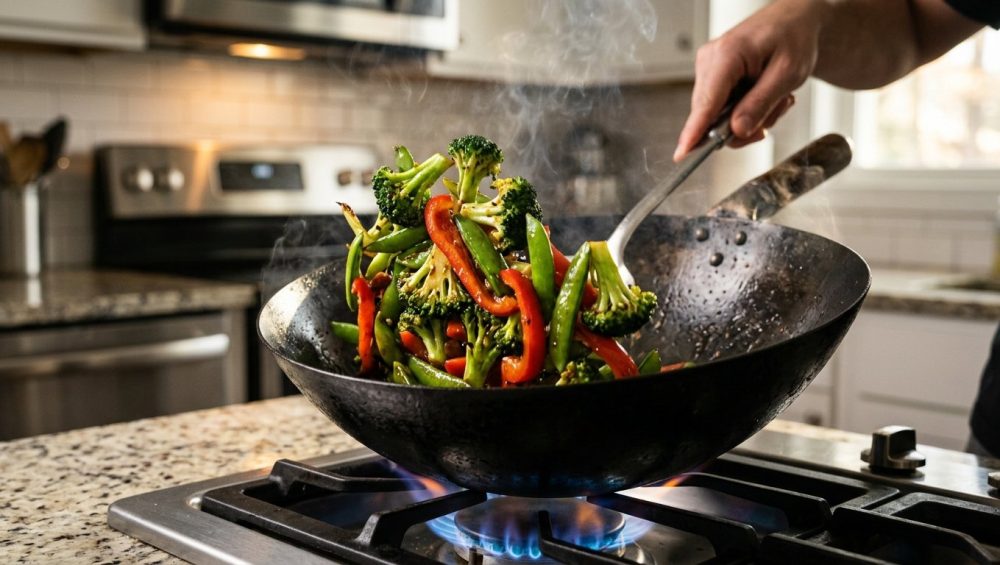
Listen, I know exactly what happened in your kitchen last night. You scrolled past a gorgeous, glossy picture of a vibrant, perfectly charred beef and broccoli stir-fry on social media. You decided, with the unearned confidence of a weekend culinary warrior, “I can absolutely do that.” You diligently chopped your vegetables, sliced your meat, and dumped the entire mountain of ingredients into your standard ten-inch non-stick skillet. You cranked the heat to medium-high, gave it a hopeful toss with a flimsy silicone spatula, and waited for the magic to happen.
Instead of a roaring sizzle, you got a depressing, wet hiss. Within three minutes, your beautiful, crisp vegetables were swimming in a pool of murky, gray liquid. Your beef turned rubbery, and your broccoli became sad and limp. You didn’t make a stir-fry, my friend. You made a stir-boil.
If you are tired of this culinary tragedy and desperately want to stop eating mushy veggies, we need to have a brutally honest conversation about your kitchen equipment. You cannot achieve restaurant-quality, blistered, smoky stir-fries in a standard Western frying pan. And you absolutely cannot do it in a toxic, peeling non-stick skillet. It is time to upgrade your gear, rethink your technique, and embrace the absolute magic of a flat-bottom carbon steel wok.
The Anatomy of a Mushy Stir-Fry: Why Your Standard Skillet is Sabotaging You
Before we can fix your dinner, we need to understand why it failed in the first place. The problem is not necessarily your recipe; the problem is fundamental thermodynamics and the physical design of your cookware.
The Surface Area and Evaporation Problem
A standard Western skillet is designed with a wide, flat bottom and short, vertical (or slightly sloped) walls. When you attempt to cook a stir-fry in one of these pans, you are forced to spread all of your ingredients across the bottom in a single, crowded layer. As the food heats up, it naturally releases its internal moisture.
In a professional kitchen, intense heat instantly evaporates this moisture on contact. But on a home stove, the pan’s temperature plummets the second you add cold food. Because the moisture has nowhere to go and the heat isn’t high enough to flash-evaporate it, the water pools at the bottom of the pan. Water boils at 212°F (100°C), which means as long as that liquid is sitting in your skillet, the temperature of your food cannot exceed 212°F.
This is a massive problem because the Maillard reaction—the complex chemical process responsible for the deep, savory browning and caramelization of proteins and sugars—does not begin until temperatures reach approximately 285°F (140°C). As long as your food is sitting in a puddle of its own juices, it is physically impossible for it to sear. This is exactly why your ground beef steams instead of browning.
The Heat Recovery Dilemma
Standard aluminum or stainless steel skillets lack the specific thermal dynamics required for stir-frying. When you dump a pound of cold chicken into an aluminum pan, the metal loses its stored heat immediately. It then takes agonizing minutes for the burner to pump enough energy back into the pan to recover that lost heat. By the time the pan gets hot again, your chicken is overcooked, tough, and completely devoid of color.
The Toxic Truth About Cheap Non-Stick Gear
If you are currently trying to stir-fry in a Teflon-coated non-stick pan, I need you to march into your kitchen and reevaluate your life choices. I have zero patience for cheap, toxic kitchenware that actively poisons your food and the environment.
The Chemical Reality of PTFE
Teflon is a brand name for polytetrafluoroethylene (PTFE), a synthetic fluoropolymer. For decades, the non-stick industry used a chemical called PFOA (perfluorooctanoic acid) to manufacture these coatings. PFOA is a notorious “forever chemical” linked to a laundry list of severe health issues, including kidney and testicular cancer. While PFOA was largely phased out of cookware manufacturing by 2015 under intense pressure from the EPA, the modern replacement is still PTFE.
PTFE is a highly stable compound at low temperatures, making it perfectly fine for gently scrambling eggs on low heat. But stir-frying requires aggressive, smoking-hot temperatures. Most home cooks think they can just crank their burner dial to “High” and hope for the best. By doing this, you are actively ruining your nonstick pans and exposing your household to dangerous chemicals.
The 500-Degree Danger Zone
According to extensive material safety data, PTFE begins to thermally degrade at approximately 500°F (260°C). If you place an empty non-stick pan on a high-heat burner to preheat it for a stir-fry, it can reach this dangerous 500°F threshold in just two to three minutes.
Once the temperature climbs above 500°F, the PTFE coating begins to break down into smaller, volatile components. By the time the pan reaches 680°F, it rapidly decomposes and releases highly toxic ultrafine particles and fluorocarbon gases into your kitchen air.
In humans, inhaling these toxic fumes causes a documented medical condition known as “polymer fume fever,” which presents as severe, flu-like symptoms including chills, fever, nausea, and body aches. For pet birds, the consequences are much more dire. Because birds have incredibly efficient respiratory systems, exposure to overheated PTFE fumes is famously lethal, often killing them in a matter of minutes. There is absolutely no justification for using a pan with a hard temperature limit of 500°F for a cooking technique that demands intense, blistering heat.
Metallurgy 101: Why Carbon Steel is the Ultimate Solution
If non-stick is toxic and standard stainless steel lacks the right shape, what is the solution? Enter the carbon steel wok. This is the undisputed king of the kitchen, the workhorse of every professional Asian restaurant on the planet, and the absolute best investment you will ever make for your weeknight dinners.
What Exactly is Carbon Steel?
To understand why this material is so magical, we need to look at the metallurgy. Carbon steel is an alloy composed of roughly 98.5% to 99% iron and 0.5% to 1.5% carbon. It is incredibly similar to cast iron, which typically contains 2% to 4% carbon. However, that slight difference in carbon content changes everything about how the metal is manufactured and how it performs on the stove.
Because cast iron is brittle, it must be poured into molds and cast with thick, heavy walls (usually 3.5mm to 6mm thick). Carbon steel, on the other hand, is highly malleable. It can be forged, stamped, and spun into incredibly thin, lightweight sheets (usually 1.2mm to 2mm thick) without losing its immense structural strength.
The Physics of Heat Transfer
The secret to the wok’s performance lies in understanding thermal conductivity. Thermal conductivity measures how fast a material can transfer heat, while thermal mass measures how much heat a material can hold.
Carbon steel has a thermal conductivity of approximately 40 to 54 W/m·K (Watts per meter-Kelvin). Because a carbon steel wok is rolled so thin, it has a very low thermal mass. This means it heats up almost instantly when placed on a flame, and it cools down almost instantly when you remove it from the heat.
When you drop cold vegetables into a carbon steel wok, the temperature drops, but because the metal is thin and highly conductive, the burner can pump heat back into the cooking surface at lightning speed. A standard 1.5mm carbon steel wok can recover its searing temperature in just 12 to 18 seconds after adding a cold chicken breast, whereas a thick cast iron skillet might take 45 to 75 seconds to recover. That rapid temperature recovery is the difference between a sad, steamed vegetable and a perfectly blistered, crunchy snap pea.
The Magic of the Patina
Unlike toxic Teflon, carbon steel develops its non-stick properties naturally through the science of polymerization. When you heat an unsaturated cooking oil (like grapeseed, canola, or peanut oil) past its smoke point on bare iron, the oil molecules break down, cross-link, and bond directly to the microscopic pores of the metal.
This creates a hard, slick, plastic-like matrix that is completely natural, non-toxic, and capable of withstanding massive amounts of heat. The more you cook with your wok, the thicker and more resilient this polymerized layer becomes. Over time, your wok will turn from a shiny silver to a deep, beautiful, glossy black, making it actually non-stick enough to slide a fried egg around without a spatula.
The Flat-Bottom Design: Decoding the Home Burner Dilemma
Now that we have established that carbon steel is the only acceptable material for a wok, we have to address the shape. If you walk into an authentic Asian market, you will see stacks of beautiful, traditional round-bottom woks. Do not buy one. I repeat, if you are cooking in a standard Western home kitchen, a round-bottom wok will ruin your life. You absolutely must buy a flat-bottom wok. Here is the undeniable physics behind why.
The Commercial vs. Home Kitchen Divide
To understand wok geometry, you have to look at the heat source. In a commercial Chinese restaurant kitchen, chefs cook on specialized wok burners. These are essentially controlled jet engines that blast out anywhere from 100,000 to over 200,000 BTUs (British Thermal Units) of raw thermal energy per hour. These burners are designed with a deep, recessed bowl. When a round-bottom wok is placed into the burner, the roaring flames shoot up and engulf the entire lower half of the wok, heating the bottom and the sloping sides simultaneously.
Your home kitchen is not a commercial restaurant. A standard Western home gas burner produces a meager 7,000 to 15,000 BTUs. Even a high-end luxury home range might top out at 20,000 BTUs.
The Wok Ring Trap
If you try to use a round-bottom wok on a flat American gas grate, it will wobble dangerously, threatening to spill boiling oil all over your feet. To fix this, people buy “wok rings”—metal collars that sit on the grate to cradle the round bottom.
This is a terrible mistake. A wok ring physically lifts the bottom of the wok an inch or two away from your already weak 15,000 BTU flame. Because heat dissipates exponentially through the air, elevating the wok means you are losing a massive amount of cooking power. You are effectively castrating your stove.
The Flat-Bottom Advantage
A flat-bottom carbon steel wok solves this problem entirely. The flat base, usually about 5 to 6 inches in diameter, sits perfectly flush against your gas grates, your electric coils, or your glass-top induction stove. This direct, metal-to-heat-source contact maximizes thermal conduction, ensuring that every single BTU your stove produces is driven directly into the steel.
Furthermore, flat-bottom woks are the only viable option for induction or electric glass-top stoves. If you use cheap, thin aluminum pans on an electric stove, the intense, localized heat ensures your frying pans keep warping. A high-quality carbon steel wok is resilient enough to handle the thermal shock, and the flat bottom ensures the magnetic field of an induction burner can actually engage the iron. It is time to stop boiling your stir-fry and start harnessing the full power of your home stove with the correct geometry.
How to Choose the Perfect Wok
You are now armed with the metallurgical and thermodynamic knowledge to buy the right tool. But the market is flooded with gimmicks. Here is exactly what you need to look for when purchasing your flat-bottom carbon steel wok.
1. The Gauge (Thickness)
Thickness is the most critical specification. If a wok is too thin (under 1.2mm), it will heat up too fast, warp on your stove, and burn your food instantly. If it is too thick (over 2.5mm), it will be too heavy to lift and toss, defeating the entire purpose of the pan’s responsive nature.
The gold standard for a home carbon steel wok is 14-gauge, which translates to approximately 1.5mm to 2mm thick. This is the perfect sweet spot: it is thick enough to retain heat and prevent warping, but light enough (usually around 3 to 4 pounds) that you can easily pick it up with one hand to toss your ingredients.
2. The Size
For a standard home stove, a 14-inch diameter wok is the absolute ideal size. A 12-inch wok is too small; you will end up overcrowding the pan and steaming your food. A 16-inch wok is too large; the edges will hang too far over your burner, creating massive cold zones, and it will be impossible to store in your cabinets. Stick to 14 inches. It comfortably cooks enough food for two to four people without crowding the cooking surface.
3. The Handle Style
You will generally see two handle styles: Cantonese and Northern. Cantonese woks have two small metal loop handles on either side. These are meant for commercial kitchens where the chef uses a towel to grab the metal. Do not buy this for your home.
You want a Northern-style wok, which features one long handle (usually wood or phenolic resin to stay cool) and one small metal helper handle on the opposite side. The long handle gives you the leverage you need to aggressively toss your food, while the helper handle allows you to safely carry a wok full of heavy food to the sink or table.
4. Spun vs. Hand-Hammered
Woks are either spun on a lathe, stamped out by a machine, or hand-hammered. Spun woks have distinct concentric circles on the inside, which actually help grip the food when you push it up the sides of the wok. Hand-hammered woks have small, beautiful indentations that serve the same purpose. Both are excellent. Just avoid anything labeled “non-stick carbon steel”—that is an oxymoron and a marketing scam designed to sell you more toxic Teflon.
The Initiation: Bluing and Seasoning Your New Wok
When your new carbon steel wok arrives, it will look silver, greasy, and completely unappealing. Do not cook in it yet. Carbon steel rusts incredibly fast, so manufacturers coat the woks in a thick layer of machine oil or beeswax to protect them during shipping. You must strip this off and season the wok yourself. This process is a rite of passage.
Step 1: The Scrub
Take the wok to your sink. Use scorching hot water, aggressive dish soap, and a stainless steel scouring pad to scrub every square inch of the wok, inside and out. You need to remove 100% of the factory coating. If you leave any factory oil on the pan, it will turn into a sticky, gummy mess when you heat it. Dry the wok completely with a towel.
Step 2: The Bluing Process (Annealing)
Turn on your stove’s exhaust fan and open a window. Place the completely dry, bare steel wok on your highest burner. As the metal heats up, it will begin to change color. First, it will turn a yellowish-brown, then a deep purple, and finally, a striking, iridescent metallic blue.
This is not magic; it is chemistry. You are creating a layer of black iron oxide (magnetite) on the surface of the steel. This bluing process fundamentally alters the surface of the metal, making it significantly more resistant to rust and creating a porous foundation for your oil to grip onto. Use an oven mitt to carefully tilt and rotate the wok until the entire inside surface has turned blue.
Step 3: The Polymerization
Once the wok is blued, turn the heat down to medium. Take a paper towel, dip it in a high-smoke-point oil (like grapeseed, canola, or peanut oil—never olive oil or butter), and wipe a microscopically thin layer of oil all over the inside of the wok.
I cannot stress this enough: the layer of oil must be so thin that the pan looks almost dry. If you leave pools or streaks of oil, they will bake into sticky, amber-colored droplets.
Let the wok sit on the heat. The oil will begin to smoke heavily. As it smokes, it is polymerizing. When the smoking stops, the oil has successfully bonded to the steel. The pan will turn a dark brown or black. Turn off the heat, let it cool slightly, and repeat the oil-and-smoke process two or three more times. Congratulations, you have just birthed a non-stick carbon steel wok.
The Sassy Sous-Chef’s Rules for Weeknight Stir-Frying
Having the right gear is only half the battle. You still need to execute. Stir-frying is a high-speed, high-stress cooking method. It is not a lazy Sunday braise. If you want to succeed, you must follow these rules religiously.
Rule 1: Mise en Place is Non-Negotiable
“Mise en place” is French for “everything in its place.” In wok cooking, it is the law. A proper stir-fry takes about four minutes from start to finish. Once the oil hits the smoking-hot steel, you do not have time to mince garlic, look for the soy sauce, or chop a bell pepper. If you turn your back on a hot wok to chop an onion, your food will burn to ash. Prep every single ingredient, mix your sauce in a small bowl, and line everything up next to the stove before you even touch the burner dial.
Rule 2: Batch Cooking is the Ultimate Secret
Remember the surface area problem? The biggest mistake home cooks make is dumping a pound of meat and two pounds of vegetables into the wok at the same time. The temperature crashes, and the food boils.
To fix this, you must cook in batches. First, get the wok smoking hot. Add a tablespoon of oil. Sear your meat undisturbed for 60 seconds to get a crust, toss it until it is 80% cooked, and then immediately remove it from the wok and put it on a plate. If you leave it in the pan while you cook the vegetables, your stir-fry meat is chewy and hopelessly overcooked.
Next, wipe the wok clean, get it smoking hot again, add a little more oil, and cook your vegetables. Because the wok is empty, the heat remains high, and the vegetables blister and char instead of steaming.
Rule 3: The Heat Gradient
A flat-bottom wok on a home stove creates a brilliant heat gradient. The flat bottom sitting directly on the burner is the searing zone—it is screaming hot. The sloping sides are the warming zone—they are significantly cooler.
Use this to your advantage. When you add garlic and ginger, push them up the sides of the wok so they don’t burn in the center. When you finally add your meat back into the wok with the vegetables, push all the food up the sides and pour your sauce directly onto the blazing hot bottom of the wok. The sauce will instantly boil, caramelize, and reduce, coating your food in a thick, glossy glaze rather than a watery broth.
Cleaning and Maintenance: Ditching the Rust
Carbon steel requires a tiny bit of respect, but it is not a fragile antique. You do not need to baby it.
When you are done cooking, take the wok to the sink while it is still warm. Run hot water into it. The thermal shock will help lift off any stuck-on food. Use a traditional bamboo wok brush or a standard sponge to scrub out the debris.
Can you use soap? Yes. The internet is full of purists who will scream at you for putting dish soap on seasoned iron. They are operating on outdated information from the 1920s when dish soap contained harsh lye that would strip seasoning. Modern liquid dish soap is incredibly mild and will not harm your polymerized patina. However, you usually won’t even need it; hot water and a brush are typically enough.
If you do have stubborn, burnt-on fond stuck to the bottom, don’t reach for a metal scraper immediately. You can just put the wok back on the stove with a little water and boil it, turning burnt bits into sauce or simply loosening them enough to wipe away easily.
Once the wok is clean, you absolutely must dry it on the stove. Towel drying is not enough; microscopic moisture will hide in the pores of the steel and cause flash rust overnight. Put the clean wok on a medium burner for two minutes until all the water evaporates. Turn off the heat, wipe a single drop of oil over the inside surface to protect it from ambient humidity, and put it away.
The Bottom Line
You do not need a culinary degree, a commercial kitchen, or a $5,000 outdoor jet-engine burner to cook mind-blowing Asian cuisine at home. You just need to respect the physics of cooking.
Throw away the peeling, toxic non-stick skillet that is steaming your dinners and threatening your health. Invest thirty or forty dollars in a high-quality, 14-inch, flat-bottom carbon steel wok. Take the time to blue it, season it, and learn the rhythm of batch cooking. It will take a few tries to get the muscle memory down, but once you hear that aggressive sizzle and taste the smoky, charred perfection of a proper home stir-fry, you will never order sad, soggy takeout again. Now get out of here, go buy a wok, and start cooking like you mean it.