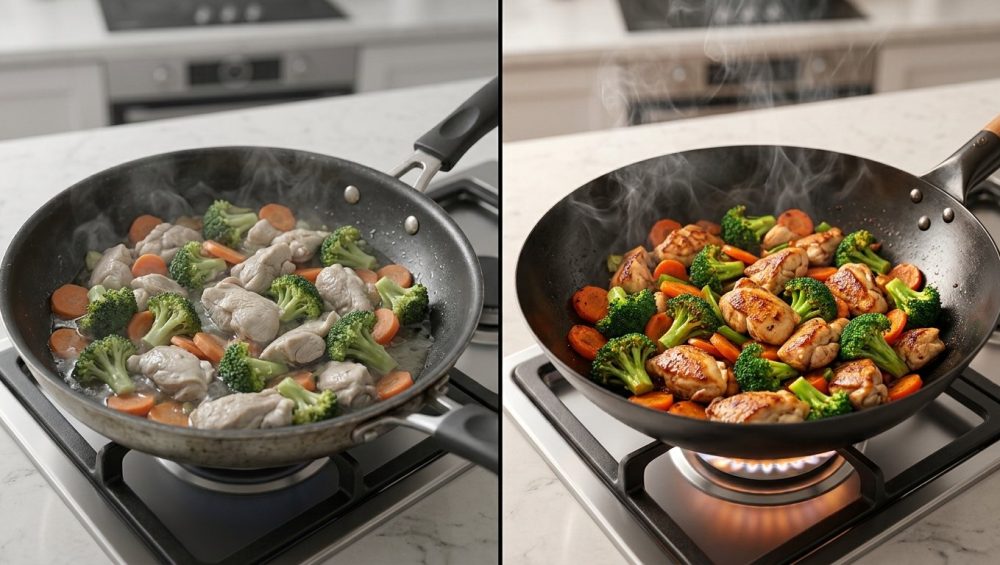
The Tragedy of the Weeknight Stir-Fry
We have all been there. It is 6:30 PM on a random Tuesday. You are exhausted from a long day of pretending to care about spreadsheets, you are starving, and you have made the noble, highly ambitious decision to be “healthy” by whipping up a quick vegetable and chicken stir-fry. You diligently chop your broccoli florets into perfect bite-sized pieces, you slice your chicken breast, and you toss it all into your trusty, scratched-up nonstick skillet. You crank the heat dial all the way to high, stepping back and expecting that glorious, restaurant-quality, aggressive sizzle.
Instead, you get a pathetic, wet hiss.
Within three minutes, your beautifully prepped chicken has turned a depressing, unappetizing shade of boiled gray. Your broccoli is actively weeping water into the pan, creating a murky, flavorless soup at the bottom of the skillet. You are no longer stir-frying, my friend. You are aggressively boiling your dinner in a shallow puddle of sadness. And frankly, you deserve better. You do not need to keep ordering takeout every time you crave decent Asian-inspired food. You just need to stop using the fundamentally wrong tools for the job.
The truth is that the modern home cook has been lied to. We have been sold a bill of goods that suggests a single, mass-produced nonstick frying pan can handle every single culinary task imaginable. It cannot. Stir-frying is an ancient, highly specific cooking method that relies entirely on rapid, violent heat transfer. Attempting to execute a stir-fry in a standard Western frying pan is like trying to win a Formula 1 race in a golf cart. It is mechanically impossible, and you are only going to embarrass yourself. If you want to stop boiling your meats and steaming your vegetables, you need to understand the thermal dynamics of your kitchen, and you need to invest in the undisputed king of the stovetop: the carbon steel wok.
The Physics of the Sizzle: Why Your Skillet is Sabotaging You
Let’s get one thing straight right out of the gate: cooking is not magic. It is just applied thermodynamics. When you drop a pound of cold, water-dense food into a hot pan, the temperature of that pan plummets immediately. Your stove is now fighting a desperate, uphill battle to pump thermal energy back into the metal before the food begins to release its internal moisture.
This is where your standard Western frying pan fundamentally fails at high-heat cooking. A standard skillet has a wide, perfectly flat bottom and short, vertical sides. When your chicken and vegetables inevitably release water as their cellular structures break down, that water has nowhere to go. It pools at the bottom of the flat pan, physically trapped beneath your ingredients. Because water cannot exceed 212°F (100°C) before turning into steam, the temperature of your cooking surface is now artificially capped at the boiling point of water.
You cannot sear meat at 212°F. The Maillard reaction—the complex chemical process between amino acids and reducing sugars that is responsible for browning and developing deep, savory flavors—does not even begin to kick into high gear until the surface temperature reaches roughly 285°F to 320°F. If your food is sitting in a puddle of water, browning is physically impossible. You are steaming it.
Furthermore, we have to talk about thermal conductivity. This is the scientific measure of how efficiently a given material transfers heat. Your heavy cast iron skillet might hold a massive amount of heat, but it transfers that heat incredibly slowly due to its density and thickness. Your cheap aluminum nonstick pan might transfer heat quickly, but it completely lacks the thermal mass required to recover its temperature when a mountain of cold vegetables hits it. We need a vessel that heats up with terrifying speed, responds instantly to the turn of your stove’s dial, and features a geometric shape designed to force rapid evaporation.
The “No-Go” Rule: The Hidden Dangers of Nonstick Pans at High Heat
Before we can formally introduce the hero of this story, we need to address the villain currently sitting in your kitchen cabinet. If you are actively trying to stir-fry in a Teflon-coated nonstick pan, I need you to put the silicone spatula down, turn off the burner, and step away from the stove.
As a culinary professional who spends her life advocating for the weekend home cook, I have a strict, uncompromising rule when it comes to toxic kitchen gear. I absolutely despise cheap, peeling, mystery-metal pans. And nonstick coatings are the absolute worst offenders when it comes to high-heat cooking applications.
Polytetrafluoroethylene (PTFE), the synthetic fluoropolymer coating commonly known by the brand name Teflon, is brilliantly designed for low-to-medium heat tasks. It is fantastic for gently scrambling eggs on a Sunday morning or flipping delicate crepes. It is fundamentally incapable of surviving the violent, blistering heat required for a proper stir-fry.
When a PTFE-coated pan reaches surface temperatures above 500°F (260°C), the chemical structure of the nonstick coating literally begins to break down, decompose, and degrade. When this thermal degradation occurs, the pan releases invisible, highly toxic fluoropolymer fumes into your kitchen air. Inhaling these airborne chemical fumes can cause a temporary but severe condition known as polymer fume fever, colloquially referred to as “Teflon flu”. This condition presents with aggressive, flu-like symptoms including chills, pounding headaches, chest tightness, and fever. These chemical fumes are so potent and dangerous that they are famously known to be rapidly fatal to pet birds kept in the vicinity of the kitchen.
Authentic stir-frying demands pan surface temperatures well north of 400°F, often pushing toward 500°F and beyond to achieve a proper sear. By blasting a Teflon pan on high heat, you are actively ruining your nonstick pans, destroying their slick surface, and potentially poisoning the air in your own home. Stop doing it. Throw that scratched-up, peeling toxic hazard in the trash where it belongs, and let’s upgrade your arsenal.
Enter Carbon Steel: The Undisputed Heavyweight Champion of the Stovetop
So, if nonstick is a toxic hazard at high temperatures, and cast iron is far too heavy to toss ingredients, what is the solution? Enter carbon steel.
Carbon steel is a highly durable metal alloy comprised of approximately 99% pure iron and roughly 1% carbon. It shares many metallurgical and chemical similarities with cast iron, meaning it is virtually indestructible and can withstand blistering, inferno-level heat without warping or releasing toxic fumes. However, because carbon steel is spun, stamped, or hand-hammered from sheets of metal rather than poured into a thick, brittle mold like cast iron, it can be manufactured to be significantly thinner and lighter.
For the weekend culinary hobbyist who wants professional results without a professional kitchen, a carbon steel wok is an absolute revelation. Unlike a heavy, sluggish stainless steel pan, carbon steel responds almost instantly to changes in heat input. When you turn your gas burner up, the thin walls of the wok get blistering hot in a matter of seconds. When you turn the burner down, or lift the wok off the flame to toss your ingredients, the temperature drops rapidly. This thermal agility is the ultimate secret to stir-frying: it gives the cook total control, allowing you to sear meat aggressively without immediately burning your delicate minced garlic and ginger.
When shopping for a wok, thickness matters. The ideal, universally recommended thickness for a carbon steel wok is 14-gauge (approximately 2.0 millimeters thick) or 16-gauge (approximately 1.5 millimeters thick). This specific metallurgical gauge provides the perfect Goldilocks balance: it is thick enough to retain enough thermal energy to sear meat upon contact, but thin enough to remain lightweight so you can actually lift the pan and toss the food with one hand.
Wok Hei: The Breath of the Wok and the Chemistry of Flavor
If you have ever eaten at a high-end Chinese restaurant, you have likely experienced a distinct flavor profile that is nearly impossible to accurately describe. It is a complex, smoky, slightly charred, and deeply savory essence that seems to magically coat every single grain of rice and every piece of meat. In Cantonese culinary tradition, this elusive, highly sought-after flavor is known as wok hei, which poetically translates to “the breath of the wok”.
Wok hei is not a bottled sauce, it is not a secret spice blend, and it is certainly not magic. It is a fleeting, invisible flavor compound born entirely from extreme thermal dynamics and advanced chemistry. When a master chef tosses ingredients high into the air above a roaring 200,000 BTU commercial jet burner, microscopic droplets of cooking oil vaporize and aerosolize. As these aerosolized oil particles meet the extreme, licking heat of the open flame, they undergo a localized, micro-combustion for a fraction of a second. This brief, fiery combustion, combined with a violently accelerated Maillard reaction and the rapid caramelization of natural sugars on the surface of the ingredients, blankets the food in complex aromatic compounds.
Can you achieve true, 100% authentic restaurant-level wok hei on a standard 15,000 BTU home gas range or an electric induction cooktop? Purists and pretentious food critics will loudly tell you no. But as a pragmatic, sassy sous-chef who refuses to let elitist chef-speak gatekeep good food, I am telling you that you can get incredibly close. By utilizing the rapid heat transfer of a carbon steel wok, strictly managing your batch sizes, and letting your pan get smoking hot before adding ingredients, you can replicate the intense searing and rapid moisture-evaporation necessary to mimic the breath of the wok in a standard home kitchen.
Anatomy of a Wok: Choosing Your New Best Friend
Not all woks are created equal. If you walk into a big-box culinary store or browse an online retailer, you will be bombarded with a dizzying, overwhelming array of options, shapes, and materials. Let me cut through the marketing fluff and tell you exactly what you need to buy to cook like an expert.
Flat Bottom vs. Round Bottom
Traditional woks have a completely round bottom. They were historically designed to sit snugly inside the circular opening of a traditional Chinese wood-fired stove, or balanced perfectly on the specialized ring of a commercial wok range. If you have a standard Western gas, electric, or induction stove, a round-bottom wok is a terrible idea. It will wobble dangerously on your grates and fail to make adequate, flush contact with the heat source. You must buy a flat-bottom wok. The flat base ensures physical stability and maximizes the surface area in direct contact with your burner, while still providing the sweeping, sloped sides necessary for tossing.
Hand-Hammered vs. Spun
Carbon steel woks are generally manufactured in three ways: stamped, spun, or hand-hammered. Stamped woks are punched out of a flat sheet of metal by an industrial machine; they are incredibly cheap, totally smooth, and generally inferior. Spun woks are shaped on a lathe and feature concentric circular grooves. Hand-hammered woks, however, are the absolute gold standard. The traditional hammering process leaves slight, subtle indentations across the interior surface of the metal. These micro-textures are crucial because they act as tiny grips, allowing you to push cooked ingredients up the sides of the wok—where the ambient temperature is lower—while you sear raw ingredients in the blazing hot center.
Handle Styles
You will encounter two main handle styles: the Cantonese style (which features two small metal ear handles on opposite sides of the bowl) and the Pow wok style (which features one long, stick-like handle, often paired with a smaller helper handle opposite it). For the home cook, the Pow wok style is infinitely superior. The long handle allows you to utilize the physical leverage needed to flip and toss your ingredients with a simple flick of the wrist, keeping the food moving rapidly without constantly relying on a spatula.
The Ritual: Seasoning Your Carbon Steel Wok Like a Pro
When your shiny new carbon steel wok arrives at your doorstep, it will likely be a bright, silver-gray color, and it will be coated in a thick, sticky layer of factory machine oil or beeswax designed to prevent rust during international shipping. Do not put food in this pan yet. You cannot cook on factory grease. You must season the wok.
Seasoning a pan is not about adding flavor to the metal; it is about creating a durable, naturally non-stick patina through the science of polymerization. When a microscopically thin layer of cooking oil is heated past its smoke point, the fat molecules break down, oxidize, and reorganize, bonding directly to the iron matrix of the wok to form a hard, slick, plastic-like polymer layer.
Here is my no-nonsense, absolutely foolproof method for seasoning your new wok:
- The Great Scrub: This is the first and only time you will ever take harsh steel wool and abrasive dish soap to your wok. Scrub the living daylights out of the interior and exterior under screaming hot water until every last trace of the sticky factory oil is gone. The bare metal should feel squeaky clean. Dry it immediately and thoroughly with paper towels.
- Bluing the Steel: Place the bare, dry wok on your stovetop burner over the highest possible heat. Slowly, the silver metal will begin to change color before your eyes. It will turn yellow, then brown, and finally a deep, iridescent blue-black. This is a chemical conversion creating black iron oxide (magnetite), which acts as a foundational layer to help prevent rust. Rotate and tilt the wok over the flame until the entire surface has turned blue.
- The First Oil Coat: Turn the heat down to medium. Take a paper towel folded into a tight pad (use tongs to hold it so you don’t burn your fingers), dip it in a high-smoke-point oil like grapeseed, peanut, or canola oil, and rub a microscopically thin layer of oil over the entire inside of the wok. I mean thin. If the oil pools, drips, or looks wet, wipe it out with a clean paper towel.
- Polymerization: Crank the heat back up to high. The wok will begin to smoke heavily. Turn on your vent hood and open a window. Let it smoke until the surface turns matte and the smoking completely stops. Congratulations, you have just laid down your first layer of polymerized seasoning.
- Repeat: Repeat the oiling and smoking process two or three more times. Your wok will transform from blue to a beautiful, mottled bronze-black. It is now completely non-stick and ready for battle.
Mastering the Stir-Fry: Technique Over Tools
You now possess the ultimate culinary tool. But simply owning a grand piano does not make you Mozart. You need the proper technique to back it up. Stir-frying is a high-speed, high-stress, unapologetically fast cooking method. It waits for absolutely no one. If you are trying to chop vegetables while your wok is already on the heat, you have already failed the mission.
Mise en Place is Mandatory
“Mise en place” is a slightly pretentious French culinary term that simply means “put everything in its place.” Before you even think about turning on the stove, every single ingredient must be chopped, sliced, minced, and portioned into small bowls. Your sauce must be mixed and sitting by the stove. If you don’t prep your aromatics beforehand, your garlic always burns into bitter, black cinders before the meat even has a chance to hit the pan.
The Longyao Technique (Hot Wok, Cold Oil)
One of the biggest mistakes amateur cooks make is adding cold oil to a cold pan and heating them up together. This degrades the oil prematurely and creates a sticky, sluggish surface. Instead, use the traditional Chinese technique of longyao. Heat the dry wok until it is smoking hot. Then, drizzle in your cold cooking oil, swirl it rapidly around the perimeter to coat the sloped sides, and immediately add your ingredients. This creates an instant, slick thermal barrier that prevents proteins from fusing to the hot metal.
Moisture is the Enemy
Water is the absolute nemesis of the stir-fry. If you wash your vegetables in the sink and throw them directly into the wok while they are still dripping wet, the temperature of the pan will crash instantly, and you will end up steaming your food. Dry your vegetables meticulously in a salad spinner or with paper towels. If you toss everything in at once without drying it, your mushy veggies will be swimming in a pool of gray, unappetizing water.
Cook in Batches
Your standard home stove simply does not have the thermal output of a commercial restaurant burner. If you dump a whole pound of cold meat and three cups of vegetables into the wok simultaneously, the heat will die, and the pan will not recover. You absolutely must cook in batches. Sear the meat first, remove it from the wok, and set it aside on a plate. Then, cook your vegetables. Finally, return the cooked meat to the wok, pour in your sauce, and toss everything together vigorously for the final thirty seconds.
Troubleshooting Your Stir-Fry: Fixing Common Rookie Mistakes
Even with a perfectly seasoned carbon steel wok and a solid game plan, things can occasionally go wrong. Here is how to troubleshoot the most common weeknight cooking disasters without losing your mind or ruining your dinner.
Why is My Meat So Tough?
If your stir-fry meat is chewy, you probably crowded the wok and accidentally boiled the protein in its own juices instead of searing it. However, it could also be a fundamental prep issue. Always slice meat against the grain to physically shorten the tough muscle fibers. Furthermore, you should utilize the Chinese restaurant secret of “velveting”—marinating the meat in a mixture of soy sauce, rice wine, and a slurry of cornstarch. The cornstarch creates a microscopic, protective gelatinous coating around the meat, shielding it from the intense heat of the wok and locking the internal moisture inside.
Why is My Chicken Dry?
If your chicken is always dry, you are quite simply overcooking it. Chicken breast, in particular, has virtually zero intramuscular fat and goes from perfectly tender to the texture of sawdust in a matter of seconds. Cut your chicken into uniform, bite-sized pieces so they cook evenly, and remember that residual heat will continue to cook the meat even after you take it out of the wok. Pull the chicken when it is 90% done; it will finish cooking gently when you toss it back in with the simmering sauce at the very end.
My Wok is Rusted. Is it Ruined?
Absolutely not. Unlike a synthetic, delicate Teflon pan, a carbon steel wok is essentially immortal. If you accidentally left it soaking in a sink full of water overnight (shame on you) and it developed a layer of orange flash rust, do not throw it away. Simply scrub the rust off with a harsh scouring pad and some acidic white vinegar, wash it thoroughly, dry it over the stove flame, and repeat the initial seasoning process. It will bounce back as good as new. Carbon steel is forgiving; it just requires a little elbow grease.
How Do I Clean This Thing?
Let’s settle a massive, highly contentious internet debate right now: you can use dish soap on your seasoned wok. The pervasive myth that soap destroys cast iron and carbon steel seasoning comes from the 19th century when soaps were made with harsh lye that would literally strip polymerized fat from metal. Modern liquid dish soaps are mild detergents. They will remove excess, rancid surface grease, but they will not strip the hard, polymerized plastic-like layer of seasoning you worked so hard to build. Wash your wok with hot water, a sponge, and a drop of soap. The most critical step is drying it. Never, ever let a carbon steel wok air dry on a rack. Place it back on the stove over medium heat until all the water evaporates, then wipe a microscopic drop of oil over the surface with a paper towel to protect it from ambient humidity before putting it away.
Reclaiming Your Weeknights
Cooking should never be a stressful, chaotic chore that inevitably ends in a soggy, disappointing meal. You do not need a fancy culinary degree to make mind-blowing food at home, and you certainly do not need a kitchen overflowing with expensive, fragile, single-use gadgets that promise the world and deliver nothing. You just need to understand the basic thermal dynamics of your cookware, ditch the toxic nonstick crutches holding you back, and invest in a tool that has been rigorously perfected over thousands of years of culinary history.
A carbon steel wok is so much more than just a frying pan; it is a high-performance engine for your stovetop. It demands a bit of respect, a touch of routine maintenance, and a willingness to embrace intimidatingly high heat. But in return for your effort, it will give you the unprecedented power to create vibrant, crisp, deeply flavorful meals in a fraction of the time it takes to wait for a delivery driver to arrive.
So throw out that peeling, sad little skillet, season up a proper piece of carbon steel, and show your weeknight dinners who is actually boss. Happy cooking, and try not to set off the smoke detector too many times.