Let’s get one thing straight right out of the gate: you do not need a culinary degree to cook like an absolute professional in your own home. What you do need, however, is to stop sabotaging yourself with terrible equipment. We have all been there. You finally decide to treat yourself to a gorgeous, high-carbon steel chef’s knife. For the first week, you feel like a kitchen god. You’re slicing tomatoes paper-thin, you’re gliding through bell peppers, and you’re actually looking forward to meal prep.
But fast forward a month, and suddenly you are violently hacking at a simple onion, wondering why your premium blade now possesses the cutting power of a wooden spoon. You assume it’s your technique, or maybe you bought a defective knife. But the blunt truth is that a dull knife is to blame for almost every frustrating, tear-filled, and dangerous moment in the kitchen, and the true culprit behind that dullness is hiding in plain sight. It is the very surface you are chopping on.
We spend so much time obsessing over the metallurgy of our knives, yet we completely ignore the runway. If you are using a cheap, toxic, or improperly designed cutting board, you are actively destroying your tools with every single chop. It is time to banish the pretentious chef-speak, look at the actual physics of your prep station, and uncover the brilliant, self-healing magic of an end-grain wooden cutting board.
The Secret Kitchen Killer Ruining Your Expensive Knives
The Blunt Truth About Your Prep Station
Think about the mechanics of chopping vegetables. You aren’t just gracefully sliding a piece of steel through a carrot; you are forcefully driving a microscopic, razor-thin edge through an object and slamming it directly into a hard surface. You do this dozens, if not hundreds, of times to prepare a single weeknight dinner. If the surface you are striking is unforgiving, the weakest link in that physical collision has to give way. Spoiler alert: that weak link is your knife’s edge.
Many home cooks are completely unaware that kitchen knives get dull not primarily from the food they are cutting, but from the board they are hitting. A tomato skin doesn’t roll a steel edge; slamming into a dense, unyielding synthetic board does. If your prep station consists of a material that fights back against your blade, you are essentially taking a hammer to your expensive cutlery.
Why We Need to Talk About Board Anatomy
Not all cutting boards are created equal, and the culinary industry has done a remarkably poor job of educating home cooks on this matter. We are constantly sold on the aesthetics of a board or its “dishwasher-safe” convenience, while the structural anatomy is completely ignored. The orientation of wood fibers, the hardness of the material, and the chemical composition of the board dictate whether your kitchen workstation will be a joy to use or a toxic, blade-destroying nightmare. It is time to look at your cutting board not just as a flat surface, but as a crucial, active participant in your cooking process.
The Anatomy of a Dull Blade: What Actually Happens When You Chop
The Microscopic Violence of a Knife Edge
To understand why cutting boards matter, you need to understand what a sharp knife actually looks like under a microscope. A perfectly sharpened chef’s knife tapers down to an apex that is incredibly thin—often ground to a delicate 15 to 20-degree angle per side. At a microscopic level, this edge is a fragile fin of steel.
When this delicate fin forcefully strikes a hard surface, one of three things happens. First, it can chip, which means microscopic pieces of steel actually snap off, leaving a jagged edge. Second, it can roll, meaning the thin fin of steel physically bends over to one side, turning a sharp “V” shape into a blunt “U” shape. Third, it can flatten, completely losing its apex. Once the edge rolls or flattens, no amount of downward pressure is going to give you a clean slice. You are no longer cutting your food; you are crushing it.
The “Impact vs. Slicing” Dilemma
When we cook, we utilize different knife motions. The “rocking chop” keeps the tip of the knife anchored while the heel goes up and down. The “push cut” drives the blade forward and down. The “guillotine chop” is a rapid up-and-down motion. Regardless of your style, the blade inevitably makes high-velocity contact with the board.
If the board is made of a material that cannot absorb this impact, the energy travels right back up into the delicate steel edge. A proper cutting board should act as a shock absorber. It needs to be firm enough to provide a stable cutting surface, but forgiving enough to yield to the microscopic apex of your knife. Finding this perfect balance is the holy grail of kitchen prep.
The Usual Suspects: Toxic, Cheap, and Knife-Destroying Boards
Plastic Boards: The Microplastic Nightmare
Let’s start with my absolute least favorite item in the modern kitchen: the cheap plastic cutting board. For years, we were sold the lie that plastic is the ultimate sanitary choice because you can just toss it in the dishwasher. But let’s talk about the horrific reality of what happens when you chop on plastic.
A recent study published in 2023 and updated in 2024 revealed that plastic cutting boards are a massive, overlooked source of microplastics in human food. Every time your knife scores a plastic board, it releases microscopic plastic particles. How many? Researchers found that chopping on a plastic board can generate roughly 15 milligrams of microplastics per cut. Over the course of a year, an average home cook can produce and ingest up to 50 grams of microplastics from their cutting board alone—that is the equivalent of eating 10 plastic credit cards.
Furthermore, as you gouge the plastic, you create deep, jagged ravines that are impossible to fully clean. Bacteria hide in these microscopic plastic trenches, surviving the dishwasher and contaminating your next meal. Banishing toxic kitchen gear like peeling, shedding plastic boards is the first step to becoming a better, healthier home cook.
Glass and Stone: The Instant Edge Killers
If you own a glass, marble, or granite cutting board, I am begging you to immediately repurpose it as a cheese platter or a trivet. I have no idea who convinced the public that cutting on glass was a good idea, but they owe the culinary world a massive apology.
On the Mohs scale of mineral hardness, glass and stone are significantly harder than the steel of your kitchen knife. When you chop on a glass board, you are literally grinding your knife against a rock. The intense friction and unyielding density of these materials will roll and chip a premium blade in a matter of minutes. Furthermore, glass is incredibly slippery. One stray drop of moisture, and your knife will skate right off the onion and directly into your fingers. They are loud, dangerous, and the absolute fastest way to ruin your cutlery.
Bamboo: The Deceptive “Eco-Friendly” Knife Destroyer
Bamboo boards look gorgeous, they are incredibly cheap, and they are marketed as the ultimate eco-friendly kitchen solution. But here is the dirty little secret: bamboo is not wood. It is a highly fibrous grass.
Bamboo is notoriously hard—often sitting around 1,380 lbf on the Janka hardness scale, compared to a knife-friendly wood like acacia or walnut. But the real issue is that bamboo contains high levels of natural silica. Silica is essentially sand. When you chop on a bamboo board, you are repeatedly dragging your delicate knife edge across microscopic grains of sand. Studies and kitchen tests show that using standard bamboo cutting boards can dull your knives 20% to 30% faster than a proper hardwood board. Add in the fact that cheap bamboo boards are held together by brittle, toxic glues, and you have a recipe for a ruined blade.
Edge-Grain vs. Face-Grain: The Wood Board Compromise
Understanding Wood Grain Orientation
So, if plastic, glass, and bamboo are out, we are left with real wood. But even within the realm of wooden cutting boards, construction matters immensely. Wood boards are typically constructed in three ways: face-grain, edge-grain, and end-grain.
Face-grain boards are made by gluing wide planks of wood together side-by-side. This is how most wooden tabletops are made. They showcase the beautiful, sweeping natural patterns of the wood, but they are highly susceptible to deep knife scratches and warping.
Edge-grain boards are the most common wooden cutting boards on the market. They are made by taking strips of wood, turning them on their side (the edge), and gluing them together. Edge-grain boards are much thicker and more durable than face-grain boards, making them a very popular, middle-of-the-road option for home cooks.
Why Edge-Grain Eventually Fails Your Knives
While edge-grain is vastly superior to plastic or bamboo, it still has a fundamental structural flaw when it comes to edge retention. In an edge-grain board, the wood fibers run horizontally across the surface of the board.
When your knife comes down, it strikes horizontally across these fibers. You are physically severing the wood fibers with every single chop. Over time, this constant severing creates permanent, visible scratches and gouges in the board. Because the fibers are being cut, they offer resistance against your blade. It is a battle of attrition: the board gets scarred, and your knife gets dull. It is a perfectly fine compromise for a budget-friendly board, but it is not the ultimate solution.
The Genius of End-Grain Wood: A Structural Masterpiece
The “Paintbrush” Analogy: How End-Grain Works
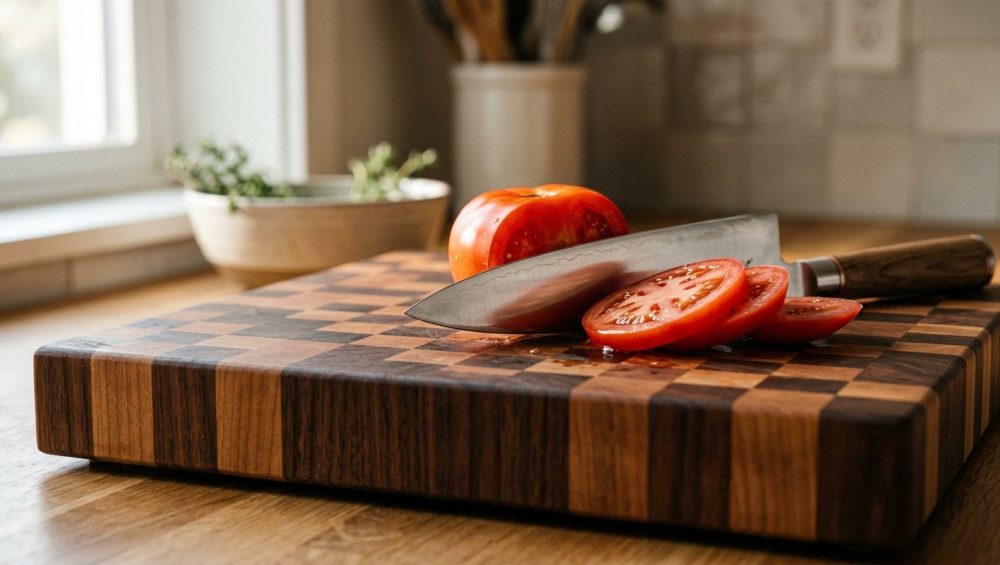
This brings us to the absolute pinnacle of kitchen prep surfaces: the end-grain cutting board. To build an end-grain board, a woodworker takes pieces of hardwood, cuts them into blocks, and turns them so that the end of the wood (the rings of the tree) faces upward. These blocks are then meticulously glued together in a checkerboard pattern.
The structural genius of this design lies in the orientation of the wood fibers. In an end-grain board, the microscopic fibers of the wood run vertically, pointing straight up at the ceiling. Think of the board like a giant, densely packed paintbrush standing on its handle, with the bristles pointing up.
When your knife strikes an end-grain board, it does not sever the fibers. Instead, the microscopic apex of the blade slides between the vertical fibers, gently parting them. The board literally yields to the knife, catching the edge in a soft, forgiving embrace rather than fighting against it.
The Self-Healing Phenomenon Explained
Because the vertical fibers of an end-grain board are pushed apart rather than cleanly severed, an incredible phenomenon occurs when you lift the knife away. The natural tension of the wood causes those fibers to close back up. This is widely referred to in the culinary world as the board’s “self-healing” property.
While it won’t magically erase a massive cleaver gouge, standard slicing and chopping marks will literally disappear as the fibers squeeze back together. This self-healing nature prevents the deep, bacteria-harboring ravines that plague plastic and edge-grain boards. More importantly, because the board is yielding to the blade, you are actively preventing the rolling and chipping that results in dulling your chef’s knife. Professional chefs who process hundreds of pounds of ingredients daily rely on end-grain boards specifically because they drastically extend the time between knife sharpenings.
Why End-Grain Absorbs Impact Better
Beyond edge retention, end-grain boards drastically improve the physical experience of cooking. Because the vertical fibers compress slightly upon impact, the board acts as a natural shock absorber. When you are doing heavy prep work—chopping dense root vegetables or breaking down poultry—this shock absorption reduces the jarring feedback that travels up your arm. It minimizes hand fatigue and makes chopping feel effortless, fluid, and remarkably quiet compared to the aggressive thwack of a plastic board.
The Science of Sanitation: Wood vs. Plastic
Capillary Action and Bacterial Neutralization
For decades, health inspectors and home cooks alike were terrified of wooden cutting boards. The assumption was that wood is porous, therefore it must soak up raw chicken juices and create a deadly bacterial breeding ground. This myth was so pervasive that the USDA initially recommended plastic over wood.
However, legendary food safety researcher Dean Cliver at UC Davis decided to actually test this theory in the 1990s, and his findings completely turned the culinary world upside down. Cliver applied dangerous bacteria, including Salmonella, E. coli, and Listeria, to both plastic and wooden cutting boards.
The results were staggering. On the plastic boards, the bacteria survived, thrived, and multiplied—especially inside the microscopic knife grooves. But on the wooden boards, the bacteria vanished. Wood is naturally highly absorbent. Through a process called capillary action, the vertical fibers of the wood actively pull moisture and bacteria down beneath the surface of the board. Once trapped deep inside the wood fibers, the bacteria are deprived of moisture and physically bind to the organic material, dying off entirely within minutes. Wood is not just a passive surface; it is an active, self-sanitizing, antibacterial powerhouse. Because end-grain boards have vertical fibers exposed directly to the surface, this capillary action is exceptionally efficient.
Debunking the “Plastic is Cleaner” Myth
So why do commercial kitchens still use plastic? It comes down to industrial dishwashers and cross-contamination protocols. Restaurants use high-heat chemical sanitizers and color-coded plastic boards (red for raw meat, green for veggies) to idiot-proof their prep lines. But you are not running a commercial prep line. You are a home cook looking for one reliable, safe, and beautiful workstation. For the home kitchen, a well-maintained wooden board is scientifically proven to be vastly more hygienic than a scarred, microplastic-shedding synthetic board. It is undeniably one of the most essential kitchen tools for beginners and experts alike.
How to Choose a Genuine, Non-Toxic End-Grain Board
Safe Woods: Maple, Walnut, and Cherry
If you are ready to invest in an end-grain board, you must pay attention to the species of wood. You need a wood that strikes the perfect balance on the Janka hardness scale—hard enough to resist deep gouging, but soft enough to pamper your knife edge.
The holy trinity of cutting board woods is Hard Maple, Walnut, and Cherry.
- Hard Maple: The industry standard. It has a Janka hardness of about 1,450 lbf. It is incredibly durable, has tight, closed pores (which aids in sanitation), and offers a beautiful, bright aesthetic.
- Walnut: Slightly softer at around 1,010 lbf, making it an absolute dream for knife edges. It features a stunning, dark chocolate hue that hides stains beautifully.
- Cherry: Sitting around 995 lbf, Cherry is gentle on knives and ages magnificently, deepening into a rich, reddish-brown patina over time.
Avoid mystery woods, heavily marketed “acacia” boards from dubious overseas manufacturers (which often have wildly inconsistent hardness levels), and highly porous woods like Red Oak, which have open grains that can trap food particles.
The Glue Factor: Avoiding Toxic Adhesives
An end-grain board is constructed from dozens of individual wood blocks glued together. Therefore, the adhesive used is just as important as the wood itself. Cheap, mass-produced boards often use industrial adhesives containing formaldehyde or melamine-formaldehyde resins. When these boards are scored by a knife, or when they are exposed to acidic foods like tomatoes or lemons, they can leach toxic chemicals into your meal.
When shopping for an end-grain board, you must verify that the manufacturer uses 100% FDA-approved, food-safe, waterproof wood glue. Titebond III is the gold standard in the woodworking industry. It is non-toxic, incredibly strong, and unaffected by the moisture of your kitchen prep. If a manufacturer won’t proudly state what kind of glue they use, run the other way. You want a minimalist kitchen setup built on safety and quality, not mystery chemicals.
Thickness and Weight: Why Heft Matters
A proper end-grain board is not something you casually toss into the sink with one hand. It should be a substantial, heavy piece of equipment. Look for a board that is at least 1.5 to 2 inches thick.
This thickness serves two critical purposes. First, it prevents warping. Wood expands and contracts with changes in humidity and moisture. A thin end-grain board will quickly bow and crack under these stresses. A thick, hefty board has the structural integrity to remain perfectly flat for decades. Second, weight equals stability. The absolute last thing you want when wielding an eight-inch chef’s knife is a cutting board that slides around on the counter. A heavy end-grain board stays planted exactly where you put it, providing a safe, immovable workstation.
The Sassy Sous-Chef’s Guide to End-Grain Maintenance
Seasoning: The Mineral Oil and Beeswax Ritual
I will be brutally honest: end-grain boards are high maintenance. If you are the kind of person who wants to throw everything in the dishwasher and forget about it, this is not for you. But if you respect your tools, the maintenance ritual is actually incredibly meditative.
Because the vertical fibers of an end-grain board are exposed, they act like tiny straws, eagerly soaking up moisture. If you allow the board to dry out, those fibers will shrink, pull apart, and eventually, your wooden cutting board keeps cracking until it literally splits in half.
To prevent this, you must season the board. This involves flooding the surface with food-grade mineral oil. (Do not use olive oil or vegetable oil, as they will go rancid and make your kitchen smell like a dive bar). The wood will drink the mineral oil, filling the cellular structure of the fibers. Once the board is fully saturated with oil, you seal it with a board butter—a mixture of mineral oil and natural beeswax. The beeswax creates a waterproof barrier on the surface, keeping the hydrating oil inside and the raw meat juices outside. You should oil a new board every day for a week, once a week for a month, and then once a month for the rest of its life.
Washing and Drying: The Golden Rules
Cleaning an end-grain board is remarkably simple, provided you follow the golden rules.
Rule #1: Never, ever put it in the dishwasher. The extreme heat and prolonged water exposure will melt the glue, warp the wood, and destroy a $200 board in a single cycle.
Rule #2: Never submerge it in the sink.
To clean the board, simply take it to the sink, use a sponge with warm water and a drop of mild dish soap, and scrub the surface. Rinse it quickly with a damp cloth or a fast splash of water.
Rule #3: The most critical step is drying. You must towel-dry the board immediately, and then stand it upright on its edge to air dry. If you lay a damp board flat on the counter, moisture gets trapped underneath. The top dries and shrinks, the bottom stays wet and expands, and the board warps into a permanent bowl shape. Stand it up, let it breathe, and respect the wood.
Resurfacing: A Board for a Lifetime
The most beautiful aspect of a thick end-grain board is that it is a “Buy It For Life” item. Even with the self-healing fibers, a board will eventually show some wear and tear after five or ten years of heavy daily use. But unlike a plastic board that must be thrown into a landfill, an end-grain board can be reborn.
All it takes is a random orbital sander and a few sheets of sandpaper. By sanding off the top fraction of an inch, you expose brand-new, pristine wood underneath. Apply a fresh coat of mineral oil and beeswax, and your decade-old cutting board looks like it was just unboxed from the woodshop yesterday.
The Financial Case for the End-Grain Investment
Calculating the Cost of Ruined Knives
I know what you are thinking: “A high-quality end-grain walnut board costs $150 to $300. I can buy a plastic board at the supermarket for $12.”
Yes, you can. But let’s do the math. If you buy a cheap plastic or bamboo board, it will aggressively dull your knives. If you are using a premium $200 Japanese or German chef’s knife, you are now forced to have it professionally sharpened three or four times a year (at $15 a pop), or you are grinding away the steel yourself on a whetstone. Every time you sharpen a knife, you are removing metal, shortening the lifespan of the blade.
Furthermore, plastic boards become deeply scarred and unsanitary within a year, meaning you have to throw them away and buy new ones constantly. Over the course of ten years, you will spend far more money replacing ruined plastic boards and prematurely worn-out knives than you ever would have spent on one premium wooden board.
Buy It For Life (BIFL) Kitchen Philosophy
We need to stop treating kitchen gear as disposable. The culture of buying cheap, toxic junk, ruining it in a year, and throwing it in the trash is exhausting and expensive. Investing in an end-grain cutting board is an investment in your culinary sanity. It is a functional piece of art that anchors your kitchen. When you have a massive, beautiful block of maple or walnut sitting permanently on your counter, it invites you to cook. It helps you eliminate kitchen chaos because you always have a dedicated, stable, and safe zone ready for prep work.
Reclaiming Your Prep Work Joy
Effortless Chopping and Mindful Cooking
Cooking should not feel like a battle of attrition against your own ingredients. When you are struggling to saw through a tomato skin, or when you are crying profusely because onions make you cry only when their cellular walls are violently crushed by a blunt blade rather than cleanly sliced by a sharp one, you lose the joy of the kitchen.
Upgrading to an end-grain cutting board changes the entire tactile experience of cooking. There is a deep, satisfying, resonant thud when a sharp knife meets an end-grain block. The blade bites gently into the wood, the fibers part, and the food falls away effortlessly. It is a symbiotic relationship between steel and wood, engineered by nature and perfected by craftsmanship.
So do yourself, your knives, and your sanity a massive favor. Throw away the microplastic-shedding synthetic mats. Toss the knife-destroying bamboo and the terrifying glass slabs. Invest in a gorgeous, hefty, self-healing block of end-grain hardwood. Treat it with a little bit of mineral oil and a lot of respect, and it will reward you with decades of razor-sharp blades, sanitary prep, and the pure, unadulterated joy of effortless cooking. Now go pour yourself a glass of wine, grab your favorite chef’s knife, and start chopping like you actually mean it.