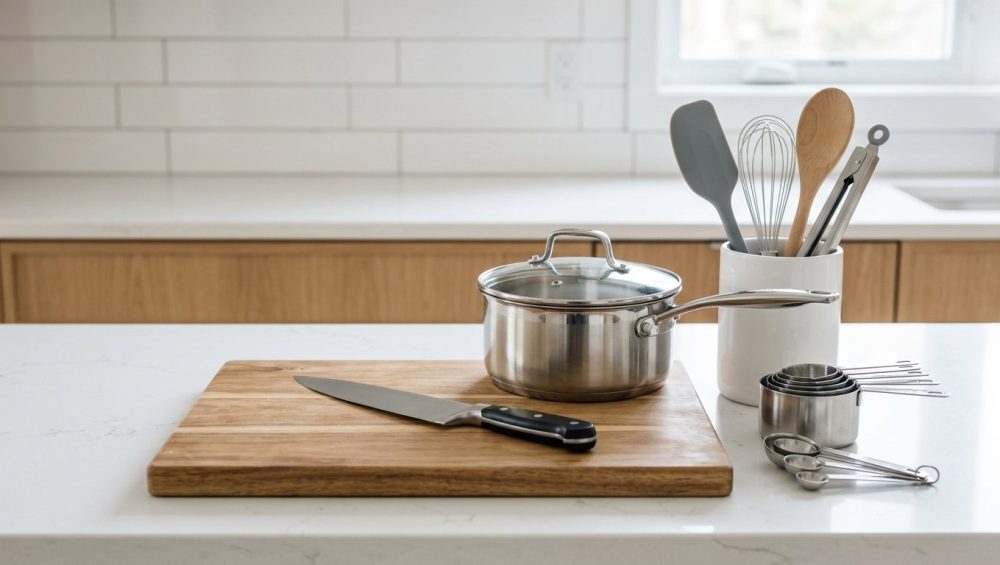
Welcome to the culinary thunderdome, my friends. If you are reading this, you are probably standing in the middle of a big-box home store, staring blankly at an intimidating wall of spatulas, wondering why on earth there are fourteen different types of garlic presses. You might be moving into your very first apartment, or maybe you have simply reached a breaking point and realized that your current setup—consisting of a dull paring knife, a warped frying pan, and a plastic spoon slightly melted on one side—is actively sabotaging your dinner.
I am here to tell you that you do not need a strawberry huller. You do not need a single-use avocado slicer. You certainly do not need a bulky, fifty-piece cookware set that takes up every square inch of your cabinet space. I have zero patience for pretentious chef-speak, but I have even less patience for the wedding registry industrial complex that tries to convince weekend culinary hobbyists that they need a commercial-grade pasta extruder just to make a decent Tuesday night dinner. Consider this your essential kitchen survival guide to navigating the culinary world without losing your mind, your money, or your counter space. We are going to build the ultimate, highly-functional minimalist kitchen setup from scratch. Grab a glass of wine, take a deep breath, and let’s get to work.
The Minimalist Kitchen Manifesto: Why Less is Actually More
Before we buy a single pan, we need to address the psychology of the space you are cooking in. Professional organizers and lifestyle experts frequently cite a staggering, albeit terrifying, statistic: the average American household contains roughly 300,000 items. Even if we assume a fraction of that number is accurate, our homes—and specifically our kitchens—are undeniably drowning in unnecessary physical clutter.
A 2023 YouGov consumer survey revealed that while the vast majority of people own the basic necessary tools, a shocking 27% of Americans actively want more kitchen gadgets, despite the overwhelming clutter they already deal with. We have been conditioned to believe that buying more specialized tools will somehow make us better cooks. This is a lie.
In reality, a disorganized, overstuffed workspace actively destroys your efficiency and your desire to cook. Studies on workplace productivity, including data published in the International Journal of Productivity and Performance Management, have shown that individuals operating in cluttered, disorganized environments can waste up to 20% of their time simply searching for tools and information. In a kitchen environment, that 20% time loss is the exact difference between a perfectly seared steak and a smoking, charred hockey puck. When your counters are covered in single-use appliances, you have no physical room to chop an onion, let alone roll out pastry dough. Embracing minimalism is the very first step in transforming your daily cooking from a chaotic, stressful chore into a highly rewarding, artistic endeavor. Less stuff equals less cleaning, less digging through drawers, and significantly more actual cooking.
The “No-Go” Zone: Toxic Trash You Need to Avoid (or Toss Immediately)
Before we talk about what you should buy, we need to talk about what you must avoid at all costs. I have a strict, non-negotiable rule in my kitchen: no cheap, toxic, peeling non-stick cookware.
Let’s talk about the dark side of convenience. Traditional non-stick coatings, most commonly known by the brand name Teflon, are made of polytetrafluoroethylene (PTFE). PTFE is a synthetic polymer that falls under the umbrella of PFAS (per- and polyfluoroalkyl substances), notoriously known as “forever chemicals” because they do not break down in the environment or in the human body.
The marketing departments of cheap cookware brands love to slap a bright green “PFOA-Free” sticker on their pans and call it a day, tricking beginners into thinking the pan is safe. Do not fall for this greenwashing. After PFOA was phased out due to its horrific health impacts, the industry largely swapped it for GenX, a chemical cousin with a slightly shorter molecular structure but the exact same terrifying health concerns. The U.S. Environmental Protection Agency (EPA) saw right through this, officially designating both PFOA and GenX as hazardous substances in 2024.
When you heat a cheap non-stick pan past 326°F—a temperature you can easily hit in just a few minutes on a standard medium-high gas burner—the chemical coating begins to degrade. As it breaks down, it releases highly toxic fumes. These fumes are so lethal they are known to cause sudden death in pet birds. In humans, inhaling these fumes causes a severe condition known as “Teflon Flu,” characterized by chills, fever, and body aches. The Washington Post reported 267 documented cases of this exact illness in 2024 alone. Furthermore, as these flimsy pans inevitably scratch and peel, they shed millions of microplastics and nanoplastics directly into your scrambled eggs.
The regulatory landscape is finally catching up to the science. Minnesota became the first state to take a hard, uncompromising stand by passing Amara’s Law, which completely bans the sale of cookware with intentionally added PFAS starting January 1, 2025. Other forward-thinking states like Colorado, Rhode Island, and Vermont are actively implementing similar bans that will take effect between 2026 and 2028.
If you currently have scratched, flaking, lightweight non-stick pans sitting in your cabinets, throw them in the garbage immediately. By tossing this toxic trash and fixing rookie kitchen mistakes, you are not just improving your food; you are actively protecting your long-term health.
The Holy Trinity of Knives: All You Will Ever Need
Walk down the aisle of any department store, and you will see massive, imposing wooden blocks holding fourteen different knives. These blocks are a scam designed to separate you from your hard-earned money. They are filled with useless filler blades you will never touch, and the block itself is a dark, impossible-to-clean cavern that breeds bacteria. When you are shopping for beginner kitchen tools, ignore the sets. You only need three knives to conquer 99.9% of all culinary tasks.
The Chef’s Knife: Your Kitchen Excalibur
If you only have the budget to invest in one high-quality item for your entire kitchen, spend it right here. An 8-inch chef’s knife is the undisputed workhorse of the culinary world. You will use it for slicing meat, dicing onions, mincing garlic, and chopping herbs.
When shopping, look for a knife with a “full tang.” This means the metal of the blade extends all the way through the handle to the base. A full tang provides essential balance and ensures the blade won’t suddenly snap off when you are trying to muscle your way through a dense butternut squash. You have two main choices in steel: German stainless steel (which is softer, heavier, and more forgiving if you accidentally hit a bone) or Japanese carbon steel (which is harder, lighter, holds a razor-sharp edge longer, but is more prone to chipping). For an absolute beginner, a high-quality forged German stainless steel blade is the safest, most durable bet.
Crucially, you must learn how to hold it. Do not grip the handle like you are holding a tennis racket with a death grip. Use the “pinch grip.” Pinch the base of the blade (the bolster) firmly between your thumb and the side of your index finger, and wrap your remaining three fingers loosely around the handle. This grip gives you absolute control over the blade, preventing it from twisting in your hand and ensuring clean, precise cuts.
The Paring Knife: For the Tiny Stuff
A chef’s knife is too unwieldy for delicate, off-board tasks. That is where a 3-inch or 4-inch paring knife comes in. This small, agile blade is designed for tasks you hold in your hands rather than on the cutting board. You will use your paring knife for hulling strawberries, peeling apples, deveining shrimp, scoring the skin of a tomato, and removing the eyes from potatoes. Because these knives take less of a beating against hard cutting boards, you don’t need to spend a fortune here; a simple, sharp, $15 paring knife will perform beautifully.
The Serrated Bread Knife: Not Just for Sourdough
The third member of the holy trinity is a 9-inch or 10-inch serrated knife. Obviously, this is essential for sawing through a crusty loaf of artisanal sourdough without crushing the soft, airy interior. However, its utility goes far beyond bread. The teeth of a serrated knife are perfect for gripping and slicing through the tough, slippery skin of ripe tomatoes without turning the flesh into a mushy puddle. It is also the ideal tool for leveling delicate cakes or slicing through massive, thick-skinned fruits like watermelons.
A note on maintenance: Buy a honing steel. A honing steel does not actually sharpen your knife; it simply realigns the microscopic teeth of the blade edge that get bent out of shape during normal chopping. A few swipes on a honing steel before you start cooking will keep your chef’s knife feeling razor-sharp for months between professional sharpenings.
Cookware That Won’t Poison You (or Fall Apart in a Year)
You do not need a twelve-piece matching set of pots and pans. You need four specific, high-quality vessels. If you buy the right materials, these four pieces will outlive you.
The Stainless Steel Skillet: The Workhorse
A 10-inch or 12-inch fully clad, tri-ply stainless steel skillet is the absolute foundation of serious cooking. “Tri-ply” construction means there is a core of highly conductive metal (usually aluminum or copper) sandwiched between two layers of incredibly durable, non-reactive stainless steel. This design gives you the rapid, even heat distribution of aluminum with the indestructible, non-toxic surface of stainless steel.
Beginners are often terrified of stainless steel because they think every piece of food will instantly cement itself to the pan. That only happens if you do not understand temperature control. To cook on stainless steel, you must preheat the dry pan over medium heat, then perform the water drop test (scientifically known as the Leidenfrost effect). Flick a few drops of water into the pan. If the water sizzles and evaporates immediately, the pan is too cold. If the water instantly shatters into a dozen tiny droplets, it is too hot. If the water forms a single, cohesive bead that glides around the surface of the pan like a mercury marble, your pan is perfectly preheated. At that exact moment, add your oil, let it heat for three seconds, and add your food. The food will sear beautifully, form a crust, and naturally release from the pan when it is ready to be flipped.
This pan is essential for developing “fond”—those deeply flavorful, caramelized brown bits that stick to the bottom of the pan after searing meat, which you then deglaze with wine or broth to make a pan sauce. You don’t need a kitchen full of gadgets to follow a pan-seared salmon and asparagus recipe; you just need one exceptional stainless steel skillet and the knowledge of how to use it.
The Cast Iron or Carbon Steel Pan: The Searing Champion
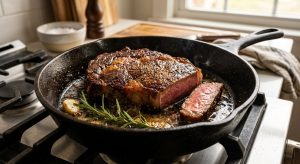
For high-heat searing, baking cornbread, or getting a crust on a smash burger, nothing beats heavy iron. A classic 10-inch bare cast iron skillet or a carbon steel pan is the original, centuries-old, non-toxic non-stick cookware.
Yes, cast iron requires a tiny bit of maintenance, but it is not the fragile prima donna the internet makes it out to be. The non-stick surface is created through “seasoning”—a process where liquid cooking oil is heated past its smoke point, causing it to undergo polymerization and bond directly to the metal. This creates a slick, black, naturally non-stick layer. Contrary to popular culinary myths passed down from your grandmother, you can wash a well-seasoned cast iron pan with modern dish soap. Modern dish soap no longer contains lye, so it will not strip polymerized oil. Wash it, dry it immediately on the stove, rub a microscopic drop of oil into the surface, and it will last for generations.
The Dutch Oven: The Ultimate Multitasker
An enameled cast iron Dutch oven (ideally in the 5.5 to 7-quart range) is the heavyweight champion of the minimalist kitchen. The heavy cast iron core retains heat beautifully, while the glass-like enamel coating means you can cook highly acidic foods (like a slow-simmered tomato sauce or a red wine beef bourguignon) without the acid eating away at the pan’s seasoning.
This single vessel can act as a soup pot, a braising dish, a deep fryer, and even a makeshift bread oven. The heavy, tight-fitting lid traps steam inside the pot, which is the secret to breaking down tough cuts of meat into melt-in-your-mouth perfection, or getting that coveted bakery-style crust on a loaf of homemade bread.
The Saucepan and Stockpot: Liquid Assets
To round out your cookware, you need two basic stainless steel pots. First, a 3-quart saucepan with a lid. This is for boiling a few eggs, making a batch of quinoa, warming up soup, or whisking together a quick gravy. Second, an 8-quart stockpot. You need volume here. An 8-quart pot gives you the necessary space to rapidly boil a pound of pasta without the water overflowing, blanch large batches of vegetables, or simmer a massive batch of homemade chicken stock on a Sunday afternoon.
The Essential Utensils and Prep Tools
With your knives and cookware sorted, you need a few critical tools to actually prep and move the food around.
Cutting Boards: Wood vs. Plastic
Let me establish a ground rule right now: glass and marble cutting boards are an absolute crime against humanity. They will instantly destroy the microscopic edge of your expensive chef’s knife.
For your primary prep surface, invest in a large, heavy wooden cutting board. Wood is naturally antimicrobial, gentle on your knife blades, and incredibly durable. If you have the budget, look for an “end-grain” wooden board, where the wood fibers face upward. When your knife strikes an end-grain board, the fibers naturally separate and then self-heal, keeping your knife sharper for much longer.
You should also keep one or two thin, inexpensive plastic cutting boards specifically reserved for handling raw poultry and meat. This prevents cross-contamination and allows you to easily toss the plastic board directly into the dishwasher for sanitization.
Spatulas, Spoons, and Tongs: The Extensions of Your Hands
Your utensil crock only needs a few high-quality items. First, ditch the flimsy nylon spatulas that melt on the edges and leach chemicals. Buy a seamless, solid-core silicone spatula. Silicone is heat-resistant up to 600°F, meaning you can use it to scramble eggs in a hot pan or scrape every last drop of batter out of a mixing bowl without fear of melting. Second, buy a sturdy wooden spoon. Wooden spoons are brilliant because they do not conduct heat (meaning the handle won’t burn your hand if you leave it resting in a pot of simmering soup) and they will never scratch the bottom of your pans. Finally, you need a pair of 9-inch or 12-inch locking stainless steel tongs with scalloped edges. Tongs are the true extensions of a cook’s hands. You will use them to flip heavy steaks, toss salads, twirl pasta, and retrieve hot jars from boiling water.
Measuring Tools and Mixing Bowls
Baking is a science, and cooking is an art, but both require a baseline of accuracy. We are heavily focused on demystifying modern recipes, and that process starts with accurate measurement. You need a set of metal dry measuring cups, a set of metal measuring spoons, and a clear glass liquid measuring cup (like Pyrex). Remember: dry measuring cups are meant to be filled to the brim and leveled off with a straight edge; liquid measuring cups have extra space at the top so you don’t spill milk all over the counter while moving it.
For prep, buy a nesting set of stainless steel or tempered glass mixing bowls. They take up the footprint of a single bowl in your cabinet but provide you with five or six different sizes for marinating meat, tossing salads, and whisking vinaigrettes.
Gadgets That Actually Earn Their Drawer Space
I am notoriously anti-gadget, but there are three specific specialty tools that offer such an immense return on investment that they absolutely earn their coveted drawer space.
The Microplane: The Flavor Maximizer
Originally adapted from a woodworking rasp, the Microplane grater is the secret weapon of professional kitchens. Its razor-sharp, photo-etched teeth can effortlessly zest the fragrant, oil-rich skin off a lemon without grabbing the bitter white pith underneath. It turns a clove of garlic or a knob of fresh ginger into a fine, melting paste in seconds, eliminating the need to meticulously mince with a knife. It will also shower your pasta with impossibly light, fluffy clouds of Parmesan cheese.
An Instant-Read Thermometer: The End of Guesswork
Cooking meat based on “time per pound” is an outdated, dangerous lie. Ovens run hot or cold, the thickness of chicken breasts varies wildly, and the starting temperature of your meat changes every time. Once you learn to decode pretentious recipe jargon, you realize that vague instructions like “cook until the juices run clear” are a terrible, unreliable metric compared to the cold, hard science of a digital temperature readout. A fast, accurate instant-read digital thermometer is the only way to guarantee perfectly medium-rare steak and ensure you never serve dry, chalky, overcooked chicken again.
The Bench Scraper: The Unsung Hero
A bench scraper is simply a rectangular piece of rigid stainless steel with a handle along one edge. It costs less than ten dollars, but it will fundamentally change how you move around your kitchen. You will use it to scoop up massive piles of chopped onions and transfer them to a hot pan without dropping them all over the floor. You will use it to portion out bread dough, smash garlic cloves, and scrape stubborn, dried-on flour off your countertops during cleanup. It is the ultimate utility player.
Organizing Your Minimalist Setup: The Flow
Buying the right tools is only half the battle; how you arrange them determines your efficiency. A beautiful kitchen is useless if you have to walk ten feet to find a wooden spoon while your garlic is actively burning on the stove.
Creating a permanently organized kitchen requires discipline and a ruthless commitment to workflow. Professional kitchens operate on the “Zone” system. You should divide your home kitchen into distinct operational areas:
- The Consumables Zone: Your pantry and refrigerator.
- The Non-Consumables Zone: Where everyday plates, bowls, and glassware live (ideally right near the dishwasher for easy unloading).
- The Prep Zone: The largest stretch of uninterrupted counter space you have. This is where your cutting board, knives, and mixing bowls should be stored.
- The Cooking Zone: The area immediately surrounding your stove. This is where your pots, pans, spatulas, tongs, and cooking oils must live.
- The Wash Zone: The sink and dishwasher area, housing your soaps, sponges, and dish towels.
By strictly grouping your tools by their function rather than their size, you eliminate unnecessary movement. Furthermore, ruthlessly clearing off your counters and storing appliances out of sight is one of the easiest, most cost-effective ways to make your kitchen feel brighter and more spacious. Keep your counters clear exclusively for the act of cooking. Adopt the French philosophy of mise en place (everything in its place)—chop all your vegetables, measure all your spices, and pull out all your tools before you ever turn on a burner.
Conclusion: Your Kitchen, Your Rules
Building a highly functional, minimalist kitchen setup is not about deprivation; it is about intentionality. It is about actively choosing to surround yourself with a few high-quality, non-toxic, reliable tools rather than a mountain of cheap plastic junk that frustrates you.
Cooking should be a joy, a creative outlet, and a reliable way to feed yourself and the people you care about. It should not be a battle against peeling Teflon and dull knives. When you invest in the right essentials, organize them efficiently, and focus on fundamental techniques rather than flashy gadgets, you unlock a completely new level of culinary confidence. When you finally master the art of effortless hosting, you will realize it has absolutely nothing to do with the quantity of your gear, and everything to do with the quality of your skills. Now, go donate that avocado slicer, sharpen your chef’s knife, preheat that stainless steel skillet, and get cooking. You’ve got this.