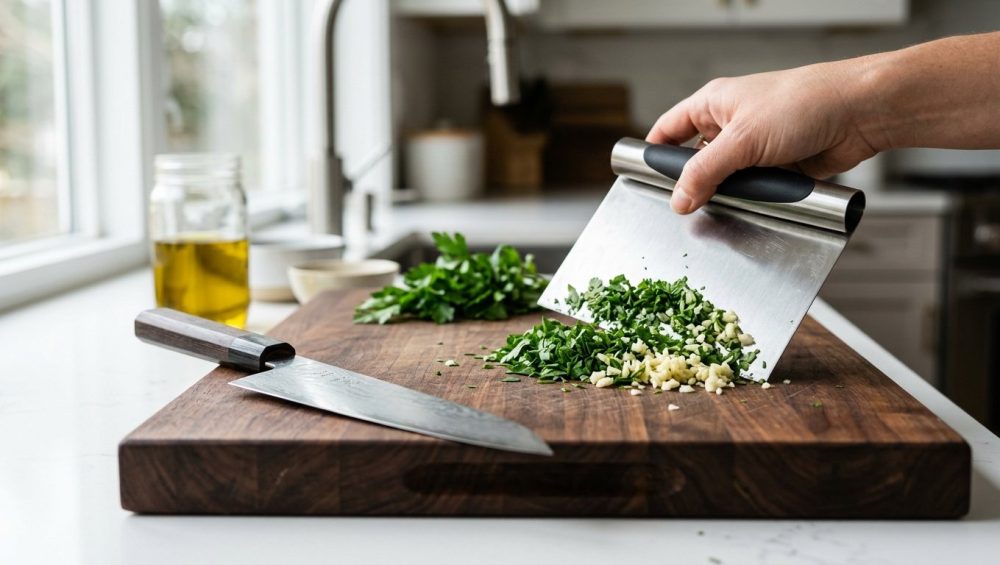
You just finished flawlessly dicing a mountain of onions for a weeknight bolognese. You are feeling like an absolute culinary rockstar. You take your gorgeous, meticulously crafted, high-carbon steel chef’s knife, turn the blade sideways, and aggressively scrape it across the wooden board to scoop up the pile.
Screeeech.
Stop it. Stop it right now. Every time you do that, a culinary angel loses its wings, and my soul temporarily leaves my body.
This single, seemingly innocent motion is the primary reason knives go dull so fast in home kitchens. We all do it. It is an incredibly hard habit to break, mostly because it feels efficient and we have all watched celebrity chefs do it on television for the last two decades. But dragging the delicate, microscopic edge of a knife across a hard surface under lateral pressure is a biomechanical nightmare for your blade.
You do not need a culinary degree to cook like a Michelin-starred chef on a Tuesday night, but you do need to treat your tools with a baseline level of respect. If you want to prep food faster, cleaner, and without destroying your most expensive kitchen investment, you need to put the knife down and pick up a food-grade stainless steel bench scraper.
Let us dive deep into the metallurgy of your knife, the physics of micro-abrasions, and why a ten-dollar piece of rigid steel is about to become your absolute favorite prep tool.
The Physics of a Razor’s Edge: What You Are Actually Destroying
To understand why scraping is a cardinal kitchen sin, we need to get a little bit nerdy about what a knife edge actually is. When you look at your chef’s knife, it looks like a solid, impenetrable wedge of metal. But at the microscopic level, that edge is shockingly fragile.
A quality chef’s knife is ground to an incredibly thin apex. On a standard, high-quality kitchen knife, that edge can measure just 10 to 15 microns across at the very tip. To put that into perspective, a single human hair is roughly 70 microns thick. Premium, high-end culinary steels can even be honed down to an astonishing 0.05 microns. At this microscopic scale, the steel is no longer a rigid, indestructible force; it is a delicate, flexible fin of metal.
Knives are engineered to withstand vertical force. When you chop straight down through a carrot, the microscopic geometry of the blade easily handles the impact because the force is distributed straight up through the thickest part of the spine.
However, knives are absolutely not designed to withstand lateral (sideways) force. When you turn your blade at an angle and drag it across a cutting board, you are applying intense sideways friction to a piece of metal that is a fraction of the width of a hair. This results in two catastrophic types of edge degradation:
Micro-Rolling: Instead of breaking off, the microscopic tip of the blade simply bends and folds over onto itself, much like a piece of aluminum foil curling over the edge of a table. The knife might still feel somewhat sharp to the touch, but the actual cutting apex is no longer aligned. When you try to slice a tomato, the rolled edge will skid right off the skin.
Micro-Chipping: If you are using a harder steel (like a Japanese VG-10 or Aogami Super steel), the metal is more brittle. Instead of rolling, the lateral friction of scraping will cause microscopic fragments of the steel to fracture and snap off completely. These tiny chips create a jagged, saw-like edge that tears food rather than cleanly parting it.
This microscopic damage is exactly why you cry chopping onions. A razor-sharp, perfectly aligned edge glides through an onion’s cellular structure, leaving the cell walls relatively intact. A rolled, micro-chipped edge acts like a microscopic bulldozer, crushing and tearing the cell walls, which releases a massive cloud of the volatile sulfur compounds that burn your eyes.
The Scraping Habit and the “Spine-Flip” Myth
If scraping is so destructive, why is it a universal instinct? It all comes down to the illusion of efficiency. When you are rushing to get a weeknight dinner on the table, time is money. You have a pile of minced garlic that needs to go into a hot pan right now before the oil smokes. Your knife is already in your hand. It has a wide, flat surface. It feels like the most logical spatula in the world.
For years, well-meaning culinary instructors have tried to correct this by teaching the “spine-flip” method. The advice goes like this: If you must use your knife to scrape, flip it upside down and use the dull spine of the blade to push the food.
Let me be brutally honest: the spine-flip is a terrible workaround.
First, it is ergonomically awkward. Kitchen knives are balanced to be held with the blade facing downward. Flipping a heavy, 8-inch chef’s knife upside down forces your wrist into an unnatural angle. Second, the spine of a knife is thick and rounded, meaning it does not sit flush against the cutting board. When you try to scoop up finely minced garlic or herbs with the spine, half of the ingredients slip right underneath the metal and stay on the board. You end up making three awkward passes just to clear the surface, completely defeating the purpose of saving time.
If you genuinely want to stop dulling your knives and speed up your prep work, you need to stop compromising. You need a dedicated tool designed specifically for gathering, lifting, and transferring high volumes of ingredients.
Enter the Bench Scraper: The Ultimate Prep Solution
The bench scraper—also known as a bench knife, dough scraper, or food scoop—is a gloriously simple piece of equipment. It consists of a wide, rectangular piece of rigid metal (usually measuring about 6 by 3 inches) attached to a tubular or molded handle.
Originally championed by professional bakers for dividing sticky bread dough and scraping flour off wooden workbenches, this tool has quietly migrated to the savory prep stations of high-end restaurant kitchens. It is, without a doubt, your kitchen’s unsung hero.
Why is it so vastly superior to a chef’s knife for transferring food?
Massive Surface Area: A standard bench scraper has a surface area equivalent to a small shovel. While a chef’s knife tapers to a point, a bench scraper maintains its deep, rectangular shape from end to end. You can easily scoop up an entire diced jumbo onion, three minced bell peppers, or a pound of chopped chicken breast in a single, effortless motion.
The Flush Edge: Unlike the rounded spine of a knife, the bottom edge of a bench scraper is perfectly straight and ground to a blunt taper. It sits perfectly flush against your cutting board, acting like a squeegee. It easily collects every single drop of garlic juice, every stray fleck of parsley, and every grain of kosher salt in one clean sweep.
Zero Danger: Scooping a mountain of wet, slippery tomatoes onto the side of a razor-sharp chef’s knife and carrying it across the kitchen to a hot stove is a fantastic way to end up in the emergency room. A bench scraper is entirely blunt. You can press your palm against the edge, use it to support a towering pile of ingredients, and confidently transport it without risking your digits.
Material Matters: The “No-Go” Rule on Toxic Gear
Because I firmly advocate for the everyday home cook, I have absolute zero tolerance for cheap, toxic, poorly manufactured kitchenware. I am militant about banishing toxic kitchen gear from your home, and the bench scraper market is unfortunately flooded with garbage that you need to avoid.
When shopping for a bench scraper, you will encounter two primary categories of cheap alternatives that you must immediately reject: flexible plastic scrapers and “mystery metal” scrapers.
The Plastic Problem: Flexible plastic bowl scrapers are great for getting the last bit of cake batter out of a mixing bowl, but they are atrocious for savory kitchen prep. Hard plastic degrades over time, especially when exposed to the heat of a dishwasher or the acidic juices of tomatoes and citrus. More alarmingly, plastic scrapers shed microplastics. Scientific studies have quantified that normal cutting and scraping activities on plastic surfaces can release tens of milligrams of microscopic polymer fragments into our food every single year. Furthermore, if you use a plastic scraper to sweep ingredients directly into a screaming-hot stainless steel skillet, the edge will instantly melt, releasing toxic fumes and ruining your dinner.
The Mystery Metal Problem: Cheap, discount-bin metal scrapers are often made of low-grade carbon steel coated with a shiny, faux-chrome finish. After a month of use, that cheap coating will begin to flake off directly into your food, and the underlying metal will rapidly succumb to rust.
You must insist on food-grade stainless steel. But even within stainless steel, there are grades.
In the culinary world, the gold standard for durability is 304-grade stainless steel (often labeled as 18/8 or 18/10, referring to its chromium and nickel content). The inclusion of nickel in 304 stainless steel makes it highly resistant to corrosion, meaning it will easily survive decades of exposure to acidic tomato juices, salty brines, and the harsh, caustic detergents of your dishwasher.
Another common option is 430-grade stainless steel. This is a ferritic steel that contains no nickel. While it is still entirely food-safe and slightly cheaper, it is marginally less resistant to rust over the long haul compared to 304. A quick way to test what you bought? 430 stainless steel is highly magnetic, while 304 is largely non-magnetic.
When evaluating the handle, look for a fully sealed, ergonomic grip. Avoid tubular metal handles with open seams or rolled edges that are not completely welded shut. Open seams are notorious bacterial traps where dirty dishwater, raw chicken juice, and food particles can pool and fester over time. Look for a scraper where the steel blade is seamlessly embedded into a solid core handle made of non-slip silicone, durable POM (polyoxymethylene), or fully sealed, welded stainless steel.
The Economics of Edge Preservation and Time Management
Let us talk about the real-world value of this tool, because weekday cooking is a delicate balance of time and money.
According to the Bureau of Labor Statistics’ American Time Use Survey, the average American spends roughly 37 minutes a day on food preparation and cleanup. If you are a weekend culinary hobbyist cooking entirely from scratch, that number is likely much higher.
When you are prepping a complex mise en place—say, a stir-fry that requires diced chicken, minced ginger, sliced scallions, chopped broccoli, and minced garlic—the logistics of moving that food from the board to the wok become a massive bottleneck. Scooping ingredients with a knife requires multiple, slow, careful trips to the stove. A wide stainless steel bench scraper cuts your transfer time in half. It is a high-volume cargo ship for your ingredients.
But the true economic brilliance of the bench scraper lies in edge preservation.
A high-quality chef’s knife is an investment, often costing anywhere from $100 to $300. When you scrape that blade across the board and induce micro-rolling and chipping, you are drastically accelerating the rate at which the knife needs professional maintenance.
In 2026, professional knife sharpening services typically charge between $10 and $20 per blade, depending on the length of the knife and the severity of the damage. If you have to send your knife to a whetstone master three times a year because you keep dragging it across a hard bamboo board, you are spending up to $60 annually just to fix a bad habit.
A premium, food-grade stainless steel bench scraper costs about $10 to $15, and it will literally outlive you. It requires zero maintenance, zero sharpening, and zero delicate handling. By absorbing all the brutal, abrasive tasks in the kitchen, it protects your expensive knife edges, saving you a small fortune in professional sharpening fees over a lifetime of cooking. Because of this massive return on investment, it is one of the absolute non-negotiable tools every beginner needs in their kitchen drawer.
When your knives stay razor-sharp for months on end, your entire cooking experience transforms. Prep work becomes a joy rather than a chore. Ingredients are sliced cleanly, cooking evenly in the pan. This simple workflow upgrade might honestly be the reason you finally stopped burning dinner, simply because you are no longer fighting with a dull blade or frantically making five trips to the stove while your garlic turns to bitter ash in the skillet.
Advanced Bench Scraper Techniques for the Weekend Warrior
Once you break the knife-scraping habit and integrate a stainless bench scraper into your daily routine, you will quickly discover that it is a ridiculously versatile multi-tool. Here are the professional techniques you should steal for your home kitchen:
1. The Dry Scrape (Board Cleaning and Sanitation)
This is perhaps the most important secondary use of the tool. After you finish chopping raw meat or sticky vegetables, your cutting board is covered in a layer of organic residue. If you immediately take a wet sponge to that board, you are just smearing the bacteria around and waterlogging the wood.
According to the FDA’s Bacteriological Analytical Manual (BAM), dangerous pathogens can begin forming protective biofilms on surfaces within just 20 minutes of contact with organic residue.
Before you ever introduce water, take your bench scraper, hold it at a firm 45-degree angle, and aggressively scrape the entire surface of the wooden board. This “dry scrape” mechanically shears away the stuck-on bits of fat, protein, and vegetable matter, leaving a smooth, mostly clean surface that is incredibly easy to wash. By minimizing the amount of time your wooden board spends soaking in hot, soapy water, you prevent the wood fibers from swelling and contracting. This moisture cycling is the exact reason your cutting board keeps cracking and warping.
2. Smashing Garlic and Ginger
We all love the classic culinary move of smashing a clove of garlic with the flat side of a chef’s knife to peel it. But doing this with a knife puts unnecessary lateral stress on the blade, and if your hand slips, you risk running your palm right across the sharp edge.
A bench scraper is the ultimate garlic smasher. The wide, flat steel surface easily covers three or four cloves at once. Give the handle a firm whack with the heel of your hand, and you will perfectly crush the garlic, releasing the alliinase enzymes that create that pungent, beautiful allicin flavor, all with zero risk of a trip for stitches.
3. Precision Dough Handling
If you occasionally dabble in weekend baking, the bench scraper returns to its original roots. Bread dough relies on a delicate network of gluten strands and trapped air pockets. When you try to divide sticky, high-hydration sourdough with a chef’s knife, the tapered edge drags through the dough, tearing the gluten network and deflating your hard-earned air bubbles.
A bench scraper’s blunt, rigid edge acts as a guillotine. It severs the dough cleanly with downward pressure rather than a slicing motion, preserving the internal structure. It is also the perfect tool for lifting and folding sticky doughs without covering your hands in floury glue. Many high-quality scrapers even feature laser-etched ruler markings along the blade, allowing you to cut perfectly uniform portions of biscuit or cinnamon roll dough.
4. Pan Deglazing and Griddle Cleaning
If you own a carbon steel griddle or a cast-iron flat top, the bench scraper is your best friend for cleanup. After searing burgers or steaks, the cooking surface is left with a layer of caramelized fond and burnt fat. While the surface is still warm, a splash of water and a firm push with a stainless steel bench scraper will instantly lift all that stubborn debris, leaving your griddle perfectly smooth and ready for a fresh coat of seasoning. (Note: Only do this on heavy carbon steel or cast iron; never use a metal scraper on a Teflon non-stick pan, as it will instantly destroy the toxic coating).
The Cutting Board Equation: Why Bamboo and Glass Are the Enemy
While we are on the subject of edge preservation, it is impossible to talk about the damage caused by scraping without addressing the surface you are scraping against.
The severity of the micro-abrasions inflicted on your knife is directly correlated to the hardness of your cutting board. In material science, the hardness of wood is measured using the Janka hardness scale. Laboratory tests have shown that cutting boards with a surface hardness exceeding 1200 Janka units cause immediate, measurable edge degradation—sometimes increasing micro-rolling by up to 22% within just 50 strokes.
This is exactly why bamboo cutting boards are secretly destroying your kitchen knives. Bamboo is not actually wood; it is a highly dense, glass-reinforced grass. It is incredibly hard, often exceeding 1300 to 1500 on the Janka scale. When you scrape a fragile, 15-micron knife edge across a rigid bamboo board, the board wins every single time, acting like a microscopic file that grinds away your blade.
The situation is exponentially worse if you are using a cutting board made of glass, marble, ceramic, or titanium. These materials are harder than the steel of your knife. Using them is the culinary equivalent of dragging your knife across a concrete sidewalk.
To properly protect your newly sharpened knives, you must pair your new bench scraper habit with a forgiving cutting surface. End-grain maple, walnut, or cherry wood boards are the gold standard. The wood fibers in an end-grain board face upward, allowing the microscopic apex of the knife blade to temporarily slide between the fibers rather than violently crashing against them. A high-quality wooden board, paired with the discipline of never scraping your knife sideways, will easily quadruple the lifespan of your sharp edge.
A Ten-Dollar Investment for Culinary Sanity
Cooking should not be a stressful, chaotic race against the clock, nor should it require a constant influx of cash to repair ruined equipment. The secret to elevating your weeknight meals is not buying a $500 Japanese Damascus steel knife; it is learning how to properly care for the $50 knife you already own.
By identifying and eliminating the destructive habit of blade-scraping, you instantly upgrade your efficiency and protect your tools. A food-grade, stainless steel bench scraper is incredibly cheap, infinitely durable, and ergonomically superior to a knife in almost every conceivable prep scenario.
It is a small, unpretentious square of metal that will dramatically speed up your ingredient transfers, keep your cutting board immaculately clean, save you a fortune in professional sharpening fees, and ultimately help you eliminate kitchen chaos.
So, do your chef’s knife—and my sanity—a massive favor. The next time you finish dicing that mountain of onions, leave the knife resting peacefully on the board. Grab your bench scraper, scoop up your masterpiece in one clean, satisfying sweep, and cook like the expert you are.