Picture this: It is a chilly Sunday afternoon, and you have spent the last three hours laboring over a gorgeous, bubbling pot of homemade soup. You meticulously chopped the mirepoix, you properly browned the meat, and you let the whole concoction simmer until your kitchen smelled like a rustic French farmhouse. You are feeling like an absolute culinary genius. You dip your spoon in, blow on the steaming broth, take a sip, and… nothing.
It is heavy. It is dull. It is the culinary equivalent of watching paint dry.
Your immediate, panicked instinct? Reach for the salt shaker. You dump a teaspoon in, stir, and taste. Still flat. You add another aggressive pinch. Now it is just a salty puddle of disappointment. Before you know it, you have ruined a perfectly good batch of expensive groceries, and you are desperately trying to figure out how to salvage dinner.
Stop. Put the salt down. Step away from the shaker.
As a home cook who has made every mistake in the book (and set off the smoke alarm more times than I care to publicly admit), I am here to tell you a fundamental truth about cooking: your soup does not need more sodium. It needs a wake-up call. It needs a splash of vinegar.
This is not pretentious chef-speak, nor is it a complicated technique that requires a culinary degree. This is basic kitchen chemistry. Today, we are going to dive deep into the absolute magic of acidity, the physiology of your taste buds, and exactly how a simple teaspoon of vinegar can transform your weeknight dinners from basic to mind-blowing. If you have ever wondered why your dinner actually needs acid, buckle up. We are leaving no stone unturned.
The Physiology of Taste: Why Your Tongue is Lying to You
To understand why your soup tastes like a bowl of boredom, we have to look at the hard science of taste perception. When you take a bite of food, you are not just experiencing an abstract concept of flavor; you are triggering a highly complex biological lock-and-key system right on your tongue.
The Five Basic Tastes and the Fat Problem
Humans can detect five primary tastes: sweet, salty, sour, bitter, and umami. Salt uses ion channels—specifically, sodium and chloride ions flow directly into your taste receptor cells, altering their electrical charge and sending a massive, immediate signal to your brain that says, “This is delicious.” This biological wiring is exactly why our default reaction to bland food is to salt it. It is an instant gratification button for our nervous system.
However, when you are cooking a rich, slow-simmered soup or stew, you are extracting a massive amount of lipids (fats) and structural proteins from your meats and oils directly into the broth. Fat is an incredible carrier of flavor, but it comes with a massive, often-ignored downside: it coats the tongue.
Recent sensory science has identified specific receptors on the tongue, such as the CD36 receptor, that are highly sensitive to fatty acids. When you eat a rich broth, those lipid molecules form a literal grease slick over your papillae (the tiny bumps on your tongue that house your taste buds). When your taste receptors are smothered in a microscopic layer of fat, they cannot effectively detect the salt or umami you have carefully built into the dish.
This is why, no matter how much salt you add to a heavy beef stew, the flavor feels muffled and distant. You are not fixing the root problem; you are just throwing sodium at a grease wall.
The Magic of the Proton Channel
Sourness—which is the perception of acidity—works through an entirely different biological mechanism. When you add an acid, like vinegar or lemon juice, to your food, it introduces hydrogen ions (protons) into the environment. These protons are tiny and aggressive. They blast through specific channels in your taste cells, triggering a sharp, bright sensation that immediately cuts right through that lipid coating on your tongue.
Acidity acts as a biological palate cleanser with every single bite. It washes away the fatty film, essentially “resetting” your taste buds so you can actually taste the savory, salty, and sweet notes hiding underneath the richness. It does not make the soup taste sour; it makes the soup taste more like itself.
The Chemistry of Soup (And Why Flatness Happens)
Let’s look at the actual pH levels of what you are cooking. As a quick refresher from high school chemistry, the pH scale measures how acidic or alkaline a substance is, ranging from 0 (battery acid) to 14 (liquid drain cleaner), with 7.0 being perfectly neutral.
Most savory ingredients we use for standard home soups—meat, potatoes, carrots, onions, and water—hover right around the neutral zone. According to food science data, a standard homemade chicken broth has a pH of about 5.8. A creamy potato soup sits right at 6.0. A hearty beef and barley stew is usually right around 6.2.
Why does this matter to you on a Tuesday night? Because a pH near 6.0 is incredibly safe, round, and completely lacking in sensory contrast. It is the culinary equivalent of listening to elevator music on a loop. When foods are too close to neutral, our palates perceive them as heavy, flat, or muddy.
Furthermore, during a long, slow simmer, many of the volatile, bright flavor compounds in your fresh vegetables literally cook off and evaporate into the air, leaving behind deep, earthy, but ultimately heavy base notes. If you have ever wondered why your chicken broth turns cloudy and tastes somewhat muddy after four hours on the stove, it is because those delicate high-notes have vanished, leaving behind a dense concentration of proteins and fats.
By introducing a splash of vinegar (which contains acetic acid, hovering around a pH of 2.5), you forcefully drag the overall pH of the pot down just enough to create contrast. That chemical contrast is exactly what your brain perceives as “brightness” and “depth.”
The “No-Go” Rule: Stop Ruining Your Soups with Toxic Pots
Before we go any further into the delicate nuances of vinegar pairings, we need to have a serious, sassy intervention about your kitchen equipment. As someone who firmly advocates for the everyday home cook, I refuse to let you put high-quality, expensive ingredients into garbage cookware.
If you are simmering acidic liquids—like tomatoes, wine, or vinegar-spiked broths—in a cheap, scratched, non-stick aluminum pot that you bought on clearance in 2012, you are actively ruining your food. I have absolutely zero patience for toxic kitchen gear. When the chemical non-stick coating on those cheap pots begins to peel, blister, and flake, it exposes the highly reactive aluminum core underneath.
When you add acid to a reactive metal pan, a chemical reaction occurs that leaches metallic ions directly into your soup. Best case scenario? Your carefully crafted minestrone tastes like a handful of dirty pennies. Worst case scenario? You are ingesting forever chemicals and mystery metals with your dinner.
You cannot achieve restaurant-quality results if you are cooking in peeling plastics. It is time to start banishing toxic kitchen gear from your life forever.
For soups, stews, and braises, you need a heavy-bottomed, completely non-reactive vessel. An enameled cast-iron Dutch oven is the absolute gold standard. The glass-enamel coating is completely inert, meaning you can boil vinegar in it all day long and it will never react or alter the flavor of your food. If you do not have enameled cast iron, a high-quality, fully clad stainless steel pot is your next best friend. (And yes, stainless steel is perfectly easy to clean if you know how to properly preheat it and utilize the water drop test to prevent sticking). Invest in good gear once, and it will take care of your food for a lifetime.
The Vinegar Arsenal: Which Acid for Which Soup?
Not all vinegars are created equal. You cannot just grab that giant plastic jug of harsh white distilled vinegar you use to descale your coffee maker and dump it into a delicate chicken consommé. Different soups demand entirely different flavor profiles. Here is your definitive, exhaustive guide to matching the acid to the broth.
1. Apple Cider Vinegar (The Reliable Workhorse)
If you only have room for one vinegar in your cramped pantry, make it a high-quality, unfiltered apple cider vinegar (ACV). ACV has a fruity, slightly sweet backbone that blends seamlessly into almost any savory application without announcing itself too loudly.
- Lentil and Bean Soups: Legumes are notoriously earthy and heavy. A splash of ACV brightens the muddy waters without overpowering the natural flavor of the beans. (As a pro tip, always wait until the end of the cooking process to add your acid, lest you watch your beans fall apart or stubbornly refuse to soften due to the low pH).
- Pork-Based Stews: Pork and apples are a classic culinary pairing; the subtle fruitiness of ACV enhances the savory, fatty notes of the meat beautifully.
- Root Vegetable Purees: Butternut squash, sweet potato, or roasted carrot soups benefit immensely from the tangy bite of ACV to cut through their natural heavy sweetness.
2. Sherry Vinegar (The Secret Weapon)
Sherry vinegar is the undisputed king of savory depth. Made from fermented Spanish sherry wine and aged in oak barrels, it has a nutty, complex, almost umami-like profile. It is significantly less sharp than standard wine vinegars but packs an incredible, sophisticated punch of flavor.
- Beef Stews: If your beef stew tastes like a heavy, plodding gravy, a tablespoon of sherry vinegar will instantly transform it into a sophisticated, restaurant-worthy dish.
- Mushroom Soups: The earthy, woody notes of wild mushrooms are amplified perfectly by the oak-aged complexity of sherry vinegar.
- French Onion Soup: A tiny splash stirred into the broth right before you top it with bread and Gruyère cheese cuts through the massive layer of melted dairy fat.
3. White Wine Vinegar (The Delicate Brightener)
Crisp, clean, and sharp, white wine vinegar is your go-to when you want to add pure acidity without altering the color or the fundamental flavor profile of the dish.
- Chicken Noodle Soup: When your chicken soup feels a bit too much like bland hospital food, white wine vinegar brings it back to life without making it taste “vinegary.”
- Seafood Chowders: It provides the same bright snap as a squeeze of lemon but with a more stable, fermented backbone that holds up better in hot liquids.
- Spring Minestrone: It highlights the fresh, grassy green notes of zucchini, spinach, and green beans.
4. Balsamic Vinegar (The Sweet Depth-Charger)
Balsamic is dark, syrupy, sweet, and intensely flavored. Because of its high sugar content and distinct molasses-like notes, it must be used with extreme caution in soups. It will turn a clear broth a murky brown, so it is best reserved for dark, robust, heavy liquids.
- Tomato-Based Soups: Tomatoes already contain citric and malic acid, but as they cook down, they can become overly sweet and heavy. Balsamic restores the acidic balance while complementing the tomato’s natural concentrated sugars.
- Chili: A secret ingredient in many award-winning Texas chilis is a splash of balsamic right at the end to balance the heat of the peppers and the heavy richness of the beef fat.
5. Rice Vinegar (The Asian-Inspired Lifesaver)
Made from fermented rice, this vinegar is much milder, sweeter, and significantly less acidic than its Western counterparts. It is delicate and completely lacks the harsh “bite” of standard white vinegar.
- Egg Drop Soup: Keeps the thickened broth light and refreshing.
- Hot and Sour Soup: It provides the essential “sour” note without overwhelming the palate.
- Miso Soup: A few drops can elevate a standard, store-bought instant miso paste into something that tastes like it came from a high-end sushi bar.
6. Champagne Vinegar (The Elegant Finisher)
Even lighter and more floral than white wine vinegar, Champagne vinegar is for your most delicate, expensive ingredients.
- Lobster Bisque or Crab Soups: It provides a whisper of acidity that cuts through the heavy cream and butter without masking the sweet, delicate flavor of expensive shellfish.
The Mechanics of the Splash: How, When, and Why
Knowing which vinegar to use is only half the battle. The execution is where most weeknight culinary warriors fail. If you just dump acid into a boiling pot indiscriminately, you are going to ruin your dinner. Cooking is about technique just as much as it is about ingredients.
Rule #1: Timing is Everything (The Volatility of Acetic Acid)
The sourness in vinegar comes from acetic acid. Acetic acid is highly volatile, meaning its chemical structure breaks down and it evaporates very quickly when exposed to sustained heat. If you add your vinegar at the beginning of a two-hour simmer, the acid will literally boil off into the air, leaving behind only trace flavor compounds and absolutely zero brightness.
You must add your vinegar at the very end of the cooking process. I call this the “finishing splash.” Once your soup is completely cooked, the meat is perfectly tender, and the vegetables are soft, turn off the heat. Remove the pot from the hot burner entirely. Now you add your acid. This preserves the sharp, bright punch of the protons, ensuring they hit your tongue exactly as intended.
Rule #2: Dosage (What exactly is a “splash”?)
As a sassy culinary blogger, I generally hate giving precise measurements for things that should be felt with the soul. But since you are reading this to learn how to fix your food, I will give you a strict baseline.
For a standard 4-to-6 quart pot of soup, start with exactly one teaspoon of vinegar.
Stir it in, let it mingle for thirty seconds, and taste the broth. Does the flavor suddenly pop? Does the liquid feel lighter on your palate? If yes, stop immediately. If it still tastes a bit muddy, add one more teaspoon.
You are not trying to make the soup taste sour. If you can actually identify the distinct taste of vinegar in your chicken noodle soup, you have gone too far. The goal is subliminal brightness. The acid should act as an invisible scaffolding that lifts the other flavors up without ever taking center stage.
Rule #3: Emulsification and Excess Fat
When you add acid to a fat-heavy broth, you are creating a very loose, temporary emulsion. Just like making a vinaigrette for a salad, the acid cuts the oil. If your soup has a massive, quarter-inch oil slick on top, however, a single teaspoon of vinegar is not going to save you. You need to physically remove some of that excess grease first. I highly recommend using a curved saucier pan to easily whisk and reduce liquids, or better yet, a bottom-release fat separator to skim the heavy broth before applying your acidic finishing touch.
Case Studies: Rescuing the Most Common Soups
Let’s put all this food science theory into practice with some real-world kitchen triage. Here is exactly how you rescue the three most common weeknight soup disasters.
Case Study A: The Heavy, Plodding Beef Stew
The Problem: You braised chuck roast, potatoes, and carrots in beef stock and red wine for three hours. It looks beautiful, but it tastes like a salt lick wrapped in a wet blanket. It is aggressively savory but totally exhausting to eat after three bites.
The Fix: Take the pot off the heat. Add 1 to 2 tablespoons of Sherry Vinegar.
The Science: The heavy rendering of beef fat (tallow) has completely coated your palate. The acetic acid slices directly through the tallow, while the oaky, fermented notes of the sherry vinegar marry perfectly with the roasted beef proteins. Suddenly, the carrots taste sweeter, the beef tastes beefier, and the broth feels rich instead of greasy.
Case Study B: The “Sick Day” Bland Chicken Noodle
The Problem: You boiled a chicken carcass with some celery and carrots. You salted it. You salted it again. It still tastes like hot water with vague chicken memories.
The Fix: Off the heat, add 1 tablespoon of White Wine Vinegar or a heavy squeeze of fresh lemon juice.
The Science: Chicken fat (schmaltz) is delicious but very mellow and unassertive. Without a sharp counterpoint, it easily gets lost. The clean, sharp hit of white wine vinegar lowers the pH just enough to trigger your sour receptors, which in turn amplifies your brain’s perception of the salt you already added.
Case Study C: The Muddy Lentil Soup
The Problem: You made a healthy, fiber-rich lentil soup. But lentils are starch-heavy and earthy, and the resulting pot looks and tastes like delicious, warm mud.
The Fix: Add 1 tablespoon of Apple Cider Vinegar and a pinch of red pepper flakes.
The Science: Starch thickens the water, muting flavor transmission to your taste buds. The fruity acidity of ACV brightens the earthy legumes, providing a necessary high-note to contrast the deep, bass-heavy flavor of the lentils.
Beyond Vinegar: The Rest of the Acid Family
While vinegar is the most shelf-stable, reliable, and versatile acid in your pantry, it is not the only tool at your disposal. Knowing when to swap vinegar for a different acid is the mark of a truly resourceful home cook.
Lemon and Lime Juice (Citric Acid)
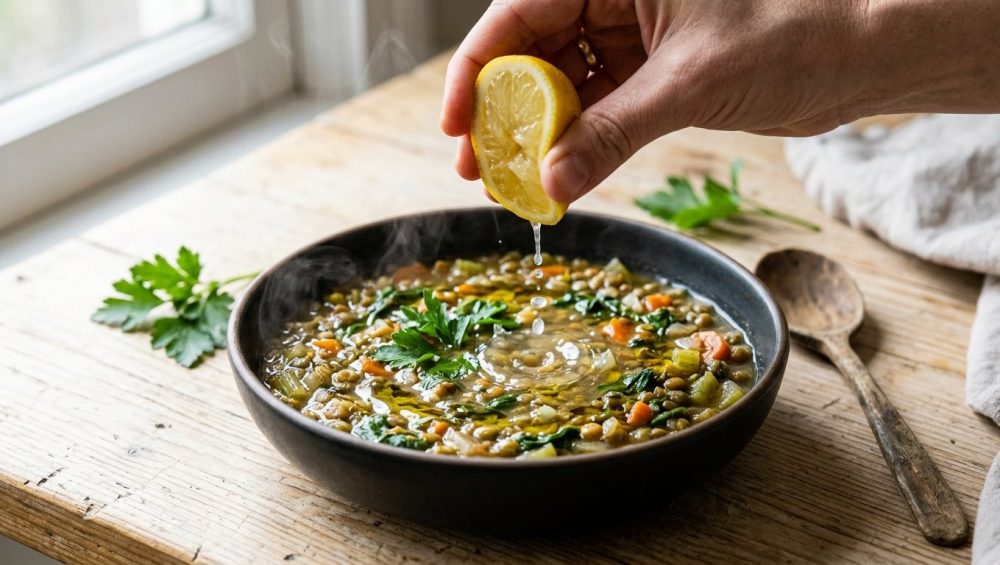
While vinegar relies on acetic acid, citrus fruits rely on citric acid. Citric acid is sharper, more aggressive, and hits the front of the tongue much faster than vinegar. It also brings distinct floral and fruity aromatic oils from the citrus zest.
- When to use it: Use fresh lemon juice for delicate, light soups like chicken, turkey, or spring vegetable broths. Use lime juice for anything with a Latin or Southeast Asian profile (tortilla soup, pho, tom yum, black bean soup).
- The Catch: Citric acid loses its punch even faster than acetic acid when heated. You must squeeze it directly into the serving bowls at the table for maximum effect, rather than into the hot pot on the stove.
Mustard
This is a professional chef’s secret weapon. Prepared mustard (like a high-quality Dijon) is heavily acidic because it is made with vinegar or verjuice, but it also contains natural emulsifying compounds present in the mustard seeds themselves.
- When to use it: If you are making a creamy soup, a pan sauce, or a cheesy broccoli soup and want to add acidity while also thickening the broth, whisk in a teaspoon of Dijon. It provides a savory tang and actively helps bind fat and water together. It is the secret power of dijon mustard working its magic in a hot application.
Cultured Dairy (Yogurt, Sour Cream, Crème Fraîche)
These ingredients rely on lactic acid, which is much rounder, softer, and creamier than either acetic or citric acid.
- When to use it: Swirl a generous dollop of sour cream or plain Greek yogurt into a bowl of borscht, chili, or spicy tortilla soup right before serving. The lactic acid brightens the dish while the dairy fat coats the tongue to protect it from extreme chili heat.
The Danger Zone: Acid and Dairy (How Not to Curdle Your Chowder)
There is one massive, glaring exception to the “just add a splash of vinegar” rule, and it involves cream-based soups. If you are making a New England Clam Chowder, a Cream of Mushroom, or a heavy Broccoli Cheddar soup, you must proceed with extreme caution.
Dairy products contain casein proteins. When the pH of a dairy-heavy liquid drops too low (meaning it becomes too acidic), these casein proteins denature, unravel, and violently clump together. This is called curdling. If you dump a shot of raw vinegar into a boiling pot of cream soup, you will instantly create a grainy, separated, horrifying mess. It is the exact same catastrophic chemical reaction that occurs when your meals turn out watery and broken because you added dairy too early in a long, hot braise.
How to safely add acid to cream soups:
- Use a milder, cooked acid: Opt for a splash of dry white wine reduced early in the cooking process (before the cream is added), rather than raw vinegar at the end. The heat will cook off the alcohol and mellow the tartaric acid, while the reduction concentrates the flavor safely.
- Add it to the bowl, not the pot: If you want a hit of lemon on your chowder, squeeze it over the individual portion right as you eat it, rather than mixing it into the master batch where it will sit and curdle over time.
- Rely on acidic garnishes: Instead of acidifying the cream directly, serve the soup with a side of acidic contrast. A spoonful of pickled jalapeños on a cheddar soup, or a side of crusty sourdough bread (which contains natural lactic and acetic acid from the fermentation process) provides the necessary balance without ruining the delicate emulsion of the soup.
Troubleshooting: The “Oops, I Poured Too Much” Disaster
We have all been there. You were trying to add a delicate, refined teaspoon of apple cider vinegar, the cheap plastic restrictor cap popped off the bottle, and you just dumped a quarter cup of pure acid into your beautiful Sunday stew.
Take a deep breath. Do not panic. Do not throw the pot out the window. You can fix this.
When a soup is over-acidic, your tongue’s proton channels are being completely overwhelmed. You need to buffer the acid immediately. You have three primary ways to rescue the pot from disaster:
1. The Baking Soda Trick (The Chemical Fix)
Baking soda (sodium bicarbonate) is highly alkaline (basic). When you add a base to an acid, they chemically neutralize each other, creating water, a little bit of salt, and carbon dioxide gas.
- How to do it: Add baking soda to the soup in microscopic amounts. I am talking 1/8th of a teaspoon at a time. Stir it vigorously. The soup will foam up and bubble rapidly (that is the CO2 gas releasing). Once the bubbling stops, taste it. The sharp acidic bite should be significantly reduced.
- The Warning: Do not add too much baking soda, or your soup will taste like a mouthful of metallic soap. Proceed with extreme caution.
2. Dilution and Fat (The Culinary Fix)
If the soup is just a little too tart, you can buffer the acid by adding more fat or starch to physically coat the tongue and block the sour receptors from being overwhelmed.
- How to do it: Swirl in a tablespoon of cold, unsalted butter, a splash of heavy cream, or a drizzle of high-quality olive oil. The lipids will help mask the excess protons. Alternatively, adding a diced raw potato and simmering until soft can help absorb some of the sharp flavors, though this takes significantly more time.
3. The Sweetness Counterbalance (The Flavor Fix)
Sweetness does not chemically neutralize acid, but it changes how your brain perceives it. This is exactly why lemonade tastes refreshing instead of like battery acid.
- How to do it: Add a tiny pinch of white sugar, a drizzle of honey, or a splash of maple syrup. The sugar will activate your sweet receptors, distracting your brain from the overwhelming sourness and creating a pleasant sweet-and-sour balance.
The Ritual of Tasting (And Why You Are Probably Doing It Wrong)
The most important tool in your kitchen is not your expensive stove, your razor-sharp Japanese chef’s knife, or your fancy enameled Dutch oven. It is your palate.
Most beginner cooks follow a recipe blindly, wait until the timer goes off, and serve the food without ever actually tasting it during the process. This is a guaranteed recipe for mediocrity. Cooking is a dynamic, living process. Ingredients change depending on the season, the brand, and how long they have been sitting in your crisper drawer. A carrot in December tastes completely different than a carrot in July. A store-bought stock can vary wildly in sodium content from batch to batch.
You must taste your food constantly. Keep a stack of clean tasting spoons next to your stove. (And please, for the love of all things holy, stop banging your wooden utensils on the edge of the metal pot to get the food off; it is exactly why your wooden spoons keep cracking and splintering into your dinners).
Taste the soup when you add the stock. Taste it halfway through the simmer. Taste it when it is completely done. Close your eyes and ask yourself: What is this missing? Is it heavy? Is it dull? Does it make the sides of my mouth water, or does it just sit there on my tongue like a wet sponge?
If it feels heavy, reach for the vinegar.
Final Thoughts: Becoming a Kitchen Alchemist
Mastering the use of acidity is the single biggest leap you can make from being a stressed-out recipe-follower to being a true, confident home cook. It is the invisible string that ties a dish together. It is the secret weapon that professional chefs use to make you think their food is inherently better than yours.
It isn’t. They just know how to manipulate your taste buds.
The next time you make a pot of soup, stew, or chili, I want you to conduct a little scientific experiment in your own kitchen. Ladle a small amount of the finished, un-acidified soup into a separate bowl. Add three drops of apple cider or sherry vinegar to that small bowl, stir it, and taste it side-by-side with the main pot.
I guarantee you will experience a massive lightbulb moment. The vinegar-spiked bowl will taste richer, more complex, and infinitely more satisfying. You will wonder how you ever survived a winter without it.
So, banish the bland. Stop relying exclusively on the salt shaker to save your meals. Build your vinegar arsenal, respect the delicate chemistry of your simmering pots, ditch the toxic gear, and start finishing your dishes like a pro. You do not need a culinary degree to make mind-blowing food; you just need a little bit of science, a lot of tasting, and the courage to add a splash of acid. Now go put a pot on the stove and make something brilliant. You’ve got this.