Pour yourself a generous glass of wine, grab a sturdy cutting board, and let’s have a brutally honest conversation about your chili. We have all been there, and there is no need to be ashamed. You invite a dozen friends over for a casual, supposedly low-stress weekend gathering, promising a hearty, soul-warming feast. You spend hours meticulously chopping, stirring, and simmering. The house smells absolutely incredible, building anticipation for hours. But when you finally sit down, exhausted, and take that first triumphant bite, your teeth meet a chalky, gritty, stubbornly hard little pebble of a kidney bean. The betrayal is absolute, the texture is ruined, and you spend the rest of the evening secretly apologizing to your guests’ dental work.
According to the latest 2025-2026 State of Home Cooking Report, a staggering 93% of American households are committed to cooking more meals at home this year, with a massive emphasis on low-effort, high-reward entertaining. We are all craving genuine connection, but absolutely nobody wants to be trapped in the kitchen sweating over a temperamental stove while their guests are in the living room having all the fun. This exact dilemma is why the communal chili bar has become the ultimate weekend hosting hack. It is infinitely scalable, wonderfully budget-friendly, and allows for endless customization. But none of that matters if the foundational element—the beans—tastes like gravel. You can stop ruining your dinner parties with last-minute stovetop panic by simply understanding the food science happening inside your pot.
I have zero patience for pretentious chef-speak, and I promise you do not need a culinary degree to cook like an absolute professional in your standard home kitchen. What you do need is a basic, no-nonsense understanding of cellular biology and thermodynamics. Yes, we are going to talk about science, but I promise to keep it highly practical and entirely relevant to your Tuesday night dinners. We are going to deconstruct exactly why your legumes are fighting you, how to manipulate their cellular structure using basic pantry staples, and how to engineer a flawless, stress-free chili bar that will have your guests begging for your secrets.
The Cellular Science of Stubborn Beans
Let’s get one thing straight right out of the gate: cooking is just edible chemistry. When you throw a cup of dried beans into a pot of water, you aren’t just heating them up to make them hot; you are attempting to initiate a highly complex series of molecular transformations. The primary villain in our story of crunchy, disappointing chili is a little polysaccharide called pectin.
Pectin is the biological glue that holds plant cell walls together. In its raw, unhydrated state, it is incredibly strong, which is why dried beans can sit in your pantry for three years and still look exactly the same as the day you bought them. When exposed to neutral water and sustained heat, this pectin network gradually breaks down. The “glue” dissolves, the plant cells separate, and the interior of the bean becomes delightfully creamy and tender. However, this biological process is highly conditional. If you alter the chemical environment of the cooking liquid, the pectin reacts entirely differently. This cellular reaction is the literal scientific reason why your dried beans never soften no matter how many hours you leave them boiling on the stove.
The Hard Water Conundrum
Before we even talk about the ingredients going into your chili, we need to have a serious talk about what is coming out of your kitchen faucet. According to the U.S. Geological Survey, approximately 85% of households in the United States have hard water. Hard water is simply tap water that contains high concentrations of dissolved minerals, specifically calcium and magnesium.
While these naturally occurring minerals are perfectly safe to drink and actually impart a crisp flavor to your drinking water, they are an absolute nightmare for cooking legumes. When you boil beans in hard water, the calcium and magnesium ions act like microscopic steel rebar. They bond directly with the pectin in the bean’s cell walls, cross-linking the molecules and reinforcing the cellular structure. Instead of dissolving under the heat, the pectin forms an impenetrable, heat-resistant fortress. You could boil those reinforced beans for ten hours straight, and they would still have the texture of a pencil eraser.
The Acidic Sabotage
If hard water is the first enemy of the tender bean, acidic ingredients are the final boss. A great chili relies heavily on crushed tomatoes, concentrated tomato paste, and sometimes a splash of apple cider vinegar or dark beer for depth of flavor. Tomatoes are highly acidic, typically sitting at a low pH of around 4.0 to 4.5.
When you introduce a low-pH acidic environment to legumes that have not yet fully softened, you trigger a catastrophic chemical reaction. The acidity shifts the pectin into a “bound” state, tightening the cellular network and making the calcium bridging even more effective. The biggest mistake you can possibly make is adding tomatoes too early in the cooking process. Once that acidic cross-linking occurs, the structural damage is irreversible. The beans are permanently locked in their hardened state, and no amount of aggressive simmering, stirring, or praying will save them.
The Thermodynamics of Starch Gelatinization
Now that we understand the cellular glue keeping the bean together, we need to talk about the filling inside. Inside those rigid plant cells are tightly packed granules of starch, specifically amylose and amylopectin. For a bean to transition from a hard seed to a creamy, luxurious bite, these starch granules must absorb water, swell up to multiple times their original size, and eventually burst in a process known as starch gelatinization.
This process is entirely dependent on sustained, precise thermal control. Starch gelatinization in beans does not happen at room temperature, and it does not happen efficiently at a lukewarm, hesitant simmer. The chemical reaction peaks in a very specific, narrow temperature window: between 185°F and 205°F (85°C to 96°C).
If your cooking liquid drops below 185°F, the starch granules will not fully hydrate, leaving the interior of the bean gritty, mealy, and unpalatable. Conversely, if you crank the heat and push the pot to a violent, rolling boil (212°F / 100°C), you introduce massive mechanical stress. The rapid expansion of steam inside the bean, combined with the violent physical agitation of the boiling water, causes the delicate skins to blow out and split entirely. You end up with a pot full of empty, shredded skins floating in a murky, overly starchy broth.
To achieve absolute legume perfection, you must hold the cooking liquid securely in that narrow 185°F to 205°F band. This requires a gentle, lazy, consistent simmer where bubbles only occasionally break the surface of the liquid.
The Sassy Sous-Chef’s Mandatory Cookware Intervention
We cannot possibly talk about maintaining precise, narrow-band temperature windows without addressing the elephant in the room: your cookware. I am about to enforce my strictest kitchen rule, and I need you to listen carefully because I am actively trying to save your dinner, your wallet, and your health.
You cannot execute a slow, steady, thermodynamically stable simmer in a cheap, flimsy, peeling non-stick pot, nor can you do it in a thin aluminum stockpot you bought for ten dollars at a discount store in college. Thin pots have absolutely zero thermal mass. They create aggressive, localized hot spots that will scorch the bottom of your chili while leaving the top layer lukewarm. Furthermore, cooking highly acidic, tomato-based stews in reactive metals—like bare aluminum or poorly seasoned cast iron—will cause the metal to physically leach into your food, giving your carefully crafted chili a harsh, metallic, blood-like taste. If your poorly seasoned skillet leaves black specks floating in your food, it is time to upgrade your gear immediately.
More importantly, I have a strict, zero-tolerance policy for toxic kitchen gear. If you are using a non-stick pot where the Teflon coating is scratched, flaking, or peeling, you need to walk into your kitchen right now and throw it in the garbage. I am completely serious. You are actively feeding your family and friends mystery forever-chemicals and toxic flakes. It is entirely unacceptable for any home cook who cares about what goes into their body.
For a massive, heavy batch of chili, you need safe, high-quality, durable equipment that offers real value and massive thermal retention. Your best friends for this job are heavy enameled cast iron Dutch ovens (like a classic Le Creuset or Staub) or high-quality, multi-clad stainless steel pots. These vessels absorb heat slowly and radiate it evenly from all sides, enveloping your beans in a consistent, stable temperature bath that makes holding a 195°F simmer completely effortless. Yes, they are a financial investment up front, but they will last longer than you will, and they will never poison your guests. Furthermore, stirring heavy stews requires sturdy tools; if your cheap wooden spoons keep cracking under the sheer weight of a massive chili batch, replace them with seamless, high-heat silicone spatulas that won’t harbor bacteria or snap in half.
The Perfect Chili Bar Sequencing: A Masterclass
We have thoroughly covered the science and the hardware. Now, let’s translate this complex chemistry into actionable, foolproof steps. The secret to an award-winning, mind-blowing chili is not a magical, heavily guarded spice blend; it is the strict, uncompromising sequencing of your ingredients. We are going to separate the cooking process into four distinct phases to outsmart the pectin, hydrate the starches, and guarantee creamy, flawless legumes every single time.
Phase One: The Chemical Brine
If you are using dried beans, you must soak them, but we are not just soaking them in plain tap water. We are going to engineer a targeted chemical brine to fight back against the hard water coming out of your sink.
Dissolve 3 tablespoons of kosher salt into a gallon of water, and submerge your dried beans (whether they are pinto, black, kidney, or a mix) for 8 to 12 hours. Why salt? Because sodium ions are the ultimate pectin disruptors. During the long soak, the sodium ions in the saltwater physically displace the calcium and magnesium ions naturally present in the bean skins and your tap water. By kicking out the structural reinforcement, the sodium actively weakens the pectin network, ensuring the beans will soften beautifully when eventually exposed to heat.
If you forgot to soak your beans overnight and you are in a desperate, pre-party rush, a tiny pinch of baking soda transforms the cooking water by raising the pH to a slightly alkaline level. This alkaline environment rapidly accelerates pectin breakdown, forcing the beans to soften in record time. However, be incredibly careful with this scientific hack—too much baking soda will completely obliterate the cellular structure, turning your beans to absolute mush and leaving a soapy, chemical aftertaste that will ruin the entire pot. Use no more than 1/4 teaspoon of baking soda per pound of dried beans.
Phase Two: The Aromatic Foundation
Every genuinely great chili starts with a deeply developed aromatic base—usually a mirepoix-adjacent blend of diced onions, bell peppers, and jalapeños. This is where we build our flavor foundation through the Maillard reaction, which is the complex browning of amino acids and reducing sugars.
Place your enameled Dutch oven over medium heat. When searing your beef or browning your vegetables, remember to heat the pan properly; never add oil first to a cold stainless steel or cast iron surface, or your food will stick like superglue. Let the dry pan get hot, add your high-smoke-point oil (like avocado or grapeseed), and then immediately add your diced onions and peppers. Sweat them down slowly until they are fully translucent, deeply fragrant, and just beginning to caramelize at the edges.
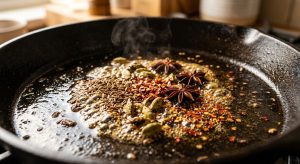
Now, let’s address the garlic situation. We are officially done adding garlic first just to watch it burn into a bitter, acrid oblivion while we wait for the onions to cook. Minced garlic is delicate and cooks in about thirty seconds. Add it to the pot only after the onions are fully softened, right before you intend to bloom your spices. Speaking of spices, drop your high-quality chili powder, ground cumin, smoked paprika, and dried oregano directly into the hot oil for about sixty seconds. This critical process, known as blooming, extracts the fat-soluble flavor compounds from the dried spices, amplifying their intensity tenfold compared to just dumping them into a wet broth.
Phase Three: The Naked Simmer
This is the most critical phase of the entire operation. If you are using your dried, chemically brined beans, drain them completely and add them to the pot along with your browned ground meat and your bloomed aromatics. Now, cover everything with a neutral liquid. This means high-quality chicken broth, rich beef bone broth, or simply fresh, filtered water.
Do not add the crushed tomatoes. Do not add the tomato paste. Do not add the lime juice, the vinegar, or the beer. Keep the environment completely neutral.
Bring the pot to a gentle boil, then immediately reduce the heat to low. You want to maintain that magical 185°F to 205°F window we discussed earlier. If you suspect your cheap, uncalibrated dial thermometer is lying to you, invest in a fast-read digital probe thermometer to periodically spot-check your liquid temperature. Cover the pot with a heavy, tight-fitting lid to trap the steam, and let the beans simmer naked in the neutral broth until they are completely, unarguably, perfectly tender. This process could take anywhere from 45 minutes to 2 hours depending on the exact age and variety of your beans. Test them constantly. When you can easily smash a bean against the roof of your mouth with just your tongue, you are finally ready for the fourth phase.
Phase Four: The Acid Integration
Only now—after the starch is fully gelatinized, the interior is creamy, and the pectin has completely surrendered—do we introduce the acid. Pour in your crushed tomatoes, your concentrated tomato paste, and any other acidic finishing elements your recipe calls for.
Adding the acid at this exact, delayed moment is a stroke of culinary genius. Why? Because while the low pH prevents raw beans from softening, it actually acts as a brilliant structural stabilizer for beans that are already cooked. The acid locks the cellular walls in their current, tender state, preventing the beans from disintegrating into total mush as the chili continues to simmer and meld. You get perfectly intact, beautiful, creamy beans suspended in a rich, deeply flavored tomato gravy. Let the whole pot simmer together for another 30 to 45 minutes so the flavors can marry and the liquid can reduce to your desired thickness.
Engineering the Mindful Chili Bar
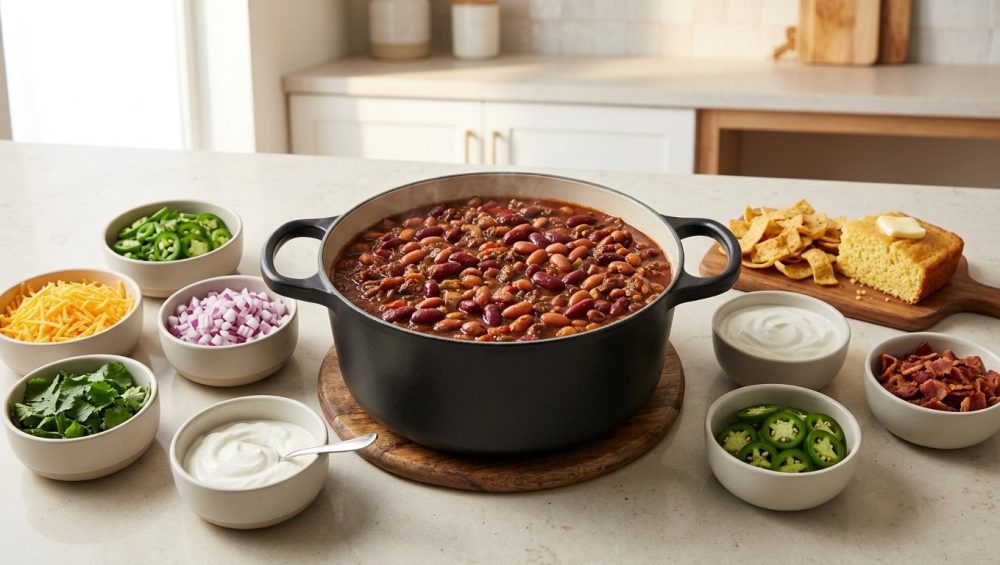
You have successfully navigated the complex biochemistry of legumes, and you now possess a massive, bubbling pot of flawless chili. Now it is time to transition from a focused home cook to an effortless, relaxed host. The entire goal of the Mindful Chili Bar is to front-load all the labor so that when your guests actually arrive, your only job is to hand them a bowl, point them toward the spread, and pour yourself a drink.
A chili bar is brilliant because it inherently accommodates almost every dietary restriction and picky eater in your friend group without requiring you to play short-order cook and make five different meals. The chili itself is the warm, comforting anchor, but the toppings are where the real magic happens. A truly spectacular chili bar relies on a carefully curated matrix of contrasting textures, temperatures, and bright flavors.
The Textural Crunch
Chili is essentially a heavy, homogenous, soft stew. To prevent palate fatigue and keep every bite interesting, you must introduce aggressive crunch. Forget boring, stale saltines. Set out bowls of crushed Fritos or sturdy tortilla chips, heavily toasted pepitas (pumpkin seeds) tossed in chili powder, crispy fried jalapeño strips, and icy-cold, razor-thin sliced radishes. The sharp, watery snap of a fresh radish against the rich, fatty, spicy chili is an absolute revelation.
The Thermal Contrast
Hot, spicy chili demands cold garnishes to balance the sensory experience and cool the palate. Offer bowls of rich, full-fat sour cream or tangy Mexican crema, chilled avocado cubes tossed in a tiny bit of lime juice (to prevent enzymatic browning while they sit on the buffet), and massive mounds of fresh, crisp, chopped cilantro.
The Acidic Punch
Even with the tomatoes cooked into the base, chili is a heavy, earthy dish that desperately benefits from bright, high-note acidity at the very end. Quick-pickled red onions are absolutely non-negotiable. They take exactly ten minutes to make (just thinly slice red onions and submerge them in warm vinegar, sugar, and salt) and they cut through the richness of the beef and beans like a laser beam. Provide plenty of fresh lime wedges for your guests to squeeze over their bowls right before eating.
The Cheese Factor
Do not insult your beautiful, scientifically perfected chili by topping it with cheap, pre-shredded cheese from a plastic bag. Those cellulose-coated pre-shredded bags ruin the luxurious texture we worked so hard to build, as the anti-caking agents actively prevent the cheese from melting properly and leave a gritty, powdery residue in the bowl. Buy a block of high-quality sharp cheddar or Monterey Jack and grate it yourself. It takes two minutes, it costs less, and the meltability is vastly superior.
Serving Logistics
Keep the finished chili in your heavy enameled Dutch oven and place it on a portable induction burner or a low-heat warming tray at the very start of the buffet line. Arrange the toppings in a logical, step-by-step progression: bases (like white rice, quinoa, or squares of cornbread) first, then the hot chili, then the cheeses (so they land on the hot chili and melt immediately), then the crunchy textural elements, and finally the cold and acidic garnishes. Stack heavy, deep ceramic bowls at the front of the line, and provide large, sturdy spoons.
The Weekday Shortcut vs. The Weekend Masterpiece
Listen, I am a realist. On a rainy Saturday afternoon, I genuinely love the slow ritual of soaking dried beans and nursing a simmering pot for three hours. But on a Tuesday night after a grueling nine-hour workday? Time is money, and efficiency is the only way we survive the week without ordering expensive, disappointing takeout.
You can absolutely execute this exact chili bar concept using high-quality canned beans. Canned beans have already undergone the hydration and gelatinization process in a massive industrial pressure cooker at the canning facility. They are fully cooked, structurally stable, and ready to eat.
To adapt this masterclass for a frantic weekday, simply build your aromatic foundation (Phase Two), add your raw ground meat, and brown it perfectly. Then, because you are skipping Phase Three, immediately add your crushed tomatoes, tomato paste, and acidic elements. Drain and rinse your canned beans thoroughly under cold running water to remove the excess sodium and the sludgy, metallic canning liquid, and fold them directly into the hot tomato base. Because the beans are already cooked and their cellular structure is locked, you only need to simmer the pot for 20 to 30 minutes—just long enough for the flavors to harmonize and the tomato liquid to reduce to a thick gravy. You get 90% of the weekend flavor in 15% of the time, and nobody will know you took a shortcut.
Troubleshooting Your Legume Nightmares
Even with the best science and the highest quality cookware, things occasionally go sideways in the kitchen. Here is how to troubleshoot the most common legume disasters without losing your mind.
The Beans Are Ancient:
If you followed all the rules, soaked your beans in a saltwater brine, kept the acid completely out of the pot, maintained a perfect 195°F simmer, and they are still hard after three hours, the problem is not your technique. The problem is your pantry. Dried beans are agricultural products, not immortal artifacts. If they sit in a warehouse or your cupboard for more than two years, the cellular structure degrades and the natural oils inside the bean go rancid. They undergo a well-documented agricultural defect known as “hard-to-cook” (HTC) syndrome, where the cotyledon becomes completely impermeable to water. Stop boiling them, throw them in the compost bin, and go buy a fresh bag.
The Broth is Too Thin:
If your beans are perfectly tender but your chili looks like a watery, unappetizing soup, do not panic and do not dump raw flour into the pot. Take a ladle, scoop out about a cup of the beans and liquid, and mash them into a thick paste using a fork or a potato masher. Stir this starchy paste back into the main pot. The mashed beans will release their fully gelatinized starches into the liquid, thickening the chili organically and beautifully without the need for flour or cornstarch slurries that dull the flavor.
The Flavor is Flat:
If you taste your finished chili and it feels heavy, dull, or like it is just “missing something,” your first instinct as a home cook will be to aggressively add more salt. Stop. Taste it critically. It probably doesn’t need salt; it needs acid. A splash of apple cider vinegar or a generous squeeze of fresh lime juice stirred in right before serving will immediately awaken the spices, cut the fat, and brighten the entire flavor profile.
Final Thoughts from the Kitchen Counter
Cooking intimidating, large-scale meals for a crowd does not require a magical culinary gift, and it certainly doesn’t require you to be a stressed-out slave to your stove while your friends are enjoying the party in the next room. It simply requires you to respect the ingredients, understand a few basic principles of food chemistry, and use the right non-toxic tools for the job.
By mastering the strict sequencing of your acid, manipulating the pectin with a salt brine, and maintaining the proper thermodynamic window for starch gelatinization, you have permanently eliminated the threat of the chalky, ruined bean. You have successfully transformed a traditionally stressful dinner party into a mindful, highly customizable, prep-friendly communal gathering.
So throw away your toxic peeling pans, buy some fresh legumes, and set up that gorgeous toppings bar. You are a highly capable home cook, and you are about to serve the absolute best chili your friends have ever tasted. Now go pour yourself another glass of wine—you’ve earned it.