Pour yourself a generous glass of whatever gets you through the week, pull up a stool, and let’s have a brutally honest conversation about a culinary tragedy that is entirely preventable.
You’ve spent your hard-earned weekend hours crafting the perfect brown sugar syrup. You’ve brewed a batch of premium loose-leaf Assam black tea. You’ve meticulously boiled your tapioca pearls. You assemble a gorgeous, café-worthy beverage for your friends, and for the first forty-five minutes, everything is glorious. But then, the afternoon drags on. Your guests take another sip, and suddenly, they are chewing on what feels like flavorless, rubbery gravel. The vibe is ruined, your friends are politely pretending they aren’t choking on tiny rocks, and you are left wondering where it all went wrong.
If you are serious about ditching takeout and bringing the premium boba shop experience into your own home, you have to understand the food science behind the pearl. It is currently August 2026, and the global bubble tea market is sitting at a staggering $4.21 billion. We are no longer just buying this stuff from mall kiosks; we are making it in our own kitchens. But home cooks are consistently failing at one crucial element: texture preservation.
Today, we are going to leave no stone unturned. We are diving deep into the molecular chemistry of tapioca starch, the thermodynamics of holding temperatures, and the exact, foolproof methods you need to employ to keep your boba perfectly chewy for hours. By the end of this masterclass, you will be fully equipped to host an interactive, stress-free bubble tea party that will make your local barista look like an amateur.
The Chemistry of the Chew: Understanding “Q” Texture
Before we can fix your hard boba, we need to understand what makes good boba so incredibly satisfying. In Taiwanese culinary culture, the perfect chewy, bouncy, elastic texture is referred to as “Q” (or “QQ” if it’s exceptionally bouncy). It is a highly sought-after mouthfeel that is neither mushy nor tough, but offers a distinct, resilient resistance to the teeth.
Authentic boba pearls are not just random balls of dough. They are a precisely engineered biopolymer matrix formed from cassava root starch. Cassava starch is unique because it is composed of two main types of long-chain polysaccharide molecules: amylose (a straight-chain starch) and amylopectin (a branched-chain starch). Tapioca starch boasts an incredibly high percentage of amylopectin—often 85% or more.
When you purchase raw boba pearls, the starch molecules inside them are tightly packed in a dense, crystalline structure. At room temperature, they are completely insoluble in water. If you drop a raw pearl into a cold glass of water, it will just sit there like a pebble. However, when you introduce these pearls to a massive volume of rapidly boiling water, a magical chemical reaction called gelatinization occurs.
The intense heat disrupts the crystalline regions within the starch, forcing the tightly bound molecules to relax and separate. As these gaps open up, water rushes into the starch granules, causing them to swell massively and absorb the surrounding liquid. The amylopectin branches out, creating a soft, jelly-like, elastic network. This full gelatinization process requires a sustained temperature of around 95°C to 98°C (203°F to 208°F) for at least 25 to 30 minutes. When executed perfectly, this is what gives you that glorious, signature “Q” texture.
The Villain of the Story: Starch Retrogradation
So, if boiling the pearls makes them perfectly soft and chewy, why do they turn into rock-hard rubber balls just a few hours later?
The answer is a merciless, naturally occurring chemical process known as starch retrogradation.
When your perfectly cooked, gelatinized boba begins to cool down, the starch molecules do not want to stay in their relaxed, water-logged state. They are chemically driven to return to their original, organized, crystalline structure. As the temperature drops, the amylose and amylopectin chains start to realign and tightly bind back together. As they squeeze together, they violently push out all the water they absorbed during the boiling process.
This is the exact same chemical process that causes a fresh loaf of bread to go stale and hard on your countertop. The water is expelled, the starch crystallizes, and your beautiful, bouncy tapioca pearls become firm, crunchy, and entirely unchewable.
Here is the most critical rule of boba science: Cold is the enemy of tapioca.
The colder the temperature, the faster starch retrogradation occurs. This is why putting leftover cooked boba in the refrigerator is a culinary felony. Within an hour in the fridge, the starches will seize up completely, leaving you with useless, hard pellets. Even at standard room temperature, perfectly cooked pearls will succumb to retrogradation and harden within 4 to 6 hours.
If you are throwing a party, 4 hours is simply not a wide enough window. You need to manipulate the chemistry to buy yourself more time.
The Sassy Sous-Chef’s Golden Rules for Cooking Boba
When you are hosting mindful gatherings, the last thing you want is your guests politely choking down rock-hard tapioca. To prevent this, we must start with a flawless cooking technique. Forget the instructions on the back of the cheap plastic bag. Here is how you actually cook boba like a professional.
Rule 1: Respect the Gear
I am a broken record on banishing toxic kitchen gear, so please, for the love of culinary sanity, use a heavy-bottomed stainless steel stockpot. Do not use a cheap, scratched aluminum pot, and absolutely do not use a peeling Teflon pan. You need a pot with significant thermal mass that can hold a steady, rolling boil without fluctuating every time a breeze hits your stove.
Rule 2: The Golden Ratio of Water to Pearl
The biggest rookie mistake I see is crowding the pot. If you dump a pound of room-temperature boba into a tiny saucepan of boiling water, the temperature of the water will immediately plummet. The starches will fail to gelatinize properly, the outsides will turn to mush, and the insides will remain raw powder.
You must use a ratio of at least 8 parts water to 1 part tapioca pearls. If you are cooking one cup of boba, you need a minimum of 8 cups of water. The boba needs room to swim, expand, and agitate in the boiling water without sticking together.
Rule 3: The Rolling Boil
While you might rely on the water drop test to check a pan for searing, cooking boba requires a massive volume of rapidly boiling water. Bring your water to a violent, aggressive, rolling boil before you even think about touching the pearls.
Do not rinse raw boba. Rinsing raw boba will cause the delicate starch spheres to instantly disintegrate in your hands. Carefully drop the dry pearls into the boiling water and immediately stir them gently with a wooden spoon to prevent them from sticking to the bottom of the pot. Wait for the pearls to float to the surface. Once they are all bobbing at the top, reduce the heat to a medium simmer, cover the pot with a tight-fitting lid, and set a timer for 30 minutes.
Rule 4: The Crucial Resting Phase
When the 30-minute timer goes off, your boba is not done. The outsides are soft, but the very center of the pearl is likely still dense. Turn off the heat entirely, but do not remove the pot from the stove, and absolutely do not take off the lid.
Let the boba sit in the hot water for another 20 to 30 minutes. This is called carryover cooking. The residual heat will gently penetrate the center of the pearls, ensuring complete and total gelatinization without violently overcooking the delicate exteriors.
Rule 5: The Shock and Rinse
Once the resting phase is complete, pour the boba into a fine-mesh strainer. A good spider skimmer or mesh strainer is one of those essential tools every beginner needs to rescue the pearls from the hot water.
Immediately run the pearls under cold tap water for about 15 to 30 seconds. This brief cold shock serves two purposes: it halts the cooking process so the pearls don’t turn into total mush, and it washes away the excess, slimy surface starch that makes the pearls stick together in a giant, unappetizing clump. Do not leave them in cold water for a prolonged period, or retrogradation will begin immediately.
The Sugar Soak: Your Anti-Retrogradation Secret Weapon
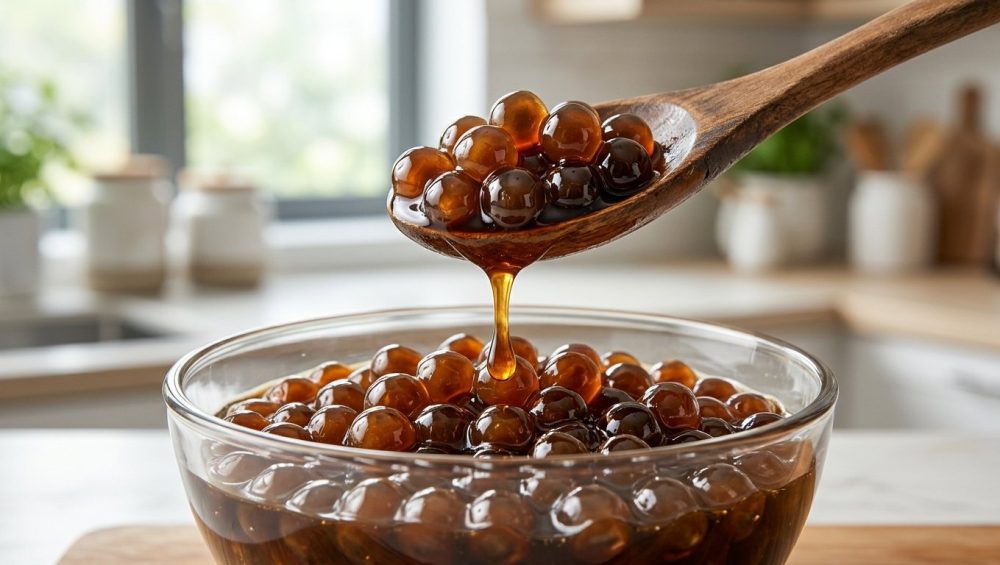
If you take your perfectly cooked, rinsed boba and leave them sitting naked in a bowl, they will harden into rubber within an hour. You must immediately submerge them in a sugar syrup. This is not just for flavor; this is a scientifically mandatory step for texture preservation.
Sucrose (sugar) is highly hygroscopic, meaning it attracts and holds onto water molecules. When you soak cooked tapioca in a concentrated sugar syrup, the sugar hydrates the area around the starch molecules. This sugar hydration acts as a physical barrier, restricting the amylose and amylopectin molecules from rearranging and crystallizing. In short, sugar acts as an anti-retrogradation agent. It locks the water inside the pearl, keeping it soft, bouncy, and chewy for hours longer than it would survive on its own.
The Perfect Brown Sugar Syrup Recipe
To create the ultimate soaking bath for your boba, you need a rich, dark syrup.
- In a small saucepan, combine 1 cup of dark brown sugar, 1/2 cup of granulated white sugar, and 1 cup of water.
- Bring the mixture to a gentle simmer over medium heat. Do not stir it aggressively, or the sugar will crystallize on the sides of the pan. Just swirl the pan gently until the sugar is completely dissolved.
- Let it simmer for 3 to 5 minutes until it thickens slightly into a rich, glossy syrup.
- Remove from heat and immediately pour it over your freshly rinsed, warm boba pearls.
Do not store your beautiful brown sugar syrup in cheap Tupperware, mostly because plastic containers stay greasy and will make your premium boba taste like last week’s leftover chili. Use a high-quality glass or ceramic bowl. Furthermore, always stir with a premium utensil; if your cheap silicone spatulas taste like soap, they are off-gassing toxic odors right into your delicate syrup. Stick to a solid wooden spoon or food-grade stainless steel.
Thermodynamics of the Party: Masterful Holding Temperatures
You have cooked the boba perfectly. You have soaked it in an anti-retrogradation brown sugar syrup. But if you just leave that bowl sitting on your kitchen island for a four-hour party, the ambient room temperature will eventually win, and the boba will harden.
The secret to a multi-hour party is maintaining proper holding temperatures so the starch doesn’t seize. Professional boba shops do not keep their cooked pearls at room temperature; they keep them in heated holding warmers.
To keep boba perfectly chewy for up to 6 hours, it must be held in its syrup at a consistent temperature between 55°C and 65°C (131°F to 149°F). If it gets hotter than 65°C, the pearls will continue to cook, break down, and turn into a soggy, gelatinous mush. If it drops below 55°C, retrogradation speeds up, and they turn hard.
Implementing smart food holding strategies, like using a fondue pot on a low setting, keeps the pearls perfectly chewy for the entire duration of your gathering. Here are the best ways to hack this in a home kitchen:
- The Slow Cooker Hack: Place your boba and syrup into a small slow cooker and set it to the “Keep Warm” setting. Leave the lid off so it doesn’t get too hot, and give it a gentle stir every 30 minutes.
- The Water Bath (Bain-Marie): Place your glass bowl of boba and syrup over a saucepan of barely simmering water. The steam will keep the bowl at a gentle, consistent temperature.
- The Thermal Carafe: If you have a high-quality, pre-warmed stainless steel thermal carafe, you can pour the boba and syrup directly into it. It will insulate the heat and keep the pearls in the safety zone for hours.
- The Ceramic Fondue Pot: A heavy ceramic fondue pot heated by a single tea light candle provides just enough gentle, ambient heat to keep the syrup warm without boiling it.
Be careful when transferring hot syrup to glass serving bowls; thermal shock is the exact reason your glass baking dish shattered last Thanksgiving. Always warm your glass vessels with hot tap water before pouring boiling syrup into them.
How to Host a Mindful Bubble Tea Party
Now that the science is handled and the pearls are safely held at 60°C, it is time to focus on the actual gathering. A mindful bubble tea party is one of the most engaging, interactive, and stress-free hosting formats you can choose, provided you prep properly. Time is money, and as a weekend culinary hobbyist, you want to spend your party mingling with a drink in your hand, not frantically boiling water in the kitchen.
Prep-Ahead Strategies (Time is Money)
The beauty of a boba bar is that 90% of the work is done before the doorbell even rings.
- Day Before: Brew your tea bases, make your syrups (mango, strawberry, classic simple syrup), and prep your garnishes.
- Two Hours Before: Boil and rest your boba pearls.
- One Hour Before: Transfer the boba to your heated holding station, set out the ice, and arrange the glassware.
The Tea Bases: Brewing for Dilution
When guests make iced bubble tea, they are going to fill their cups with ice. If you brew your tea at a standard drinking strength, the ice will melt and dilute the beverage into a watery, flavorless mess. You must brew your tea bases at double strength.
- Classic Assam Black Tea: Use 2 tablespoons of loose-leaf black tea per cup of boiling water. Steep for 5 to 7 minutes. Strain and chill. This robust, malty tea holds up beautifully to heavy milk and rich brown sugar.
- Jasmine Green Tea: Green tea is delicate. If you steep it in boiling water, you will burn the leaves and extract bitter tannins. Steep your jasmine green tea in water that is around 80°C (175°F) for no more than 3 to 4 minutes.
- Oolong Tea: A deeply roasted Oolong provides a complex, earthy base that pairs incredibly well with oat milk and fruit syrups.
The Interactive Boba Bar Setup
Create a logical flow for your guests so they can build their drinks without creating a traffic jam.
- Station 1: The Foundation. Start with the warm boba holding station. Provide a long-handled, slotted spoon so guests can scoop the pearls, and a small ladle for the brown sugar syrup.
- Station 2: The Ice. A large, insulated ice bucket with heavy-duty tongs. (Do not skip the ice; cold drinks contrast beautifully with the warm, chewy boba).
- Station 3: The Tea Bases. Serve your pre-chilled, double-strength teas in elegant glass pitchers. Label them clearly.
- Station 4: The Milks and Mixers. Offer variety. Whole milk is classic, but oat milk provides a fantastic creamy texture that complements black tea perfectly. Coconut milk is excellent for fruit-based teas.
- Station 5: The Finishers. Wide boba straws are non-negotiable. Regular straws will clog and cause immense frustration. Provide cocktail shakers so guests can vigorously shake their creations—shaking aerates the tea, blends the syrups, and creates that signature frothy top.
Troubleshooting the Tapioca Tragedies
Even with the best intentions, things can go sideways. If you encounter a boba disaster, here is how to pivot like a pro without letting your guests see you sweat.
Problem: The boba turned into a giant, sticky clump in the syrup bowl.
The Fix: You likely didn’t rinse them thoroughly enough after cooking, or your syrup is too thick. Do not try to pry them apart with a spoon; you will just smash them. Pour a splash of hot water into the bowl and stir vigorously. The hot water will thin the syrup and release the pearls.
Problem: The boba is mushy and falling apart on the outside.
The Fix: You either didn’t wait for the water to reach a rolling boil before adding them, or you cooked them at a violent, aggressive boil for the entire 30 minutes instead of dropping it to a simmer. Unfortunately, you cannot un-mush boba. You will have to start over. Next time, respect the gentle simmer.
Problem: The boba is perfectly soft on the outside but hard and powdery in the dead center.
The Fix: You skipped or rushed the resting phase. The carryover cooking is mandatory for the heat to penetrate the core of the starch sphere. If you catch this while they are still in the pot, just put the lid back on and let them sit in the hot water for another 15 minutes.
Problem: I have two cups of leftover cooked boba at the end of the night. Can I save them?
The Fix: Realistically? No. While some people claim you can freeze cooked boba and microwave it later, the texture will never be the same as fresh. Tapioca is cheap. Your time and sanity are valuable. Accept that boba is an ephemeral, in-the-moment delicacy. Throw the leftovers away, wash your heavy-bottomed stainless steel pot, and go to bed victorious.
Final Thoughts from the Kitchen
Hosting a mindful bubble tea party shouldn’t require a degree in molecular gastronomy, but understanding the basic thermodynamics of your ingredients separates the chaotic amateurs from the effortless hosts. By respecting the starch, managing your holding temperatures, and refusing to cut corners with cheap equipment, you guarantee a flawless experience for your guests.
Now, get out there, buy some high-quality tapioca, fire up that stove, and show your friends what a real, uncompromising cup of boba tastes like. Cheers.