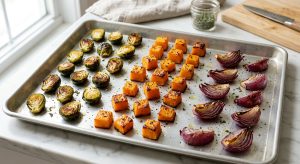
We all know the exact sound. You are having a relatively peaceful Friday evening, sipping a glass of reasonably priced Pinot Noir, and congratulating yourself for actually cooking instead of ordering takeout for the third time this week. You have carefully arranged a beautiful medley of asparagus, fingerling potatoes, and chicken thighs on a baking sheet. You slide it into a 425-degree oven, set the timer, and walk away.
Ten minutes later, a violent, metallic BANG echoes through your kitchen.
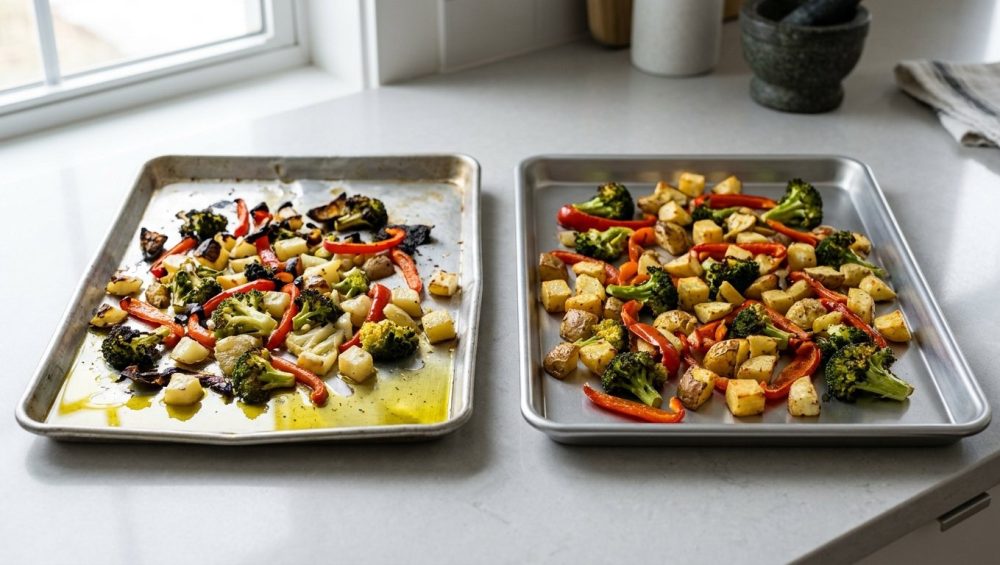
It sounds like a gunshot. The dog starts barking. You nearly drop your wine. You cautiously approach the stove and peer through the oven window, fully expecting to see that your glass baking dish shattered into a million jagged pieces across the bottom rack. But no. It is just your flimsy, grocery-store baking sheet throwing a thermodynamic temper tantrum. It has violently warped, lifting one corner two solid inches into the air, twisting diagonally, and sending a tidal wave of hot olive oil and chicken juices pooling into the opposite corner.
If this sounds familiar, take a deep breath. You are not crazy, and you are not a bad cook. You do not need a culinary degree to roast a potato, but you do need tools that do not actively sabotage your dinner. One of my core philosophies as a home cook is that professional-level results are completely achievable in a standard home kitchen—but only if you stop buying cheap, disposable, toxic garbage that belongs in a landfill rather than an oven.
Today, we are going to dive deep into the kitchen science of why your baking sheets pop, twist, and warp under high heat. We are going to explore the physics of thermal expansion, break down why warped pans are ruining your weeknight meals, and most importantly, I am going to tell you exactly what commercial-grade equipment you need to buy instead. Spoiler alert: it is cheaper than you think, and it will last you the rest of your life.
The Anatomy of a Baking Sheet “Pop” (The Kitchen Science)
To understand why your pan just tried to jump off the oven rack, we have to talk about thermodynamics and metallurgy. I promise I will keep the pretentious chef-speak to an absolute minimum, but we need to look at the hard science of what happens when cold metal meets a hot oven.
The Physics of Thermal Expansion
At a molecular level, metals expand when they are heated. As the temperature rises, the kinetic energy of the metal atoms increases, causing them to vibrate more vigorously and push further apart. This phenomenon is known as thermal expansion. When you place a room-temperature baking sheet into a hot oven, the metal physically grows.
If the entire baking sheet were to heat up at the exact same rate, this expansion would not be a problem. The pan would simply get infinitesimally larger in all directions while remaining perfectly flat. However, in the real world—and especially in a conventional home oven—heat distribution is never perfectly even.
The Belt Effect: Why Rims Matter
The primary culprit behind the terrifying oven BANG is a massive temperature differential between the flat base of your baking sheet and the raised outer rim.
Think about the geometry of a standard baking pan. The base is a wide, thin, flat expanse of metal with a massive amount of surface area exposed directly to the radiant heat of the oven’s lower heating element. The rim, on the other hand, is a short, structured, folded edge with significantly less surface area facing the heat source.
Because of this design, the wide base of the pan heats up—and therefore expands—much faster than the rim. The rapidly expanding base needs room to grow, but the cooler, slower-expanding rim acts like a rigid, unyielding belt pulled tightly around a Thanksgiving dinner belly. The rim refuses to let the base expand outward. The kinetic stress builds and builds across the metal lattice until it reaches a critical breaking point. Since the base cannot expand outward, it has no choice but to buckle upward or downward. The sudden release of this pent-up mechanical stress is what causes that loud, jarring POP.
The Role of Temperature Differentials and Thermal Shock
The structural conflict between the base and the rim is severely exacerbated by how we actually cook. When you load a baking sheet with food, you are introducing a massive temperature differential.
Imagine you place a row of refrigerator-cold chicken breasts on the right side of the pan, and leave the left side empty. The empty side of the pan will absorb ambient oven heat and expand rapidly. The side sitting under the cold chicken will remain relatively cool, as the thermal energy is being absorbed by the dense, cold protein. This creates microscopic tugs-of-war across the surface of the metal.
This is also why your pan will violently twist if you take it straight out of a 450-degree oven and toss it into the sink under cold running water. The rapid, uneven contraction of the metal causes thermal shock, permanently warping the molecular structure of the pan. Once a cheap pan is permanently warped, it will never sit perfectly flat again.
The Ripple Effect: Why Warped Pans Ruin Your Dinner
You might be thinking, “Okay, so my pan makes a loud noise and looks a little crooked. Who cares? It still cooks the food, right?”
Wrong. When your pan warps, it fundamentally alters the cooking environment, turning your carefully planned weeknight dinner into a chaotic, unevenly cooked disaster. Time is money, and spending 45 minutes roasting a meal only to have half of it ruined is an unacceptable waste of both.
The Death of the Maillard Reaction
The secret to incredible, restaurant-quality food is the Maillard reaction. This is the complex chemical reaction between amino acids and reducing sugars that occurs at high temperatures, giving browned food its distinctive color and deeply savory flavor. For the Maillard reaction to occur efficiently, your food needs direct, continuous, even contact with a hot, flat surface.
When your baking sheet pops and twists into a makeshift skateboard ramp, it lifts a significant portion of your food entirely off the hot surface. The ingredients sitting on the elevated corner of the pan lose direct conductive heat. Instead of searing and caramelizing, they are left high and dry in the ambient air, resulting in sad, mushy veggies that gently steam and shrivel. If you want to master the secret to perfect crunch, it strictly requires a pan that maintains flush contact with your ingredients.
The Oil Pool of Doom
Gravity is undefeated. When your pan warps, every single drop of olive oil, rendered animal fat, and vegetable moisture instantly rushes down to the lowest corner of the pan.
This creates two distinct, equally terrible cooking zones. The high side of the pan becomes a dry, arid desert where your food scorches and burns. The low side of the pan becomes a deep-frying swamp. The broccoli that happened to be sitting in the low corner is now completely submerged in a boiling puddle of chicken fat and oil. It will emerge soggy, greasy, and completely unappetizing.
The Safety Hazard Nobody Mentions
Beyond ruining your dinner, warped pans are a genuine safety hazard. When you open the oven door to retrieve a pan that has twisted diagonally, you are dealing with a highly unstable surface covered in 400-degree liquid fat. Trying to balance a warped, wobbly pan with oven mitts while preventing a pool of boiling oil from sloshing over the lowered edge and onto your arms (or your dog) is a dangerous game of kitchen roulette.
The Hall of Shame: Toxic, Flimsy, and Useless Gear
I am going to be brutally honest with you: the vast majority of baking sheets sold in big-box grocery stores and trendy home goods boutiques are absolute garbage. They are manufactured to look shiny on the shelf, survive exactly three uses, and then be replaced. I have a strict “No-Go” rule on toxic, flimsy kitchenware. Let’s look at the worst offenders so you know exactly what to avoid.
The Flimsy Supermarket Specials
You know the ones. They cost $9.99, weigh less than a paperback book, and you can literally bend them in half with your bare hands. These entry-level pans are stamped out of incredibly thin, lightweight metal. They possess zero structural integrity. Because the metal is so thin, it cannot withstand the internal pressure created by rapid temperature changes. These pans will warp the very first time you use them, and they will permanently discolor after one batch of cookies. Throw them away.
The Toxic Nightmare of Cheap Non-Stick Coatings
This is where my blood pressure really spikes. I absolutely despise cheap non-stick bakeware. Most consumer-grade non-stick baking sheets are coated with a polymer called PTFE (polytetrafluoroethylene), best known by the brand name Teflon.
PTFE belongs to a massive class of synthetic chemicals known as PFAS (per- and polyfluoroalkyl substances). These are frequently referred to as “forever chemicals” because they do not break down in the environment or in the human body. According to extensive research by the Ecology Center, up to 20% of tested non-stick baking pans and 79% of non-stick cooking pans are coated with PTFE.
Here is the terrifying reality: when these thin pans warp and overheat, or when you inevitably scratch them with a metal spatula, that non-stick coating begins to degrade. When scratched or heated past certain thresholds, Teflon can release toxic microscopic particles and gaseous compounds. Exposure to PFAS has been linked to a host of severe health issues, including endocrine disruption, abnormal thyroid function, reduced immune system response, and an increased risk of kidney and testicular cancers.
You might think you are banishing toxic kitchen gear by explicitly purchasing pans labeled “PFOA-free.” Do not be fooled by this clever marketing loophole. While PFOA was phased out due to its extreme toxicity, manufacturers simply replaced it with newer, under-researched PFAS chemicals (like GenX) that exhibit highly similar toxicological profiles.
Furthermore, these non-stick coatings are incredibly fragile. You will undoubtedly notice how these cheap pans start losing their slip after just a few months of standard use. If you try to save time by using aerosol cooking sprays, the soy lecithin in the spray will rapidly bake onto the surface, completely ruining your nonstick pans by forming a sticky, polymerized glue that is impossible to wash off. Even if you pivot to trendy “green” ceramic-coated pans, you will likely find that they lost its non-stick properties within a year due to microscopic heat fractures in the sol-gel coating. Non-stick coatings simply do not belong on high-heat roasting pans.
The Dark Coating Deception
Many cheap baking sheets are finished with a dark grey or black coating. In the world of thermodynamics, dark colors absorb and radiate heat far more aggressively than light, reflective colors. If you bake cookies on a dark-coated pan, the bottom of the cookie will absorb a massive amount of radiant heat and burn to a crisp before the center of the dough has even finished setting. You want a light-colored, reflective metal pan for even, controlled baking.
The Holy Grail: What You Should Actually Buy
If you want to cook like an expert, you need to use the tools that experts use. Walk into the back of any high-end restaurant, commercial bakery, or bustling catering kitchen, and you will not see a single flimsy, black, non-stick baking sheet. You will see towering stacks of heavy-duty, battle-scarred, commercial-grade half-sheet pans.
These pans are the unsung, indestructible workhorses of the culinary world. They cost around $15 to $25 each, they will never warp under normal cooking conditions, and they will literally outlive you.
What is a Half-Sheet Pan?
In the commercial restaurant industry, bakeware sizes are strictly standardized. A “full-size” sheet pan measures 18 by 26 inches, which is far too large to fit into a standard residential home oven. Therefore, the gold standard for the home cook is the “half-sheet pan,” which measures exactly 13 by 18 inches. This size perfectly maximizes the real estate of a standard home oven, allowing you to roast a massive batch of vegetables or a full spatchcocked chicken with ease.
The Magic of Heavy-Gauge Metal
When shopping for a commercial half-sheet pan, the most important metric to look for is the “gauge” of the metal. In sheet metal manufacturing, the gauge represents the thickness of the metal. Counterintuitively, the lower the gauge number, the thicker and heavier the metal is.
Cheap supermarket pans are usually made from 20-gauge or 22-gauge metal, which is practically aluminum foil. For a professional-grade pan that refuses to warp, you want to look for 18-gauge or 14-gauge metal.
You have two primary material choices:
- Bare, Uncoated Aluminum: Pure aluminum is an exceptional conductor of heat. It heats up rapidly, cools down quickly when removed from the oven, and distributes thermal energy evenly across the entire surface of the pan, eliminating hot spots.
- Aluminized Steel: This is a hybrid material featuring a heavy-duty steel core that has been hot-dip coated with an aluminum-silicon alloy. The steel core provides indestructible structural rigidity, while the aluminum coating provides the necessary heat conductivity.
Both 18-gauge aluminum and aluminized steel are phenomenal choices that will drastically elevate your cooking.
The Structural Genius of the Rolled Wire Rim
The true secret weapon of a commercial half-sheet pan is not just the thickness of the metal, but the engineering of the rim. High-quality pans feature a fully enclosed, tightly rolled rim.
Inside that rolled edge, manufacturers encapsulate a thick ring of galvanized steel wire. This hidden steel wire acts as an unyielding skeleton for the pan. When the flat base of the pan heats up and tries to expand, the galvanized steel wire rim provides immense structural resistance, forcing the aluminum base to expand evenly and flatly rather than buckling and popping. It is a simple, brilliant feat of metallurgical engineering.
If you are looking for specific brands to upgrade your kitchen, you cannot go wrong with Nordic Ware’s Naturals line, USA Pan, Chicago Metallic, or Made In’s commercial bakeware.
How to Care for Commercial Bakeware (Without Ruining It)
Once you invest in high-quality, heavy-gauge half-sheet pans, you need to know how to maintain them. Commercial aluminum pans are virtually indestructible when it comes to heat and impact, but they have one massive Achilles’ heel: chemistry.
Step Away from the Dishwasher
You must never, under any circumstances, put a bare aluminum or aluminized steel baking sheet into a dishwasher. This is a hard and fast rule.
Dishwasher detergents are highly alkaline (they have a very high pH) to break down tough food proteins. Aluminum is a highly reactive metal. When alkaline dishwasher detergent mixes with hot water and blasts against bare aluminum, it causes a violent chemical reaction called oxidation.
If you run your beautiful new half-sheet pan through the dishwasher, it will emerge covered in a chalky, dark grey, powdery residue. This oxidized layer will rub off onto your hands, stain your dish towels, and leach a metallic flavor into your food. In severe cases, the chemical residue left behind by harsh detergents might even make your food taste like soap.
Commercial sheet pans are strictly hand-wash only. Fortunately, because they heat so evenly and do not scorch food into oblivion, they are incredibly easy to clean with standard dish soap, warm water, and a non-abrasive sponge.
Embracing the Patina (Polymerization is Your Friend)
When you first buy a commercial aluminum half-sheet pan, it will be gleaming, silver, and pristine. After a few months of heavy roasting, baking, and broiling, it will inevitably start to develop amber, brown, and black stains baked into the metal.
Do not panic, and do not spend hours scrubbing your pan with steel wool trying to make it look brand new. Those dark stains are not dirt; they are polymerized cooking oils. When fats are heated past their smoke point, they bond molecularly with the metal surface in a process called polymerization.
In the culinary world, this is called a “patina.” Professional chefs actually prize well-seasoned, heavily patinated sheet pans. That layer of polymerized oil acts as a natural, non-toxic, non-stick coating. Furthermore, the darkened surface slightly increases the thermal emissivity of the pan, meaning it will roast vegetables and brown meats even more efficiently. Your pan is not dirty; it is earning its stripes.
Dealing with Stubborn Burnt Bits
If you accidentally burn a sugary marinade onto the pan and genuinely need to remove a raised, crusty layer of carbon, do not reach for toxic chemical oven cleaners. Simply sprinkle a generous layer of baking soda over the offending area, pour a little hydrogen peroxide over it to create a paste, and let it sit for two hours. The mixture will gently break down the burnt carbon, allowing you to wipe it away with a sponge without damaging the aluminum.
Pro-Level Sheet Pan Cooking Hacks
Now that you have banished the toxic, warping garbage from your kitchen and upgraded to a heavy-gauge, rolled-rim commercial sheet pan, it is time to optimize how you actually use it. Having professional gear is only half the battle; utilizing professional techniques is what gets dinner on the table faster and tastier.
Mastering the Preheated Pan Technique
One of the best ways to guarantee a phenomenal, crispy sear on roasted vegetables or meats is to preheat your sheet pan. When you turn your oven on to 425 degrees, place your empty, heavy-gauge sheet pan inside on the middle rack. Let the metal absorb that thermal energy for 15 minutes.
When you carefully remove the blazing hot pan and drop your oiled vegetables onto it, you will hear an immediate, aggressive sizzle. You are jump-starting the Maillard reaction the exact second the food hits the metal, ensuring a deeply caramelized crust before the interior of the food has time to turn to mush.
However, you must respect the laws of thermal shock. Preheating a pan is brilliant for room-temperature vegetables, but do not throw rock-hard, freezing cold proteins directly onto a 450-degree pan. Slapping a frozen, icy fish filet onto blazing hot aluminum causes a violent temperature swing that is a guaranteed ticket to ruining your salmon, seizing the proteins, and potentially shocking even a high-quality pan. Always let your proteins take the chill off on the counter for 15 minutes before roasting.
The Truth About Pan Liners
To make weeknight cleanup incredibly efficient, you should utilize pan liners. But you need to use the right liner for the right job.
For 90% of your savory cooking—roasting broccoli, baking chicken thighs, making sheet pan fajitas—unbleached parchment paper is the undisputed king. It provides a naturally non-stick surface, can withstand oven temperatures up to 425 degrees without combusting, and allows the conductive heat of the aluminum pan to reach your food for proper browning.
Conversely, you should be extremely wary of using silicone baking mats for high-heat savory roasting. While reusable silicone mats are fantastic for baking delicate sugar cookies or macarons, silicone is a thermal insulator. If you place a thick rubber mat between your hot aluminum pan and your potatoes, the silicone will block the conductive heat transfer. Your potatoes will steam on top of the rubber mat instead of frying against the hot metal. Save the silicone for the bakery, and use parchment paper for dinner.
Strategic Food Placement
Finally, respect the concept of airflow and moisture evaporation. When vegetables and meats cook, they release a massive amount of water vapor. If you overcrowd your beautiful new half-sheet pan, piling ingredients on top of each other, that water vapor gets trapped. The temperature of the pan will plummet, and your food will boil in its own juices.
Always leave a small perimeter of space around every single piece of food on your sheet pan. The exposed hot aluminum between the ingredients acts as a thermal engine, rapidly evaporating the escaping moisture and allowing the dry oven heat to crisp the edges of your food. If you have too much food for one half-sheet pan, do not pile it up. Simply grab your second half-sheet pan, divide the food evenly, and utilize two oven racks.
Final Thoughts
Cooking should be a joyful, creative, and relaxing end to your day—not a stressful battle against cheap equipment that warps, pops, and poisons your food. By understanding the simple physics of thermal expansion and recognizing the marketing lies behind flimsy, toxic non-stick bakeware, you can take total control of your kitchen.
Throw away the warped supermarket pans that sound like a snare drum every time you turn the oven past 350 degrees. Invest twenty dollars in a heavy-gauge, bare aluminum, rolled-rim commercial half-sheet pan. Treat it with respect, keep it out of the dishwasher, and let it develop a beautiful, dark patina. It will reward you with perfectly seared, evenly cooked, stress-free meals for the rest of your life. Now, pour yourself another glass of wine, preheat your oven, and go roast something spectacular.