Welcome to the kitchen, my friends. Grab a large glass of wine, pull up a stool, and let’s have a brutally honest chat about something that strikes absolute fear into the hearts of even the most confident weekend culinary hobbyists: hosting a dinner party.
If the mere thought of inviting six people over for a home-cooked meal makes you want to break out in hives, fake a sudden illness, and hide under your duvet, I promise that you are not alone. For decades, we have been force-fed this ridiculous, unattainable, glossy magazine fantasy of what entertaining is supposed to look like. We’ve been conditioned to believe that if we aren’t serving a perfectly timed, six-course tasting menu on hand-pressed Belgian linen while wearing a spotless cashmere sweater, we are completely failing at adulthood.
Let’s take a collective deep breath and throw that toxic perfectionism directly into the compost bin. You do not need a Michelin star to throw a phenomenal party. You do not need a culinary degree to make mind-blowing food. You just need a solid plan, a few clever shortcuts, and a healthy dose of perspective.
The Myth of the Perfect Dinner Party (and Why We’re Trashing It)
Before we get into the tactical advice, let’s look at the cold, hard statistics of modern entertaining. If you feel anxious about having people over, the data proves you are in the overwhelming majority. According to recent industry surveys, a staggering 80% of adults feel the heat when hosting dinner parties, with 76% feeling intense, crushing pressure to ensure their guests have a good time.
The specific fears are even more relatable. Nearly half of all hosts (47%) admit they stress out over getting the house immaculately clean before guests even arrive, while 38% are paralyzed by the fear that their food simply won’t taste good. Even worse, 30% of people have lived the absolute nightmare of cooking a dish that completely flopped while an audience of hungry friends watched from the living room.
But here is the glorious, liberating news: the pretentious, buttoned-up dinner party is officially dead. And frankly, good riddance.
As we move deeper into 2026, we are witnessing a massive cultural shift. Gen Z and Millennials are leading a full-blown renaissance of the “retro dinner party” and the intimate supper club. They are officially “graduating” from loud, overpriced clubs and saturated restaurant scenes, opting instead for the comfort of the dining room table. In fact, recent data shows a 160% increase in Pinterest searches for dinner party aesthetics, while interest in rigid, over-engineered restaurant tasting menus has plummeted by 38%.
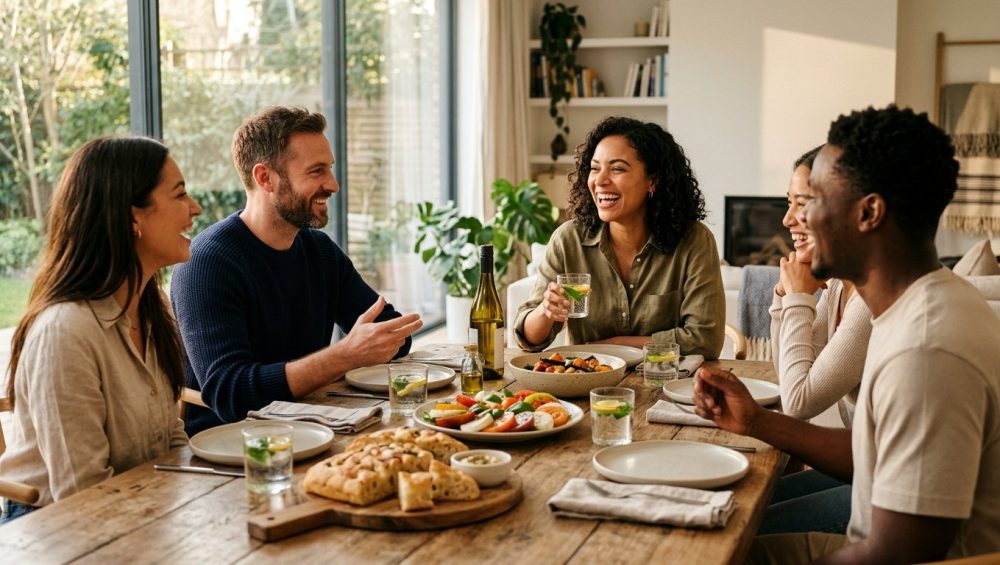
Why? Because people are utterly exhausted by digital fatigue, economic volatility, and performative perfection. They don’t want a theatrical show; they want genuine connection. They want to host a relaxed dinner party where the wine flows freely, the laughter is loud, and nobody cares if the water glasses don’t match the wine stems.
What Actually is “Mindful Hosting”?
You’ve probably heard the term “mindful gathering” tossed around wellness blogs and lifestyle podcasts, usually accompanied by pictures of people meditating in beige linen. Let’s strip the pretentious, woo-woo fluff away. What does it actually mean for you, the everyday home cook?
Connection Over Culinary Perfection
Mindful hosting simply means prioritizing the human experience over the culinary execution. It means acknowledging that your friends are coming over to see you, not to critique your knife skills or judge the clarity of your consommé. When you focus on mindfulness, you shift your frantic energy from “How do I impress these people?” to “How do I make these people feel welcome?”
In a modern landscape filled with constant notifications and chronic dysregulation, true hospitality is offering your home as a sanctuary. It is providing a space where your friends can put their phones in their pockets, exhale, and just exist.
The Statistics Behind the Shift
The event and hospitality industries are already pivoting hard toward this mindset. Trend forecasters for 2026 are noting that 61% of younger demographics prefer social, narrative-driven dining formats over traditional, stuffy restaurant experiences. Furthermore, the American Heart Association reported that 84% of adults wish they could share a meal with loved ones more often, noting a direct, scientifically proven correlation between shared meals and lowered stress levels.
People are craving authenticity. They want effortless meals that serve as the warm, inviting backdrop for real, unfiltered conversation. They want the food to be the glue, not the entire show.
Ground Rule #1: Stop Apologizing for Your Kitchen Skills
I need you to hear me loud and clear: stop apologizing for your food. Unless you accidentally gave someone food poisoning (which, if you follow my cookware and temperature advice later, you won’t), there is zero reason to announce your perceived failures to the table.
Do not say, “I’m so sorry, the chicken is a little dry.” Do not say, “I messed up the glaze, it was supposed to be shinier.” Your guests likely didn’t even notice, and by pointing it out, you are forcing them into an awkward position where they have to comfort you while chewing. Serve the food with confidence.
Embracing the “Good Enough” Menu
Imposter syndrome in the kitchen is rampant among beginners. You scroll through social media, see a twenty-two-year-old influencer making their own butter from scratch while casually braising a whole duck, and you think, “I have no business hosting.” Nonsense.
You don’t need a culinary degree to feed people beautifully. You just need to avoid the most common, easily fixable traps. By simply identifying and correcting a few rookie kitchen mistakes—like overcrowding the roasting pan, refusing to use enough salt, or forgetting to taste your food as you go—you instantly elevate your dishes from merely “edible” to absolutely delicious.
The Aesthetic Without the Agony: Setting the Vibe
If the food is only 20% of a mindful gathering, the vibe is the other 80%. You could serve mediocre, lukewarm takeout pizza on paper plates, but if the lighting is moody, the music is perfectly curated, and the conversation is flowing, your guests will think it’s the most chic soirée of the year. Conversely, you could serve a flawless, labor-intensive beef wellington under glaring fluorescent lights in dead silence, and everyone will be calling an Uber by 8:00 PM.
Lighting is Everything (Turn Off the Big Light)
I say this with all the love and snark in my heart: turn off the big overhead light. Nothing kills a party vibe faster than making your guests feel like they are being interrogated in a sterile hospital waiting room.
You want layered, warm, forgiving lighting. Scatter inexpensive tea lights and taper candles across the dining table and kitchen countertops. Use floor lamps and table lamps equipped with warm bulbs (always aim for a 2700K color temperature). The goal is to make your kitchen feel brighter and more spacious during the day, but at night, we want the atmosphere to be moody, intimate, and universally flattering.
Tablescapes for the Tactically Challenged
Put down the tweezers and step away from the expensive florist. You do not need to spend hundreds of dollars on towering floral arrangements that just block everyone’s view across the table anyway.
Keep it rustic and simple. Go to the grocery store, buy some fresh, aromatic herbs like rosemary or thyme, and lay them loosely down the center of the table. Scatter some citrus fruits—lemons, limes, or blood oranges cut in half. It looks effortlessly European, it smells incredible, and it costs about five dollars. Use whatever plates you have; mismatched dishware is charming and adds character. If you want one cheap upgrade, buy a set of real cloth napkins. They instantly signal to your guests that this is a special occasion, even if you’re serving tacos.
The Power of the Playlist
Do not leave the music to chance, and absolutely do not let a streaming service’s autoplay algorithm dictate the mood of your evening. Music is the invisible architecture of your party.
Build a playlist that evolves with the night. Start with upbeat, welcoming tracks (think vintage soul, funk, or upbeat indie) for when guests arrive and are grabbing their first drink. Transition to mellow, conversational music during dinner (jazz, acoustic, or lo-fi beats) so people don’t have to shout over the bass. Finally, ramp the energy back up slightly for post-dinner drinks. Keep the volume at a level where it fills the silences but respects the conversation.
Menu Planning for the Chronically Intimidated
When you are a beginner, your dinner party menu should be a testament to your cleverness, not your technical prowess. Weekdays are for survival; weekends are for elaborate, multi-step cooking projects—but only if you are cooking for yourself. When you have guests coming over, time is money, and your sanity is priceless.
The “Assembly Over Cooking” Philosophy
The greatest trick the culinary world ever pulled was convincing home cooks that every single component of a meal must be served piping hot and cooked entirely from scratch. Enter the “Assembly” method.
Start your evening with a massive, visually stunning grazing board. Buy high-quality cheeses, assorted cured meats, olives, marcona almonds, and fresh seasonal fruit. Arrange it beautifully on a wooden board. It requires exactly zero actual cooking, keeps your guests happily fed while you finish the main course, and looks incredibly impressive.
The One-Pot Wonder Strategy
For the main event, avoid anything that requires you to juggle four different pans on the stove while simultaneously monitoring the broiler. You want dishes that can be made ahead of time, develop flavor as they sit, and simply need to be kept warm.
Think rich, slow-braised short ribs, a hearty Tuscan chicken stew, or a massive, bubbling tray of baked ziti. These are forgiving dishes. If your guests are thirty minutes late, a braise will only get more tender. If you want something slightly more elevated but still foolproof, a beautiful platter of pan-seared salmon and asparagus takes literally minutes to execute, looks like a million bucks, and requires minimal cleanup.
Dietary Restrictions Without the Drama
In 2026, it is virtually guaranteed that someone in your friend group is gluten-free, dairy-free, vegan, or allergic to a specific ingredient. As a beginner host, this can induce sheer panic.
The secret? Do not cook five different customized meals. Find one naturally accommodating, modular dish. A build-your-own taco bar or a massive Mediterranean mezze spread allows everyone to customize their plate safely without you having to play the role of a frantic short-order cook.
Outsourcing Without Guilt
I give you full, unadulterated permission to buy the dessert. Go to a phenomenal local bakery, buy a gorgeous fruit tart or a decadent flourless chocolate cake, take it out of the cardboard box, place it on a nice serving platter, and throw away the evidence. You are a host, not a martyr. Focus your energy on the main course and the vibes.
A Non-Negotiable PSA: Ditch the Toxic Cookware
Alright, gather ’round, because it is time for my signature rant. You can cut corners on prep time, you can buy store-bought dessert, and you can serve mismatched napkins. But the one thing I will absolutely not tolerate in your kitchen—or recommend on my blog—is cheap, toxic, peeling non-stick cookware. I despise it with the fire of a thousand suns, and if you care about the food you serve your friends, you should too.
Why Cheap Gear Ruins Good Food (and Your Health)
We need to talk about PFAS (per- and polyfluoroalkyl substances), notoriously known as “forever chemicals.” These synthetic nightmare compounds are the key ingredients behind the slick, water-resistant coating on your cheap Teflon pans.
According to extensive 2025 and 2026 medical reviews, widespread exposure to PFAS is linked to a horrifying laundry list of health issues. We are talking about premature ovarian insufficiency, reduced fertility, immune disorders, thyroid disease, preeclampsia in pregnant women, and multiple forms of cancer. These chemicals are called “forever chemicals” because they do not break down in the environment, and they accumulate in your body over time.
If that doesn’t make you want to throw your scratched skillet directly into the trash, consider this: a groundbreaking 2026 study revealed that a single, microscopic scratch on a non-stick pan can release up to 9,000 toxic microplastic particles directly into your food. Yes. Nine thousand toxic particles from one rogue spatula scrape. You wouldn’t knowingly serve shredded plastic to your friends, so why on earth are you cooking their dinner on a pan that does exactly that?
Investing in Safe, Reliable Basics
You do not need to buy a 24-piece, flimsy cookware set from a late-night infomercial just to host a party. You only need a few beginner kitchen tools that are safe, durable, and reliable.
Invest in a heavy-duty cast iron skillet (which naturally becomes non-stick when seasoned properly and can outlive you), a high-quality stainless steel sauté pan, and an enameled Dutch oven for your braises. These are the core kitchen essentials every beginner needs to achieve professional-level sears and stews without poisoning anyone.
And while you’re upgrading your gear to things that actually work, grab a bench scraper. It costs about five dollars, makes transferring massive piles of chopped onions to your safe new skillet an absolute breeze, and makes you look like you actually know what you’re doing.
The Timeline: How to Not Have a Meltdown on the Day Of
The difference between a stressed-out, sweaty host and a relaxed, charming host is entirely dictated by their timeline. Mindful gatherings require strategic, front-loaded planning. If you are chopping onions when your guests arrive, you have already lost the battle.
The Week Before: Setting the Stage
Your mindful gathering actually begins a week in advance. This is when you finalize your guest list and send out your invitations. And please, send a real invitation. It doesn’t have to be expensive paper—a beautifully designed digital invite shows intention and sets the tone far better than a casual “u guys around Friday?” text. This is also the time to ask your guests about those aforementioned dietary restrictions so you aren’t blindsided on Friday night.
Two Days Before: The Prep
This is when you do your heavy lifting. Grocery shopping happens today. Wash and chop your vegetables, storing them in airtight containers. Make any sauces, marinades, or salad dressings.
This is also when you clean the house. You don’t need to deep-clean the baseboards with a toothbrush, but you do need to declutter the spaces your guests will see. Maintaining a permanently organized kitchen makes this step a breeze, as you won’t be frantically shoving mail, random appliances, and laundry into cabinets at the last minute.
The Morning Of: The Details
Run your dishwasher so it is completely empty before the party starts. Empty your trash cans. Make sure your bathroom has plenty of toilet paper, a clean hand towel, and a nice, fragrant soap. These sound like trivial, boring details, but they are the foundational elements of true hospitality. You want your guests to feel taken care of without having to ask for anything.
The Day Of: Strategic Slacking
On the afternoon of the party, your goal is to do as little actual cooking as possible. Set the dining table in the morning. Arrange your rustic herb centerpieces. By the time 4:00 PM rolls around, all you should be doing is assembling the charcuterie board, pulling the wine out of the fridge, and popping your pre-prepped main course into the oven.
An Hour Before: Pour the Wine
This is my golden, unbreakable rule of hosting: sixty minutes before your first guest is scheduled to arrive, you stop working. You take a shower, you put on an outfit that makes you feel fabulous, you light the candles, you turn on the playlist, and you pour yourself a glass of wine.
When the doorbell rings, you will answer it with a drink in your hand, a calm demeanor, and a genuine smile on your face, fully ready to master the art of effortless hosting.
Handling Mishaps Like a Boss
No matter how well you plan, how closely you follow the recipe, or how organized your timeline is, something will eventually go wrong. It is the universal law of the kitchen. How you react to the mishap dictates the entire mood of the party.
When the Food Burns
If you burn the roast, drop the chicken on the floor, or utterly curdle the cream sauce, do not panic. Do not cry. And whatever you do, do not spend the rest of the night aggressively apologizing and ruining the vibe.
Laugh it off. Pour everyone another round of drinks, pull out your phone, and order a massive stack of pizzas from the best local joint in town. Your friends are there to see you, not to judge your culinary execution. They will remember the night you confidently and hilariously pivoted to pizza long after they would have forgotten a mediocre, stressful roast.
When Guests Arrive Too Early (or Too Late)
There is a special place in the underworld for guests who arrive fifteen minutes early while you are still in your bathrobe frantically wiping down the countertops. If this happens, hand them a job. Give them a bottle of wine to open or a bowl of lemons to slice. It breaks the ice, makes them feel useful, and gets them out of your way.
On the flip side, if guests are running late, don’t let the food suffer. Turn the oven down to a “keep warm” setting, cover the food with foil, and focus your attention on the guests who actually respected your time and showed up when they were supposed to.
When the Conversation Lulls
Sometimes, especially if you are bringing together different friend groups who don’t know each other well, the conversation might hit a wall. Have a few mindful prompts in your back pocket. Ask the table about the best meal they’ve ever eaten on vacation, or what ridiculous pop culture hill they are willing to die on. People love talking about themselves; you just need to give them the runway to do it.
The Aftermath: Mindful Cleanup
The party is winding down. The wine bottles are empty, the candles are burning low, the playlist has transitioned to soft acoustic guitars, and everyone is full, happy, and laughing. Now comes the final test of a mindful host: the cleanup.
Resist the Urge to Scrub
Do not, under any circumstances, start aggressively scraping and washing dishes while your guests are still sitting at the table. It completely shatters the relaxed vibe and acts as a glaring, passive-aggressive signal that you want them to leave your house immediately.
Clear the plates, stack them neatly in the kitchen out of sight, and return to your guests. The dishes will still be there in the morning. Tonight is about soaking in the warmth of a successful gathering. You did it. You conquered the kitchen, you avoided the toxic cookware, you didn’t apologize for your food, and you created a space for real human connection.
Now, pour yourself one last glass of wine, sit back, and enjoy the beautiful mess you’ve made. Cheers, chef.