Picture this: You have spent the better part of your Saturday meticulously braising a massive batch of short ribs. You have reduced the wine sauce to a glossy, mirror-like perfection. You have whipped the potatoes until they are practically clouds. You plate everything beautifully, carry it to the dining room with the pride of a Michelin-starred chef, and sit down with your guests. Ten minutes into the meal, you take a bite, and absolute tragedy strikes. Your masterpiece is lukewarm. The potatoes have seized into a starchy, gluey paste, and the braising liquid has congealed into an unappetizing slick of cold fat.
It is a culinary heartbreak, and frankly, it is entirely preventable.
The culprit isn’t your cooking technique. The culprit is your serving ware. You served your soul-warming food in a flimsy, lightweight bowl that bled heat faster than a screen door in a blizzard. If you want to survive the kitchen during the chaotic holiday season or your weekend dinner parties, you need to stop treating serving dishes as mere visual accessories. They are not just pretty table decorations. They are functional tools. They are thermal batteries.
Welcome to the unapologetic, fiercely science-backed masterclass on optimizing thermal mass in safe serving ware. We are going to dive incredibly deep into the physics of heat retention, the ruthless material safety standards you must adopt, and the actionable, professional-level techniques that will ensure your food stays piping hot from the first bite to the last. Because when you are trying to master the art of effortless hosting, temperature control is absolutely everything.
The Physics of Not Eating Cold Mashed Potatoes
Let’s get one thing straight right out of the gate: I am a cook, not a quantum physicist. But you do not need to wade through pretentious recipe jargon or hold a doctorate to understand basic thermodynamics. Heat always seeks equilibrium. When you place a 180°F serving of food into a 68°F dining room, the thermal energy immediately begins escaping into the surrounding air and into the vessel itself.
If you put hot food into a cold, thin, lightweight bowl, the food will rapidly transfer its heat to the bowl until they are both the exact same temperature. Because the bowl lacks physical mass, it quickly loses that transferred heat to the surrounding air. The result? Cold food and disappointed guests. To prevent this, we have to leverage two fundamental principles of material science: specific heat capacity and thermal conductivity.
Specific Heat Capacity Explained
Specific heat capacity is the amount of energy required to raise the temperature of one gram of a substance by one degree Celsius. In the context of the kitchen, it dictates exactly how much thermal energy a material can store before it reaches its maximum temperature.
Think of it like a sponge soaking up water. A thin aluminum pan is like a single ply of a paper towel—it absorbs a tiny bit of water (heat) very quickly, but it dries out almost instantly. A dense ceramic or cast iron dish is like a thick, heavy luxury bath towel. It takes a lot more water (energy) to get it fully saturated, but once it is, it holds onto that moisture (heat) for a very long time.
The science here is fascinating. Clay and ceramics actually have a specific heat capacity roughly three times higher than iron by weight. This means that gram for gram, clay can store significantly more heat energy than metal. However, because cast iron is incredibly dense and heavy, a standard cast iron pot has a massive total thermal mass, making it a formidable, unstoppable heat reservoir.
Thermal Conductivity vs. Thermal Retention
Here is where most home cooks get confused, leading to disastrous dinner party decisions. Thermal conductivity is the measure of how fast heat moves through a given material. Copper and aluminum have extremely high thermal conductivity. They heat up in mere seconds and cool down just as fast. This makes them brilliant for sautéing delicate fish or sweating onions on a busy Tuesday night when time is money and you need instant temperature control. But for serving? They are an absolute disaster.
Cast iron and high-fired ceramics, on the other hand, have remarkably low thermal conductivity. Cast iron clocks in around 50 to 80 W/mK, while ceramics are drastically lower, often hovering between a mere 1 to 3 W/mK. Because they are poor conductors, they are phenomenal insulators. They act as a thermal vault, locking the heat inside the vessel and releasing it into your food at a slow, agonizingly steady drip rather than dumping it into the atmosphere. Serving a bubbling, cheese-crusted gratin in a cold, thin metal dish is one of those rookie kitchen mistakes I see constantly. Stop doing it.
The Three Enemies of Hot Food: Conduction, Convection, and Radiation
To truly optimize your serving ware, you must understand how your food is losing heat in the first place. Heat escapes your beautiful meal in three distinct ways:
- Conduction: This is heat transfer through direct physical contact. When hot food touches a cold serving bowl, the heat conducts directly from the food into the material. If the bowl is thin and unheated, it will suck the life out of your dish instantly.
- Convection: This is heat transfer through fluids or gases. As the hot air and steam rise off the top of your food, cooler air rushes in to replace it, constantly stripping heat away from the surface. This is why lids are your best friend.
- Radiation: This is heat emitted as infrared energy. Everything warm radiates heat outward. Dense, dark materials like cast iron actually absorb and re-radiate this energy back into the food highly efficiently.
By choosing the right materials, you can fight all three of these thermal enemies simultaneously.
The “No-Go” Zone: Toxic and Terrible Serving Ware
Before we talk about the magnificent materials you should be using, we need to have a serious, uncompromising conversation about the absolute garbage masquerading as cookware in modern stores. I have a strict, zero-tolerance policy for toxic kitchenware. I do not care if it was on a clearance sale. I do not care if the pastel color matches your dining room curtains perfectly. If your serving ware is actively poisoning you or degrading toxic compounds into your food, it belongs in a hazardous waste bin, not on your dining table.
PFAS, PFOA, and the Alphabet Soup of Toxins
Let’s talk about non-stick coatings. If you are baking and serving food in a scratched, peeling, cheap non-stick roasting pan, we need an immediate intervention. Traditional non-stick coatings have historically been manufactured using PFAS (per- and polyfluoroalkyl substances). These are notoriously known as “forever chemicals” because their carbon-fluorine bonds are so incredibly strong that they simply do not break down in the environment or in the human body. They accumulate over time, and they have been linked to a horrifying array of health issues.
The regulatory landscape is finally, thankfully, catching up to this chemical nightmare. As of January 1, 2025, Minnesota became the very first state to strictly ban the sale of nonstick cookware coated with intentionally added PFAS under a landmark piece of legislation known as “Amara’s Law”. Other states, including Colorado, Rhode Island, and California, are aggressively following suit with phased-in manufacturing bans extending through 2028 and 2032.
If entire state governments are enacting sweeping, historical legislation to ban these chemicals from your kitchen, you have absolutely no business serving your family a holiday roast in a degrading Teflon-coated pan. Your kitchen survival guide must ruthlessly prioritize your long-term health over the minor, fleeting convenience of a slippery surface.
The Melamine Myth and Lead-Laced Glazes
Then we have the aesthetic traps: melamine and cheap, unregulated imported ceramics. Melamine is a hard plastic resin. It might look like a sleek, modern ceramic bowl, but it is an absolute thermal nightmare. It cannot hold heat, and worse, if you expose it to high temperatures (like microwaving it or serving boiling-hot soups), the material can break down and migrate toxic chemicals directly into your food.
But the real horror show lies in poorly regulated, cheap imported ceramics. You might think that beautifully painted terracotta bowl you found at a discount market is a steal, but it could be quietly loaded with heavy metals. In late 2024 and throughout 2025, the FDA issued severe, continuously updated warnings regarding imported cookware and ceramics—particularly from certain international manufacturers—that were tested and found to leach significant, dangerous levels of lead into food.
Lead toxicity is cumulative, silent, and devastating, particularly for young children and pregnant women, leading to severe neurological effects, lowered IQ, and developmental issues. The FDA explicitly advised consumers to check their cabinets and throw these compromised items away immediately—warning them not even to donate the items to charity. When you are curating your beginner cooking essentials, you must demand absolute transparency. Only purchase ceramics and stoneware from reputable, established brands that explicitly verify their glazes are 100% lead-free and cadmium-free.
Enameled Cast Iron: The Heavyweight Champion of Heat
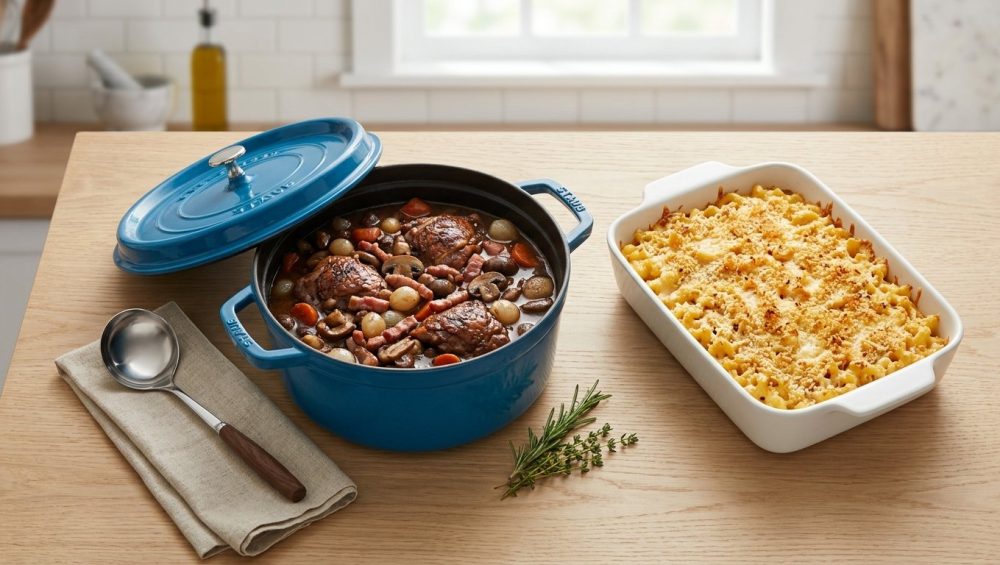
If I were forced to choose only one material to cook and serve in for the rest of my natural life, it would be enameled cast iron, without a second of hesitation. It is the undisputed heavyweight champion of the culinary world. Even if you are operating within a strict minimalist kitchen setup, a high-quality enameled cast iron Dutch oven or shallow braiser is absolutely non-negotiable.
Why It Works: The Science of Density
We have already established that cast iron possesses a massive thermal mass due to its sheer, unyielding density. When you heat a heavy cast iron braiser on the stove or in the oven, it absorbs a tremendous amount of thermal energy. It takes its sweet time getting hot, but once it is fully saturated with heat, it stubbornly refuses to let it go.
If you bring a bubbling, slow-cooked stew to the dining table in a pre-warmed enameled cast iron pot, the thick iron walls of the vessel will actively radiate heat back into the food for well over an hour. This means your guests can go back for second or third helpings, and the food will still be steaming hot. It completely eliminates the stress of timing your meal perfectly to the exact minute your guests sit down. The pot does the babysitting for you.
Safety Profile: Glass Meets Iron
Bare cast iron is a fantastic, durable material, but it is highly reactive. If you simmer highly acidic foods—like a rich, slow-cooked tomato ragù, a wine-heavy coq au vin, or a bright citrus reduction—in bare iron, the acid will aggressively strip the polymerized oil seasoning and impart a harsh, metallic, bloody taste to the food.
Enameled cast iron solves this chemical problem perfectly. During the manufacturing process, the interior and exterior of the iron are coated in a layer of vitreous enamel, which is essentially finely powdered glass (frit) that has been melted and fused to the iron at incredibly high temperatures (often exceeding 1,400°F). This creates a pristine surface that is entirely non-reactive, completely non-toxic, and utterly impervious to acidic foods. It gives you the legendary, heavy-duty heat retention of raw iron paired with the pristine, safe, easy-to-clean cooking surface of glass.
How to Pre-Heat for Maximum Effect
Here is the ultimate secret that separates the flustered amateurs from the relaxed pros: thermal mass works in both directions. If you pour hot food into a cold cast iron pot, the immense thermal mass of the iron will violently suck the heat out of your food in order to warm itself up. You will ruin your dinner’s temperature before it even hits the table.
To leverage thermal mass correctly, you must pre-heat the vessel. If I am serving a dish that was cooked in a different, less attractive pan, I will place my empty enameled cast iron serving dish into a 250°F oven for 20 to 30 minutes before dinner. By the time I transfer the hot food into it, the pot is a glowing thermal battery, fully charged and ready to keep my hard work hot for the entire duration of the gathering.
High-Fired Ceramics and Stoneware: The Elegant Insulators
While a heavy cast iron pot is brilliant for rustic stews and heavy, hearty braises, sometimes you want something a bit more refined and elegant for a formal table setting. Enter high-fired ceramics and stoneware. These are not just pretty dishes to look at; they are highly engineered, incredibly effective tools for the culinary curious.
Understanding the Clay Hierarchy: Earthenware, Stoneware, and Porcelain
Not all ceramics are created equal, and understanding the difference is crucial for optimizing your thermal mass.
- Earthenware: This is clay fired at relatively low temperatures (around 1,800°F to 1,900°F). Because it is fired low, it remains highly porous and relatively fragile. It must be glazed to hold liquids. While it has decent heat retention, it lacks the dense mass needed for extended serving, and it chips easily.
- Stoneware: This is the sweet spot for home cooks. Stoneware is fired at medium-high temperatures (between 2,100°F and 2,300°F). At this heat, the clay undergoes a magical process called vitrification.
- Porcelain: Fired at extremely high temperatures (up to 2,600°F), porcelain is glass-like, non-porous, and incredibly durable. However, because it is so strong, it is often spun very thin to create delicate teacups and fine china. Thin porcelain lacks the thick mass required to hold significant heat.
Vitrification and Thermal Mass
The true magic of high-quality stoneware serving dishes lies in that vitrification process. When the clay is fired at those extreme temperatures, the silica within the clay actually melts and turns into glass, filling in all the microscopic pores of the material. This makes the stoneware incredibly dense, completely waterproof, and phenomenally good at holding heat.
Because ceramics have an exceptionally low thermal conductivity, they act as a literal thermal wall. Once a thick stoneware baking dish gets hot, the heat struggles immensely to escape through the dense, tightly bonded structure of the material. This is exactly why a bubbling lasagna baked in a heavy stoneware dish will still be dangerously hot and bubbling 20 minutes after you take it out of the oven.
The Lead and Cadmium Warning (Revisited and Reinforced)
I will say it again because the stakes are simply too high: the safety of ceramics entirely depends on the chemical composition of the glaze. The brilliant, eye-catching reds, vibrant yellows, and deep blues you see on cheap, imported pottery are frequently achieved using toxic levels of lead and cadmium. When these dishes are heated in an oven, or when they come into contact with highly acidic foods (like a vinaigrette, a tomato sauce, or a citrus reduction), those heavy metals leach directly out of the glaze and into your meal.
When purchasing stoneware for baking or serving, you must look for explicit safety certifications. Reputable, high-quality brands will proudly and publicly state that their products meet or exceed California Proposition 65 standards and FDA regulations for lead and cadmium. If a company is vague about their materials, or if the price seems too good to be true, walk away immediately.
Glassware: The Double-Edged Sword of the Kitchen
We cannot discuss thermal mass without addressing glass. Glass bakeware is ubiquitous in home kitchens, but it behaves very differently than metal or clay, and it requires a specific set of rules to use safely and effectively.
Borosilicate vs. Soda-Lime Glass
Glass is an excellent insulator, meaning it holds heat very well once it gets hot, much like stoneware. However, not all glass is the same.
Historically, high-end glass bakeware was made from borosilicate glass. Borosilicate is engineered to withstand extreme temperature fluctuations without shattering. It is the same material used in laboratory beakers.
However, in recent decades, many popular brands switched their manufacturing to soda-lime glass to save money. Soda-lime glass is highly susceptible to thermal shock. If you take a hot soda-lime glass casserole dish out of a 400°F oven and place it on a cold granite countertop, or if a drop of cold water hits the hot glass, it can violently explode into thousands of razor-sharp shards, ruining your meal and potentially sending you to the hospital.
The Shatter Factor and Thermal Shock
If you choose to serve in glass, you must manage its thermal properties carefully. Glass takes a long time to heat up, but because it acts as an insulator rather than a conductor, it will keep your casserole hot for a very long time on the table.
To prevent thermal shock, always place hot glass serving dishes onto a thick, dry cloth towel or a wooden trivet—never directly onto a cold stone or metal surface. And never, ever move a glass dish directly from the refrigerator to a hot oven.
Soapstone and Terracotta: The Ancient Innovators
If you want to take your steps to culinary artistry to the absolute next level and explore historical, time-tested methods of heat retention, look no further than soapstone and terracotta. Our ancestors did not have microwaves or warming drawers; they relied entirely on the raw elements of the earth to keep their meals hot.
Soapstone: Nature’s Thermal Battery
Soapstone, scientifically known as steatite, is a naturally occurring metamorphic rock that is incredibly dense and rich in talc and magnesite. It has been used for thousands of years by indigenous cultures to carve highly effective cooking vessels. Soapstone is almost magical in its ability to absorb and retain heat. It is entirely non-porous, meaning it does not harbor bacteria or absorb off-flavors, and it is completely unaffected by acids.
A thick soapstone serving platter, heated gently in the oven, will stay radiating hot for hours. It is the ultimate, show-stopping vessel for serving roasted root vegetables, sizzling fajitas, or resting a massive prime rib right at the table. It is incredibly heavy, it is admittedly expensive, but it is worth every single penny if you are a serious host who values performance.
Terracotta: The Porous Powerhouse
Terracotta is unglazed, low-fired clay. Unlike vitrified stoneware, it is highly porous. While it lacks the dense, glass-like structure of high-fired ceramics, it has a unique thermal trick up its sleeve that has been utilized in traditional Roman Römertopfs and Moroccan Tagines for centuries.
When you soak an unglazed terracotta pot in water for 15 minutes before cooking, the porous clay absorbs the moisture deep into its walls. As the pot heats up in the oven, that trapped water slowly turns to steam, gently and evenly cooking the food from the inside out while the thick clay walls absorb the ambient heat. When you bring a thick terracotta pot to the table, it holds heat beautifully.
However, because it is porous, unglazed terracotta can easily absorb dish soap and rancid oils if not cared for properly. You must clean it only with hot water and a stiff brush. If you are using glazed terracotta to avoid this maintenance, refer back to my strict, uncompromising warnings about verifying lead-free glazes.
Strategic Plating and Pre-Heating: The Host’s Secret Weapon
You can buy the most expensive, scientifically optimized, artisanal enameled cast iron in the world, but if you do not use it correctly, you are wasting your money. When you are planning meals for mindful moments, the absolute last thing you want is the anxiety of rushing the food to the table before it freezes. Here is exactly how you weaponize thermal mass in your own dining room to create a stress-free environment.
The Oven-Warming Method
Your serving vessels are only half the battle. If you serve a piping hot, perfectly rested piece of steak onto an ice-cold porcelain dinner plate, the plate will instantly suck the heat out of the meat through direct conduction. Professional, high-end restaurants never serve hot food on cold plates. Neither should you.
Before your guests arrive, stack your ceramic dinner plates and your heavy serving bowls in a cold oven. Set the temperature to 170°F (or use the designated “Warm” setting if your oven has one). Let them sit in there for at least 30 to 45 minutes. When it is time to plate the food, pull them out using a dry kitchen towel. The plates will be warm to the touch, but not dangerously hot, and they will dramatically extend the eating window of your meal.
A crucial safety note: Never put cold glass or cold ceramics into a pre-heated, blazing hot oven. The sudden, violent thermal shock will cause the material to aggressively expand unevenly and shatter. Always heat them gradually by placing them in the oven while it is still cold.
Water Baths and Trivets
If you are hosting a long, lingering dinner party where people will be talking, drinking wine, and grazing for hours, you need to protect your serving ware from the table itself. A solid wood or glass dining table is a massive heat sink. If you place a hot cast iron pot directly onto a cold wooden table, the wood will relentlessly pull the heat out of the bottom of the pot through conduction.
Always use a thick wooden or natural cork trivet. Cork is a fantastic, naturally occurring insulator. By elevating the hot serving vessel off the table and placing it on an insulating material, you trap the heat inside the pot where it belongs, rather than losing it to your furniture.
For the absolute ultimate in temperature control, utilize a hot water bath right at the table. If you are serving creamy mashed potatoes or a delicate hollandaise sauce in a ceramic bowl, nestle that bowl into a slightly larger cast iron skillet filled with an inch of boiling water. The water acts as a perfect thermal buffer, gently and continuously transferring steady heat to the ceramic bowl without scorching the delicate food inside.
The Lid Strategy: Defeating Convection
Never underestimate the power of a heavy, tight-fitting lid. As we discussed earlier, convection is the process of heat escaping through the air. Every second your food sits uncovered, steam carries vital thermal energy away into the atmosphere.
If you are serving a dish that doesn’t need a crispy top (like a braise, a stew, or mashed potatoes), keep the lid on the serving vessel until the exact moment people are ready to scoop. A heavy cast iron lid not only traps the steam, but the lid itself absorbs heat and radiates it back down onto the surface of the food.
Conclusion: Serve Smart, Eat Hot
Cooking is an act of love, but serving is an act of calculated strategy. You do not need a culinary degree to make mind-blowing food, but you do need to respect the basic, unavoidable laws of physics. Stop undermining your own hard work, your expensive ingredients, and your precious time by dumping your beautiful, meticulously prepared meals into cheap, thin, toxic plastic bowls.
Invest in high-quality enameled cast iron. Buy dense, high-fired, verified lead-free stoneware. Treat your serving dishes as the powerful thermal batteries they are, and take the extra five minutes to pre-heat them properly.
When you harness the true power of thermal mass, you buy yourself the ultimate luxury as a host: time. You get to sit down, pour yourself a large glass of wine, and actually enjoy the mindful gathering you worked so hard to create, knowing with absolute scientific certainty that your food will remain perfectly hot, safe, and delicious until the very last bite is gone. Now go pre-heat your plates, banish that peeling Teflon to the garbage, and stop serving your guests cold mashed potatoes.