Let’s get one thing straight right out of the gate: you are an adult, and you deserve better than sad, limp, waterlogged vegetables that look and taste like they were prepared in a hospital cafeteria. If your roasted broccoli routinely comes out of the oven looking like a soggy green sponge, or your potatoes resemble damp cardboard, you are not alone. According to the 2025-2026 State of Home Cooking Report, while 51% of Americans are actively trying to incorporate more vegetables into their daily meals, a massive portion of those home cooks abandon the effort simply because they cannot achieve appetizing results.
But here is the good news: you do not need a culinary degree, a commercial kitchen, or a personal chef to achieve those mind-blowing, perfectly caramelized, crispy-edged vegetables you pay twenty dollars for at a trendy bistro. You just need to understand a tiny bit of basic food science and stop making the same easily avoidable rookie mistakes.
If you are finally ready to fix your food and transform your weeknight side dishes from a dreaded chore into the star of the dinner table, you have come to the right place. Grab a glass of wine, preheat your oven, and let’s dive deep into the brutal, undeniable chemistry of why your vegetables are turning to mush—and exactly how to force them to crisp up instead.
The Brutal Science of the Mush: Why Bad Things Happen to Good Produce
To understand how to roast a vegetable perfectly, you first have to understand what a vegetable actually is on a microscopic level. Vegetables are essentially just beautifully structured water balloons. Their rigid cellular walls are made up of cellulose, hemicellulose, and pectin. When they are raw, that pectin acts like biological cement, holding the cell walls tightly together and giving the vegetable its firm, crisp snap.
When you introduce heat, everything changes. Food science dictates that most vegetables will begin to soften significantly when their internal temperature reaches between 185°F (85°C) and 203°F (95°C). At this critical thermal threshold, the pectin dissolves and the cellulose structure weakens. As those cell walls collapse, what happens to all the liquid trapped inside? It violently releases.
And there is a staggering amount of liquid in there. Zucchini is roughly 95% water by weight. Broccoli is 91% water. Even dense, starchy root vegetables like potatoes are hovering around 79% water. When you put these water-dense plants into a hot oven, that internal moisture immediately begins to migrate to the surface and evaporate.
Here is where the magic—or the tragedy—happens. To get that gorgeous, savory, golden-brown crust on your food, you need to trigger the Maillard reaction. This complex chemical reaction between amino acids and reducing sugars is responsible for the incredible flavors of seared steak, toasted bread, and perfectly roasted carrots. However, the Maillard reaction does not even begin to kick into high gear until the surface temperature of the food reaches approximately 285°F (140°C).
Do you remember your high school physics? Water boils and turns to steam at 212°F (100°C). As long as there is liquid water actively sitting on the surface of your vegetables, the surface temperature of that food physically cannot exceed 212°F. It is thermodynamically impossible. Therefore, if your vegetables are expelling water faster than your oven can evaporate it, they will sit in a puddle of their own juices, gently steaming at 212°F. You will never hit the 285°F required for the Maillard reaction, and you will be left with a pan of mush.
The Holy Trinity of Roasting Ruin
Now that we know the science, let’s talk about how you are actively sabotaging it. When it comes to ruined, soggy vegetables, there are three cardinal sins that almost every home cook commits on a busy weeknight.
Mistake 1: The Personal Space Violation (Pan Crowding)
This is the number one offender in home kitchens everywhere. You chop up two massive heads of broccoli, a whole cauliflower, and a pound of carrots, and you pile them all onto a single, standard-sized baking sheet. They are overlapping, touching, and fighting for their lives.
When you crowd the pan, you are creating a micro-climate of intense humidity. Remember all that water evaporating out of the dissolving pectin walls? When the vegetables are packed tightly together, that moisture has nowhere to go. It gets trapped between the pieces of food, creating a dense cloud of steam. Instead of the dry, ambient heat of the oven roasting the exterior of your produce, the trapped steam gently boils the vegetables from the outside in.
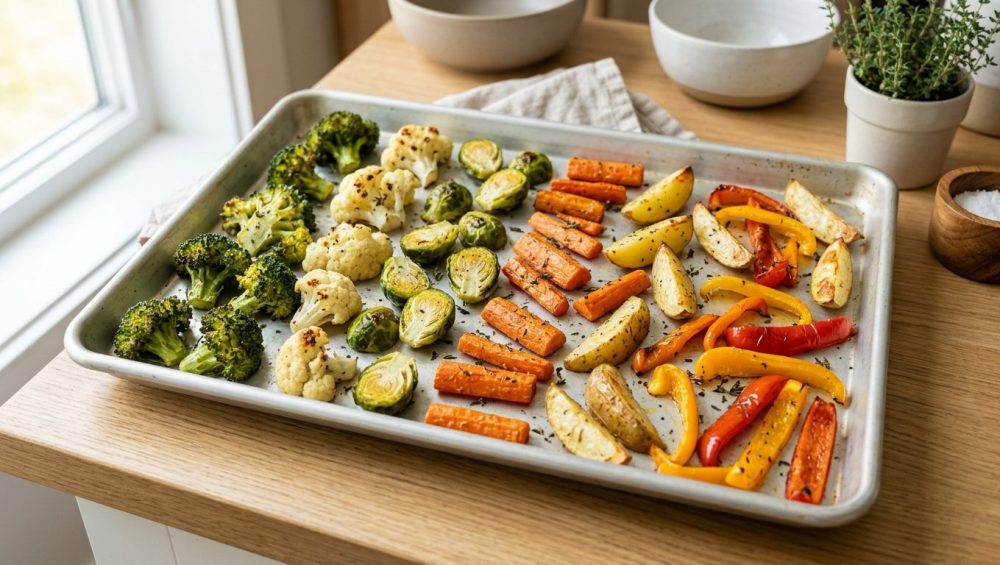
Vegetables are introverts; they demand personal space. If you want crispy edges, every single piece of food on that pan needs at least a quarter-inch of bare metal around it. If you have too many vegetables for one pan, you have two choices: use two pans, or cook in batches. Cramming them all onto one sheet is a guaranteed ticket to Soggy Town.
Mistake 2: Temperature Timidity
I do not know who started the vicious rumor that 350°F is an appropriate temperature for roasting vegetables, but I would like to have a strong word with them. 350°F is for baking delicate vanilla cakes and gently warming up casseroles. It is an absolute insult to a Brussels sprout.
When you put cold, water-dense vegetables into a lukewarm 350°F oven, they spend entirely too much time in what food scientists call the “evaporative lag phase”. This is the agonizingly long window of time where the vegetable is slowly heating up, releasing its water, and struggling to evaporate that moisture. Because the oven temperature is too low, the evaporation process drags on forever. By the time the surface finally dries out enough to start browning, the interior of the vegetable has been cooking for forty-five minutes and has completely disintegrated into a mealy, unappetizing paste.
You need aggressive, confident heat. We are talking 425°F to 450°F. You want the ambient heat to be so intense that the moment the vegetable releases its surface moisture, that moisture is instantly flash-evaporated, allowing the surface temperature to rapidly climb past the 285°F Maillard threshold while the interior is still perfectly tender-crisp.
Mistake 3: The Oil Paranoia
A lot of well-meaning home cooks try to make their healthy weeknight dinners even healthier by skimping on the olive oil. They give their massive bowl of chopped potatoes a pathetic, one-second spritz of cooking spray and call it a day. This is a massive culinary error.
In the oven, fat is not just an ingredient for flavor; it is a vital thermodynamic bridge. Air is actually a terrible conductor of heat. Oil, on the other hand, is a fantastic conductor. When you coat your vegetables in a generous, even layer of oil, that oil acts as a liquid heat-transfer medium, frying the surface of the vegetable directly against the hot metal of the baking sheet.
If you do not use enough oil, the dry spots on your vegetables will simply dehydrate, shrivel up, and turn into tough, leathery husks. One of the most simple kitchen fixes you can implement today is to stop being terrified of healthy fats. Toss your vegetables until every single piece is visibly glistening.
Prep Like a Perfectionist: The Pre-Oven Rituals
Crispy vegetables are not made in the oven; they are made on the cutting board. How you treat your produce before it ever sees the heat will dictate your final results.
The Enemy is Moisture
We have established that water is the mortal enemy of the Maillard reaction. So why on earth are you washing your broccoli in the sink and then immediately throwing it onto a baking sheet while it is still dripping wet? You are literally adding extra water to a food that is already 91% water.
After you wash your vegetables, you must dry them with the obsessive zeal of a museum curator handling ancient manuscripts. Use paper towels, use clean kitchen linens, or better yet, throw your chopped florets and leafy greens straight into a salad spinner and aggressively spin them until they are bone dry. If your vegetables are wet when they hit the oil, the oil will not adhere properly, and that surface water will have to boil off in the oven before any browning can even think about occurring.
Surface Area is King
The crispy, caramelized bits are the best part of the vegetable. Therefore, logic dictates that we should want to maximize the amount of surface area that comes into direct contact with the hot pan.
Stop chopping your vegetables into awkward, uneven, spherical chunks. Spheres have terrible surface-to-volume ratios and barely touch the pan. Instead, utilize bias cuts. Slice your carrots on a sharp diagonal to create long, flat, oval surfaces. Cut your potatoes into wedges or flat-sided cubes. Halve your Brussels sprouts and place them meticulously cut-side down.
Furthermore, you must ensure your prep tools are not actively working against you. If you are hacking away at a bell pepper with a dull knife, you are not cleanly slicing through the cell walls; you are crushing and bruising them. Crushed cell walls leak excess water prematurely, leaving you with a soggy cutting board and a compromised vegetable. Once you have cleanly chopped your produce, use a wide bench scraper to scoop everything up in one swift motion, ensuring you transfer all the food to the bowl without leaving a mess behind.
The Great Salt Debate
Salt is a magical mineral, but it is also a powerful osmotic agent. When you apply salt to the surface of a raw vegetable, it immediately begins to draw water out from inside the cell walls and pull it to the surface.
If you salt your high-moisture vegetables (like zucchini or bell peppers) and then let them sit on the counter for twenty minutes while you prep other things, they are going to sweat profusely. By the time they hit the oven, they will be swimming in a puddle of their own extracted juices. For high-moisture vegetables, do not salt them until the very last possible second before they go into the oven. Alternatively, you can roast them completely naked and hit them with a generous shower of flaky sea salt the moment they come out of the oven.
Banish the Toxic Junk: The Gear You Actually Need
As the Sassy Sous-Chef, I have a strict, non-negotiable rule in my kitchen: life is too short, and our health is too precious, to cook on cheap, flimsy, toxic garbage. If you want professional-level results, you need gear that actually functions properly.
The Baking Sheet Reality Check
Go to your kitchen cabinets right now and look at your baking sheets. If they are dark gray, covered in a mysterious flaking non-stick coating, and weigh less than a paperback novel, throw them directly into the recycling bin. I am entirely serious.
Cheap, thin baking sheets are a culinary disaster. Because they lack mass, they cannot hold onto heat. When you put a pound of cold vegetables onto a thin pan, the temperature of the metal plummets instantly. Furthermore, thin pans are notorious for thermal shock. If you have ever wondered why your baking sheets pop and violently warp loudly in the middle of a roasting session, it is because the flimsy metal is expanding unevenly under high heat. A warped pan means your vegetables are no longer sitting flat against the metal; they are pooling in the corners, steaming in oil and water.
More importantly, most cheap dark pans are coated in PTFE (Teflon) or similar non-stick chemicals. These chemical coatings begin to break down and degrade rapidly at temperatures over 450°F. We just established that we need to roast at 425°F to 450°F. You are toeing a very dangerous, toxic line, and I absolutely refuse to eat roasted broccoli garnished with peeling chemical flakes.
You need heavy-gauge, bare aluminum half-sheet pans. Commercial kitchens use thick aluminum because it has phenomenal thermal conductivity. It absorbs the oven’s heat rapidly and transfers it violently and efficiently directly into the bottom of your food. Heavy aluminum will not warp, it will not peel, and it will give you the aggressive sear you are looking for. Stainless steel is also a highly durable, non-toxic option, though it takes slightly longer to heat up than aluminum.
The Truth About Pan Liners
To line, or not to line? That is the question that plagues home cooks daily.
If you want the absolute maximum amount of caramelization and crunch, you should roast your vegetables directly on the bare metal of your aluminum or stainless steel pan. The direct metal-to-food contact provides the most efficient heat transfer possible.
If you absolutely despise doing dishes and insist on a liner, use unbleached parchment paper. Parchment paper is incredibly thin and allows the vast majority of the heat to transfer through to the food while providing a safe, non-stick barrier. Heavy-duty aluminum foil is also acceptable, though it can occasionally cause vegetables to stick if not heavily oiled.
However, you must completely avoid using silicone baking mats for high-heat roasting. While silicone mats are fantastic for baking delicate macarons and preventing sugar cookies from spreading, they are literally made of rubber and fiberglass. Silicone is a highly effective thermal insulator. It actively blocks and absorbs the heat from the metal pan, preventing it from reaching the bottom of your vegetables. If you roast potatoes on a thick silicone mat, the bottoms will be pale, soft, and deeply disappointing.
Weekday Warriors vs. Weekend Perfectionists
I firmly believe that time is money, and when you get home at 6:00 PM on a Tuesday, you do not have the patience for a three-hour culinary project. But on a Sunday afternoon, you might have the time to chase absolute Michelin-star perfection. Here is how to adapt the science for your schedule.
The Weekday Shortcut: The Hot Pan and the Microwave
If you want to shave ten to fifteen minutes off your roasting time and guarantee a better crust on a busy weeknight, do not put your vegetables onto a cold pan. While your oven is preheating to 450°F, stick your empty, heavy-gauge aluminum baking sheet inside it.
When you toss your oiled vegetables onto a pan that is already screaming hot, you completely bypass the evaporative lag phase. The surface water flash-evaporates the millisecond it hits the metal, and the Maillard reaction begins immediately. As a bonus, the instant sizzle sears the exterior of the vegetable, which helps prevent food sticking to the bare metal.
If you are dealing with incredibly dense root vegetables like carrots or butternut squash, and you want to stop eating mushy veggies that take an hour to cook through, use your microwave. Toss your chopped root vegetables in a glass bowl with a tiny splash of water, cover with a plate, and microwave them for three to four minutes. This rapid steam par-cooks the dense interior and begins to break down the pectin. Drain them, dry them thoroughly, toss them in oil, and throw them onto your preheated baking sheet. You will cut your oven time in half and achieve a perfectly tender interior with a blistered exterior.
The Weekend Project: The Alkaline Slurry Trick
If it is a Sunday and you want to make the greatest roasted potatoes of your entire life, you are going to use the alkaline par-boiling method popularized by J. Kenji López-Alt and the food science nerds at Serious Eats.
Here is the secret: pectin breaks down significantly faster in an alkaline environment. If you boil your potato chunks in water that has been spiked with a half-teaspoon of baking soda (which raises the pH and makes the water alkaline), the exterior surface of the potato will rapidly degrade and break down, while the interior remains solid.
When you drain these potatoes, you toss them violently in a bowl with your olive oil or duck fat. That broken-down, mushy exterior mixes with the fat to create a thick, starchy paste—a slurry—that coats the entire surface of the potato. When you roast these slurry-coated potatoes at 450°F, that starchy paste fries in the oven, creating a shatteringly crisp, glass-like crust that is thick, golden, and profoundly crunchy. It takes a little extra time to boil the water, but the results will ruin standard roasted potatoes for you forever.
The Master Reference Guide: Vegetable-Specific Strategies
Not all vegetables are created equal. Treating a delicate zucchini the same way you treat a dense parsnip is a recipe for disaster. Here is your cheat sheet for handling the unique biology of different produce.
The Brassicas: Broccoli, Cauliflower, and Brussels Sprouts
These are the undisputed kings of the roasting pan. Their tightly packed florets and leaves have thousands of tiny ridges that crisp up beautifully.
- The Strategy: High heat (425°F), plenty of oil, and strategic placement. For Brussels sprouts, you must cut them in half and place every single one cut-side down against the bare metal. The flat surface will caramelize deeply, while the outer leaves will char and crisp like potato chips. Do not flip them; just let them sear.
The Root Vegetables: Potatoes, Carrots, Parsnips, Beets, and Sweet Potatoes
These vegetables are dense, starchy, and have tightly bound pectin structures. They take a long time for the heat to penetrate to the center.
- The Strategy: If you have the time, roast them at 400°F to 425°F for 35 to 45 minutes, flipping once at the halfway mark. If you are in a rush, use the microwave par-cook method or the alkaline boiling trick mentioned above. Sweet potatoes contain a high amount of natural sugars, so keep a close eye on them to ensure they caramelize rather than burn.
The High-Moisture Nightmares: Zucchini, Yellow Squash, Eggplant, and Bell Peppers
These vegetables are basically water balloons masquerading as food. Zucchini is 95% water. If you look at them wrong, they turn into a soggy, limp mess.
- The Strategy: Extreme heat (450°F) and extreme personal space. Cut them into thick, substantial pieces (do not slice them thin, or they will disintegrate). Do not salt them until they come out of the oven. Preheat the pan so they sizzle immediately upon contact. You want to blister the outside rapidly before the interior structure completely collapses into mush.
The Alliums: Onions, Shallots, and Garlic
These bring immense flavor, but they have a very high natural sugar content.
- The Strategy: Sugars burn quickly at high temperatures. If you are roasting a medley of vegetables, do not put minced garlic on the pan at the very beginning. It will incinerate into bitter, black ash within fifteen minutes. If you want garlic flavor, infuse your cooking oil with garlic beforehand, or toss the roasted vegetables with fresh garlic and herbs the moment they come out of the oven while they are still piping hot. For onions, cut them into thick wedges leaving the root intact so they do not fall apart and burn.
Troubleshooting the Soggy Aftermath
We have all been there. Despite your best intentions, you misjudged the spacing, your oven runs cold, or you simply rushed the process, and you are staring at a pan of sad, steamed, mushy vegetables. Can they be saved?
If they are just slightly under-crisped, you can attempt an emergency rescue. Transfer the vegetables onto a wire rack set inside a clean baking sheet, and place them directly under your oven’s broiler for three to four minutes. The intense, direct, top-down radiant heat of the broiler will quickly evaporate the remaining surface moisture and force a rapid Maillard reaction without overcooking the interior much further. Keep your eyes glued to the oven window, because broilers can take food from perfectly browned to charcoal in a matter of seconds.
If they are truly far gone—limp, gray, and texturally ruined—do not throw them away. Pivot. A soggy roasted vegetable is just a soup waiting to happen. Throw that mushy roasted cauliflower or those sad carrots into a blender with some hot vegetable broth, a splash of heavy cream, and a handful of sharp cheddar or parmesan cheese. Blend it until silky smooth, and congratulations: you just made an incredibly complex, deeply flavored roasted vegetable bisque. No one ever has to know you actually messed up the side dish.
The Final Word
Cooking is not magic; it is just applied physics and chemistry that you get to eat at the end of the day. By understanding how water, heat, and pectin interact, and by respecting the fundamental rules of thermal conductivity, you can permanently banish mushy vegetables from your kitchen. Give your produce space to breathe, crank up the heat, don’t skimp on the oil, and throw away those toxic, warped pans. You are the master of your oven. Now go show that broccoli who is boss.