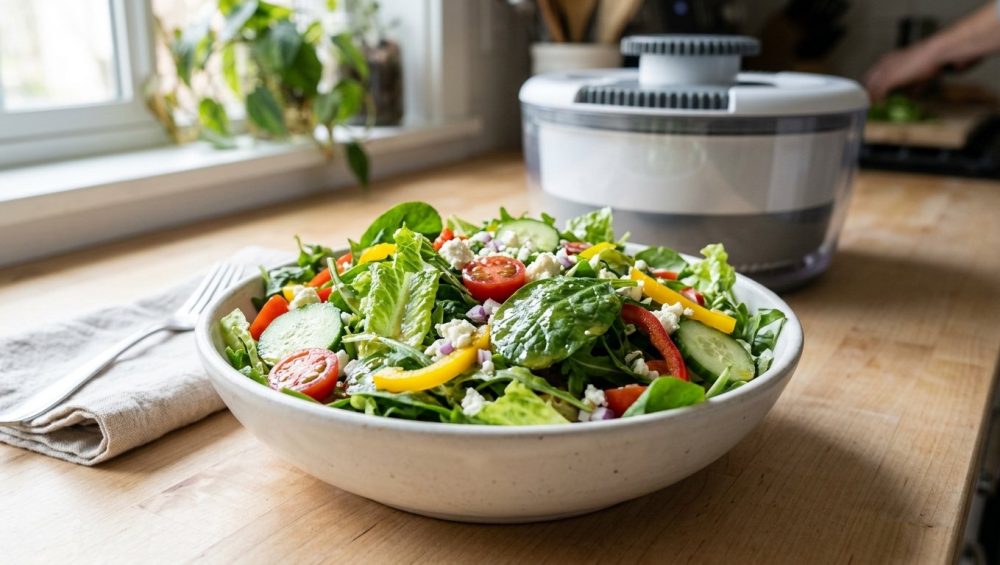
You’ve had a long, exhausting day. You want something green, crisp, and vibrant to go with your weeknight dinner. You chop up a beautiful head of romaine, whisk together a quick, punchy vinaigrette, toss it all in a bowl, and sit down to eat. But instead of a restaurant-quality salad, you are met with a depressing, limp pile of greens sitting in a watery, separated puddle of oil and vinegar at the bottom of your bowl. Sound familiar? Listen, I love a good kitchen shortcut as much as the next busy cook, but if you are washing your greens and just giving them a half-hearted shake over the sink before dressing them, you are committing a cardinal culinary sin.
I have absolutely zero patience for pretentious chef-speak, but I also have zero patience for ruined food. You do not need a culinary degree to make a mind-blowing, perfectly dressed salad at home. You just need to understand basic physics and own one specific, non-negotiable tool: a high-quality salad spinner.
Let’s talk about the grim reality of the American kitchen for a moment. According to the United States Department of Agriculture (USDA) and the Environmental Protection Agency (EPA), the United States wastes between 30 to 40 percent of its available food supply every single year. That translates to roughly 133 billion pounds of food, or about $1,500 to $1,600 a year for the average family of four. And do you know what one of the biggest offenders is? Leafy greens. We buy them with the best of intentions, let them rot in the crisper drawer, or we serve them soggy, hate eating them, and throw the rest away. If you are serious about mastering simple weeknight dinners, you need to stop treating your side salads as a watery afterthought and start treating them with the respect they deserve.
The Food Science of Hydrophobic Repulsion
Let’s get into the practical food science, because understanding exactly why your dressing won’t stick to wet lettuce is the first step to permanently elevating your culinary game. This isn’t just about residual water diluting your flavor—though a watered-down vinaigrette is a tragedy in its own right. This is about a phenomenon known as hydrophobic repulsion.
Nature designed leafy greens to survive the elements. The surface of a lettuce leaf is covered in a thin, natural waxy cuticle. This microscopic layer is meant to protect the plant’s cellular structure, keeping the aqueous cytoplasm inside the cells from leaking out, while also shielding the leaf from external damage.
Now, let’s look at your salad dressing. A standard vinaigrette is heavily oil-based. As you probably remember from middle school chemistry, oil and water do not mix. They are immiscible. Water is a polar molecule, while oil is non-polar. Because oils repel polar molecules like water, they are classified as hydrophobic, which literally translates to “water-fearing”.
When you wash your lettuce and fail to dry it completely, a thin, invisible layer of water clings to that waxy cuticle. When you pour your beautiful, expensive olive oil vinaigrette over those wet leaves, a microscopic battle takes place. The hydrophobic oil in your dressing is violently repelled by the hydrophilic water clinging to the leaf. The water acts as an impenetrable physical barrier. The oil simply cannot adhere to the surface of the lettuce. Instead, it slides right off the water layer, dragging your carefully balanced seasonings with it, and pools into a sad, bland puddle at the bottom of your salad bowl.
If you want to excel at preventing soggy salads, you have to eliminate that water barrier. Bone-dry greens allow the oil to interact directly with the leaf’s surface, clinging to it and coating it evenly, ensuring that every single bite is packed with flavor.
The Chemistry of Emulsions and Why They Shatter
To truly understand the tragedy of wet lettuce, we need to dive a little deeper into the chemistry of your dressing. A classic vinaigrette is a temporary emulsion—a forced marriage between two conflicting elements, typically fat (oil) and acid (vinegar or citrus juice).
Because oil and vinegar naturally want to separate into two distinct layers, we use mechanical force (whisking) to break the oil into tiny droplets and disperse them throughout the acid. To keep them from immediately separating again, we introduce an emulsifier, also known as a surfactant. Emulsifiers are the hand-holders of the molecular world. They contain both hydrophobic (water-fearing) and hydrophilic (water-loving) regions. Think of an emulsifier as a bridge: one end grabs onto the oil, and the other end grabs onto the water, locking them together in a smooth, homogenous mixture. Common culinary surfactants include egg yolks, Dijon mustard, and honey.
When you create a perfectly emulsified vinaigrette, it becomes thick, glossy, and capable of clinging beautifully to dry ingredients. But emulsions are delicate. They rely on a very specific ratio of fat to liquid. When you pour your stable emulsion over wet, poorly drained lettuce, you are introducing a massive, uncontrolled amount of excess water into the equation.
This flood of residual wash water disrupts the delicate balance of your surfactant bridge. The sheer volume of water overwhelms the emulsifier’s ability to hold the oil and liquid together. The result? Your emulsion shatters. Understanding why your vinaigrette separates on the plate is crucial. The dressing breaks apart into greasy oil slicks and harsh, acidic pools of vinegar. The acid, now separated from the protective buffer of the oil, attacks the delicate cellular walls of the lettuce, causing the leaves to wilt and turn limp at an accelerated rate.
By taking the time to thoroughly dry your greens, you are preventing emulsion breakage. You are allowing the dressing to remain a cohesive, creamy unit that coats the leaves rather than destroying them.
Centrifugal Force and the Engineering of the Salad Spinner
So, how do we get our greens perfectly, scientifically dry without spending an hour patting each individual leaf with a paper towel? Enter the salad spinner. This seemingly simple device is actually a marvel of everyday kitchen engineering, relying on the principles of centrifugal force to do the heavy lifting for you.
All salad spinners share the same basic anatomy: a perforated inner basket that rests on a central pivot point inside a larger, solid outer bowl. The lid houses a mechanical mechanism that engages with the inner basket, forcing it to rotate at high speeds.
When the basket spins rapidly, Newton’s first law of motion dictates that the water droplets clinging to the lettuce want to travel in a straight line. The solid walls of the inner basket force the lettuce leaves to travel in a circle, but the water droplets pass right through the perforations. The centrifugal force propels the water away from the center, stripping it off the leaves and trapping it in the outer bowl, leaving the greens safely inside the basket.
While the physics have always been the same, the engineering of the salad spinner has evolved dramatically. If you grew up in the 1980s or early 90s, you likely remember salad spinners as chaotic, frustrating devices. They relied on retractable pull-cords or awkward hand cranks. Pull-cords required significant upper body strength, often caused the entire bowl to jump violently across the kitchen counter, and harbored bacteria when the wet strings retracted into the lid. Cranks were just as bad, requiring the user to apply force in the same direction the basket was spinning, leading to severe instability.
Then, in 1998, a company called OXO completely reinvented the category. Drawing inspiration from an old-school children’s spinning top toy, their engineers developed the first-ever pump-activated salad spinner. This was a massive leap forward in ergonomic kitchen design. A simple, one-handed downward pump action translated into rapid horizontal rotation.
But the engineers didn’t just guess at how fast the basket needed to spin. During the development process, they actually calculated the exact surface tension of water droplets resting on lettuce leaves. By understanding the surface tension, they could mathematically determine the precise level of centrifugal force—and the exact RPMs (revolutions per minute)—required to aggressively dislodge the water without bruising, crushing, or damaging the delicate greens. It is this kind of thoughtful, science-backed engineering that makes a high-quality spinner one of the most essential beginner kitchen tools you can own.
Time is Money: Efficiency in the Weeknight Kitchen
I firmly believe that anyone can cook like an expert and produce mind-blowing food without a culinary degree. But I also know that on a Tuesday night, after a long day of work, time is money. You need efficiency. You need clever, time-saving cooking hacks that allow you to get a healthy, vibrant meal on the table before you lose your mind and order delivery.
A lot of home cooks avoid making side salads because washing and drying lettuce feels like a tedious, time-consuming chore. But a salad spinner isn’t just a dryer; it is a three-in-one prep station that actually streamlines your workflow.
First, the inner basket functions as a highly effective colander. You can dump your chopped greens directly into the basket, run them under cold water, and agitate them with your hands to loosen dirt and grit. Second, the outer bowl acts as a soaking tub. If your greens are particularly sandy (I’m looking at you, spinach and leeks), you can fill the outer bowl with water, submerge the basket, and let the dirt fall to the bottom.
Finally, once the greens are spun dry, the spinner acts as the ultimate crisper storage vessel. If you want a shortcut to conquering weeknight cooking anxiety, prep a massive batch of greens on Sunday. Wash them, spin them bone-dry, pour out the excess water from the outer bowl, and put the entire salad spinner right into the fridge. The hard outer shell protects the delicate leaves from getting crushed, while the elevated inner basket keeps the greens lifted away from any residual moisture that might pool at the bottom. The result? Crisp, vibrant lettuce that lasts for over a week without turning into brown slime. When you are trying to eliminate daily kitchen chaos, having pre-washed, perfectly dry greens ready to grab at a moment’s notice is an absolute game-changer.
The “No-Go” Rule on Toxic Gear: Choosing the Right Spinner
Let’s get one thing straight: I have absolutely zero patience for cheap, toxic kitchenware. If you are going to invest in a tool that handles your fresh, raw produce, you need to be uncompromising about the materials it is made from.
The market is flooded with bargain-bin salad spinners made from flimsy, mystery plastics. These cheap models are a false economy. The high-speed centrifugal force puts a tremendous amount of stress on the plastic components. Cheap spinners will inevitably develop hairline fractures, the pump mechanisms will strip and fail, and the brittle plastic bowls will shatter the first time you accidentally drop them. Worse, low-grade plastics can leach endocrine-disrupting chemicals (like BPA and phthalates) into your food, especially if they are exposed to heat in the dishwasher.
I strongly advocate for ditching toxic kitchen gear and upgrading to materials that are safe, durable, and built to last a lifetime. When shopping for a salad spinner, you have three acceptable options:
1. Heavy-Duty, BPA-Free Tritan Plastic
If you prefer a lightweight option, look for spinners explicitly labeled as made from BPA-free Tritan or heavy-duty polycarbonate. Brands like OXO use thick, shatter-resistant plastics that can withstand years of aggressive pumping and dishwasher cycles without degrading.
2. Borosilicate Glass
For those who want to completely eliminate plastic from their food contact surfaces, borosilicate glass is a phenomenal option. Borosilicate is the same thermal-shock-resistant glass used in laboratory beakers. Some premium spinners feature an outer bowl made entirely of elegant, sturdy borosilicate glass. Not only is it 100% non-toxic and scratch-resistant, but the glass bowl is beautiful enough to go straight from the counter to the dining table as a serving vessel.
3. Stainless Steel
A stainless steel outer bowl is the ultimate workhorse. It is virtually indestructible, completely non-toxic, and retains cold temperatures beautifully. If you chill a stainless steel spinner bowl in the fridge for ten minutes before tossing your salad in it, it will keep your greens crisp and cold throughout the entire meal.
The Mechanism Matters
Beyond the bowl material, pay attention to the spinning mechanism. Avoid pull-cords at all costs. Look for a one-handed, pump-activated design with a built-in braking system. The brake button is not just a gimmick; it allows you to stop the high-speed rotation instantly, which is crucial when you are moving fast during meal prep. Furthermore, ensure that the lid can be easily disassembled for cleaning. Spinners with sealed lids trap moisture and become breeding grounds for black mold and bacteria.
Step-by-Step Masterclass: Achieving Bone-Dry Greens
Owning the right gear is only half the battle; technique is everything. If you are tired of watery salads and want to start fixing your food at home, follow this rigorous, step-by-step masterclass for achieving bone-dry, restaurant-quality greens.
Step 1: The Ice Water Shock
Never wash your greens in warm or room-temperature water. Warm water softens the cellular walls and promotes wilting. Fill the outer bowl of your spinner with ice-cold water. Submerge the chopped greens in the basket and let them soak for 5 to 10 minutes. The cold water acts as a shock to the plant’s vascular system, causing the cells to absorb moisture and plump up, resulting in a dramatically crisper texture.
Step 2: The Lift and Rinse
After the soak, do not simply pour the water out of the bowl through the greens. All the sand and dirt that sank to the bottom will just be poured right back over your lettuce. Instead, lift the inner basket out of the water. Dump the dirty water from the outer bowl, rinse it clean, and place the basket back inside.
Step 3: Mind the Capacity
The biggest mistake home cooks make is overstuffing the spinner. Centrifugal force requires empty space for the water to escape. If you pack the basket to the brim, the greens in the center will remain trapped in a wet, compressed brick. Only fill the basket to a maximum of three-quarters capacity. If you are prepping a massive salad, do it in two batches. It takes an extra thirty seconds and makes a world of difference.
Step 4: The Spin Cycle
Lock the lid in place and engage the pump. You want to achieve maximum RPMs to overcome the surface tension of the water. Give it several firm, rapid pumps until it is humming at top speed, and then let it coast for about 10 to 15 seconds.
Step 5: The Drain and Repeat
Press the brake button to stop the basket. Remove the lid and lift the basket out. You will likely see a significant amount of water pooled in the outer bowl. Dump that water down the drain. For truly bone-dry greens, place the basket back in the empty bowl and give it one more quick spin. This secondary spin removes the stubborn microscopic droplets that clung on during the first round.
Beyond Lettuce: Unexpected Uses for Your Salad Spinner
A common complaint about salad spinners is that they are bulky and take up valuable cabinet real estate. While this is undeniably true, a high-quality spinner is not a single-task unit. It is an incredibly versatile, multi-tasking workhorse that can be used for a variety of culinary applications.
1. Drying Delicate Fresh Herbs
Fresh herbs like cilantro, parsley, and basil are notoriously difficult to wash and dry without crushing them. If you chop wet herbs, they turn into a bruised, oxidized green paste that sticks to your knife and cutting board. A quick trip through the salad spinner removes the water gently, keeping the leaves intact and fluffy. This is the absolute best way to stop fresh herbs getting slimy in your fridge.
2. Prepping Berries and Grapes
Berries are highly susceptible to mold, and excess moisture is mold’s best friend. When you bring home strawberries, blueberries, or grapes, wash them in the spinner basket and give them a very gentle, low-speed spin to remove the surface water before storing them. This simple step can extend the shelf life of your expensive berries by days.
3. Reviving Limp Vegetables
If you find sad, rubbery celery, carrots, or radishes languishing in the back of your crisper drawer, don’t toss them. Chop them up, throw them in the spinner basket, and submerge them in an ice water bath for twenty minutes. The vegetables will rehydrate and crisp up beautifully. Spin them dry, and you have managed to revive sad wilted vegetables that would have otherwise ended up in the landfill.
4. Wringing Out Salted Vegetables
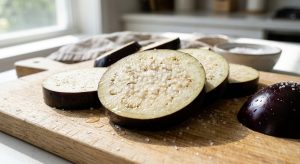
When making dishes like eggplant parmesan, zucchini fritters, or cucumber tzatziki, recipes often require you to salt the vegetables to draw out excess moisture. Usually, you have to squeeze the water out by hand using a kitchen towel—a messy, frustrating process. Instead, place the salted, weeping vegetables into your spinner and let centrifugal force extract the bitter liquid for you.
The Perfect Toss: Dressing Your Dry Greens Like a Professional
Now that you have achieved perfectly crisp, bone-dry greens, you are ready for the final step. Having dry lettuce is only half the equation; how you apply the dressing dictates the final texture of the dish.
Never, under any circumstances, pour dressing directly out of a bottle onto a plated pile of greens. This results in heavy, saturated spots and completely dry, flavorless patches. To achieve a professional, restaurant-quality salad, you must embrace the art of the toss.
Use an oversized mixing bowl—much larger than you think you need. The bowl should be at least twice the volume of the greens you are dressing. Add your dry greens to the bowl. Next, spoon your emulsified vinaigrette around the perimeter of the bowl, allowing it to trickle down the sides, rather than dumping it directly onto the leaves.
Drop the tongs. Tongs bruise delicate greens and fail to distribute dressing evenly. Wash your hands thoroughly, reach into the bowl, and gently lift and toss the greens with your fingers. Your hands are the most sensitive tools in your kitchen. Tossing by hand allows you to feel the greens, ensuring that every single leaf is coated in a microscopic, glistening layer of vinaigrette without being weighed down. If you need a comprehensive essential kitchen survival guide tip, let it be this: trust your hands.
Because your greens were meticulously dried in the salad spinner, there is no hydrophobic water barrier to repel the oil. There is no excess moisture to shatter your delicate emulsion. The dressing will cling effortlessly to the waxy cuticle of the lettuce, delivering bright, punchy, perfectly balanced flavor in every single bite.
Cooking exceptional food at home doesn’t require magic, and it certainly doesn’t require a culinary degree. It requires an understanding of the basic physical properties of your ingredients, a refusal to settle for toxic or inefficient gear, and the willingness to take an extra thirty seconds to do things right. Stop accepting sad, watery, diluted salads as a weeknight inevitability. Invest in a high-quality, pump-activated salad spinner, respect the science of hydrophobic repulsion, and start eating greens that actually taste as good as they look.