Listen, we need to have a serious talk about that sound. You know the one. That nails-on-a-chalkboard, metal-on-wood screech that happens right after you finish dicing an onion. You take the delicate, finely honed edge of your expensive chef’s knife, turn it sideways, and scrape it aggressively across the cutting board to scoop up your vegetables. Every time I hear that sound in a kitchen, a little piece of my culinary soul dies.
I get it. You are tired. It is a random Tuesday night, you have a skillet screaming hot on the stove, and you need to get those onions and bell peppers from the board to the pan before the oil starts smoking. Your knife is already in your hand, so it naturally becomes a makeshift spatula. It seems like the most efficient move. But let me be brutally honest with you: that single, seemingly harmless habit is the exact reason you are constantly complaining about how your knives cannot even slice through a ripe tomato without squishing it into a sad, pulpy mess.
You are destroying your blades. You are making your prep work harder, slower, and infinitely more dangerous. But do not panic, because I am not just here to scold you. I am here to introduce you to the cheapest, most effective, and most transformative tool you will ever buy: the stainless steel bench scraper. It is the ultimate prep-time savior, and it is going to change the way you cook forever.
The Microscopic Carnage: What Actually Happens When You Scrape
To understand why I am so incredibly dramatic about this, we have to look at the anatomy of a kitchen knife. I promise I will not bore you with pretentious chef-speak, but we need a quick dose of physics.
The Anatomy of an Edge
When you look at the edge of a properly sharpened chef’s knife, it looks like a solid, straight line of metal. But if you were to look at that same edge under a microscope, you would see a delicate, V-shaped apex. On a standard Western-style kitchen knife, this edge is typically ground to an angle of about fifteen to twenty degrees on each side. On Japanese knives, that angle can be as acute as ten to twelve degrees.
This microscopic V-shape is designed to do exactly one thing: withstand vertical pressure. When you chop, slice, or rock your knife up and down through an ingredient, the force is distributed straight up the spine of the blade. The steel is engineered to handle that downward force flawlessly, easily parting the cellular walls of your food.
The Devastation of Lateral Force
But what happens when you turn that blade sideways and drag it across a hard surface? You are applying lateral (sideways) force to a microscopic sliver of metal that is roughly the thickness of a human hair. The steel is simply not designed to handle pressure from that direction.
Depending on the type of knife you own, one of two disastrous things will happen. If you are using a softer German or Western stainless steel knife, the microscopic edge will literally bend and roll over on itself. This is called “edge rolling,” and it creates a burr—a tiny lip of metal that hooks to one side. Once the edge is rolled, the knife is effectively blunt. It will no longer bite into food; instead, it will slip off the surface. It is the exact reason why a dull knife is to blame for your tears when chopping onions, as it violently crushes the onion cells and releases a massive spray of eye-irritating sulfur compounds rather than slicing cleanly through them.
On the other hand, if you are using a high-carbon Japanese knife with a much harder steel rating, the edge will not just roll—it will micro-chip. Harder steel is more brittle, and dragging it sideways across a cutting board will snap off microscopic pieces of the apex. This leaves your blade feeling jagged and rough, completely ruining the smooth action required for efficient vegetable prep.
The True Cost of a Ruined Blade: Financial and Physical Toll
You might be thinking, “So what? I’ll just sharpen it.” But let us talk about the actual cost of this bad habit, because scraping your board is bleeding your wallet dry and putting your fingers at serious risk.
The Financial Drain of Professional Sharpening
If you want to fix a rolled or chipped edge properly, you cannot just drag it through one of those cheap, pull-through plastic sharpeners that sit in your junk drawer (which, by the way, actively strip away too much metal and ruin the blade profile). You need professional sharpening.
As of recent industry data, professional knife sharpening services in the United States charge an average of $1.00 to $2.50 per inch of blade. That means restoring a standard eight-inch chef’s knife will cost you anywhere from $10 to $20 per visit, and even more if the sharpener has to grind out the micro-chips you caused by scraping. If you are constantly rolling your edges, you will find yourself needing professional maintenance three or four times a year. Over a decade, you will have spent more on sharpening than the actual cost of a premium, high-end knife.
The Emergency Room Statistics
But the financial cost is nothing compared to the physical danger. Let me make this abundantly clear: a dull knife is a dangerous knife. When an edge is rolled from scraping, it loses its ability to grip the surface of the food. When you try to cut through the tough skin of a bell pepper or a tomato, the blade requires significantly more downward force. When it inevitably slips, all of that applied pressure goes directly into the path of least resistance—which is usually your stabilizing hand.
The statistics are genuinely staggering. In the United States alone, emergency rooms treat an estimated 350,000 knife-related injuries every single year. That breaks down to roughly 1,190 knife injuries treated in ERs every single day. A massive 66% of these injuries strike the fingers or thumbs, and 94% result in severe lacerations. The vast majority of these accidents are directly attributed to dull blades slipping under pressure. So, when you scrape your board, you are not just making one of those rookie kitchen mistakes; you are actively setting yourself up for a trip to the hospital for stitches.
Enter the Bench Scraper: The Ultimate Prep-Time Savior
So, how do we solve this? How do we move massive piles of chopped ingredients from the board to the pan quickly without destroying our expensive knives? Enter the bench scraper.
Also known as a bench knife, dough scraper, or pastry scraper, this tool is the undisputed kitchen’s unsung hero. In its purest form, it is simply a wide, rectangular piece of stiff stainless steel with a handle running along the top edge. It has a blunt, straight bottom edge that is perfectly designed to sit flush against your cutting board.
Historically, the bench scraper was the exclusive domain of bakers and pastry chefs. They used it to manipulate sticky bread dough, portion out rolls, and scrape dried flour off their wooden workbenches (hence the name). But somewhere along the line, savvy savory chefs realized that this simple piece of metal was the answer to all of their prep-line prayers. Today, you will not find a single professional kitchen in the world that does not have a stack of bench scrapers sitting on the prep tables. It is time you brought this professional secret into your own home.
The “Time is Money” Weekday Prep Hack
As someone who firmly believes that anyone can cook like an expert, I also know that time is your most precious commodity. When you are staring down a busy Wednesday evening, you need shortcuts. You need efficiency. You need to conquer your weeknight cooking anxiety by streamlining your workflow.
Moving Mountains of Ingredients
Think about how you currently transfer a large diced onion. If you use your hands, you are making three or four trips, dropping pieces on the floor, and getting onion juice all over your fingers. If you use your knife, you are balancing a precarious pile on a narrow blade, inevitably spilling half of it, and ruining your edge in the process.
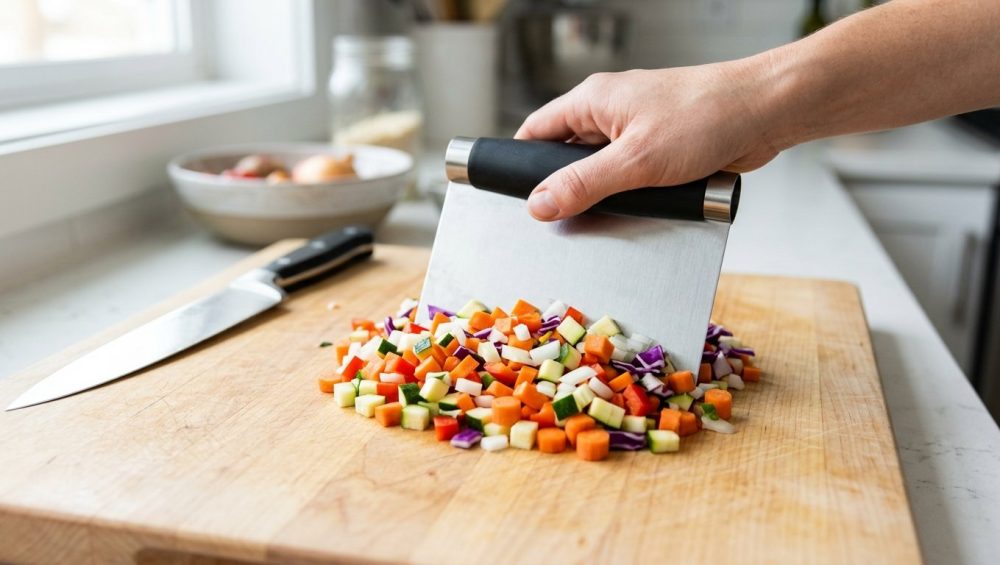
With a bench scraper, you have a massive, flat surface area—typically about six inches wide and three inches tall. You simply lay your knife flat on top of the pile of chopped food to stabilize it, slide the bench scraper underneath, and you can instantly pick up an entire diced onion in one single, elegant motion. It takes two seconds. You carry it to the stove, slide the food into the pan, and move on. It is an absolute game-changer for speed.
The Instant Board Clear
But the efficiency does not stop at transferring food. A clean workspace is the hallmark of a good cook. When you finish peeling carrots, trimming celery, or coring bell peppers, your cutting board is covered in scraps. Instead of picking them up by the handful and making multiple trips to the trash can, you simply hold your trash bin or compost bucket at the edge of the counter. One wide, sweeping motion with the bench scraper clears the entire board instantly. Your workspace is reset, clean, and ready for the next ingredient. This flow state is how you transform cooking from a stressful chore into a peaceful daily habit.
Beyond the Scoop: Unexpected Masterclass Uses
If you think the bench scraper is just a glorified spatula, you are vastly underestimating it. I despise unitaskers—tools that only do one specific job. Kitchen space is valuable, and every tool needs to earn its keep. The bench scraper is the ultimate multitasker. Here is a masterclass in how to use it.
1. Smashing Garlic Like a Pro
Forget the garlic press. Peeling and mincing garlic is tedious, but a bench scraper makes it effortless. Place a clove of garlic on your board, lay the flat, wide side of the bench scraper over it, and give the handle a firm whack with the heel of your hand. The skin pops right off. If you need a quick paste, sprinkle the smashed garlic with coarse salt, and use the rigid edge of the scraper to drag and mash the garlic against the board until it breaks down into a smooth puree.
2. Portioning Dough and Ground Meat
Whether you are making homemade gnocchi, portioning out pizza dough, or dividing a pound of ground beef for smash burgers, the bench scraper is your go-to blade. Because you are pressing straight down, it acts as a guillotine, cleanly severing dough or meat without tearing it. Many high-quality scrapers even have ruler markings laser-etched onto the metal, allowing you to cut perfectly uniform portions every single time.
3. Leveling Measuring Cups
Baking is a science, and accuracy matters. When you scoop a cup of flour, you cannot just shake it until it looks flat. You need a straight edge to sweep across the top of the measuring cup to level it off perfectly. The rigid, perfectly straight edge of a bench scraper is ideal for this.
4. Smoothing Frosting on Cakes
If you ever decide to tackle a weekend baking project and want those perfectly smooth, professional-looking sides on a layer cake, you do not need to buy a specialized icing smoother. Hold your bench scraper vertically against the side of the cake, spin the turntable, and watch as it creates a flawless, bakery-quality finish.
5. Deep Cleaning Your Counters
After kneading dough or rolling out pie crust, your countertops are usually plastered with dried, cemented flour and sticky bits of dough. A wet sponge will just turn that flour into glue. Instead, take your bench scraper and use the edge to dry-scrape the counter. It will effortlessly pop off all the dried bits, allowing you to sweep them into the trash before you ever introduce water. It is a brilliant way of surviving kitchen disasters involving sticky, unmanageable messes.
The “No-Go” Rule: Banishing Toxic and Cheap Gear
Now, because I love you, I need to yell at you for a minute. If you go online to buy a bench scraper, you are going to see a lot of options. You will see beautiful stainless steel models, and you will see cheap, flimsy, brightly colored plastic ones selling for two dollars. Do not you dare buy the plastic one.
I have a strict “no-go” rule when it comes to toxic, cheap kitchenware, and plastic scrapers are at the top of my hit list. Here is the brutal truth: plastic kitchen tools are actively poisoning your food and your body.
The Microplastic Nightmare
When you take a hard plastic scraper and drag it firmly across a wooden or plastic cutting board, friction occurs. That friction causes microscopic pieces of the plastic tool to shave off and mix directly into the food you are preparing. Scientific studies have explicitly highlighted the dangers of plastic kitchen utensils, revealing that abrasion between plastic tools and surfaces releases significant amounts of microplastics and nanoplastics into our meals.
These particles are so small that they can cross cellular membranes in the human body. Furthermore, if you are using black plastic utensils or scrapers, the danger is even worse. Studies have shown that black plastic kitchenware is frequently manufactured using recycled electronic waste, which contains highly toxic flame retardants. Exposure to these chemicals has been linked to severe health issues, including thyroid disease and reproductive harm.
The Flimsy Factor
Beyond the health risks, plastic scrapers are just garbage tools. They flex and bend when you try to pick up heavy ingredients. The edges chip easily, creating jagged grooves that harbor dangerous bacteria. They melt if you accidentally set them too close to a hot stove. When you are building your collection of beginner kitchen tools, you must prioritize durable, safe materials.
What to Buy Instead: The Anatomy of a Perfect Scraper
You are going to buy a high-quality stainless steel bench scraper. They cost between ten and fifteen dollars, and they will literally last you the rest of your life. Just like how those rock-hard bamboo boards are ruining your knives, plastic scrapers are ruining your health. Upgrading to steel is the easiest step you can take toward banishing toxic kitchen gear from your home entirely. Here is exactly what you should look for:
- The Blade: It must be made of high-carbon stainless steel. It should be stiff, with absolutely zero flex. The bottom edge should be straight and blunt—it does not need to be sharp like a knife to do its job.
- The Tang: Look for a scraper where the metal blade extends all the way up through the handle (a full tang). This ensures the handle will never snap off under pressure.
- The Handle: Avoid scrapers with cheap, hollow plastic handles that can crack and trap dishwater. Look for a handle made of rolled stainless steel, sealed solid wood, or tightly bonded, food-grade silicone that offers a non-slip grip even when your hands are covered in olive oil.
- The Extras: The best scrapers feature laser-etched ruler markings (in both inches and centimeters) along the bottom edge, and sometimes even a quick reference chart for volume conversions printed directly on the metal face.
Technique: How to Actually Use Your Bench Scraper Like a Pro
Owning the right tool is only half the battle; knowing how to wield it is what separates the weekend hobbyist from the seasoned expert. Using a bench scraper is incredibly intuitive, but there is a specific rhythm to it that will dramatically speed up your workflow. Let us break down the core movements.
The Scoop and Stabilize
When you have a massive pile of diced vegetables—let us say, a mirepoix of onions, carrots, and celery—do not try to shove the scraper under the pile blindly. Instead, use your chef’s knife in your dominant hand and the bench scraper in your non-dominant hand. Lay the flat side of your knife gently on top of the pile to hold it steady. Then, slide the edge of the bench scraper firmly against the cutting board and push it under the pile. The knife acts as a ceiling, preventing the vegetables from tumbling over the top of the scraper. You can now lift the entire mound securely without losing a single rogue carrot.
The Board Sweep
When it is time to clear scraps, angle matters. Do not hold the scraper perfectly perpendicular (at a 90-degree angle) to the board, as this can cause it to stutter and skip across the surface. Instead, tilt the handle slightly toward you, creating a 45-degree angle with the board. Apply firm, even downward pressure, and push away from your body in one smooth, continuous sweeping motion. This angle acts like a snowplow, cleanly taking every single scrap and drop of moisture with it directly into your compost bin.
The Dough Fold
If you are working with wet, highly hydrated bread dough (like a focaccia or ciabatta), the dough will stick to your hands like glue. The bench scraper becomes an extension of your hand. Dip the edge of the metal scraper in a little bit of water or flour to prevent sticking. Slide it under the edge of the wet dough, lift, and fold the dough over onto itself. You can knead and shape an entire loaf without ever actually touching the sticky mass with your fingers.
Maintenance and Care: Protecting Your Gear
Because a good stainless steel bench scraper is practically indestructible, maintenance is blissfully simple, but it still requires a tiny bit of common sense.
First, just like your knives, you should wash your bench scraper by hand. If your scraper has a wooden handle, putting it in the dishwasher is an absolute death sentence. The extreme heat and harsh detergents will strip the natural oils from the wood, causing it to swell, crack, and eventually rot. Even if you have a solid stainless steel or silicone handle, the prolonged moisture of a dishwasher cycle can cause the high-carbon steel blade to develop rust spots.
Instead, the moment you are done using it, simply run it under warm water, give it a quick wipe with a soapy sponge, and dry it immediately with a clean towel. It takes five seconds. Store it in a drawer or hang it on a magnetic knife strip right next to your chef’s knife—because they are now officially a package deal.
As for your knives, now that you have stopped using them as bulldozers, you need to maintain that pristine edge. Get them professionally sharpened once or twice a year, and use a ceramic honing rod once a week to keep the microscopic apex perfectly aligned.
The Final Slice
Cooking should be a joy, not a stressful, chaotic mess of dull blades, crushed tomatoes, and scattered onion pieces. As a home cook, you do not need a culinary degree to produce mind-blowing food, but you do need to respect your tools and your time.
Stop treating your expensive chef’s knife like a cheap shovel. The microscopic damage you are causing every time you scrape that blade across the board is costing you money, slowing down your prep, and drastically increasing your chances of a nasty trip to the emergency room.
For the price of a couple of fancy coffees, you can buy a high-quality, stainless steel bench scraper that will outlast you. It will protect your knife edges, instantly clear your workspace, and make you feel like an absolute powerhouse on the cutting board. It is the smartest, simplest upgrade you can make to your daily routine. So, do yourself a favor, banish the bad habits, buy the right gear, and get back to making incredible food. You’ve got this.