Let’s skip the long, drawn-out stories about how I spent my childhood wandering through farmers’ markets picking heirloom carrots. You are not here for a memoir; you are here because you are tired of opening your oven door to find a tragic, soggy, gray puddle of vegetables. You wanted a steakhouse-quality, beautifully caramelized side dish to elevate your weeknight dinner, and instead, you accidentally created a sad steam bath.
Look, I get it. You are a busy professional. You chop up whatever produce is languishing in the crisper drawer, throw it on a pan, drizzle it with whatever oil is within arm’s reach, and shove it into a 350°F oven while you try to answer three more emails. But here is the brutal truth: you are not roasting your vegetables. You are steaming them. And there is a massive, fundamental difference in the physics of those two cooking methods.
The good news? You absolutely do not need a culinary degree to fix this. You just need to understand a few basic rules of heat transfer, moisture management, and equipment selection. We are going to break down exactly why your vegetables are turning to mush, how to fix your technique, and how to make weeknight side dishes that are genuinely mind-blowing.
The Science of the Mush: Why You Are Failing at Roasting
To understand why your vegetables are turning out limp and lifeless, we need to talk about the holy grail of cooking: the Maillard reaction. Without getting overly pretentious, the Maillard reaction is a complex chemical process where amino acids and reducing sugars react under high heat to create hundreds of brand-new flavor compounds and that glorious, golden-brown crust. It is the exact same science that makes a seared steak taste incredible, turns pale dough into crusty bread, and makes roasted coffee beans so aromatic.
But the Maillard reaction has a mortal enemy, and its name is water.
This reaction generally does not kick into high gear until the surface temperature of your food reaches around 285°F (140°C). Here is the problem: water boils and turns to steam at 212°F. As long as there is liquid water sitting on the surface of your food, the temperature of that surface cannot physically exceed 212°F.
Vegetables are essentially delicious little water balloons. Zucchini is roughly 94% water; mushrooms are 92% water; even dense carrots are about 88% water. When you put them in a hot oven, that internal moisture naturally begins to escape. If you do not manage that moisture correctly, the water pools around the vegetables. They end up simmering in their own juices at 212°F, completely bypassing the Maillard reaction. By the time all that water finally evaporates and the temperature can rise, the cellular structure of the vegetable has entirely collapsed. You are left with mush. Mastering the art of the kitchen means learning how to control this fundamental battle between heat and moisture. If you ignore the physics of water evaporation, you will just keep ruining your dinners night after night.
The Crowded Pan Epidemic: Enforcing Social Distancing
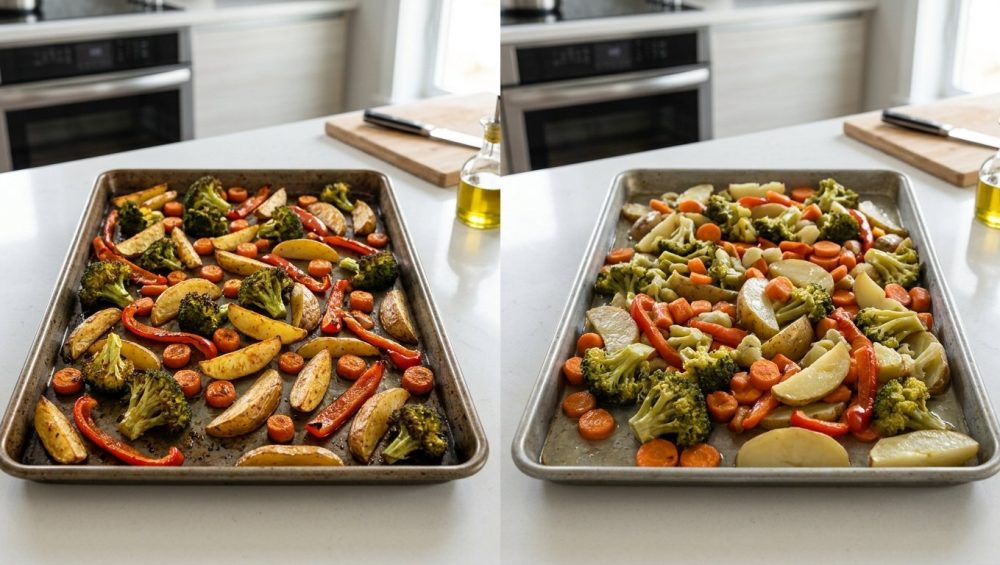
The single most common mistake home cooks make is overcrowding the baking sheet. I know you don’t want to wash two pans on a Tuesday night. I understand the temptation to dump two entire heads of chopped broccoli, a diced onion, and a pound of carrots onto one standard half-sheet pan.
But when you cram all those vegetables together so they are touching shoulder-to-shoulder, you are creating a humid, tropical microclimate right there on your baking sheet. As the oven heat penetrates the vegetables, they all begin releasing their internal water as steam. Because there is absolutely no airflow between the pieces, that steam gets trapped. The vegetables in the center of the pan never stand a chance; they are effectively trapped in a sauna.
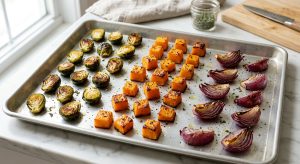
If you want to get them crispy, you must enforce strict social distancing on your baking sheet. Every single piece of vegetable needs a buffer zone of hot, dry air circulating around it to carry the evaporating moisture away. You should be able to clearly see the bottom of the pan between the pieces. If your vegetables are piled on top of each other, you have already lost the game. Bite the bullet, grab a second baking sheet, and split the load. Your dishwasher can handle it; your palate cannot handle more mush.
The Cold Pan Catastrophe: Stop Starting from Zero
This is the weeknight shortcut that is actively sabotaging your meals. You prep your vegetables, toss them on a room-temperature metal pan, and slide it into the oven.
Let’s look at the thermodynamics of what happens next. When you put a cold, thick metal pan covered in wet, cold vegetables into a 425°F oven, the pan does not instantly become 425°F. It takes a solid seven to ten minutes for that metal to absorb enough ambient heat to actually start cooking the food. During those crucial first ten minutes, your vegetables are just sitting there, slowly warming up, relaxing, and leaking their internal water into a puddle on the cold metal.
The fix is incredibly simple but entirely transformative: put your empty baking sheet into the oven while the oven preheats. By preheating the pan, you are turning a passive piece of metal into an active, aggressive cooking surface. When you carefully drop your oil-coated vegetables onto a pan that is already sitting at 425°F, you will hear an immediate, aggressive sizzle. That sound is the surface moisture of the vegetables instantly vaporizing upon contact with the hot metal. You bypass the steaming phase entirely and jump-start the browning process from second one.
The “No-Go” Toxic Gear Rant: What Are You Roasting On?
We need to have a very serious, brutally honest conversation about the equipment you are using. I have absolutely zero patience for cheap, peeling, toxic kitchenware. If you are trying to roast vegetables on a scratched, flimsy, non-stick baking sheet you bought for ten dollars at a big-box store five years ago, you are actively doing yourself a disservice.
Most cheap non-stick bakeware is coated with PTFE (commonly known by the brand name Teflon), which belongs to a broader class of chemicals known as PFAS, or “forever chemicals”. While these coatings are generally considered stable at lower temperatures, roasting requires high, aggressive heat—often 425°F to 450°F. When you repeatedly expose cheap non-stick coatings to high heat, they degrade, scratch, and eventually flake off directly into your food. I am incredibly passionate about banishing toxic kitchen gear from the home kitchen. You do not need a chemical non-stick coating to roast vegetables; you need heat, oil, and proper technique.
Furthermore, cheap pans are structurally weak. If your baking sheets keep warping and twisting diagonally the second they get hot, they are ruining your food. A warped pan creates an uneven surface where all your expensive cooking oil pools into one corner, leaving half your vegetables dry and burning, while the other half deep-fries in a puddle. And if your pan literally pops in the oven with a loud bang, it is far too thin to retain the thermal mass required for a good sear.
Throw out the scratched non-stick junk. Invest in heavy-gauge, uncoated aluminized steel, bare commercial aluminum, or carbon steel half-sheet pans. They are practically indestructible, they will never warp under high heat, and they conduct thermal energy flawlessly. Yes, you will have to wash them with a sponge instead of just wiping them down, but your food will taste infinitely better, and you won’t be eating flaking polymer coatings.
Oil Mismanagement: Drowning vs. Starving
Let’s talk about lubrication. The way you apply oil to your vegetables dictates whether they will caramelize beautifully or turn into a greasy, flaccid mess.
The lazy method is spreading raw vegetables onto the baking sheet and indiscriminately drizzling oil over the top. Do not do this. This method guarantees that some pieces will be absolutely drenched in oil, while others remain bone dry. The dry pieces will scorch and burn to a bitter crisp, while the drowned pieces will soak up the fat and turn to mush.
You must toss your vegetables in a large mixing bowl before they ever see the pan. You want every single floret, slice, and cube to be coated in a microscopic, even layer of fat. Why? Because oil is a heat conductor. Vegetables have irregular, bumpy surfaces. When a piece of broccoli sits on a flat metal pan, only a tiny fraction of the vegetable is actually touching the metal. The oil fills in those microscopic gaps, acting as a thermal bridge that transfers the intense heat of the pan directly into the food.
However, you must use the right oil. Extra virgin olive oil is wonderful, but it has a lower smoke point and contains unrefined particles that can burn at high roasting temperatures. If you are cranking your oven to 425°F or 450°F, you need an oil that can take the heat. Avocado oil, refined olive oil, or grapeseed oil are excellent choices. They provide the necessary thermal conductivity without breaking down into acrid, bitter smoke.
Oven Temperature Timidity: Turn Up the Heat
If I catch you roasting vegetables at 350°F, we are going to have words. 350°F is a lovely temperature for baking a gentle, tender banana bread. It is an absolutely atrocious temperature for roasting vegetables.
When the oven temperature is too low, the vegetables cook through and their cellular walls collapse long before the surface moisture can evaporate and trigger the Maillard reaction. You end up with vegetables that are fully cooked and completely soft, but entirely devoid of color, texture, or complex flavor.
You need to be aggressive. You are looking for a flash-evaporation of surface moisture. For most hearty vegetables, 400°F to 425°F is the absolute sweet spot. This temperature is hot enough to rapidly boil off the water and sear the exterior, but gentle enough that the inside of the vegetable has time to become tender before the outside turns to pure carbon. For extremely high-water vegetables like zucchini or summer squash, you sometimes need to push it to 450°F to force that water out as fast as physically possible. Stop being timid with your oven dial.
The Moisture Mitigation Strategy: Dry Your Produce
This should be obvious by now, but if water is the enemy of browning, then washing your vegetables and immediately throwing them onto a baking sheet dripping wet is culinary self-sabotage.
If you rinse your broccoli florets under the faucet, you must dry them. A salad spinner is not just for lettuce; it is an incredible tool for violently extracting water from the nooks and crannies of cruciferous vegetables. If you don’t have one, lay the vegetables out on a clean kitchen towel and pat them aggressively dry.
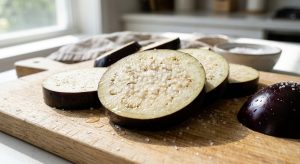
Sometimes, you are dealing with vegetables that are so inherently watery that surface drying isn’t enough. Eggplant, mushrooms, and thick-cut zucchini hold massive amounts of water deep within their cell walls. In these specific cases, the microwave is your best friend. By giving these high-water vegetables a quick two-minute zap in a microwave-safe bowl, you gently break down their cell walls and force them to release a significant portion of their internal liquid. You can then drain that liquid away, toss the par-cooked vegetables in oil, and roast them. Because you have already eliminated the excess water, they will caramelize in the oven beautifully instead of boiling in a puddle.
Anatomy of a Vegetable: Not All Produce is Created Equal
One of the biggest weeknight mistakes is chopping up potatoes, broccoli, and bell peppers, tossing them all on the same pan, and expecting them to cook at the exact same rate. Vegetables have vastly different densities, sugar contents, and moisture levels. You have to treat them according to their category.
Root Vegetables (The Slow Burners)
Potatoes, carrots, parsnips, and beets are incredibly dense and have a lower water content. They take a long time to cook through to the center. The key here is cutting them uniformly. If you have massive chunks of potato next to paper-thin slices, the thin slices will burn to ash before the thick chunks are even tender. Give root vegetables plenty of time, and don’t be afraid to leave them undisturbed on the hot pan for a solid 15 to 20 minutes before you even think about flipping them. Let that crust develop.
Cruciferous Vegetables (The Caramelization Kings)
Broccoli, cauliflower, and Brussels sprouts are the absolute royalty of the roasting pan. Their complex, frilly physical structures are packed with tiny little buds and leaves that catch oil and crisp up into addictive, charred perfection. The secret to cruciferous vegetables is maximizing pan contact. Always slice Brussels sprouts in half and place them meticulously cut-side down on the preheated baking sheet. That flat surface area against the scorching hot metal will yield a deeply browned, steak-like sear.
High-Water Vegetables (The Troublemakers)
Zucchini, yellow squash, bell peppers, and onions are packed with moisture. They are highly prone to turning into a floppy, soggy mess. For these, you must enforce the strictest social distancing on the pan, use the highest heat (425°F to 450°F), and avoid tossing them too frequently. Every time you stir them, you lower the pan temperature. Let them sit, let the water burn off, and let the heat do its job.
The Advanced Level-Up: The Alkaline Hack
If you have mastered the basics and you want to take your weekend potato roasting to an absolute, mind-blowing, Michelin-star level, we need to talk about manipulating the pH of your food.
When you roast potatoes, you want a fluffy interior and a glass-like, shattering crunch on the exterior. To achieve this, you need to break down the starches on the outside of the potato before it ever hits the oven. You do this by par-boiling the potato chunks. But if you want to accelerate this process and create the ultimate crispy crust, you need to make the boiling water alkaline.
When you just add baking soda to the boiling water (about a half teaspoon per two quarts of water), the alkaline environment rapidly breaks down the exterior of the potato. After about ten minutes of boiling, you drain the potatoes and violently shake them in the pot. That alkaline-softened exterior mashes up and creates a thick, starchy paste that coats the outside of the potato chunks. When you toss those coated potatoes in oil and hit them with the intense, dry heat of the oven, that starchy sludge dehydrates and fries into an unbelievably thick, crispy shell. It is a food science trick that will ruin normal roasted potatoes for you forever.
The Finishing Touch: Wake Up Your Food
Alright, you have followed all the rules. You preheated your heavy-duty, non-toxic baking sheet. You dried your broccoli, tossed it evenly in high-smoke-point oil in a bowl, gave it plenty of space on the pan, and blasted it at 425°F. You pull the pan out of the oven, and the vegetables look incredible—deeply browned, charred at the edges, and perfectly tender.
You take a bite, and… it tastes a little heavy. A little flat.
Your immediate, ingrained instinct is to reach for the salt shaker. Stop right there. Assuming you seasoned your vegetables appropriately with kosher salt before they went into the oven, salt is not what you are missing. What your dinner actually needs acid.
Roasting concentrates sugars and brings out deep, earthy, savory notes. Combined with the oil, the flavor profile can become very heavy on the palate. You need a sharp, bright counterpunch to cut through that richness and wake the dish up. A fresh squeeze of lemon juice over your roasted broccoli, a light drizzle of aged balsamic vinegar over your Brussels sprouts, or a splash of sherry vinegar tossed with your roasted mushrooms will completely transform the dish. The acid lifts the heavy roasted flavors, balances the inherent sweetness of the caramelized sugars, and makes the vegetables taste vibrant and alive.
Cooking incredible food at home isn’t about having a culinary degree or buying a six-hundred-dollar set of copper pans. It is about understanding the basic mechanics of what is happening in your oven. Respect the Maillard reaction, fear trapped moisture, and treat your ingredients with a little bit of scientific intention. Now go preheat your baking sheet, give your vegetables some breathing room, and finally eat a side dish that actually deserves to be on your plate.