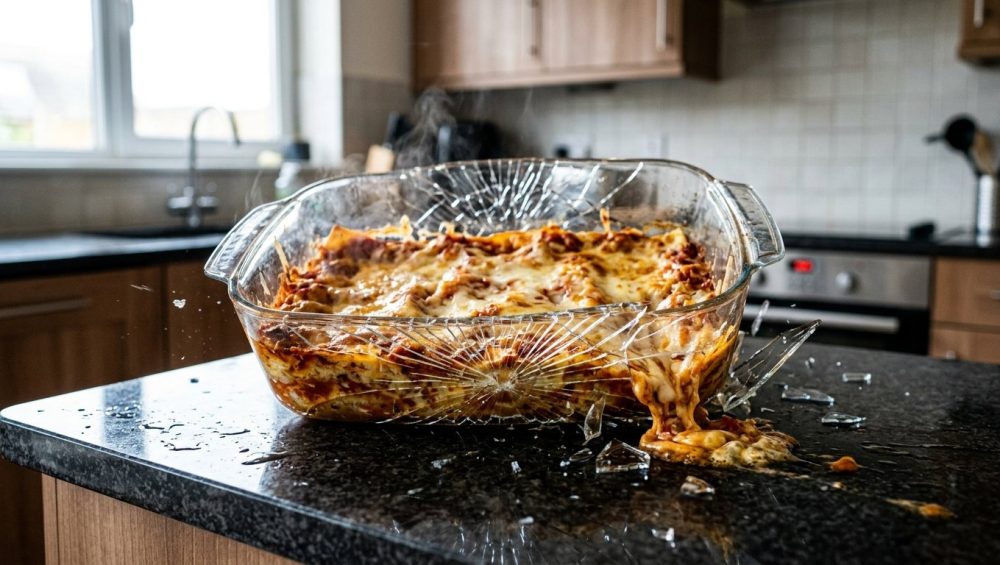
Picture this: It is a Tuesday night. You are exhausted from a long day of pretending to care about spreadsheets, and all you want is the comforting, bubbling embrace of a homemade baked ziti. You did everything right. You layered the pasta, you didn’t skimp on the whole-milk ricotta, and you baked it until the mozzarella was a glorious, golden-brown mosaic. You pull the heavy glass casserole dish out of the oven, set it proudly on your sleek, cold granite countertop, and turn your back to grab a serving spoon.
Then, it happens.
BANG.
It sounds like a small explosive device just went off in your kitchen. You whip around to find that your beautiful, painstakingly crafted ziti is now a tragic crime scene of marinara sauce and thousands of dull, square glass cubes. Dinner is ruined, your kitchen is a hazard zone, and you will be finding rogue shards of glass in your slippers for the next six months.
If this has ever happened to you, take a deep breath and put down the takeout menu. You are not cursed, and you are not a bad cook. In fact, this is one of the most common rookie kitchen mistakes that plagues even the most seasoned home chefs. The culprit isn’t your culinary technique; it is a fascinating, frustrating phenomenon of material science known as thermal shock.
As a home cook who firmly believes that weeknight dinners should be efficient and weekend cooking should be a joy, I have zero patience for kitchen gear that actively sabotages us. We don’t have time for exploding casseroles. Time is money, and frankly, I refuse to waste either on substandard, unpredictable equipment. Today, we are going to dive deep into the absolute masterclass of glass bakeware. We are going to strip away the pretentious chef-speak and look at the hard, undeniable physics of why your favorite casserole dish betrayed you, the scandalous corporate history of modern glass manufacturing, and exactly how to stop this from ever happening again.
The Anatomy of a Kitchen Disaster: What is Thermal Shock?
To understand why your glass dish just committed spontaneous combustion, we need to talk about thermodynamics. Don’t panic—you don’t need a degree in molecular physics to understand this. You just need to know how materials react to heat.
The Dance of the Molecules
When you put a piece of glass bakeware into a 400-degree oven, the heat energy transfers into the glass. At a molecular level, the atoms inside the glass start to get excited. They vibrate, they dance, and they push away from each other. This causes the entire structure of the glass to physically expand. It is a microscopic change, completely invisible to the naked eye, but it is happening. When you take the glass out of the oven and it begins to cool, those atoms lose their energy, slow down, and pull closer together, causing the glass to contract.
The Coefficient of Thermal Expansion
In the world of material science, a material’s willingness to expand when heated and shrink when cooled is measured by something called the “Coefficient of Thermal Expansion,” or CTE. A low CTE means a material barely changes size when the temperature fluctuates. A high CTE means the material expands and contracts dramatically.
Here is the kicker: glass is a terrible conductor of heat. It is an insulator. That means heat does not travel quickly or evenly through it. If you take a hot glass pan and set it on a cold surface, the very bottom layer of the glass instantly cools down and tries to shrink. However, the inside layer of the glass (the part touching your bubbling hot lasagna) is still blazing hot and fully expanded.
You now have a microscopic tug-of-war happening inside the walls of your bakeware. The bottom is pulling inward, and the top is pushing outward. This creates massive internal stress. When that stress exceeds the structural tensile strength of the glass, the material physically rips itself apart. We call this catastrophic failure “thermal shock.”
If you have ever wondered why your baking sheets keep warping in the oven, it is the exact same principle of uneven thermal expansion, just with metal instead of glass. Metal warps and bends under the stress. Glass, however, is rigid. It cannot bend, so it breaks.
The Great Glass Betrayal: Borosilicate vs. Tempered Soda-Lime
Now, you might be thinking, “Wait a minute. My grandmother used the same glass Pyrex dish for fifty years. She took it from the fridge, put it in the oven, and slammed it onto a cold counter, and it never once exploded. What gives?”
Your grandmother wasn’t a wizard. She just had better glass. To understand why your modern glass baking dish shattered, we have to look at one of the most frustrating downgrades in the history of American kitchenware manufacturing.
The Golden Age of Borosilicate
Back in 1915, Corning Glass Works introduced Pyrex to the world. It was a revolutionary product made from borosilicate glass. Borosilicate glass is manufactured by adding boron trioxide to the traditional glass-making mixture of silica sand, soda ash, and limestone.
Adding boron changes the molecular structure of the glass, giving it a remarkably low Coefficient of Thermal Expansion. Specifically, borosilicate 3.3 glass has a thermal expansion coefficient of just 3.3 x 10⁻⁶ K⁻¹. This means that when it is heated or cooled, it barely changes size at all. Because it doesn’t expand or contract significantly, it is practically immune to thermal shock. You can take a borosilicate dish out of a hot oven and throw it into a snowbank, and it will likely survive. This is why borosilicate is still the mandatory standard for laboratory equipment like test tubes and beakers.
The Soda-Lime Switch
For decades, American kitchens were outfitted with bulletproof borosilicate Pyrex. But in 1998, Corning sold the Pyrex brand to a company called World Kitchen (which later became Corelle Brands). Shortly after the acquisition, the new manufacturers quietly changed the recipe for all Pyrex manufactured and sold in the United States.
They stopped using borosilicate and switched to a cheaper alternative: tempered soda-lime glass.
Soda-lime glass has a thermal expansion coefficient that is roughly three times higher than borosilicate glass. It expands and contracts wildly with temperature changes. To compensate for this, the manufacturers “tempered” the glass using a heat-treatment process to make it stronger, but tempering does not change the material’s underlying CTE.
Why did they make the switch? The official corporate line is that tempered soda-lime glass is more resistant to mechanical impact. Meaning, if you drop a soda-lime glass dish on your kitchen floor, it is less likely to break than borosilicate. The unofficial reason? Soda-lime glass is significantly cheaper to manufacture, melts at a lower temperature, and is easier to mass-produce.
How to Spot the Difference
If you want to know which type of glass you have, look at the logo stamped on the glass. If the logo is in all capital letters—PYREX—it is likely older, vintage borosilicate glass. If the logo is in lowercase letters—pyrex—it is modern, tempered soda-lime glass manufactured for the US market. (Interestingly, the Pyrex brand in Europe, manufactured by Arc International, never made the switch. European Pyrex is still made of high-quality borosilicate).
The Physics of the Shatter: Why Tempered Glass “Explodes”
So, we know that modern American glass bakeware is made of soda-lime glass, which expands and contracts dramatically. But why does it explode so violently? Why doesn’t it just crack down the middle like a normal plate?
The answer lies in the tempering process.
The Tension and Compression Tug-of-War
When modern glass bakeware is manufactured, the soda-lime glass is heated to an incredibly high temperature (around 600°C) and then blasted with freezing cold air. This rapid cooling process causes the outer layer of the glass to cool, shrink, and harden immediately. However, the inner core of the glass is still hot and expanded.
As the inner core eventually cools and tries to shrink, it is trapped by the already-hardened outer layer. This creates a permanent state of extreme physical stress inside the glass. The outer layer is in a constant state of “compression” (squeezing inward), while the inner core is in a constant state of “tension” (pulling outward).
This tension is actually what gives tempered glass its mechanical strength. It acts like an invisible force field against physical drops and bumps. But it is a fragile peace treaty.
The Catastrophic Release
When you introduce thermal shock to a tempered soda-lime glass dish—say, by putting a hot dish on a wet counter—the sudden contraction of the glass disrupts that delicate balance of tension and compression. Once the compressive outer layer is breached by a microscopic thermal crack, the immense pent-up energy of the inner tension is released all at once.
The glass doesn’t just crack; it violently rejects its own existence. The energy release causes the glass to shatter instantly into thousands of small, granular cubes. From a safety perspective, this is technically a feature, not a bug. Tempered glass is designed to shatter into dull cubes rather than giant, razor-sharp guillotine shards that could severely injure you. But when you are just trying to feed your family on a Tuesday, having your dinner turn into a shrapnel grenade is small comfort.
The “No-Go” Zone: Everyday Kitchen Habits That Will Detonate Your Bakeware
Now that you understand the physics, it is time to look at your own kitchen habits. If you are using modern, lowercase-pyrex or any other brand of tempered soda-lime bakeware, you are walking a tightrope of thermal dynamics every time you turn on the oven.
Just like discovering the sneaky habits ruining your nonstick pans, you need to identify the exact behaviors that trigger thermal shock. Here are the absolute “No-Go” actions that will guarantee an exploding casserole.
The Wet Towel and the Puddle of Doom
Water is a highly efficient conductor of heat—it transfers temperature about 25 times faster than air. If you take a 400-degree glass dish out of the oven and set it down on a damp dish towel, or a countertop that has a small puddle of water on it, you are actively initiating thermal shock. The water rapidly leeches the heat out of the bottom of the glass, causing it to contract at a violently fast rate while the sides remain expanded. Boom. Always ensure your landing zone is bone dry.
The Cold Granite Countertop
Granite, marble, and quartz countertops are beautiful, but they are massive thermal heat sinks. They are naturally cold to the touch because they pull heat away from objects rapidly. Setting a hot glass dish directly onto a cold stone countertop is essentially the same as throwing it into an ice bath. The temperature differential is too extreme for soda-lime glass to handle.
The Fridge-to-Oven Speedrun
I preach constantly about how “Time is Money” on weeknights. We all love a make-ahead meal that can go straight from the refrigerator into the oven. But if you are using modern glass bakeware, this speedrun will cost you dearly. Taking a 35-degree glass dish full of cold chicken and shoving it directly into a preheated 425-degree oven is a death sentence for the glass. The outside of the dish expands rapidly in the ambient heat of the oven, while the core of the glass is kept frozen by the cold food inside. The stress is too great.
The Deglazing Disaster
Imagine you are roasting a beautiful pork loin in a glass dish. You pull it out of the oven, and the bottom of the dish is covered in gorgeous, caramelized brown bits (the fond). You decide to pour a splash of cold white wine or chicken broth into the scorching hot glass dish to make a quick pan sauce.
Stop right there. Pouring cold or even room-temperature liquid directly onto hot soda-lime glass is the fastest way to trigger an explosion. The liquid instantly cools the surface it touches, causing rapid contraction against the hot surrounding glass.
The Stovetop and Broiler Fallacy
Glass bakeware is designed for the ambient, indirect heat of a baking oven. It is absolutely, unequivocally never to be used under the direct, intense, localized heat of a broiler, nor should it ever be placed directly on a stovetop burner (gas or electric). Direct heat creates massive localized expansion in one specific spot of the glass, while the rest of the dish remains relatively cool. This uneven expansion will shatter the dish in minutes.
The Sassy Sous-Chef’s Unbreakable Rules for Glass Bakeware Safety
If you are going to continue using modern soda-lime glass in your kitchen, you need to treat it with the respect its fragile thermal physics demand. Transforming your cooking from a stressful chore into kitchen artistry means controlling your environment and eliminating unpredictable variables. Here are my unbreakable rules for surviving your glass bakeware.
Rule 1: The Preheating Mandate
Never, ever put a glass dish into an oven while it is preheating. Ovens do not gently warm up to your desired temperature. The heating element at the bottom of the oven blasts intense, direct, radiant heat (often exceeding 500 degrees) to bring the ambient air up to temp quickly. If your glass dish is in the oven during this preheat phase, it is being subjected to direct, localized thermal stress. Always wait until the oven is fully preheated and the heating element has cycled off before inserting your glass dish.
Rule 2: The Dry Cloth and Trivet Mandate
You must create a thermal buffer between your hot glass and your cold countertops. When setting up a minimalist kitchen setup, a good trivet is non-negotiable. Always place hot glass bakeware on a dry, thick cloth potholder, a wooden cutting board, or a cork/silicone trivet. Wood and cork are excellent thermal insulators. They will not pull heat away from the glass rapidly, allowing the dish to cool down slowly and evenly.
Rule 3: The Room Temperature Transition
Patience is a virtue that prevents exploding dinners. If you have a casserole in the fridge that you want to bake, you must let it sit on the counter for at least 30 to 45 minutes to take the chill off the glass before it goes into the oven. Conversely, if you have leftovers in a hot glass dish, you must let the dish cool completely to room temperature on a trivet before placing it in the refrigerator or freezer.
Rule 4: The Liquid Cushion
If you are roasting vegetables, chicken, or a roast in a glass dish, the food will not cover the entire bottom of the pan. The empty, exposed glass will heat up much faster than the glass sitting under the cool, moist meat. This uneven heating can cause thermal shock. To prevent this, always add a small amount of liquid (water, broth, or wine) to the bottom of the dish before you put it in the oven. The liquid acts as a thermal regulator, ensuring the entire bottom of the dish heats evenly.
Ditching the Duds: Upgrading Your Kitchen Arsenal
If you have been reading my blog for any length of time, you know my stance on kitchen gear. I have a strict “No-Go” rule on toxic, cheap, or actively dangerous equipment. Just as a cheap bamboo board is ruining your knives, cheap soda-lime glass is ruining your dinners and putting your safety at risk.
When it comes to surviving kitchen disasters, prevention is always your best strategy. If you are tired of babysitting your temperamental glass bakeware, it is time to upgrade. When you are stocking your beautifully organized dream kitchen, you need to invest in materials that work for you, not against you.
The Vintage PYREX Hunt
If you love the look and feel of glass and want to stick with it, your best bet is to hit the thrift stores, estate sales, and antique malls. Look for the all-caps PYREX logo. These vintage pieces are made of original borosilicate glass. They are virtually indestructible against thermal shock, incredibly durable, and often come in gorgeous, retro mid-century patterns. They are a true buy-it-for-life item.
Sourcing Modern Borosilicate
If you don’t want to hunt for vintage goods, you can still buy modern borosilicate glass—you just have to know where to look. OXO Good Grips manufactures a line of glass bakeware specifically made from thermal-shock-resistant borosilicate glass. Additionally, if you look for brands manufactured in Europe (like Arc International), you will often find genuine borosilicate. Always check the packaging before you buy; if it proudly advertises “Thermal Shock Resistant” or explicitly states “Borosilicate,” you are in the clear. If it just says “Tempered Glass,” put it back on the shelf.
The Enameled Cast Iron Upgrade
If you want to completely eliminate the risk of shattering glass, my ultimate recommendation is to switch to enameled cast iron. Brands like Le Creuset, Staub, or the more budget-friendly Lodge make incredible enameled cast iron roasting pans and casserole dishes.
Cast iron is an exceptional conductor and retainer of heat. The enamel coating makes it naturally non-stick and completely non-reactive to acidic foods like tomatoes (unlike bare cast iron). Yes, they are heavy, and yes, the premium brands are an investment, but they will literally outlive you. You can take an enameled cast iron pan from the fridge, put it in a blazing hot oven, move it to the stovetop to reduce a pan sauce, and serve it directly on the table. No thermal shock, no explosions, no stress.
High-Quality Stoneware and Ceramic
Another fantastic alternative is high-fired stoneware or ceramic bakeware (like those made by Emile Henry). Stoneware is fired at incredibly high temperatures, making it highly resistant to thermal shock. It heats very evenly, retains heat beautifully to keep your food warm on the table, and provides a stunning, rustic aesthetic. It is perfect for lasagnas, gratins, and baked desserts.
Heavy-Gauge Stainless Steel
For roasting meats and vegetables, nothing beats a heavy-gauge, multi-clad stainless steel roasting pan. Stainless steel is virtually indestructible. It can handle massive temperature swings, it is safe for the broiler, and you can put it directly on the stovetop burners to make a gravy from the pan drippings. Maintaining a safe and permanently organized kitchen means relying on versatile, multi-purpose workhorses like stainless steel.
The Sassy Sous-Chef’s Final Verdict: Cook Smart, Not Scared
Cooking should be a joy, a creative outlet, and a way to nourish yourself and the people you love. It should never feel like you are defusing a bomb in your own home. You do not need a culinary degree to make mind-blowing food, and you certainly don’t need a degree in thermodynamics to keep your kitchen safe.
Understanding the science behind your tools is the ultimate kitchen hack. Once you know why modern soda-lime glass shatters, you take the power back. You are no longer at the mercy of unpredictable kitchen disasters. You can choose to navigate the quirks of tempered glass with smart, safe habits, or you can choose to banish it from your kitchen entirely in favor of superior materials like borosilicate, enameled cast iron, or stoneware.
Whichever path you choose, remember that you are the boss of your kitchen. Don’t let cheap, temperamental gear bully you out of making that Tuesday night baked ziti. Respect the physics, protect your countertops, ditch the toxic junk, and keep cooking with confidence. Now, if you’ll excuse me, I have a vintage PYREX dish calling my name, and a lasagna that needs my undivided attention. Stay sassy, stay safe, and happy cooking!