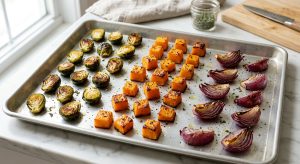
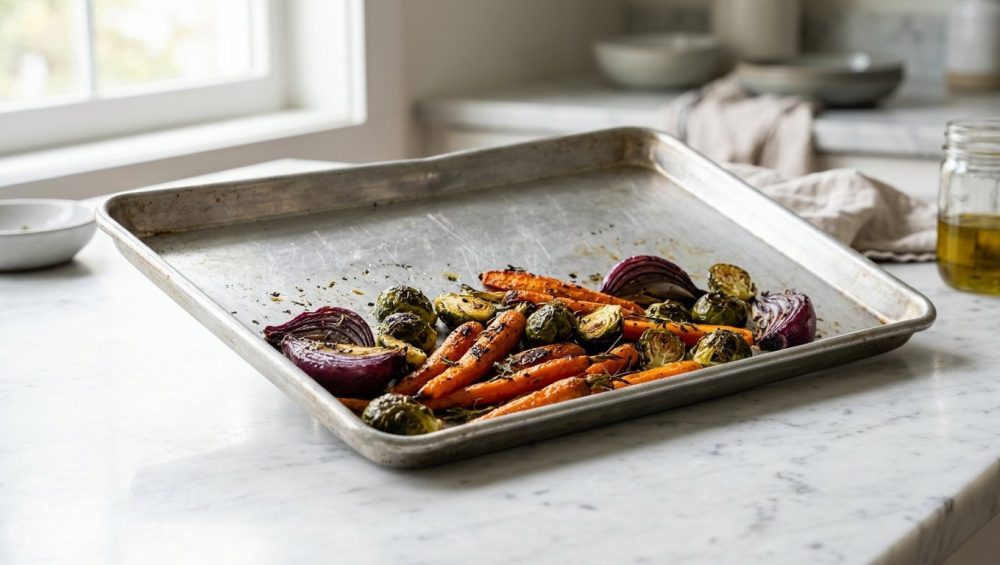
Picture this: It is a beautiful Friday evening. You have poured yourself a generous glass of Pinot Noir, you have some jazz playing softly in the background, and you are finally unwinding after a chaotic work week. You have decided to treat yourself to a beautiful, healthy sheet pan dinner. You have meticulously chopped your broccoli florets, tossed them in extra virgin olive oil, seasoned them with kosher salt and freshly ground black pepper, and slid the pan into a blazing hot 425-degree oven. You close the oven door, take a sip of wine, and turn your back to wash the cutting board.
And then… BANG!
It sounds like a gunshot went off in your kitchen. Your heart leaps into your throat. The cat scatters under the sofa. You cautiously approach the oven, half expecting to see flames or a shattered heating element, only to peer through the glass and realize that your cheap, flimsy baking sheet has violently twisted itself into a metallic pretzel. Your beautifully arranged broccoli is now sliding into a sad, oily pile in the bottom-left corner of the pan.
Listen up, buttercup. I have been there. I have set off the smoke detector, ruined countless dinners, and jumped out of my skin at that terrifying oven pop more times than I care to admit. But you do not have to live like this. That violent twist is not a ghost haunting your oven, and it is not just “one of those things” that happens when you cook. It is a highly predictable, entirely preventable phenomenon rooted in the laws of thermodynamics and metallurgy.
Today, we are going to dive deep—and I mean extraordinarily deep—into the science of why your baking sheets keep warping, popping, and twisting in the oven. We are going to break down the physics of thermal shock, the crucial importance of metal gauge, and why you need to stop buying garbage cookware from the supermarket aisle. I firmly believe that anyone can cook like an expert and make mind-blowing food without a culinary degree, but you absolutely cannot do it if your equipment is actively fighting against you. Time is money, especially on a busy weeknight, and we do not have time for warped pans ruining our meals. Grab your wine, pull up a stool, and let’s get into it.
The Physics of the Pop: What Exactly is Happening Inside Your Oven?
To understand why your baking sheet sounds like it is trying to escape the oven, we need to talk about basic material science. Do not worry, I will not bore you with pretentious chef-speak or overly dry academic jargon, but we do need to respect the physics of the kitchen.
When you place a piece of metal into a hot environment, it undergoes a process called thermal expansion. At a microscopic level, the heat energy transfers into the metal, causing its atoms to vibrate more rapidly. As these atoms become energized, they push away from one another, causing the metal to physically expand and take up more space. Different metals have different coefficients of thermal expansion, meaning they grow and shrink at different rates when exposed to heat, but all of them will expand to some degree.
Here is where the problem starts: your baking sheet does not heat up perfectly evenly. When you slide a cold pan into a 400-degree oven, the large, flat surface area of the bottom of the pan absorbs heat incredibly fast. It wants to expand outward in all directions. However, a standard baking sheet is not just a flat piece of metal; it has a rolled rim around the edges. That rim is thicker, often reinforced with a steel wire, and it acts as a structural frame.
Because the rim is thicker and differently shaped, it heats up and expands at a much slower rate than the thin, flat bottom of the pan. This creates a violent tug-of-war. The bottom of the pan is rapidly expanding and pushing outward, but the cooler, rigid rim is holding it back, refusing to budge. The stress builds and builds across the surface of the metal until it reaches a critical breaking point. The metal has to go somewhere to relieve the immense pressure, so it forcefully buckles upward or downward.
That sudden buckling is the loud BANG that makes you spill your wine. The pan has literally contorted itself to accommodate the uneven thermal expansion. If you are using a high-quality, heavy-duty pan, the metal is thick enough to absorb this internal stress without buckling. But if you are using a cheap, thin pan, it simply lacks the structural integrity to hold its shape.
The Ripple Effect: Why a Warped Pan is Actively Ruining Your Food
You might be thinking, “Okay, so my pan makes a loud noise and looks a little twisted. Who cares? It still holds food, right?”
Wrong. A warped pan is a culinary disaster waiting to happen. It is not just a cosmetic issue; it fundamentally alters the way your food cooks, and not for the better.
First and foremost, a warped pan destroys your heat distribution. When a baking sheet twists, it is no longer sitting flat against the oven rack. Instead of having consistent, level contact, the pan is now resting on two opposite corners, wobbling in the mid-air of the oven. This means the heat from the oven is hitting the pan unevenly. The parts of the pan that are lifted higher will cook differently than the parts sagging lower.
Secondly, let’s talk about the dreaded oil pool. When you are roasting vegetables, you toss them in oil to help conduct heat and achieve that beautiful, caramelized browning. But when your pan buckles, it creates a slope. Gravity takes over, and all of your olive oil, butter, meat juices, and marinades immediately run down into the lowest corner of the warped pan.
What happens next is a tragedy. The food sitting on the high side of the pan is left completely dry. It will scorch, burn, and stick to the metal because it has lost its protective layer of fat. Meanwhile, the food sitting in the low corner is completely submerged in a boiling pool of liquid. Instead of roasting and caramelizing, it is boiling and steaming. If you are tired of soggy roasted veggies that look like they were boiled in a puddle of their own despair, your warped pan is likely the primary culprit.
This slope is equally disastrous for baking. Imagine trying to bake a delicate sponge cake, a batch of perfectly spaced chocolate chip cookies, or a thin sheet of brownies on a surface that looks like a skateboard ramp. Your cake batter will pool to one side, resulting in a cake that is an inch thick on the left and paper-thin on the right. Your cookies will slide into each other, forming one giant, unevenly baked mega-cookie that is burnt on the edges and raw in the middle.
The Four Rookie Mistakes That Murder Your Sheet Pans
Even if you own a decent baking sheet, you can still ruin it if you treat it poorly. Metal is tough, but it is not invincible. If you want your equipment to last, you need to understand the behaviors that cause extreme thermal stress. This is one of those rookie kitchen mistakes that completely ruins otherwise perfectly good cookware. Let’s break down the four most common pan-destroying habits.
Mistake 1: The Cold-Water Quench
This is, without a doubt, the number one killer of baking sheets. You just pulled a blistering hot pan of roasted potatoes out of a 425-degree oven. You plate the food, and then, in a misguided attempt to be efficient and clean up quickly, you toss the 400-degree metal pan straight into the sink and turn on the cold water.
Hiss! The steam billows up, and you think you are doing a great job deglazing the pan. What you are actually doing is subjecting the metal to catastrophic thermal shock.
When cold water hits a hot pan, the metal attempts to contract instantly. But because the water only hits certain parts of the pan first, the contraction is wildly uneven. The metal violently pulls against itself, permanently warping and bending the pan out of shape. It is exactly the same scientific principle that explains why your frying pan wobbles after you ran it under the tap while it was still smoking hot. Never, ever quench a hot pan. Let it cool completely on the stovetop or a wire rack before it ever comes near water.
Mistake 2: The Naked Zones
When you place food on a baking sheet, the food acts as a heat sink. It absorbs the thermal energy from the metal beneath it, keeping that specific area of the pan relatively cooler. If you place a small, dense item—like two chicken breasts—right in the dead center of a massive half-sheet pan, you are creating a recipe for warping.
The exposed, naked areas of the pan will absorb the oven’s heat incredibly fast and attempt to expand. The area directly under the cold chicken breasts will remain much cooler and resist expansion. This massive temperature differential across the same piece of metal will almost guarantee a loud pop. To prevent this, try to distribute your food evenly across the entire surface of the pan. If you are only cooking a small amount of food, use a smaller pan (like a quarter-sheet pan) rather than leaving vast expanses of bare metal exposed to the heat.
Mistake 3: The Frozen Food Assault
We all rely on frozen conveniences from time to time. There is no shame in throwing some frozen french fries or chicken nuggets into the oven on a busy Tuesday. But dumping a bag of rock-hard, ice-cold frozen food directly onto a room-temperature (or worse, preheated) baking sheet causes intense, localized thermal shock. The metal directly under the frozen food rapidly contracts, while the rest of the pan expands in the oven heat. To mitigate this, line your pan with parchment paper or a silicone baking mat to create a slight thermal buffer between the ice-cold food and the bare metal.
Mistake 4: The Broiler Abuse
Your oven’s broiler is essentially an upside-down grill. It blasts intense, direct, radiant heat downwards, often reaching temperatures in excess of 500 or 550 degrees Fahrenheit. Thin, cheap baking sheets are not designed to withstand this kind of concentrated thermal assault. If you place a flimsy pan two inches away from a blazing broiler element, it is going to warp, and it is going to warp fast. If you need to broil something, you must use a heavy-gauge, commercial-grade pan, or better yet, a cast iron skillet or a dedicated broiler pan made of thick enameled steel.
The “No-Go” Rule: Banishing Toxic, Cheap Non-Stick Pans
We need to have a serious talk about the bakeware aisle at your local big-box grocery store. You know the pans I am talking about. They are impossibly lightweight, they cost about eight dollars, and they are coated in a mysterious, dark grey or black “non-stick” finish.
As your sassy culinary guide, I am giving you a strict directive: stop buying these. I am a massive advocate for banishing toxic kitchen gear from your house entirely, and these cheap sheet pans are public enemy number one.
First of all, they are made of metal so thin you could practically bend it over your knee. Because they lack any real mass or thickness, they are guaranteed to warp the second the oven hits 375 degrees. But the warping is only half the problem.
The real issue is the cheap non-stick coating. These mystery chemical coatings are simply not designed to withstand the high-heat roasting that weekend culinary hobbyists love to do. When you blast these pans at 425 or 450 degrees, the coating begins to degrade. It blisters, it peels, and it inevitably flakes off directly into your roasted potatoes and chocolate chip cookies. Nobody wants toxic Teflon sprinkles on their dinner. If you have a dark non-stick pan in your cabinet right now that has scratches, peeling edges, or a flaky surface, throw it in the recycling bin immediately. It is not worth your health.
Furthermore, dark-colored pans absorb heat much faster and more aggressively than light-colored aluminum pans. This means that if you try to bake cookies on a dark non-stick pan, the bottoms of your cookies will burn and turn black long before the centers are fully baked. You might as well be ruining your nonstick pans with aerosol cooking spray while you’re at it (which, by the way, leaves a sticky, polymerized residue that ruins the non-stick finish anyway).
Ditch the toxic mystery metal. You do not need a non-stick coating on a baking sheet. You need high-quality bare metal, and you can achieve a non-stick surface the professional way: by using parchment paper, a silicone baking mat, or a good old-fashioned layer of butter or oil.
The Masterclass on Buying the Right Gear: Metallurgy for the Home Cook
If you want professional-level results in a standard home kitchen, you need to buy the exact same pans that professional bakers and restaurant chefs use. The good news? Professional pans are actually cheaper, more durable, and vastly superior to the gimmicky consumer pans sold in department stores.
The holy grail of bakeware is the commercial-grade, bare aluminum half-sheet pan. Let’s break down exactly what you should be looking for when you upgrade your kitchen arsenal.
1. The Magic of 18-Gauge Aluminum
In the world of sheet metal, thickness is measured by “gauge.” It is a slightly counterintuitive system: the lower the gauge number, the thicker and heavier the metal.
A lot of the flimsy pans you find in grocery stores are 20-gauge or even 22-gauge aluminum. They are paper-thin, lightweight, and buckle under the slightest thermal stress. On the other end of the spectrum, you have 10-gauge or 12-gauge pans, which are incredibly thick, heavy, and typically reserved for heavy-duty industrial bakeries.
For the everyday home cook, the absolute sweet spot is 18-gauge aluminum. An 18-gauge pan is thick enough to resist warping, buckling, and popping in high heat, but it is still lightweight enough to comfortably pull out of the oven with one hand. It offers the perfect balance of thermal mass, durability, and maneuverability. Brands like Nordic Ware (specifically their Naturals line) and Vollrath (their Wear-Ever 3000 series) produce exceptional 18-gauge aluminum pans that will literally last you a lifetime.
2. Pure Aluminum vs. Aluminized Steel
When shopping for commercial pans, you will generally encounter two materials: pure aluminum and aluminized steel.
Pure aluminum is the undisputed king of heat conductivity. It heats up rapidly, distributes that heat perfectly evenly across the entire surface of the pan, and cools down quickly once removed from the oven. This rapid response to temperature changes gives you immense control over your cooking and baking. Because it distributes heat so well, it completely eliminates hot spots, ensuring that the cookies in the corner of the pan bake at the exact same rate as the cookies in the center.
Aluminized steel is a core of strong steel sandwiched between thin layers of aluminum. These pans are incredibly rigid and virtually impossible to warp, making them incredibly durable. However, steel does not conduct heat nearly as efficiently as pure aluminum. They take longer to heat up and longer to cool down, and they are significantly heavier.
For 95% of home cooks, a pure 18-gauge aluminum pan is the superior choice. It offers the best browning, the most even baking, and the most predictable performance.
3. The Importance of the Rolled Edge
Never buy a completely flat cookie sheet without raised edges. They are prone to bending and they limit what you can cook (good luck roasting a juicy chicken on a flat sheet without grease spilling all over your oven floor).
You want a “half-sheet pan” (which measures roughly 18 by 13 inches) with a rolled rim. But pay close attention to that rim. The highest quality pans feature an encapsulated galvanized steel wire rolled tightly inside the aluminum rim. This hidden steel wire acts as a rigid skeleton for the pan. Even when the aluminum bottom wants to expand and warp under high heat, that steel wire holds the perimeter completely stiff, reinforcing the pan’s structural integrity and preventing the dreaded pop.
How to Treat Your Good Pans Like Royalty
Once you have invested in a stack of beautiful, shiny, 18-gauge aluminum half-sheet pans, you need to know how to maintain them. Consider this your essential kitchen survival guide for keeping your bakeware pristine and warp-free for decades.
The Dishwasher is the Enemy
I know, I know. When you are rushing to throw together simple weeknight dinners, it is tempting to just chuck everything into the dishwasher and go watch television. But you must never, under any circumstances, put a bare aluminum sheet pan in the dishwasher.
Dishwasher detergents are highly alkaline and contain harsh chemical enzymes designed to break down baked-on food. When these aggressive chemicals interact with pure aluminum, they cause a rapid chemical reaction called oxidation. If you put a shiny aluminum pan in the dishwasher, it will come out dull, chalky, mottled, and covered in a dark grey residue.
While this oxidation is not necessarily toxic, it ruins the finish of the pan. That chalky grey residue will rub off onto your hands, your dish towels, and potentially your food. It removes the natural smoothness of the aluminum, making the pan more prone to sticking. Always hand wash your aluminum pans with warm water, mild dish soap, and a non-abrasive sponge. If you have stubborn, baked-on grease, let the pan soak in warm soapy water for twenty minutes, or use a paste made of baking soda and hydrogen peroxide to gently lift the stains.
Embrace the Patina
Over time, your pristine, shiny aluminum pans will start to look a little beaten up. They will develop scratches from your spatula, brown baked-on grease stains in the corners, and a generally duller appearance.
Do not panic, and do not throw them away! In the culinary world, this is called a “patina,” and it is actually a badge of honor. A well-used, slightly darkened aluminum pan will actually absorb heat slightly better than a brand-new, highly reflective shiny pan. Professional restaurant kitchens are filled with sheet pans that look like they have survived a war. As long as the pan is structurally flat and clean to the touch, a little discoloration is perfectly fine.
Proper Storage
Do not stack heavy cast iron skillets or Dutch ovens on top of your sheet pans in the cabinet. While 18-gauge aluminum is strong, continuous heavy weight can eventually cause the metal to bow. Store them vertically in a cabinet divider, or stack them neatly together. And please, do not use your baking sheet as a cutting board. Slicing a pizza directly on the aluminum will leave deep, permanent gouges in the metal that can harbor bacteria and cause food to stick.
Can You Actually Fix a Warped Pan?
Let’s say you are reading this article a little too late, and you already have a warped pan sitting in your kitchen. Can it be saved?
The honest answer is: it depends on the severity of the warp. If the pan has a deep, sharp crease in the metal, it is permanently compromised. The structural integrity of the aluminum has been broken, and no amount of hammering will ever make it perfectly flat again.
However, if the pan just has a gentle, bowed curve to it, you might be able to perform some percussive therapy to snap it back into shape. According to the food scientists at America’s Test Kitchen, you can try the towel and mallet trick.
Here is how you do it: Place the warped baking sheet in a low 200-degree Fahrenheit oven for about ten minutes. You want the metal to be warm to the touch, which makes it slightly more malleable and less prone to cracking. Take the warm pan out and place it upside down on a flat, hard, sturdy surface (like a concrete garage floor or a heavy wooden workbench) that you have lined with a thick towel. Place another towel over the top of the upside-down pan to protect the metal.
Take a rubber mallet (not a metal hammer, which will dent the aluminum) and gently but firmly tap the warped areas of the pan. Work your way around the bowed sections, tapping the metal back into its original flat plane.
Will it be perfect? Probably not. It will likely always have a slight memory of the warp and may be prone to popping again in the future. But it can salvage a pan well enough to use for basic roasting.
When to Repurpose and When to Replace
If a pan is hopelessly warped and looks like a metal taco, do not throw it in the trash just yet. Warped pans are useless for baking cookies or roasting vegetables, but they make fantastic utility trays.
Keep a warped pan around to use as a drip tray under a messy pie in the oven. Use it to transport raw meat out to the barbecue grill. Let your kids use it as a containment tray for messy crafts, painting, or beadwork. You don’t want to deal with a scenario where your containers stain orange from leftover grease, so use the old warped pan to corral messy, staining items in the garage or under the sink.
But when it comes to actual cooking, you need to replace it. A flat pan is a safe, effective pan.
Alternatives to Sheet Pans: When to Use What
While the 18-gauge aluminum half-sheet pan is the undisputed workhorse of the kitchen, it is not the only tool you should be using. Knowing when to swap out your sheet pan for a different vessel is key to preventing damage and achieving the best culinary results.
The Heavy-Duty Roasting Pan
If you are cooking a massive, 15-pound Thanksgiving turkey, a prime rib roast, or a whole leg of lamb, a standard sheet pan is not the right tool. The sheer weight of a massive cut of meat, combined with the high volume of rendered fat and juices, is too much for a one-inch rolled rim to handle. You risk overflowing the pan and starting a grease fire in your oven, and the concentrated weight can cause the aluminum to bow. For large, heavy roasts, invest in a dedicated, heavy-gauge stainless steel roasting pan with high, sturdy walls and thick riveted handles.
The Glass Bakeware Warning
A lot of home cooks try to use glass casserole dishes as a substitute for a metal baking sheet when roasting vegetables or meats. This is a massive mistake. Glass is a terrible conductor of heat, meaning your vegetables will steam and turn to mush rather than developing a crispy, caramelized sear.
More importantly, standard consumer glass bakeware is highly susceptible to thermal shock—even more so than metal. If you roast a chicken in a glass dish at 425 degrees, and then take that blazing hot glass dish out of the oven and set it down on a cold granite countertop or a slightly damp towel, the glass will rapidly contract and violently explode into a thousand pieces. This is not an exaggeration; it happens all the time, which is exactly why your glass baking dish shattered the last time you tried to roast a chicken at high heat. Glass should be reserved for gentle, moderate-temperature baking, like casseroles, lasagnas, and bread puddings. Keep it away from high-heat roasting.
The Cast Iron Skillet
If you are only cooking for one or two people and you want to roast a handful of Brussels sprouts or sear a couple of chicken thighs, leave the large sheet pan in the cabinet and reach for your cast iron skillet. Cast iron has immense thermal mass. It absorbs heat slowly but holds onto it with incredible tenacity. It will not warp, pop, or twist in the oven, and it provides an unparalleled, aggressive sear on meats and vegetables. And if you are wondering why your food always sticks to stainless steel, it is because you aren’t managing your heat correctly—a problem that a well-seasoned cast iron pan naturally mitigates with its polymerized non-stick surface.
The Final Word on Warping
Cooking at home should be a joyful, creative, and relaxing experience. It should not feel like you are navigating a minefield of exploding glass and violently popping metal. The tools you use in your kitchen dictate the quality of the food you produce, and you simply cannot achieve perfection if you are constantly fighting against cheap, inferior equipment.
The terrifying oven “bang” is not a mystery of the universe. It is just the sound of thin, cheap metal surrendering to the laws of thermodynamics. By understanding the science of thermal shock, avoiding extreme temperature fluctuations, and investing in a proper, commercial-grade 18-gauge aluminum half-sheet pan, you can banish the pop from your kitchen forever.
Stop putting up with lopsided cakes, burnt corners, and steamed vegetables. Do yourself a favor: march into your kitchen right now, take a hard look at those flimsy, peeling, dark non-stick baking sheets, and throw them away. Head to a restaurant supply store or hop online and spend the fifteen or twenty dollars it takes to buy a real, professional pan. Your sanity, your safety, and your weekend culinary masterpieces will thank you.
Now, if you will excuse me, my wine glass is empty, and I have a perfectly flat, warp-free pan of crispy roasted broccoli waiting for me in the kitchen. Happy cooking, and stay sassy!