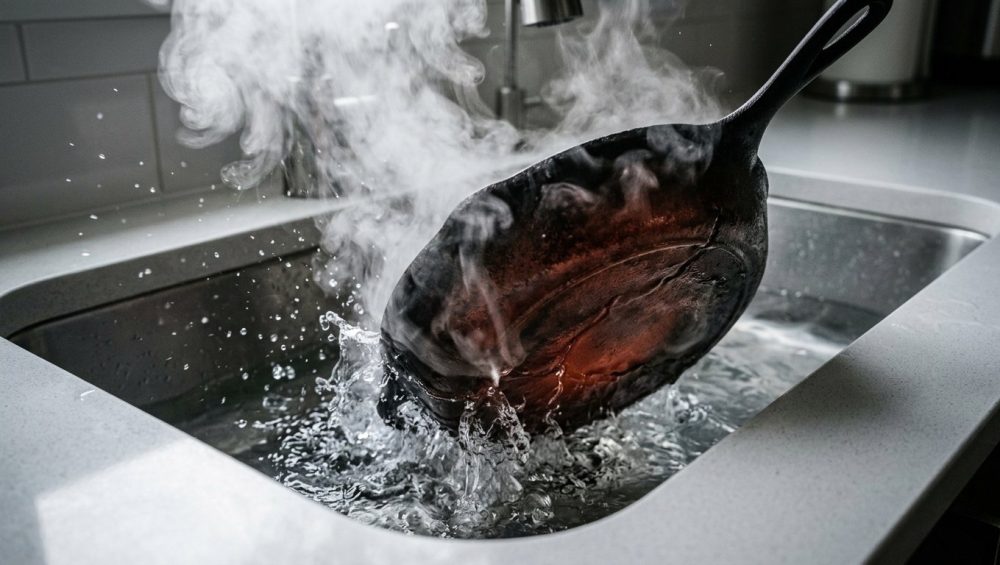
Picture this scenario: It is 7:30 PM on a random Tuesday. You are exhausted, starving, and you just managed to nail a surprisingly perfect, restaurant-quality sear on a pair of chicken breasts. You plate the food, and because you are a responsible, highly efficient adult who firmly believes that “time is money” during the weekday grind, you decide to tackle the cleanup immediately. You grab the blazing hot, grease-splattered skillet off the stove, carry it triumphantly to the sink, and turn the cold tap water on full blast.
Hiss.
A massive, dramatic cloud of steam billows up into your face. The grease instantly solidifies. You feel like an absolute culinary wizard, a master of the kitchen domain, conquering your chores with ruthless efficiency.
Congratulations. You just murdered your frying pan.
That incredibly satisfying sizzle you just heard? That was not the sound of grease lifting effortlessly from the metal. That was the sound of your cookware screaming in structural agony. You have just subjected your pan to the brutal, unforgiving physics of thermal shock, and you are the exact reason why your frying pan currently wobbles on the stove like a broken seesaw.
If you have ever been frustrated by spinning skillets, cooking oil that stubbornly pools on one side of the pan, and dinners that cook unevenly no matter what you do, pull up a chair. Grab a glass of wine. We need to have a brutally honest conversation about metal expansion, gradual cooling, and why your post-dinner cleanup routine is secretly destroying your kitchen.
The Sizzle of Death: Why You Are Accidentally Murdering Your Cookware
Let us get one thing straight: I am your biggest cheerleader. I firmly believe that absolutely anyone can cook like an expert without dropping fifty grand on a culinary degree. But part of cooking like a pro means treating your equipment like a pro.
The psychology behind the “immediate sink plunge” is totally understandable. We all want to save time. Nobody wants to scrub a cold, crusty pan at 9:00 PM when Netflix is calling. But plunging a 400-degree piece of metal into 60-degree tap water is the fastest way to turn a high-quality cooking vessel into a useless piece of modern art.
Water has a massive specific heat capacity, meaning it absorbs thermal energy incredibly fast. When that cold water hits the scorching hot metal, the temperature of the pan drops by hundreds of degrees in a fraction of a second. This rapid, violent energy transfer might make for a cool steam show, but it wreaks absolute havoc on the structural integrity of the material.
The Material Science of Thermal Shock (Explained for Normal People)
I have zero patience for pretentious chef-speak, but we do need to briefly channel our inner high school physics teacher to understand exactly what is happening here. Do not worry, I will keep the science tight and relevant to your food.
Metal Expansion and Contraction
Everything in the universe expands when it gets hot and contracts when it gets cold. Metal is no exception. When you place a skillet on a hot stove, the crystalline lattice of the metal atoms gets excited, vibrates, and pushes apart. The pan actually gets physically larger. Different materials have different “coefficients of thermal expansion,” which is just a fancy way of saying some metals stretch out faster than others.
For instance, the coefficient of thermal expansion for stainless steel is around 17.3 x 10⁻⁶ /°C, while cast iron sits lower at around 12.0 x 10⁻⁶ /°C. Aluminum, on the other hand, expands wildly, making it highly reactive to temperature changes.
The Yield Point and Plastic Deformation
When you finish cooking and let a pan cool slowly on the stovetop, all of those excited metal atoms gently settle back into their original positions. The entire structure contracts uniformly.
But when you blast a superheated pan with cold tap water, the surface of the metal that the water touches (usually the center of the base) instantly shrinks. Meanwhile, the sidewalls and the core of the metal are still blazing hot and fully expanded. This creates a massive, violent internal tug-of-war. The center is pulling inward while the edges are pushing outward.
Eventually, the stress becomes too much. The metal reaches what engineers call its “yield point.” Instead of bouncing back, the metal undergoes “plastic deformation.” It physically bends, twists, or buckles to relieve the internal tension. Once a pan undergoes plastic deformation, it is game over. It will never, ever naturally bend back to its original flat shape.
The Anatomy of a Warped Pan: What Actually Happens
You might not notice the damage immediately. Thermal shock can be cumulative. But eventually, the symptoms of a murdered pan become impossible to ignore.
Spinning Skillets and the “Spinner” Phenomenon
The most obvious sign of a warped pan is the dreaded “spinner” effect. Because the center of the pan cooled faster than the edges, the base bows outward, creating a convex shape.
When you place this pan on a flat glass or induction stovetop, it no longer sits flush. Instead, it balances precariously on that tiny center bulge. If you try to stir a batch of scrambled eggs, the entire skillet spins around like a DJ’s turntable. Not only is this incredibly annoying, but it is also genuinely dangerous if you are working with hot oil.
The Oil Pooling Problem
A convex, bowed pan fundamentally ruins your ability to cook food properly. Because the center of the skillet is now slightly elevated, gravity does what gravity does best. The moment you pour cooking oil into the pan, it immediately runs away from the center and forms a deep moat around the outer edges.
Think about what happens next. You drop a beautiful, expensive piece of salmon right into the center of the pan. Because there is no oil there, the fish instantly adheres to the dry metal and tears to shreds when you try to flip it. Meanwhile, the vegetables you pushed to the edges of the pan are literally deep-frying in a pool of boiling fat. Your food is simultaneously burnt, stuck, and soggy.
Cookware Materials on Trial: Who Survives the Sink?
Not all pans are created equal. Some materials can take a beating, while others will wave the white flag the moment they see a drop of cold water.
Multi-Clad Stainless Steel: The Strong but Sensitive Type
High-quality multi-clad stainless steel pans are the workhorses of a serious home kitchen. They are built by sandwiching a highly conductive core (like aluminum or copper) between layers of durable stainless steel.
Because these pans are made of multiple metals, they are inherently at risk. Remember those thermal expansion coefficients we talked about? Aluminum expands and contracts much faster than stainless steel. If you thermally shock a clad pan, the inner core shrinks faster than the outer layers. This can cause the base to warp, or in extreme cases, the layers can actually shear and separate. Actively focusing on mitigating thermal shock is critical to keeping these expensive investments perfectly flat.
Carbon Steel and Cast Iron: Tough but Not Invincible
Cast iron and carbon steel are beloved for their incredible thermal mass. They hold onto heat like a vault. But that exact property makes them incredibly vulnerable to rapid temperature changes.
According to a 2021 study published in the Journal of Materials Engineering and Performance, the fracture toughness of cast iron plummets by a staggering 68% when it is rapidly cooled from 400°F to room temperature in under 90 seconds. Because cast iron is a brittle alloy, it doesn’t just warp when shocked—it can literally crack clean in half with the sound of a gunshot. Furthermore, thermal shock destroys the polymerized oil layer you worked so hard to build, which is exactly why your damaged pan leaves black specks all over your dinner.
Carbon steel is slightly more forgiving than cast iron, but it is generally thinner, meaning it is highly susceptible to bowing. Mastering the heat control and understanding the thermodynamics of carbon steel pans will save you from unintentionally turning your favorite wok into a wobbly nightmare.
Aluminum and Cheap Non-Stick: The Absolute Worst Offenders
Gather round, friends, because it is time for my absolute favorite topic. If you follow my blog, you know I have a strict, non-negotiable rule about banishing toxic kitchen gear from your home.
Cheap, lightweight non-stick pans are almost always made of thin-gauge aluminum (often less than 2mm thick). Aluminum is an incredibly soft metal with a loose molecular structure. It heats up blazingly fast, but it also warps faster than any other material in your kitchen.
When a cheap aluminum pan warps, the rigid, toxic PTFE or PFAS non-stick coating applied to its surface cannot stretch to accommodate the bent metal. So, the chemical coating cracks, micro-fractures, and begins peeling off directly into your scrambled eggs. This structural failure is the primary reason these pans start losing their slip after a few months of use. If you have ever been left wondering why your expensive skillet suddenly lost its non-stick properties so quickly, thermal shock is the likely culprit. And as a quick side note, remember that aerosol cooking spray is the enemy of any coated surface, as the propellants bake into an impenetrable, sticky resin.
The Hidden Costs of a Warped Frying Pan
A wobbly pan is not just an aesthetic annoyance. It actively sabotages your cooking and your kitchen appliances in ways you might not even realize.
Uneven Heat Distribution and Ruined Dinners
When a pan bows, the metal is no longer making uniform contact with the heating element. The parts of the pan touching the stove get blisteringly hot, while the raised sections remain lukewarm. This creates extreme hot and cold spots. You will find yourself constantly rotating your food, praying that half of your chicken doesn’t emerge raw while the other half turns into charcoal. You simply cannot execute a proper sear without a perfectly flat surface.
The Induction Cooktop Nightmare
If you cook on an induction range, a warped pan is a literal showstopper. Induction cooking does not rely on radiant heat; it uses electromagnetic fields to heat the metal of the pan directly.
However, this magnetic field weakens exponentially with distance. If the base of your pan is bowed by even one or two millimeters, it breaks the magnetic link. The induction sensors will fail to detect the pan, the stove will click off, and your cooking process will violently halt. Commercial induction hobs can dump up to 5000W of power into a pan instantly, meaning if you put a cold, thin pan on a high induction setting, it will warp and disconnect in a matter of seconds. This intense, localized thermal stress is the exact same reason your baking sheets keep warping in the oven when exposed to sudden, uneven heat blasts.
How to Clean a Scorching Hot Pan Without Destroying It
So, if we cannot plunge our dirty pans into the sink, how on earth are we supposed to clean up efficiently on a busy weeknight? I promised you time-saving hacks, and I intend to deliver.
The Deglazing Loophole (Why Hot Liquid is Okay)
You might be thinking, “But Sassy Sous-Chef, every professional recipe tells me to pour cold wine or broth into a screaming hot pan to make a sauce! Isn’t that thermal shock?”
That is an excellent question. The difference comes down to volume and thermal mass. When you deglaze a pan, you are adding a very small amount of liquid. That liquid rapidly boils and evaporates. The phase change from liquid to gas absorbs a tremendous amount of heat energy, which quickly cools the surface of the pan, but it does not instantly drop the temperature of the entire mass of the metal by 300 degrees like submerging it in a sink full of water does.
Deglazing is actually the absolute best method for turning burnt bits into sauce while you cook. It lifts the stuck-on fond effortlessly, leaving you with a delicious pan sauce and a skillet that is already 90% clean before dinner is even served.
The “Leave It on the Stove” Strategy
If you are not making a pan sauce, the ultimate time-saving cleanup strategy is incredibly simple: Do absolutely nothing.
When you finish cooking, plate your food, turn off the burner, and just leave the dirty pan sitting right there on the stovetop. Go sit down. Drink your wine. Eat your meal. By the time you finish dinner and return to the kitchen thirty minutes later, the pan will have gradually cooled down to a safe, manageable temperature. You have not wasted any time; you simply shifted the cleanup window to align with basic thermodynamic safety.
Safe Washing Temperatures
You should only ever introduce water to a pan when it is warm to the touch—not hot, and definitely not smoking. If you can comfortably hover your hand an inch above the metal without wincing, it is safe to wash.
If you are utilizing the classic water drop test to gauge temperature before cooking, remember that the same visual cues apply in reverse. If a drop of water dances across the surface like a frantic mercury bead (the Leidenfrost effect), the pan is way too hot for the sink. If the water simply sits there and gently evaporates, you are in the clear. Always use warm soapy water for the initial wash, as matching the water temperature to the residual heat of the pan completely eliminates any remaining risk of thermal shock.
Can You Fix a Warped Pan? (The Brutal Truth)
I am a realist. I know that despite our best intentions, mistakes happen. Maybe your well-meaning partner tried to “help” with the dishes and aggressively dunked your favorite skillet into an ice-cold sink. Can it be saved?
The Mallet Method (For Carbon Steel Only)
If you have a warped carbon steel pan, you might be able to perform some aggressive DIY metalworking. Because carbon steel is somewhat malleable, some home cooks have success heating the pan up, placing a block of wood over the bowed center, and aggressively whacking it with a rubber mallet to force the metal back into alignment.
I will be brutally honest: this is a desperate measure. It requires a lot of physical force, it is incredibly loud, and it rarely results in a pan that is 100% perfectly flat again. If you cook on a gas stove with heavy grates, a slightly imperfect pan is manageable. If you cook on flat glass or induction, a hammered pan will likely still wobble enough to drive you crazy.
When to Cut Your Losses and Upgrade
If you warped a cheap, thin aluminum non-stick pan, do not even bother trying to fix it. Throw it in the recycling bin. Bending aluminum back into shape will only further fracture the toxic non-stick coating, making it actively hazardous to cook with.
Consider this your sign from the culinary universe to finally upgrade your gear. Invest in a heavy-gauge, multi-clad stainless steel skillet, a thick carbon steel pan, or a classic cast iron workhorse. Yes, they require a bit more upfront investment, but they will last you a lifetime if you treat them right.
The Sassy Sous-Chef’s Final Verdict on Pan Care
Cooking is not magic; it is just delicious, edible physics. You do not need a Michelin star to make mind-blowing food in your home kitchen, but you do need to respect the basic laws of thermodynamics.
Your frying pan is the most important tool in your culinary arsenal. It sears your steaks, sautés your vegetables, and builds the foundation of your sauces. Stop torturing it. Stop rushing the cleanup process at the expense of your equipment’s structural integrity.
Give your pans the grace to cool down slowly. Treat your metals with respect. If you can master the simple art of patience at the sink, your cookware will reward you with perfectly even heat, flawless sears, and a lifetime of stress-free weeknight dinners. Now get out of here, go preheat a pan—slowly—and make something amazing.