You have absolutely been there. It is Sunday afternoon, and you have spent the last three hours hovering over a simmering pot of homemade soup. You diligently chopped your mirepoix, you browned your meats, and you let the whole concoction bubble away until the kitchen smelled like a rustic countryside inn. You finally dip a spoon in, blow on it, and take a taste.
And it is… fine.
It is not terrible, but it is heavy. It is muffled. It is, for lack of a better culinary term, completely flat.
Your immediate, deeply ingrained instinct is to reach for the salt shaker. You sprinkle in a generous pinch. You stir, you taste again. Now it just tastes like salty flat soup. You add a crack of black pepper. Nothing changes. You stare into the pot, wondering why you didn’t just open a can and save yourself an entire afternoon.
Listen to me, and put the salt shaker down. Your soup does not have a sodium deficiency. Your soup has an acid deficiency.
As a home cook who has ruined enough dinners to write a textbook on the subject, I can tell you that understanding the delicate balance of flavor profiles is the single most important hurdle to clear in your culinary journey. When it comes to fixing rookie kitchen mistakes, learning how to wield acid is the ultimate game-changer. We are taught from day one to season our food with salt and pepper, but we are rarely taught to season with acidity. Today, we are going to strip away the pretentious chef-speak and dive deep into the food science of why your homemade meals taste one-dimensional, and exactly how a simple splash of vinegar or citrus can instantly transform your cooking from a stressful chore into a masterpiece.
The Anatomy of a “Flat” Soup
To understand the cure, you must first understand the disease. Why does a soup that contains high-quality broth, fresh vegetables, and beautifully seared meat end up tasting like a dull, homogenous bowl of nothing?
The Blanket of Fat and Palate Fatigue
When you simmer a soup, stew, or braise for an extended period, the fats from your cooking oils, butter, and animal proteins melt and emulsify into the cooking liquid. Simultaneously, the collagens from the meat and bones break down into rich, luxurious gelatin. This creates a beautifully silky mouthfeel, which is exactly what you want in a hearty winter meal.
However, there is a biological downside to all this richness. Fat coats the tongue. It acts as a literal physical barrier, a slick blanket that covers your taste buds. When you take a bite of a rich, fat-heavy dish, that coating prevents the more delicate flavor molecules from directly interacting with your sensory receptors.
Furthermore, your palate gets bored easily. When every spoonful hits the exact same heavy, savory, umami-rich notes, your taste buds experience “palate fatigue.” The flavors blur together into a single, muddy note. Without any sharp contrast to wake your senses back up, your brain registers the food as dull and uninspired.
The Salt Illusion
When confronted with a flat dish, most of us reflexively add salt. Salt is a flavor enhancer, so the logic tracks: if the flavor is weak, add the enhancer. But salt is not a miracle worker. It can only amplify what is already there. If what is already there is a heavy, muddy wall of fat and starch, adding salt will simply give you a highly seasoned wall of fat and starch.
You do not need an amplifier; you need a palate cleanser. You need something that cuts through the richness, resets your taste buds, and provides a sharp contrast that makes the savory elements pop. This is exactly why your dinner needs acid.
The Biological Machinery of Taste: Why Acid is a Magic Trick
This is not just culinary folklore; this is applied food chemistry and human biology. The reason a squeeze of lemon or a dash of vinegar works so miraculously well is rooted in how our gustatory system operates.
Hacking Your Ion Channels
Flavor is not just an abstract concept; it is a physiological reaction. When you add an acidic ingredient to your soup, the protons (hydrogen ions) from weak organic acids—like the citric acid in lemons, the acetic acid in vinegar, or the malic acid in apples—actively lower the pH level of the food.
When this slightly acidic liquid hits your tongue, it modulates the ion channels on your taste receptor cells. According to sensory science trials, lowering the oral pH actually increases the neural firing rate for sweet and salty receptors by roughly 20%. Read that again: acid physically alters your taste buds to make them more sensitive to salt. This means that adding a splash of acid makes the salt that is already in the pot taste significantly saltier and more pronounced, without you ever having to add another grain of actual sodium.
The Salivation Equation
Have you ever noticed that just thinking about biting into a raw lemon wedge makes the back of your jaw tingle and your mouth water? That is your body’s evolutionary response to acidity.
Human saliva is roughly 99.5% water, but that remaining half-percent is a complex cocktail of proteins, enzymes, and electrolytes that are absolutely crucial for tasting food. Your taste buds cannot detect flavor compounds unless those compounds are dissolved in a liquid medium. When you eat something acidic, your brain sends an immediate SOS to your salivary glands to flush the mouth with saliva in an attempt to buffer and neutralize the acid.
This flood of saliva acts as a rapid-transit system for flavor. It efficiently dissolves the aromatic compounds in your soup and washes them directly over your taste receptors. By introducing a tiny amount of acid to your soup, you are literally making the food “mouthwatering,” forcing your own biology to amplify the taste of the meal.
Suppressing the Bitter Truth
Sometimes a soup tastes flat because the flavor profile is subtly dragged down by bitter undertones. Perhaps you got a little too aggressive when browning your mirepoix, or maybe you used a robust, bitter green like kale or mustard greens in your broth.
Acid is a master of disguise. In an acidic environment, bitter compounds (like caffeine or the sulfurous compounds in certain vegetables) bind much more weakly to the taste receptors on your tongue. Introducing acid to a dish can reduce your perception of bitterness by up to 37%, allowing the sweeter, more savory notes of your vegetables and meats to shine through unimpeded.
The Thermodynamics of Flavor: Why Timing is Everything
If acid is such a miracle worker, you might be wondering why you shouldn’t just dump a cup of vinegar into the pot right at the beginning of the cooking process. The answer comes down to thermodynamics and the fragile nature of flavor molecules.
The Evaporation of Volatile Organic Compounds
Acids like lemon juice and vinegar are not just pure, isolated chemical acids. They are complex liquids made up of water, sugars, and, most importantly, Volatile Organic Compounds (VOCs). These VOCs are what give a lemon its bright, floral, citrusy aroma, and what give apple cider vinegar its fruity, fermented funk.
The keyword here is volatile. These compounds are highly unstable and evaporate very quickly when exposed to heat. If you squeeze a beautiful, fresh lemon into a pot of chicken soup and then boil it for two hours, the heat will completely destroy and evaporate those delicate aromatic oils. The soup will retain a dull, muddy tartness, but you will lose all the bright, fresh “zing” that actually wakes up the palate. This is especially tragic when your homemade chicken broth turns cloudy and you desperately need that sharp, floral citrus note to cut through the visual and textural heaviness.
The Golden Rule of Finishing
Because heat destroys the very compounds we are trying to utilize, the golden rule of acid is this: You must add it at the very end of the cooking process, right before serving.
In the culinary world, this is known as “finishing” a dish. You do all your heavy lifting—the searing, the simmering, the reducing—and then, once the pot is off the heat, you stir in your splash of acid. This preserves the volatile aromatics, ensuring that the bright, sharp notes hit your nose and your tongue the second you take a bite.
There is one notable exception to this rule: tomatoes. Tomatoes contain natural acids that provide structural flavor to a dish. When cooking a marinara or a tomato bisque, you absolutely want to simmer those tomatoes to reduce their harshness and concentrate their sugars. However, even if you have simmered a tomato base for hours, you will often find that the tomato sauce tastes metallic or flat by the time it is done. The solution? A tiny splash of fresh balsamic or red wine vinegar stirred in off the heat to replace the volatile acids that cooked away.
The Sassy Sous-Chef’s Definitive Acid Pairing Masterclass
Not all acids are created equal. You cannot just blindly grab whatever bottle is sitting in the back of your pantry and dump it into your dinner. You must pair the specific flavor profile of the acid with the underlying ingredients of your soup. Here is your definitive, no-nonsense pairing guide.
Citrus: The Bright and the Bold
Citrus juices are the sharpest, most aggressive acids in your arsenal. They bring a distinct, fruity brightness that cuts through heavy fats like a laser beam.
- Lemon Juice: This is the undisputed king of the kitchen. Lemon juice pairs flawlessly with poultry, fish, and green vegetables. It is the mandatory finishing touch for a classic chicken noodle soup, a creamy potato leek puree, or a traditional Greek avgolemono. Crucial Note: Always use freshly squeezed lemon juice. The bottled stuff sitting on the supermarket shelf contains preservatives that give it a harsh, metallic aftertaste.
- Lime Juice: Lime has a slightly more bitter, tropical edge than lemon. It is the absolute cornerstone of Latin American and Southeast Asian soups. If you are making a rich tortilla soup, a heavy black bean chili, or a deeply aromatic bowl of pho, a heavy squeeze of fresh lime juice right over the bowl is non-negotiable.
The Vinegar Spectrum: From Apple to Sherry
Vinegars offer a more complex, fermented acidity than citrus. They bring depth, earthiness, and a subtle savory quality that complements hearty, robust stews.
- Apple Cider Vinegar (ACV): ACV has a wonderful, fruity tang that pairs beautifully with pork and root vegetables. If you are making a heavy split pea soup with a smoked ham hock, or a creamy butternut squash bisque, a splash of ACV will instantly elevate the dish.
- Red Wine Vinegar: This is your heavy hitter. It is robust, tannic, and deep. It is the ultimate savior for dark, beefy broths. If your weekend beef stew is tough on the palate and feels like a bowl of pure mud, a tablespoon of red wine vinegar will cut through that heavy beef fat and bring the root vegetables back to life.
- White Wine & Champagne Vinegar: These are the elegant, delicate cousins of red wine vinegar. They are crisp and clean. Use them to finish light vegetable minestrones, seafood chowders, or delicate white bean soups where a darker vinegar would overpower the broth.
- Sherry Vinegar: If you do not have a bottle of sherry vinegar in your pantry, fix that immediately. It has a nutty, incredibly complex flavor profile that pairs flawlessly with earthy ingredients. It is the undisputed best friend to any mushroom soup or lentil stew.
- Balsamic Vinegar: Proceed with extreme caution. Balsamic is very sweet, syrupy, and highly overpowering. It should almost never be used in a clear broth. Reserve it exclusively for finishing rich tomato soups or roasted red pepper bisques, and even then, use it by the drop.
Dairy and Vegetal Acids
Sometimes, you don’t want the sharp, watery bite of citrus or vinegar. You want a creamy, textural acidity.
- Sour Cream, Yogurt, and Crème Fraîche: The lactic acid in fermented dairy provides a gentle, rounded tang. A dollop of sour cream is what makes a heavy, beet-heavy borscht palatable. It is also the perfect way to finish a painfully spicy chili, as the dairy fat coats the tongue while the lactic acid brightens the meat.
- Tomatoes and Wine: While usually used as foundational ingredients rather than finishing agents, remember that deglazing a pot with white wine or adding a tablespoon of tomato paste provides a crucial baseline of acidity that will support the rest of the dish as it simmers.
A Brutally Honest Warning About Toxic Cookware
We need to take a brief, highly serious detour. I have zero patience for cheap, toxic kitchenware, and if you are going to start utilizing acid in your cooking, you need to understand the metallurgy of your pots and pans.
The Chemistry of Aluminum Leaching
Do not, under any circumstances, simmer or finish highly acidic foods in cheap, untreated, bare aluminum cookware.
Aluminum is a highly reactive metal. When it comes into prolonged contact with acids (like tomatoes, wine, vinegar, or citrus), the acid literally eats away at the natural oxide layer protecting the metal. This chemical reaction strips aluminum ions directly out of the pot and leaches them into your food.
The result? Your beautiful, vibrant soup will take on a dull, unappetizing gray discoloration, and it will taste like you are chewing on a handful of loose change. It imparts a harsh, bitter, metallic flavor that absolutely ruins the dish. While health authorities generally state that the minimal amount of aluminum leached is not acutely toxic, it is a culinary disaster that I refuse to tolerate in a home kitchen. The same rule applies to unseasoned cast iron; acid will strip the seasoning and leach dietary iron into the food, turning it black and metallic.
The Non-Reactive Kitchen Arsenal
If you are going to cook like an expert, you need non-reactive gear.
- Enameled Cast Iron: A heavy-bottomed enameled Dutch oven (like a Le Creuset or Staub) is the holy grail for soup making. The glass-like enamel coating is completely inert and will never react with your acidic ingredients, while the cast iron core provides flawless heat retention.
- Stainless Steel: High-quality, fully clad stainless steel is completely safe for acidic foods. If you find that food sticks to your stainless steel pots, you simply need to learn proper temperature control and the Leidenfrost effect; do not abandon them for cheap aluminum.
- Anodized Aluminum: If you absolutely must use aluminum for its lightweight properties, ensure it is hard-anodized. This electrochemical process creates a hardened, non-reactive surface that protects the metal from acidic degradation. If you need a curved saucier pan for reducing acidic pan sauces, anodized aluminum or fully clad stainless are your only acceptable options.
The “Spoon Test”: A Foolproof Method for Fixing Dinner
Now that you understand the science, the pairings, and the cookware, how do you actually apply this to the pot of flat soup sitting on your stove right now?
You do not just uncap a bottle of vinegar and pour it in. Cooking is an exercise in incremental adjustments. You are going to use a technique I call the “Spoon Test.”
The Micro-Dose Isolation
- Isolate: Take a standard soup spoon and ladle out a small sample of the broth and a few vegetables from your main pot. Step away from the stove so the steam isn’t clouding your senses.
- Taste the Baseline: Taste the soup on the spoon. Acknowledge the flatness. Note how heavy it feels on your tongue.
- The Micro-Dose: Take your chosen acid (let’s say, apple cider vinegar). Dip the very tip of a clean teaspoon into the vinegar, and transfer literally one or two drops into your soup spoon.
- The Assessment: Stir it gently on the spoon and taste it again.
Did the flavors suddenly snap into high definition? Did the underlying saltiness magically appear? Did the heavy fat suddenly feel light and clean? If yes, you have found your pairing. If it tastes weird or clashes, dump the spoon, rinse it, and try again with a different acid (like lemon juice instead of vinegar).
Scaling Up to the Pot
Once you have successfully proven the concept on a single spoon, it is time to scale up to the main pot.
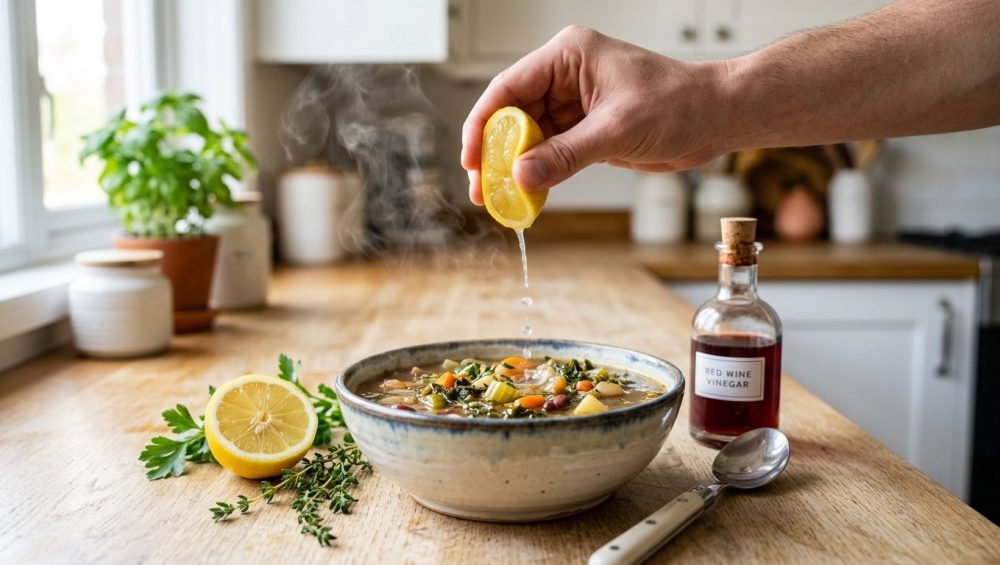
Turn off the heat. Add the acid incrementally. For a standard 4-quart pot of soup, start with one teaspoon of your chosen vinegar or citrus juice. Stir it thoroughly, wait ten seconds for the flavors to distribute, and taste.
You are looking for the culinary sweet spot: the point where the soup tastes incredibly vibrant and well-seasoned, but before you can explicitly identify the flavor of the acid. If your guest takes a bite and says, “Wow, this has a lot of lemon in it,” you have gone too far. The acid should act as a ghost ingredient—an invisible scaffolding that lifts the other flavors up without drawing attention to itself.
This simple, methodical approach to tasting and adjusting is exactly how you master simple weeknight dinners. It eliminates the guesswork and allows you to rescue a bland meal in less than sixty seconds.
Beyond the Soup Bowl: A Culinary Philosophy
Once you understand the power of finishing acids, you will start seeing applications for it everywhere in your kitchen.
That heavy, rich pan sauce you made for your pork chops? It needs a few drops of sherry vinegar right before you pour it. That massive tray of roasted root vegetables that tastes a little too sweet and earthy? Toss them with a squeeze of fresh lemon juice right when they come out of the oven. That dense, incredibly rich macaroni and cheese? A tiny dash of hot sauce (which is primarily vinegar) will cut through the dairy fat and make it addictive rather than cloying.
The true art of the home kitchen is not about memorizing complex, pretentious recipes or buying five-hundred-dollar knives. It is about understanding the fundamental laws of flavor and chemistry. It is about knowing how to maintain a beautiful, rust-free skillet, knowing why your proteins stick, and knowing how to manipulate salt, fat, and acid to trick your own taste buds into experiencing something spectacular.
So, the next time you find yourself staring down a pot of flat, boring, one-dimensional soup, do not panic. Do not reach for the salt. Grab a lemon, grab a bottle of good vinegar, and perform a little bit of culinary magic. You’ve got this.