Listen to me. I love you, but we need to have a serious intervention about your Friday night pizza routine.
You spend days agonizing over flour types. You coddle your yeast like it is a newborn baby. You splurge on the imported San Marzano tomatoes and the fancy, water-packed mozzarella that costs more than your first car. You stretch the dough, you dress it beautifully, and you slide it into your oven with the pride of an artisan baker. And what happens? Ten minutes later, you pull out a pale, limp, tragic disc of disappointment. You pick up a slice, and the tip immediately droops toward the floor, dumping a puddle of orange grease and sad, sliding cheese all over your plate. The bottom is blonde, gummy, and tastes like a wet sponge.
You blame the recipe. You blame the flour. You assume that because you do not have a $5,000 imported wood-fired brick oven sitting in your backyard, you are simply doomed to mediocre, floppy pizza for the rest of your natural life.
Stop it. Put down the takeout menu. The problem is not your culinary skill, and the problem is certainly not your dough. The problem is your equipment, and more specifically, your fundamental misunderstanding of thermal physics. If you want to cure cooking anxiety on pizza night, you have to understand the invisible enemy ruining your crust: poor heat transfer.
It is time to ditch the flimsy, cracking ceramic stones and the cheap aluminum baking sheets. Today, we are going deep into the science of why your homemade pizza is soggy, and how upgrading to a heavy, ultra-conductive slab of carbon steel will permanently change your life. No pretentious chef-speak, no culinary degree required—just pure, unapologetic kitchen science. Pour yourself a glass of wine, and let’s fix your pizza.
The Illusion of the 500°F Home Oven
To understand why your pizza crust is currently failing, we first have to talk about the lies your kitchen appliances tell you. When you preheat your standard home oven to 500°F (or 550°F if you are lucky), and it beeps to tell you it is ready, what does that actually mean?
It means the ambient air inside that metal box has reached 500°F. But here is the brutal truth: air is an absolutely terrible conductor of heat.
Think about it this way. You can comfortably reach your bare hand into a 400°F oven for a few seconds to grab a baking dish without immediately bursting into flames. The air is 400°F, but it does not transfer its thermal energy to your skin fast enough to cause instant damage. Now, imagine touching a 400°F cast iron skillet with your bare hand. You would be in the emergency room before you could even scream. The temperature is exactly the same, but the rate of heat transfer is entirely different.
When you place a wet, heavy, raw pizza dough onto a standard baking sheet in a 500°F oven, the dough acts as a massive thermal sink. It immediately cools down the pan, and the 500°F air surrounding the pizza simply cannot pump heat back into the bottom of the crust fast enough to cook it. Even if you use a simple oven thermometer to verify the ambient air temperature is perfectly accurate, the air alone will never crisp your crust. The moisture from your sauce and cheese begins to seep downward, racing against the clock. Because the bottom of the dough is not receiving a violent, immediate blast of conductive heat, the moisture wins. The dough steams rather than bakes, resulting in that dreaded, doughy, blonde undercarriage.
To make professional-level pizza, you do not need hotter air. You need a massive thermal battery that can violently and rapidly pump heat directly into the bottom of the dough the exact millisecond it makes contact.
Enter the Heavy Metal: The Genius of the Baking Steel
For decades, the standard advice for home cooks was to buy a ceramic or cordierite pizza stone. And for a while, that was the best we had. A stone is porous, it holds heat reasonably well, and it is certainly better than a thin aluminum baking sheet. But stones have fatal flaws: they take forever to preheat, they are notorious for violently cracking under thermal shock, and quite frankly, they just do not conduct heat fast enough to mimic a commercial pizza oven.
Then, the culinary world experienced a heavy metal revolution.
In 2012, a guy named Andris Lagsdin was working at his family’s steel manufacturing plant in Massachusetts. He was an avid home pizza maker who was incredibly frustrated by the limitations of standard pizza stones. One day, he was reading Nathan Myhrvold’s legendary culinary science encyclopedia, Modernist Cuisine, and came across a single, passing sentence that changed everything: “Steel conducts heat better than stone”.
Lagsdin had a literal “aha” moment. Surrounded by heavy metal, he grabbed a quarter-inch thick slab of A36 carbon steel, took it home, scrubbed it down, and threw it in his oven. The pizza he baked on it that night was a revelation—blistered, charred, incredibly crispy, and baked in half the time of a traditional stone. He launched a Kickstarter for the “Baking Steel,” it was heavily praised by food science writers, and a brand new era of home cooking was born.
As I always preach when banishing toxic kitchen gear, I have zero tolerance for cheap, peeling, chemically coated nonsense. A baking steel is the exact opposite of that. It is a solid, indestructible, heavy-gauge slab of carbon steel. It has no toxic non-stick coatings. It will never shatter if you accidentally drop cold tomato sauce on it. It will literally outlive you, your children, and probably the house you are currently living in.
The Thermal Physics Breakdown: Steel vs. Stone
Why does a piece of steel completely obliterate a traditional cordierite pizza stone in a side-by-side bake? It all comes down to two specific principles of physics: thermal conductivity and thermal mass (heat capacity).
1. Thermal Conductivity (The Speed of Heat)
Thermal conductivity measures how quickly a material moves heat from itself into whatever is touching it. This is the single most important metric for pizza making. Cordierite, the most common material used for high-end pizza stones, has a thermal conductivity of roughly 1.5 W/m·K. It is an insulator by nature, meaning it releases its stored heat gradually and slowly.
Carbon steel, on the other hand, has a thermal conductivity of roughly 54 W/m·K. This means that carbon steel transfers heat to your pizza dough approximately 18 to 36 times faster than a standard ceramic stone.
When you launch a pizza onto a 500°F cordierite stone, the stone gently warms the dough. When you launch a pizza onto a 500°F carbon steel plate, the steel aggressively and violently dumps its heat into the dough. The steel does not actually get hotter than the stone—they both sit at 500°F in the same oven—but the steel feels significantly hotter to the dough because it is delivering that thermal energy at breakneck speed.
2. Thermal Mass and Density (The Heat Battery)
Heat transfer speed is useless if the material runs out of heat immediately. This is where density comes into play. While the specific heat capacity (the amount of energy required to raise the temperature of a given mass) of steel is actually lower than cordierite, steel is incredibly dense—about three times denser than a pizza stone.
Because it is so incredibly dense, a given volume of steel stores significantly more thermal energy than the exact same volume of stone. It is a massive thermal battery. When the cold dough hits the steel and begins sucking away its heat, the steel has such deep reserves of energy that its surface temperature barely drops. It just keeps pumping heat into the crust, allowing you to bake multiple pizzas back-to-back without having to wait 30 minutes for the oven to recover.
The Science of “Oven Spring” and Blistered Crusts
So, what actually happens to your dough when it is subjected to this violent, rapid heat transfer? You achieve the holy grail of baking: explosive oven spring.
If your pizza dough keeps shrinking back while you stretch it, you are already fighting a losing battle with your gluten network. But even perfectly relaxed, beautifully fermented dough will bake into a dense, heavy hockey puck if it lacks proper heat transfer.
Oven spring is the rapid, dramatic expansion of dough that occurs during the first few minutes of baking. When the raw dough hits the blazing hot carbon steel, two magical things happen simultaneously:
- Yeast Hyper-Drive: The intense heat instantly penetrates the bottom of the dough, warming the interior. For a brief, glorious moment before they die off, the yeast cells go into absolute overdrive, rapidly feeding on sugars and expelling massive amounts of carbon dioxide gas.
- Steam Expansion: The water trapped inside the dough matrix rapidly heats up and turns into steam. Because gases expand when heated, this steam forces the gluten structure to balloon upward.
Here is why the baking steel is critical for this: In order to get massive, airy bubbles (what bakers call “alveolation”) in your crust, the dough must expand before the exterior starches gelatinize and the crust hardens. If the heat transfer is slow (like on a regular baking sheet), the outer crust slowly dries out and forms a rigid shell before the interior gases have fully expanded. The dough is trapped, resulting in a flat, dense pizza.
Because carbon steel transfers heat 18 times faster than stone, it flash-boils the moisture inside the dough, creating violent steam expansion instantly. The dough rockets upward, creating those beautiful, airy, translucent bubbles in the crust before the exterior structure has a chance to lock it into place.
The Maillard Reaction and Evaporative Cooling
Let’s talk about browning. That deeply roasted, charred, complex flavor on the bottom of a good pizza comes from the Maillard reaction—a chemical reaction between amino acids and reducing sugars that rapidly accelerates when surface temperatures exceed 265°F (130°C).
However, as the water in your pizza dough evaporates, it cools the surface of the dough down. This is called evaporative cooling (it is exactly how human sweat works). In a standard oven setup, evaporative cooling prevents the bottom of the dough from ever getting hot enough to trigger a robust Maillard reaction.
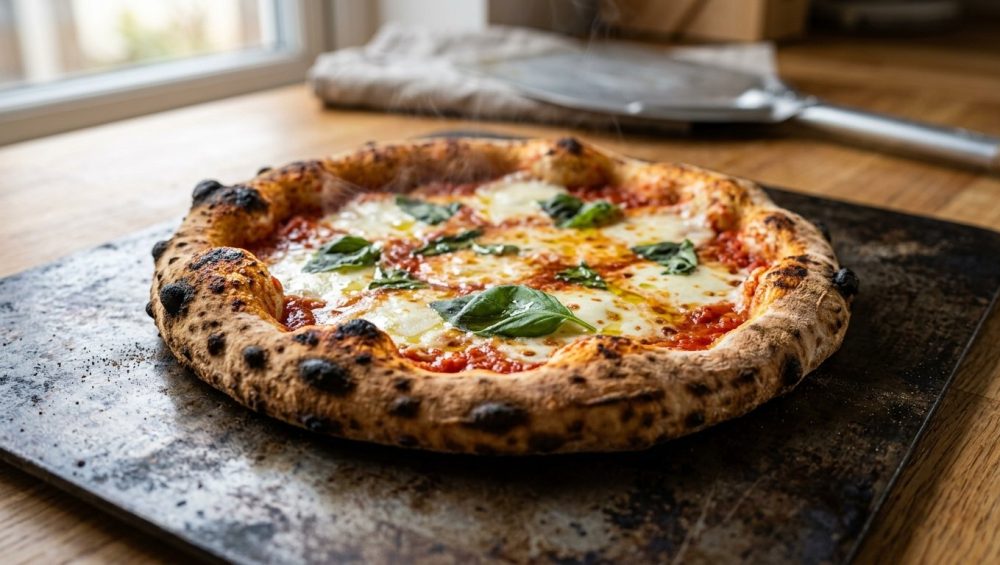
A baking steel completely overrides this. It pumps heat into the bottom of the dough so aggressively that it easily outpaces the evaporative cooling effect. The moisture is driven off immediately, the surface temperature of the dough skyrockets past 265°F, and you get gorgeous, leopard-spotted charring in a matter of minutes.
How to Actually Use a Baking Steel (The Master Method)
Buying the gear is only half the battle. If you throw a baking steel into a cold oven, preheat it for ten minutes, and toss a pizza on it, you are going to be miserable. To truly unlock the magic of a baking steel, you have to treat it like the thermal battery it is. Here is my foolproof, step-by-step method for the ultimate home bake.
1. Strategic Oven Placement
Do not put your steel on the very bottom rack. You want it positioned in the upper third of your oven, roughly 6 to 8 inches below the top broiler element. Why? Because pizza requires two types of heat: conductive heat from the bottom to crisp the crust, and radiant heat from the top to melt the cheese and blister the top crust. By placing the steel high in the oven, you maximize the radiant heat bouncing off the ceiling.
2. The Extreme Preheat
This is non-negotiable. You must preheat your oven to its absolute maximum temperature (usually 500°F or 550°F) for a minimum of one full hour before you launch your first pizza. Do not trust the oven when it beeps after 15 minutes. The air might be 500°F, but that 16-pound slab of steel needs time to fully saturate with thermal energy. Give it 60 minutes to charge the battery.
3. The “Broiler Trick”
A standard home oven maxes out around 550°F, but professional Neapolitan pizza ovens operate at 850°F to 900°F. How do we close the gap? We cheat.
About 10 minutes before you are ready to launch your pizza, switch your oven from “Bake” to “Broil.” The broiler element will glow red hot, blasting the top of the steel with intense, direct infrared radiation, pushing the surface temperature of the steel well past 600°F.
Right before you slide the pizza onto the steel, turn the oven back to “Bake” (or leave the broiler on if your oven allows it and you want an aggressively charred top). The super-charged steel will cook the bottom of the crust in 4 to 6 minutes, while the residual intense heat at the top of the oven perfectly blisters the cheese.
Care, Maintenance, and Building a Non-Stick Patina
Because a baking steel is made of raw A36 carbon steel, it requires a tiny bit of respect. If you leave it soaking in a sink full of soapy water, it will rust. If you run it through the dishwasher, I will personally come to your house and revoke your kitchen privileges.
When you first get your steel, it needs to be washed, dried completely, and seasoned. The physics of seasoning cast iron and carbon steel are identical; you are building a protective polymer layer. You rub a microscopic layer of high-smoke-point oil (like grapeseed or canola) over the entire surface, and bake it at 400°F for an hour. The heat causes the oil to break down and undergo polymerization, bonding to the metal and creating a naturally slick, rust-proof, dark patina. Many modern baking steels actually ship pre-seasoned, which is a lovely bonus.
For daily maintenance, you almost never need to wash it. If cheese bubbles over and burns onto the steel, simply let the steel cool down in the oven. Once it is safe to handle, use a stiff bench scraper to knock off any burnt, carbonized bits right into the trash. Wipe it down with a dry paper towel, and leave it in your oven. (Pro-tip: Just store the steel in your oven permanently. It acts as a thermal mass for your everyday baking, helping your oven recover temperature faster when you open the door to check on a roast).
The “Less is More” Rule for Toppings
I need to issue a very stern warning here. You can own the thickest, most expensive baking steel on the planet, but you cannot defy the laws of physics if you sabotage the dough.
The biggest rookie mistake in homemade pizza is overloading the pie. When mastering modern recipes for artisan or Neapolitan-style pizza, you must remember that restraint is the ultimate sophistication.
Fresh mozzarella is essentially a delicious water balloon. If you slice a massive, one-inch thick slab of fresh mozzarella and drop it on your dough, it is going to weep a torrential flood of liquid whey the second it hits the heat. Your steel will try its hardest, but it will be drowned.
If you are using fresh mozzarella, tear it into small chunks and let it drain on paper towels for at least an hour before baking.
The same goes for your sauce. Do not ladle a massive soup of watery, uncooked crushed tomatoes onto the dough. Use a light, even layer. You should almost be able to see the dough through the sauce.
And vegetables? If you want mushrooms, peppers, or onions on your pizza, sauté them in a pan first to drive off their internal moisture. Raw vegetables will sweat all over your cheese in the oven, turning the top of your pizza into a swamp. Keep it light, keep it dry, and let the crust be the star of the show.
Beyond Pizza: Other Genius Uses for Your Steel
If you are hesitating to buy a baking steel because you think it is a “unitasker,” let me stop you right there. I despise kitchen unitaskers. A baking steel is one of the most versatile pieces of heavy culinary artillery you can own.
1. The Ultimate Smashburger Griddle:
Because it is a solid slab of conductive metal, you can place your steel directly over two burners on your gas or induction stovetop, or throw it right onto your outdoor grill. Let it get screaming hot, and you have a massive, professional-grade plancha. It is the absolute best surface in the world for making diner-style smashburgers. The extreme heat transfer instantly sears the beef, creating an incredible crust that you simply cannot achieve in a standard frying pan. When you are done, a chainmail scrubber works wonders without stripping the seasoning you’ve built up.
2. Artisan Bread Baking:
If you bake sourdough or rustic boules, the steel is your best friend. Bread requires the exact same intense bottom-heat and oven spring as pizza. Baking your loaves directly on the steel produces a dramatically thicker, darker, and more blistered bottom crust. A perfectly baked loaf with a hardened crust retains its internal moisture longer, meaning your fresh bread goes stale much slower.
3. The Cold Slab for Pastry:
Carbon steel does not just hold heat; it holds cold. If you are making pie dough, croissants, or laminating butter into pastries, heat is your enemy. Place your baking steel in the freezer for an hour, then pull it out and set it on your kitchen counter. It acts as an incredible, food-safe cold plate. You can roll out your dough directly on the freezing steel, and it will keep the butter perfectly chilled and solid while you work, preventing your pastry from turning into a greasy mess.
The Bottom Line
You do not need to order delivery anymore. You do not need to accept soggy, sad, floppy pizza as a reality of the home kitchen. You definitely do not need to spend thousands of dollars on a dedicated outdoor pizza oven that you will only use three times a summer.
All you need is a basic understanding of thermal conductivity, an hour of preheating, and a heavy, indestructible piece of carbon steel. By upgrading your baking surface from an insulating ceramic stone to a highly conductive metal plate, you are fundamentally changing the thermodynamics of your oven. You are forcing heat into the dough faster than the moisture can ruin it, unlocking blistering oven spring, gorgeous Maillard browning, and a crust that shatters when you bite into it.
So stop buying flimsy, toxic, non-stick pizza pans. Go get yourself a slab of heavy metal, turn your oven up as high as it will go, and start making the best pizza of your life. You’ve got this.