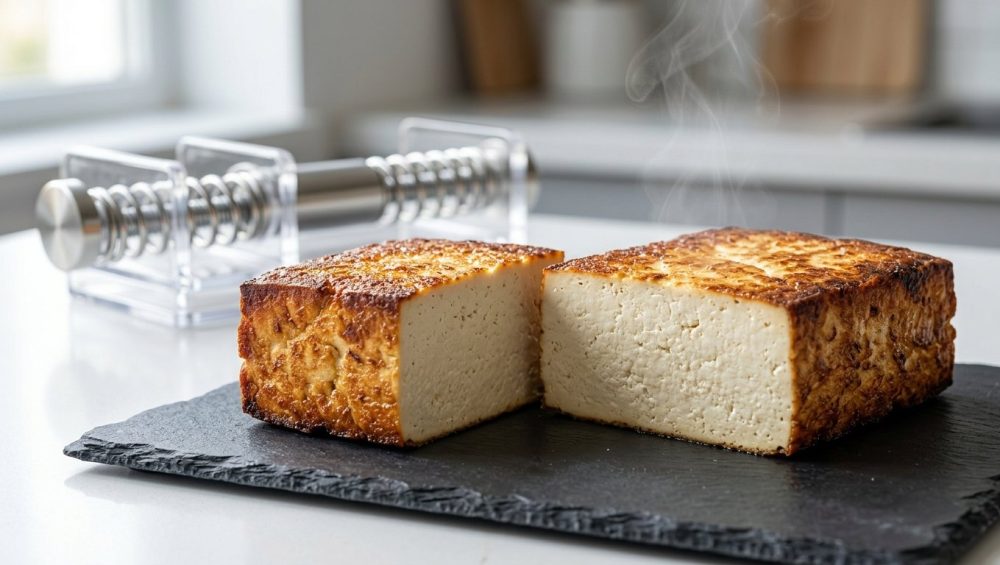
Listen, we need to have a serious, sit-down intervention about your weeknight tofu. I know exactly how this story goes, because I have lived it, and I have ruined enough dinners to write a thesis on it. You buy a beautiful block of extra-firm tofu, envisioning a platter of golden, shatteringly crisp, restaurant-quality cubes. You heat up your skillet, toss the tofu in, and instead of a satisfying, aggressive sizzle, you are met with a pathetic hiss.
Within minutes, your pan is flooded with a murky, chalky liquid. The tofu is actively boiling in its own juices. You try to flip it, but the delicate crust you prayed for has permanently glued itself to the metal. You scrape it off, resulting in a mangled, pale, spongy mess that tastes like disappointment and wet cardboard. If you constantly find that your tofu always sticks to the pan and refuses to crisp up, I am here to tell you that it is absolutely not your fault. You are not a bad cook; you are simply losing a battle against thermodynamics and material science.
The culinary industry is full of pretentious chef-speak that tells you to “cook with your heart” or “feel the heat of the pan.” I have zero patience for that fluff. We do not cook with our hearts; we cook with applied physics. And the fundamental law of physics dictating your tofu’s failure is that you cannot sear water. If you want to transform a block of coagulated soy milk into a crispy, flavor-packed masterpiece on a busy Tuesday night, you need to understand the porous microstructure of the ingredient, the thermal dynamics of the Maillard reaction, and why an archaic stack of cookbooks is ruining your dinner.
It is time to ditch the culinary superstitions and embrace the absolute genius of a spring-loaded tofu press. Let us deeply analyze exactly why your tofu is currently a sad, wet sponge, and how a simple, scientifically sound tool will permanently revolutionize your plant-based cooking.
The Anatomy of a Kitchen Disaster: Why Your Tofu is Currently a Sad, Wet Sponge
To understand why tofu behaves the way it does in a hot skillet, we have to put on our lab coats and look at it on a microscopic level. Tofu is not just a solid, uniform block of vegetable matter. It is a highly complex, porous network known as a soy protein matrix.
When traditional tofu is manufactured, fresh soy milk is heated and treated with natural coagulants. The most common coagulants used in commercial extra-firm tofu are calcium sulfate (gypsum) or magnesium chloride (nigari). When these salts are introduced to the warm soy milk, they cause the soy proteins (specifically glycinin and beta-conglycinin) to denature, unfold, and bond together. This chemical reaction creates a three-dimensional, cross-linked web.
However, this web is not completely solid. It is essentially a microscopic sponge. As the proteins bond, they trap massive amounts of water inside the matrix. In fact, even a block of commercially pressed “extra-firm” tofu is still composed of roughly 80 to 85 percent water by weight. The calcium sulfate creates relatively large, coarse pores that are incredibly efficient at holding onto intracellular moisture.
This high water-holding capacity (WHC) is fantastic for keeping the tofu fresh and structurally sound while it sits in a plastic tub on a supermarket shelf. But the moment you take it out of the package, that trapped water becomes your greatest enemy. As long as those microscopic pockets are flooded with moisture, there is absolutely no room for anything else to enter. This is the exact scientific reason why your tofu doesn’t absorb flavor when you try to marinate it straight out of the package. You are essentially trying to pour water into a glass that is already completely full.
More importantly, that trapped water is the primary culprit behind your lack of a crispy crust. To understand why, we have to look at the thermal mechanics of pan-frying.
The Thermodynamics of Pan-Frying (Or Why Water is the Enemy of Flavor)
If you want to cook like an expert without spending a fortune on culinary school, you only need to master one scientific concept: The Maillard reaction.
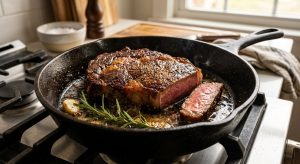
The Maillard reaction is a complex cascade of chemical reactions between amino acids (which are abundant in soy protein) and reducing sugars. When subjected to high heat, these compounds rearrange themselves into hundreds of brand-new, incredibly potent flavor molecules—think pyrazines, furans, and thiophenes. This is the exact reaction that gives a seared steak its savory crust, turns pale dough into golden-brown bread, and makes roasted coffee smell divine.
Here is the catch, and it is the single most important rule in your kitchen: The Maillard reaction does not occur in any meaningful way until the surface temperature of your food reaches between 285°F and 320°F (140°C to 160°C).
Now, let us look at water. At standard atmospheric pressure, water boils and turns into steam at exactly 212°F (100°C). Because of water’s incredibly high specific heat capacity and its latent heat of vaporization, it acts as a thermal thermal barrier. As long as there is liquid water present on or just below the surface of your food, the temperature of that surface is physically capped at 212°F. It cannot and will not get hotter until every single drop of water has evaporated.
When you toss an unpressed block of tofu into a hot skillet, the heat from the pan immediately transfers to the water trapped inside the soy protein matrix. The water rapidly heats up and turns into steam. That steam violently escapes, flooding the bottom of your pan. Instead of searing in hot oil at 350°F, your tofu is now gently simmering in a shallow pool of its own 212°F juices. You are not pan-frying; you are effectively poaching.
Because the surface temperature is capped at the boiling point of water, the Maillard reaction is completely halted. You will never achieve that 285°F threshold. The crust will never form. To make matters worse, as the proteins heat up and denature further, they become incredibly sticky, eagerly bonding to the microscopic pores of your cookware. (This is why mastering the water drop test is so vital for your stainless steel skillets, but even that won’t save you if your food is a waterlogged sponge).
The physics are undeniable. If you want crispy tofu, you must aggressively evict the water from the protein matrix before the heat is applied.
The Archaic “Cookbook and Paper Towel” Method: A Brutal Takedown
If you Google how to press tofu, you will inevitably stumble upon thousands of blogs enthusiastically recommending the “cookbook method.” The instructions are always the same: Wrap the tofu in half a roll of paper towels, put it on a plate, place a cutting board on top, and balance a heavy cast-iron skillet or a stack of college textbooks on the cutting board. Let it sit for an hour.
As a busy professional who values efficiency, safety, and actual results, I absolutely despise this method. It is archaic, it is messy, and fundamentally, it is a mechanical failure.
First, let us talk about weight distribution. A stack of books or a skillet does not apply perfectly even, vertical pressure. Because a block of tofu is rarely perfectly level, the heavy objects on top will inevitably lean to one side. This uneven weight distribution causes the tofu to compress asymmetrically. You end up with a wedge-shaped block that is squished flat on one side and completely unpressed on the other.
Secondly, the “cookbook method” relies on static, dead weight. When you first place a five-pound book on the tofu, the force is immense. The sudden, uncalibrated pressure often exceeds the tensile strength of the soy protein matrix, causing the block to violently fracture and split down the middle. Once the matrix is cracked, the structural integrity is ruined. Your beautiful cubes will crumble into irregular, jagged crumbles the second you try to toss them in the pan.
Furthermore, as the water slowly drains out, the tofu block physically shrinks in height. Because the dead weight is just resting on top, it becomes increasingly unstable as the block compresses. I cannot tell you how many times I have walked into the kitchen to find my favorite cast-iron skillet crashed onto the countertop because the tofu shifted.
Finally, wrapping your food in bleached paper towels is not just wasteful; it is counterproductive. Paper towels have a finite absorption capacity. Once they are saturated—which happens in about three minutes—they just sit there, holding the expelled liquid directly against the tofu, allowing the sponge to slowly suck the water right back in through capillary action.
If you want to cook like a pro, you need to stop relying on precarious towers of canned beans. You need to invest in the right gear. And when it comes to the essential tools every beginner needs, a dedicated, scientifically designed tofu press is non-negotiable.
Enter the Genius of the Spring-Loaded Tofu Press
A spring-loaded tofu press is not a unitasker gadget designed to clutter your drawers; it is a precision instrument built on the principles of mechanical engineering. It solves every single problem created by the cookbook method through the brilliant application of continuous, calibrated tension.
The design is brilliantly simple. It typically consists of an outer container to catch the expelled water, an inner perforated strainer basket that holds the tofu, and a lid equipped with heavy-duty tension springs and a locking mechanism. You drop the block in, snap the lid down, and walk away.
But what is actually happening inside that little plastic box is a masterclass in physics and material science.
The Physics of Constant Mechanical Pressure
The core flaw of the cookbook method is static weight. The core genius of a spring-loaded press is dynamic tension, governed by Hooke’s Law.
In physics, Hooke’s Law states that the force exerted by a spring is directly proportional to the distance it is compressed or extended ($F = -kx$). When you lock the lid of a tofu press into place, you are compressing the stainless steel springs. These springs immediately fight back, exerting a downward force onto the pressing plate.
A high-quality press is calibrated to deliver approximately 3 to 5 pounds of continuous mechanical force. This specific range is the “Goldilocks zone” for soy protein. It is enough pressure to overcome the internal capillary forces holding the water inside the microscopic pores, but it is gentle enough that it does not exceed the structural limits of the coagulated protein network.
Because the springs are applying dynamic pressure, the press adapts in real-time. As the water is expelled through the perforated basket, the tofu block shrinks in height. If you were using a dead weight, the pressure dynamics would become unstable. But because the springs are pushing down, they continuously expand to fill the void, maintaining a constant, relentless pressure on the block from the first minute to the thirtieth minute.
This gradual, continuous force ensures that the water is squeezed out evenly, from the very center of the block out to the edges, without ever fracturing the delicate matrix. You are left with a perfectly intact, densely packed brick of soy protein that is structurally sound enough to be thinly sliced, aggressively tossed in a wok, or skewered for the grill.
Material Science: Why Build Quality Actually Matters
I have a very strict, uncompromising rule in my kitchen: The “No-Go” Rule on toxic gear. I absolutely refuse to use cheap, degrading plastics, peeling non-stick coatings, or mystery metals that leach chemicals into my food. When it comes to banishing toxic kitchen gear, you have to be highly discerning about the tools you purchase.
Because a tofu press is actively squeezing liquid out of your food under pressure, the materials it is constructed from are incredibly important. The market is currently flooded with incredibly cheap, poorly manufactured knockoffs. Do not buy them.
A premium spring-loaded press must be constructed from highly durable, BPA-free ABS (Acrylonitrile Butadiene Styrene) plastic, or a similarly robust, food-safe polymer. ABS is prized for its high tensile strength and impact resistance. It will not warp under the constant tension of the springs, and more importantly, it will not leach endocrine-disrupting bisphenols into your food when exposed to the slightly acidic nature of soy whey.
Equally critical is the metallurgy of the springs themselves. They must be made from high-grade, 304 or 316 stainless steel. Tofu whey contains salts and organic acids. If a manufacturer cheaped out and used standard carbon steel springs with a flimsy chrome plating, the plating will inevitably chip. The moment that happens, the acidic whey will attack the carbon steel, causing it to rapidly oxidize and rust. You will end up with toxic, orange rust water dripping directly into your food.
Furthermore, you want a press that is entirely dishwasher safe. Just as you eventually learn silicone spatulas taste like soap if you buy the cheap filler-loaded ones, you will quickly learn that a cheap press will crack and rust after two cycles in the dishwasher. Invest in a high-quality, BPA-free, stainless-steel-sprung press. It will cost you twenty-five dollars, it will last a decade, and it will pay for itself in saved paper towels within a month.
The Microstructural Transformation: From Sponge to Steak
So, what actually happens to the tofu once you have subjected it to 30 minutes of relentless, spring-loaded pressure? The transformation is fundamental.
As the 3 to 5 pounds of force compresses the block, the microscopic, water-filled pores created by the calcium sulfate coagulant are forced to collapse. The intracellular water is violently expelled, dripping down through the perforated basket and safely away from the tofu.
Because the pressure was applied gradually via springs, the protein strands themselves are not broken; they are simply compacted. The soy protein matrix becomes incredibly dense. This dramatically increases the structural integrity of the block, giving it a meaty, satisfying chew that mimics the mouthfeel of animal proteins.
But the real magic happens when you introduce flavor. By mechanically forcing the water out of the pores, you have effectively created a vacuum. The matrix is now empty, dry, and desperate for moisture. If you take this densely pressed block, cut it into cubes, and submerge it in a high-impact marinade—say, soy sauce, rice vinegar, sesame oil, and grated ginger—the empty pores will aggressively suck the liquid deep into the center of the cube via capillary action.
(Pro-Tip for the weekend culinary hobbyist: If you want to take this texture to the absolute extreme, try freezing it first right in the package. Freezing causes the water inside the tofu to crystallize and expand, stretching the protein matrix into massive, cavernous pockets. When you thaw it and then put it in your spring-loaded press, the water drains out, leaving behind a wildly porous, incredibly chewy, sponge-like structure that absorbs three times as much marinade.)
Whether you freeze it or just press it fresh, the removal of water is the ultimate key to unlocking flavor and, crucially, unlocking the Maillard reaction.
The Ultimate Blueprint for Restaurant-Quality Crispy Tofu
Now that you understand the thermodynamics, the material science, and the mechanical engineering, it is time to put it all together. Here is my definitive, no-nonsense blueprint for achieving mind-blowing, shatteringly crispy tofu on a hectic weeknight.
Step 1: The Mechanical Press (Time: 15 to 30 minutes)
Remove your extra-firm tofu from the package and drain the excess liquid. Place the block into the strainer basket of your spring-loaded press. Lock the lid down. You will immediately see water begin to pool in the bottom catch-tray. Leave it on the counter for at least 15 minutes, or put it in the fridge for up to a few hours if you are prepping ahead.
Step 2: The Starch Coating (The Crisp Catalyst)
Unlock the press and remove your dense, dry block of tofu. Cut it into uniform cubes (about 3/4 of an inch). Because the surface is now dry, we need to create a starchy batter that will rapidly dehydrate and fry in the pan.
Toss the cubes in a bowl with a tablespoon of soy sauce and a teaspoon of neutral oil. This acts as a binder. Next, sprinkle over 2 tablespoons of cornstarch, potato starch, or arrowroot powder. Toss vigorously until every cube is coated in a dry, white, powdery layer. Starch is composed of amylose and amylopectin, which gelatinize and then aggressively dehydrate when exposed to hot oil, forming a glass-like, crispy shell.
Step 3: The Thermodynamic Sear
Heat a heavy-bottomed skillet (carbon steel or cast iron is ideal) over medium-high heat. Let the dry pan get hot first. Add 2 tablespoons of a high-smoke-point oil (like avocado or grapeseed oil). Do not use an aerosol spray; nothing is faster at ruining your nonstick pans or leaving sticky polymerized residues on your carbon steel than commercial cooking sprays.
Wait until the oil is shimmering and just barely beginning to smoke. This ensures the pan is well above the 285°F Maillard reaction threshold.
Step 4: The Sizzle and Spacing
Carefully add the tofu cubes to the pan. Do not crowd them. If the cubes are touching, they will trap steam between them, lowering the ambient temperature and preventing a crust from forming.
Because you used a spring-loaded press, there is no excess water to leak out and drop the pan’s temperature. The hot oil immediately attacks the starch coating. The Maillard reaction kicks into high gear. You will hear an aggressive, satisfying crackle.
Let the cubes sit, completely undisturbed, for 3 to 4 minutes. If you try to move them too early, you will tear the delicate crust. Once the bottom is a deep, golden brown, flip them.
Step 5: The Flavor Finish
Once the tofu is crispy on all sides, remove it from the pan. Turn the heat down to low. This is the perfect time to build your sauce by blooming in oil some minced garlic, ginger, and red pepper flakes for 30 seconds, then adding your liquid glaze (soy sauce, maple syrup, rice vinegar). Toss the crispy tofu back in for exactly 15 seconds to coat it in the glaze, then immediately remove it from the heat so the crust doesn’t get soggy.
Serve it immediately, garnished with scallions you freshly sliced (and please, make sure you aren’t dulling your knife on those terrible bamboo cutting boards).
Conclusion: Stop Settling for Mediocrity
You do not need a culinary degree to make incredible, restaurant-quality food at home. You just need to stop fighting against the laws of physics and start equipping your kitchen with tools that actually work.
Soggy, flavorless tofu is not a foregone conclusion; it is simply a symptom of trapped intracellular moisture and capped surface temperatures. By investing in a high-quality, BPA-free, spring-loaded tofu press, you are applying the brilliant mechanics of Hooke’s Law to effortlessly expel water, alter the protein microstructure, and unlock the thermal threshold required for the Maillard reaction.
Stop wasting rolls of paper towels. Stop balancing heavy cast-iron skillets on top of your dinner. Stop accepting mediocre, steamed soy cubes. Embrace the science, buy the press, and go make the crispiest, most aggressively flavorful tofu of your life. You’ve got this.