Listen to me closely, because we are about to solve one of the most maddening, persistent, and universally despised culinary tragedies in the modern home kitchen. We are going to talk about eggplant.
If you are like most weekend culinary hobbyists, your relationship with this beautiful, glossy purple vegetable (which is technically a berry, but we will get to that nerdery in a minute) is fraught with disappointment. You buy a gorgeous, firm eggplant at the farmer’s market with visions of silky, caramelized perfection dancing in your head. You bring it home, chop it up, and toss it into a hot skillet with a generous glug of premium olive oil.
And then, the nightmare begins.
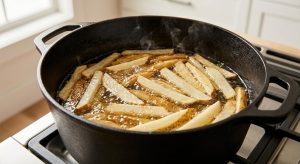
Within three seconds, the eggplant drinks every single drop of oil in the pan. The skillet is bone dry. You panic and pour in more oil. The eggplant greedily swallows that, too. You repeat this desperate cycle until you have emptied half a bottle of expensive extra virgin olive oil into the pan, only to be rewarded with a heavy, soggy, oil-logged pile of mush that tastes like a greasy kitchen sponge.
It is a culinary disaster. It makes you feel like a failure. But I am here to tell you that it is absolutely not your fault. You are not a bad cook; you are simply fighting a losing battle against plant biology. You do not need a culinary degree to fix this. You do not need to spend hours meticulously prepping your vegetables. You just need to understand the science of what is happening in your skillet, and you need to harness the secret, highly underrated power of your microwave.
The Biological Sabotage: Why Eggplant Is an Oil Sponge
To understand why your dinner is currently dripping in excess fat, we have to put on our lab coats and look at the anatomy of Solanum melongena.
Botanically speaking, the eggplant is a berry. Unlike denser vegetables such as potatoes, carrots, or even zucchini, the flesh of an eggplant—known as the mesocarp—is incredibly unique. It is composed of parenchymatous tissue that contains vast, microscopic intercellular air pockets. In fact, depending on the specific cultivar, up to 45 percent of an eggplant’s total volume is just empty air.
Think of the eggplant’s cellular structure as a highly porous, dry household sponge. When you drop raw, cubed eggplant into a hot skillet coated with oil, a fascinating and infuriating physical reaction occurs. The heat of the pan causes the air trapped inside those microscopic pockets to rapidly expand and escape. As the air evacuates the cellular structure, it creates a microscopic vacuum effect. Through the physics of capillary action, the surrounding cooking oil is violently sucked into the empty spaces left behind by the escaping air.
This is the exact biological mechanism that explains why your eggplant absorbs so much oil the second it touches the pan. It is not absorbing the oil into the actual plant cells; it is storing the oil in its massive internal air cavities. Once the oil is trapped inside those pockets, it is incredibly difficult to get it out. The result is a heavy, greasy, unappetizing texture that masks the delicate, earthy flavor of the vegetable and adds hundreds of unnecessary, heavy calories to your meal.
If we want to achieve that restaurant-quality, tender, perfectly caramelized exterior with a creamy, melt-in-your-mouth interior, we have to destroy those air pockets before the eggplant ever comes into contact with a drop of cooking oil.
The Traditional Osmotic Salting Method (And Why I Hate It for Weekdays)
If you open almost any traditional cookbook published before 2010, the authors will smugly tell you that the only way to properly prepare eggplant is to salt it.
The traditional technique, known as “degorging,” involves slicing or cubing the eggplant, tossing it with a massive amount of kosher salt, placing it in a colander in the sink, and waiting. The science behind this is perfectly sound: the sodium chloride creates an osmotic gradient. The salt draws the intracellular water out of the plant tissue. As the water is extracted, the cell walls physically collapse, crushing the air pockets and condensing the spongy texture into a denser, firmer matrix.
When you finally rinse the salt off, thoroughly dry the eggplant with paper towels, and fry it, it absorbs significantly less oil because the capillary tubes have been destroyed.
There is just one massive, glaring problem with this traditional method: Time is money, and we do not have time for this nonsense on a Tuesday night.
Osmotic salting takes a minimum of 45 to 60 minutes to achieve the desired structural collapse. If you are a busy professional trying to feed yourself or your family after a long day at the office, waiting an hour for a vegetable to “sweat” is completely out of the question. If you actually want to master simple weeknight dinners, you have to ruthlessly eliminate bottlenecks in your prep routine. Traditional salting is the ultimate bottleneck. It requires extra bowls, a colander, a mountain of paper towels, and an hour of dead time.
Furthermore, the secondary reason cookbooks tell you to salt eggplant is to “draw out the bitter juices.” Let me be brutally honest: this is outdated advice from the 1950s. Historically, older varieties of eggplant contained high levels of water-soluble alkaloids like solanine, which gave the flesh a harsh, astringent, bitter flavor. Today, modern agricultural hybridization has practically bred the bitterness out of the vegetable. Varieties you find at the grocery store today—like the standard American Globe, the slender Japanese and Chinese varieties, or the adorable striped Fairy Tale eggplants—contain solanine levels well below human sensory detection thresholds. You are no longer salting to remove bitterness; you are only salting to collapse the sponge.
And I am going to show you how to collapse that sponge in three to five minutes.
The Microwave Miracle: Rapid Internal Steaming
It is time to stop treating your microwave like a glorified Hot Pocket reheating chamber. Your microwave is a highly efficient thermodynamic tool, and it is the absolute best weapon in your arsenal for prepping eggplant.
Microwaves work through dielectric heating. The magnetron inside the appliance generates electromagnetic radiation that specifically targets and agitates polar molecules—primarily water—inside your food. Because eggplant has a naturally high moisture content (it is about 92 percent water by weight), it is the perfect candidate for this technology.
When you place cubed raw eggplant into the microwave, the electromagnetic waves penetrate the tissue and agitate the internal water molecules, generating rapid, intense friction. The water inside the eggplant quickly reaches its boiling point and turns into steam. Because this heat is being generated internally rather than being conducted from the outside in, the eggplant essentially steams itself from the inside out.
This rapid internal steaming achieves the exact same biological result as a one-hour osmotic salt bath, but it does it in a fraction of the time. The intense internal heat causes the cell walls to rupture and the spongy air pockets to completely collapse. The structure of the mesocarp shrinks, condenses, and firms up.
By the time you pull the eggplant out of the microwave, it is structurally transformed. The air pockets are gone. The capillary vacuum tubes have been destroyed. If you want to stop eating greasy eggplant for the rest of your life, you must embrace this scientifically validated prep step. When this pre-steamed, structurally condensed eggplant finally hits your hot skillet, there are no air pockets left to absorb the oil. The oil stays in the pan where it belongs, transferring heat to the surface of the vegetable and triggering the beautiful Maillard reaction that creates a caramelized, deeply savory crust.
Step-by-Step: The 5-Minute Prep Protocol
We have covered the theory. Now let’s get our hands dirty and execute this masterclass technique. It is incredibly simple, requires almost zero cleanup, and will save your weeknight cooking routine.
Step 1: The Cut
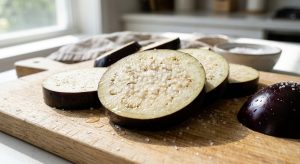
Start by breaking down your eggplant. For standard weeknight stir-fries, pasta sauces, or curries, I recommend cutting the eggplant into uniform 1-inch to 1.5-inch cubes. Uniformity is critical in cooking; if you have giant chunks and tiny slivers, they will cook at wildly different rates, leaving you with a mix of burnt crisps and raw, spongy blocks.
A quick note on knife skills: use a properly sharpened chef’s knife. If you are using a dull blade, you are not slicing the vegetable; you are crushing it, which damages the cell walls and leads to rapid enzymatic browning. This is exactly why your knives go dull so quickly if you are using terrible surfaces like glass or bamboo cutting boards. Treat your tools with respect. Once diced, you need a bench scraper to efficiently scoop up the massive volume of cubed eggplant and transfer it to your prep station without scraping your delicate knife edge across the board.
Step 2: The Microwave Setup
Take a large, microwave-safe plate (ceramic or glass) and line it with two layers of heavy-duty paper towels. The paper towels are crucial here; as the eggplant steams and collapses, it will expel a significant amount of liquid. The towels will absorb this exuded moisture, preventing the eggplant from boiling in its own juices and turning into absolute mush.
Arrange the eggplant cubes on the paper towels in a single, even layer. Do not pile them into a mountain. If you have a massive Globe eggplant, you may need to do this in two batches. Overcrowding the plate will trap too much steam and lead to uneven cooking.
Step 3: The Nuke
Place the plate in the microwave. Do not cover it. You want the steam to escape the cellular structure, not get trapped under a lid.
Microwave the eggplant on HIGH power. If you have a standard 1000-watt to 1100-watt microwave, start with 3 minutes. If you have a weaker 700-watt model, you may need 4 to 5 minutes.
You are looking for specific visual and tactile cues. The eggplant should look significantly shriveled, slightly translucent, and reduced in volume by about a third. When you carefully poke a cube, it should feel soft and pliable, with the spongy resistance completely gone. It should not be entirely cooked to the point of disintegration, but the structural collapse must be visible.
Step 4: The Squeeze (Optional but Recommended)
Carefully remove the plate from the microwave (it will be hot). You will notice that the paper towels are soaked. If you want an exceptionally crispy sear in the skillet, take another dry paper towel, place it over the top of the hot eggplant cubes, and press down very gently. You are not trying to smash them into a paste; you just want to blot away any remaining surface moisture. Surface moisture is the sworn enemy of the Maillard reaction (the chemical process responsible for browning and flavor development). The drier the surface of the eggplant, the faster and more beautifully it will sear in the pan.
Searing Like a Pro: Ditch the Toxic Gear
Now that you have perfectly prepped, structurally sound, non-spongy eggplant, it is time to cook it. But before you turn on your stove, we need to have a very serious conversation about your kitchen equipment.
I have zero patience for pretentious chef-speak, but I have even less patience for cheap, toxic kitchenware that actively ruins your food and poisons your body. If you take your beautifully prepped eggplant and throw it into a scratched, peeling, $15 non-stick Teflon pan, I will personally come to your house and confiscate your spatulas.
Searing vegetables properly requires high, sustained heat. Traditional non-stick coatings (PTFE, PFOA, and other forever chemicals in the PFAS family) begin to break down and release toxic polymer fumes at temperatures over 500°F (260°C). Furthermore, these cheap aluminum pans have terrible thermal mass; the moment you add a large volume of room-temperature eggplant, the temperature of the pan plummets, causing the vegetable to steam and boil rather than sear. You must be aggressive about banishing toxic kitchen gear from your home. It is not worth the health risks, and it objectively makes you a worse cook.
And while we are on the subject, throw away those aerosol cooking sprays. The chemical propellants and cheap emulsifiers (like soy lecithin) polymerize under heat and bond to the surface of your cookware, creating a sticky, impossible-to-remove residue that is actively ruining your nonstick pans and making your stainless steel look like a disaster zone.
To achieve a professional-level sear, you need a pan with high thermal conductivity and serious heat retention. A heavy-bottomed, fully clad tri-ply stainless steel skillet, a well-seasoned carbon steel pan, or a classic cast-iron skillet are your only acceptable options here.
If you are terrified that your food sticks to stainless steel, you just need to learn the basic thermodynamics of the Leidenfrost effect. Heat your dry stainless steel skillet over medium-high heat for about two to three minutes. Flick a tiny drop of water into the pan. If the water sizzles and evaporates instantly, the pan is too cold. If the water fractures into a dozen tiny droplets that scatter everywhere, it is too hot. But if the water drop forms a perfect, cohesive bead of mercury that glides effortlessly around the surface of the pan without evaporating, you have reached the exact thermal sweet spot (around 380°F to 400°F).
At this precise moment, add a tablespoon or two of high-smoke-point oil (like avocado oil, grapeseed oil, or clarified butter). You do not need a massive pool of oil, because your microwaved eggplant is no longer a sponge!
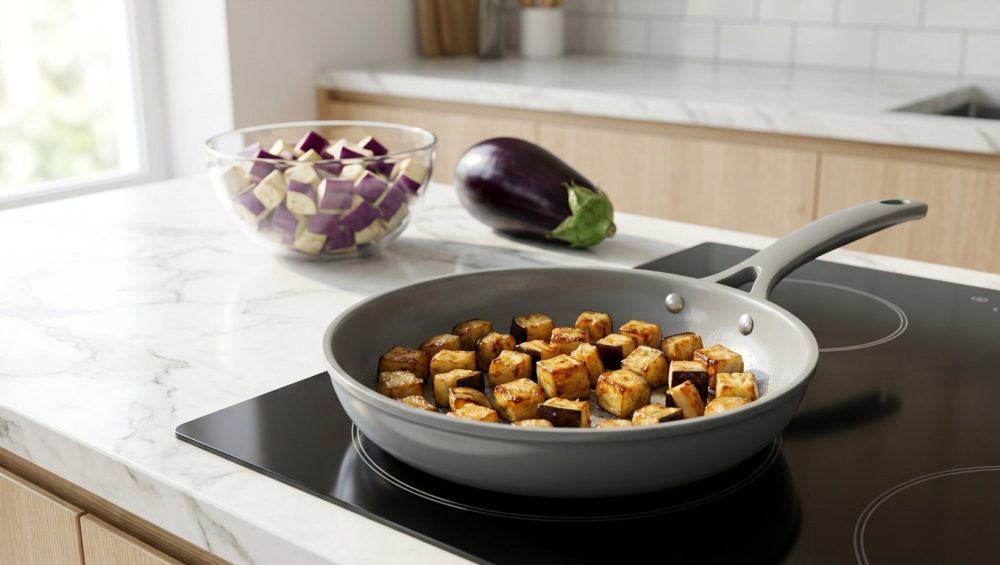
Add the eggplant cubes in a single layer. Do not overcrowd the pan. Let them sit, completely undisturbed, for at least two minutes. Do not shake the pan. Do not poke them with your tongs. Let the intense heat of the heavy skillet do its job. The natural sugars and proteins on the surface of the eggplant will undergo the Maillard reaction, creating a deeply browned, savory crust. Once the bottom is beautifully caramelized, give the pan a toss to sear the other sides.
Because you collapsed the air pockets in the microwave, the eggplant will fry beautifully in just a tablespoon of oil, yielding a texture that is impossibly creamy on the inside and perfectly roasted on the outside.
Building Flavor: What to Do With Your Perfect Eggplant
Once you master this microwave-to-skillet technique, it will completely transform your daily meals. You have unlocked the ability to cook eggplant perfectly on a Tuesday night in under 15 minutes. The culinary applications are virtually endless.
The Weeknight Pasta alla Norma:
Toss your perfectly seared eggplant cubes into a bubbling pan of high-quality marinara sauce. Because the eggplant is already fully cooked and structurally sound, it won’t disintegrate into mush when it hits the acidic tomato sauce. Let it simmer for two minutes to absorb the flavors, toss it with al dente rigatoni, and finish with a massive grating of salty ricotta salata and fresh torn basil. It is a masterpiece.
The Sichuan Garlic Stir-Fry:
Eggplant is a staple in Chinese cuisine. Sear your microwaved cubes in a carbon steel wok until blistered. Push them to the side and bloom minced garlic, ginger, scallions, and a spoonful of spicy doubanjiang (fermented chili bean paste) in the center of the wok. Toss everything together with a splash of soy sauce, black vinegar, and a pinch of sugar. The eggplant will be meltingly tender but will hold its shape perfectly, mimicking the texture of a deep-fried dish with a fraction of the fat.
The Oven Roast Upgrade:
This microwave trick isn’t just for the stovetop. If you constantly complain that your roasted vegetables are mushy, apply this hack before you bake. Toss your pre-microwaved eggplant cubes with olive oil, salt, pepper, and smoked paprika, and spread them on a blazing hot, pre-heated bare aluminum sheet pan. Roast at 425°F. Because you already removed the excess moisture and collapsed the sponge, they will roast in half the time and develop crispy, caramelized edges that are impossible to achieve with raw, water-logged eggplant.
Debunking the Great Eggplant Myths
Before I let you loose in your kitchen, we need to address a few pervasive, obnoxious myths about eggplant that continue to circulate on internet food blogs. I want you armed with facts, not folklore.
Myth 1: You Must Always Peel the Eggplant
Unless you are making a silky smooth purée like baba ganoush, leave the damn skin on. The deep purple skin of the eggplant is packed with nasunin, a powerful anthocyanin antioxidant that protects cell membranes from damage. More importantly for the home cook, the skin provides crucial structural integrity. When you cook the soft flesh of the eggplant, the skin acts like a corset, holding the chunks together so they don’t turn into baby food in your skillet. Yes, the skin on massive, overripe Globe eggplants can occasionally be tough, but if you are buying firm, medium-sized eggplants, the skin will tenderize beautifully during the cooking process.
Myth 2: Male vs. Female Eggplants
You have probably heard the old wives’ tale that eggplants have genders, and that “male” eggplants have fewer seeds and are less bitter than “female” eggplants. You are supposed to look at the dimple on the blossom end of the fruit to determine the gender. This is botanical nonsense.
Eggplants are the fruit of a plant that produces perfect flowers, meaning the flowers contain both male and female reproductive organs. The fruit itself does not have a gender. The shape of the dimple (whether it is round or dash-shaped) is merely a genetic variation in how the blossom detached from the fruit, and it has absolutely zero correlation with the number of seeds inside or the bitterness of the flesh. If you want fewer seeds, select an eggplant that feels heavy for its size and has taut, glossy skin. Dull, wrinkled skin indicates an overripe, older eggplant that will be spongy and packed with hard seeds.
Myth 3: More Oil Equals More Flavor
It is a fundamental rule of cooking that fat carries flavor. However, there is a massive difference between a vegetable being coated in flavorful fat and a vegetable being drowned in it. When an eggplant acts like a sponge and absorbs half a cup of oil, the delicate, earthy, slightly sweet flavor of the mesocarp is completely diluted and overwhelmed by the taste of the fat. By using the microwave method, you restrict the oil to the exterior of the vegetable. The fat facilitates the Maillard browning and coats the palate, but when you bite into the cube, you actually taste the pure, unadulterated flavor of the eggplant itself.
The Bottom Line
Cooking is not magic. It is applied physics, chemistry, and biology. When you understand the cellular structure of the ingredients you are working with, you stop fighting against them and start using their properties to your advantage.
You do not have to settle for greasy, heavy, oil-logged eggplant ever again. You do not have to waste an hour of your precious evening salting and pressing vegetables in the sink. By utilizing the rapid internal steaming power of your microwave, you can bypass the biological sabotage of the eggplant’s spongy mesocarp in under five minutes.
You are a capable, intelligent home cook. Arm yourself with a sharp knife, a heavy stainless steel or carbon steel skillet, and the scientific knowledge of how to manipulate moisture. Now go buy a beautiful, glossy eggplant, fire up that microwave, and make a weeknight dinner that will absolutely blow your mind. You’ve got this.