The Universal Tragedy of Greasy Eggplant
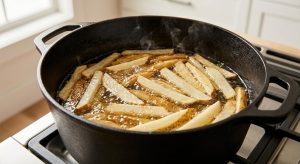
Listen up, my fellow weekend culinary warriors. We need to have a serious, intervention-level conversation about the purple elephant in the room. You have likely experienced the profound disappointment of cooking eggplant at home. You buy a gorgeous, glossy, firm aubergine from the farmer’s market, envisioning a platter of tender, caramelized, perfectly browned medallions. You slice it up, get your pan screaming hot, and pour in a generous glug of expensive extra-virgin olive oil. You drop the slices in, hear that satisfying sizzle, and then—within three seconds—every single drop of oil vanishes.
The pan is bone dry. The eggplant looks exactly the same, only now it is inexplicably heavy and sweating grease. Panic sets in. You pour in more oil. The eggplant drinks that, too. By the time you serve dinner, you aren’t eating a vegetable; you are eating an oil-logged kitchen sponge that leaves a slick of heavy grease on your palate. If you are tired of fixing rookie kitchen mistakes every time you host a dinner party, it is time to face the facts. Eggplant is ruthless.
But here is the good news: you do not need a culinary degree, a professional blast chiller, or a brigade of sous-chefs to fix this. I have set off my smoke detector enough times to know that professional-level results are absolutely achievable in a standard home kitchen. You just need to understand the science of what is actually happening in your skillet. We are going to break down exactly why this beautiful vegetable behaves like a vacuum cleaner, and I am going to give you foolproof, scientifically backed methods to stop it. No pretentious chef-speak, no fluff—just the hard culinary truth.
The Science of the Sponge: Why Your Eggplant Drinks Oil
To defeat the enemy, you must first understand the enemy. And to understand the eggplant, we have to talk about biology. Understanding the cellular structure of your ingredients is one of the most critical steps to culinary artistry.
Anatomy of a Culinary Vacuum
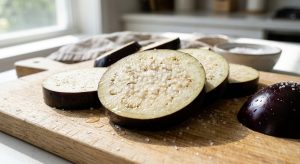
Eggplant (Solanum melongena) is technically a berry, belonging to the nightshade family. If you were to look at the raw flesh of a standard globe eggplant under a microscope, you would not see a solid mass of tissue. Instead, you would see something that looks remarkably like bubble wrap or a natural sea sponge. This specific biological structure is made up of “aerenchyma” cells.
Aerenchyma tissue is essentially a vast network of tiny cells separated by large, interconnected air pockets. In nature, these air spaces help the plant breathe and manage moisture. In your kitchen, however, these air pockets are a structural disaster waiting to happen.
When you drop a slice of raw eggplant into hot oil, a rapid chain of thermodynamic events occurs. The intense heat of the pan immediately warms the air trapped inside those tiny pockets. Basic physics tells us that hot air expands. As the air expands, it forcefully escapes the flesh of the eggplant—this is the loud hissing and sizzling sound you hear when the vegetable first hits the pan.
But nature abhors a vacuum. As the hot air rushes out, the structural integrity of those tiny air pockets briefly collapses, creating a negative pressure zone. This microscopic vacuum effect instantly sucks the surrounding cooking fat deep into the core of the flesh. Because the aerenchyma network is so vast, a single cup of raw eggplant—which naturally contains a mere 25 calories and virtually zero fat—can absorb tablespoons of heavy oil in a matter of seconds, transforming a healthy side dish into a caloric nightmare.
Know Your Ingredient: A Sassy Guide to Eggplant Varieties
Not all eggplants are created equal, and your prep method will heavily depend on which variety you brought home from the grocery store. Before you start hacking away at that beautiful purple skin, please make sure you aren’t using a dull knife, as tearing the delicate flesh will only expose more air pockets to the oil.
The Globe Eggplant (The Ultimate Sponge)
This is the massive, dark purple, tear-drop-shaped behemoth you see in every American supermarket. It has the highest ratio of aerenchyma tissue (air pockets) to flesh. It is the most notorious oil-drinker of the bunch and absolutely requires one of the aggressive prep methods listed below before cooking.
Japanese and Chinese Eggplants
These are the long, slender, lighter purple varieties. They are a home cook’s best friend. Because they have a much denser cellular structure, fewer seeds, and significantly fewer air pockets, they absorb far less oil than their globe counterparts. You can often get away with a very brief prep or even skip it entirely if you are doing a rapid, high-heat stir-fry.
Italian, Rosa Bianca, and Fairy Tale Eggplants
These heirloom varieties fall somewhere in the middle. They are slightly smaller, sweeter, and have thinner skins than the standard globe. They still have a spongy texture, but they are less bitter and slightly denser. They still benefit immensely from prep, but they won’t punish you quite as severely if you rush the process.
Method 1: The Salting Strategy (Osmosis is Your Best Friend)
If you have a weekend afternoon to dedicate to your culinary projects, the traditional salting method is the gold standard. This is the old-school technique your Italian grandmother swore by, and she was right—even if she didn’t know the exact chemistry behind it.
The Chemistry of Osmosis
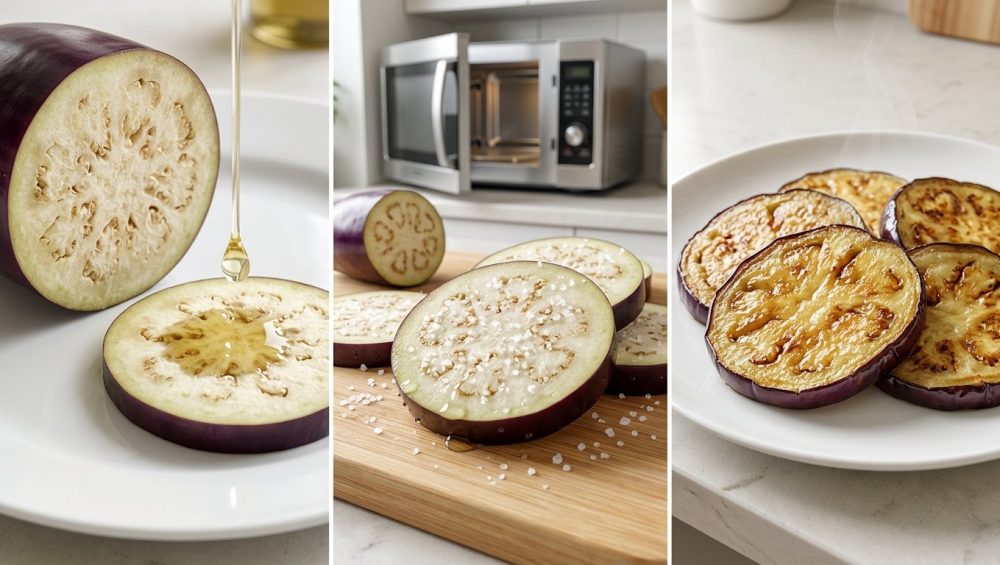
Salting eggplant works through the magical power of osmosis. When you coat the surface of the flesh with salt, you create a high-solute environment on the outside of the cell walls. To achieve equilibrium, the plant cells release their internal water. As this water is drawn to the surface, it fills the empty air pockets. As the moisture is extracted, the entire spongy structure of the eggplant physically deflates and collapses. When the air pockets are already collapsed before the eggplant hits the heat, there is no vacuum effect, and the oil stays exactly where it belongs: in the pan.
Dry Brining: The Step-by-Step Process
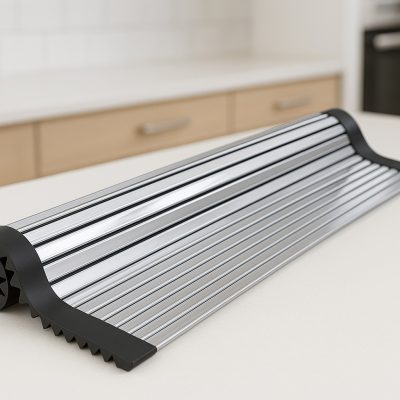
- Slice and Arrange: Cut your eggplant into your desired shapes (rounds, cubes, or planks). Lay them out in a single layer on a wire cooling rack set over a baking sheet.
- Salt Generously: Do not be shy. Sprinkle a heavy layer of kosher salt on both sides of the slices. (Never use iodized table salt for this; it tastes metallic and is too fine to control).
- Wait it Out: Walk away for at least 45 to 60 minutes. You will eventually see heavy beads of brown, bitter liquid pooling on the surface of the flesh.
- The Critical Wipe Down: Once the moisture beads up, grab your trusty metal bench scraper to transfer the slices to a cutting board. You MUST thoroughly wipe away the salt and the extruded liquid using paper towels. If you skip this step, your food will be unedibly salty, and the excess surface water will cause the hot oil in your pan to violently splatter.
A Warning on Reactive Cookware
If you choose to salt your eggplant cubes in a bowl rather than on a rack, ensure you are using glass, ceramic, or high-quality stainless steel. Never salt your vegetables in a cheap aluminum bowl unless you want to figure out why your tomato sauce tastes metallic. The salt will react with cheap metals and ruin the flavor of your dish.
Method 2: The Microwave Hack (The Weekday Lifesaver)
I am a busy professional. You are a busy professional. We both know that time is money. When you are rushing to whip up pan-seared salmon and asparagus on a busy Tuesday night, nobody has a spare hour to sit around watching an eggplant sweat on a wire rack. For weekday meals, we ruthlessly prioritize efficiency. Enter the microwave hack.
Steaming From the Inside Out
Microwaves get a bad rap in pretentious culinary circles, but they are an incredible tool for manipulating the water content of vegetables. Microwaves work by emitting electromagnetic waves that specifically target and excite water molecules, causing them to vibrate rapidly and generate heat.
When you put raw eggplant in the microwave, you are effectively steaming it from the inside out. The internal water rapidly heats up, softening the rigid cell walls and forcefully collapsing the aerenchyma air pockets in a matter of minutes. Because you aren’t adding any external water (like you would if you boiled it), the eggplant doesn’t get waterlogged. It just deflates, effectively destroying its sponge-like properties before it ever touches your skillet.
The Step-by-Step Microwave Method
- Prep the Plate: Line a large, microwave-safe plate with two layers of heavy-duty paper towels. This is non-negotiable. As the structure collapses, the eggplant will release steam and moisture; the paper towels prevent the slices from sitting in a puddle and turning to mush.
- Arrange and Nuke: Place your eggplant slices or cubes in a single layer on the paper towels. Microwave on high for 3 to 5 minutes.
- Check the Texture: You are looking for the flesh to turn slightly translucent, pliable, and dramatically shrunken. It should look a bit deflated and sad—that means it worked.
- Fry with Confidence: Transfer the pre-cooked, collapsed eggplant directly to your hot skillet. Because the air pockets are already gone, the eggplant will sear beautifully, utilizing only a fraction of the oil it normally would.
Method 3: The Liquid Soak (Fighting Fire with Water)
If you do not want to collapse the air pockets using salt or radiation, your other scientific option is to completely fill those pockets with something else so that the oil literally has no room to enter. This is the blockade method.
The Capillary Action Blockade
By submerging raw eggplant slices in a liquid—typically whole milk or heavily salted water—you utilize capillary action. The spongy aerenchyma network acts like a wick, drawing the liquid deep into the core of the vegetable. You generally need to soak the slices for about 30 to 45 minutes, keeping them submerged with a heavy plate.
Why Milk Works Wonders
While saltwater brining works well, soaking in milk is a classic Southern trick for fried eggplant. The milk fills the voids. When you take the eggplant out, pat it completely dry, and drop it into hot oil, the water content of the absorbed milk rapidly evaporates, pushing outward and keeping the oil at bay. Furthermore, the milk solids that remain trapped inside the flesh undergo the Maillard reaction, contributing to a rich, deeply savory, and slightly sweet interior texture that pairs perfectly with a crispy breadcrumb coating.
Method 4: The Protein and Starch Shield
Sometimes, the best offense is a good defense. If you are making a dish that requires a heavy fry—like a classic Eggplant Parmesan or a crispy Szechuan garlic eggplant—you can prevent oil absorption by building an impenetrable barrier around the exterior of the flesh.
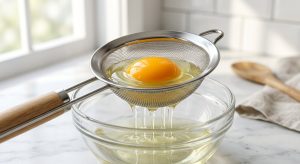
The Egg White Wash
Proteins are magnificent structural building blocks. By lightly whisking an egg white and brushing a microscopic layer over your raw eggplant slices, you create a protein shield. The instant that egg white hits the 350°F oil, the proteins denature and coagulate, forming a solid, microscopic wall that seals the surface of the eggplant. The interior flesh steams gently in its own moisture, completely protected from the surrounding fat.
The Starch Crust
If you are cubing your eggplant for a stir-fry, toss the cubes in a light dusting of cornstarch or potato starch right before they hit the pan. Just like learning how baking soda transforms stir-fries, mastering the starch barrier is a game-changer for home cooks. The starch quickly absorbs the surface moisture of the eggplant and gelatinizes the second it touches the hot oil. This creates an immediate, shatteringly crisp exterior crust. The oil physically cannot penetrate the gelatinized starch barrier, leaving the interior meltingly tender and the exterior perfectly crunchy.
The “No-Go” Rule on Toxic Gear: A Mandatory Cookware Rant
I would be doing you a massive disservice if I taught you the science of prepping eggplant but let you cook it in a garbage pan. As a culinary blogger who respects the craft, I am a massive advocate for banishing toxic kitchen gear from your home. I have absolutely zero patience for cheap, lightweight, peeling non-stick skillets.
Why Your Cheap Pan is Ruining Your Dinner
Here is the brutal truth: you cannot achieve a proper, hard sear on a vegetable in a flimsy $15 Teflon pan. Those pans lack thermal mass. When you take a room-temperature, water-dense ingredient like an eggplant and drop it into a thin aluminum pan, the temperature of the pan plummets instantly.
When the temperature drops, your oil cools down. Cold oil is the enemy of frying. Instead of instantly searing the exterior and locking out the fat, cold oil slowly seeps into the food, resulting in a greasy, soggy, unappetizing mess. Furthermore, heating cheap non-stick coatings (which often contain PFAS and other forever chemicals) to the high temperatures required for proper searing can cause the coating to degrade, releasing toxic fumes into your kitchen and flaking mystery chemicals into your food. Throw it directly into the trash.
The Superiority of Safe, High-Mass Cookware
To cook like a pro, you need cookware that holds its heat. You need heavy-clad stainless steel, thick carbon steel, or enameled cast iron. These materials possess immense thermal mass. When you add your eggplant to a pre-heated carbon steel skillet, the temperature barely drops. The oil stays hot, the sear is instantaneous, and the vegetable cooks efficiently.
If you are terrified of your food sticking to stainless steel, you simply need to learn the physics of heat management. If you properly utilize the water drop test, your stainless steel will perform beautifully, creating a natural non-stick surface via the Leidenfrost effect. And please, remember that aerosol cooking spray is the enemy of high-quality cookware. The soy lecithin in those sprays burns at low temperatures, leaving an impossible-to-remove polymerized sticky residue on your expensive pans. Use real, high-smoke-point liquid oil.
The Execution: Heat, Oil, and the Virtue of Patience
You have prepped your eggplant perfectly. You have a heavy, high-quality pan. Now, we must execute the cooking phase flawlessly. Even with the best prep in the world, poor stove management will ruin your dish.
Temperature Control and Smoke Points
You must use an oil that can handle the heat. Extra-virgin olive oil is delicious for finishing, but its lower smoke point makes it risky for high-heat searing. Opt for avocado oil, grapeseed oil, or a high-quality refined peanut oil.
Bring your pan to medium-high heat. You want the oil to shimmer and glide across the surface of the pan like water. If it is smoking violently, it is too hot and will burn the outside of the eggplant before the inside cooks. If it is completely still and cool, the eggplant will absorb it. You are aiming for a steady, aggressive sizzle the moment the food makes contact.
The “Oil Squeeze” Phenomenon
This is the most important psychological hurdle for a home cook to overcome. Even if you have salted or microwaved your eggplant, it may still absorb a small amount of oil when it first hits the pan. The pan might look a bit dry after a minute.
Do not panic. Do not reach for the oil bottle. Have patience.
As the eggplant continues to cook, the intense heat will eventually break down the cellular structure completely. When the cell walls fully collapse and the flesh turns soft and custardy, a miraculous thing happens: the eggplant will actually release the oil it initially absorbed back into the pan. If you prematurely panic and add more oil during the dry phase, you will end up with a swimming pool of grease when the vegetable finally surrenders its payload. Trust the process. Let it cook.
The Golden Rule of Crowding
Finally, respect the space in your pan. If you pile three eggplants’ worth of cubes into a single skillet, you are no longer frying; you are steaming. The moisture escaping from the vegetables will lower the pan’s temperature and trap steam, preventing the Maillard reaction (browning) from occurring. The result will be gray, mushy, unappetizing sludge. Work in batches. Give your ingredients room to breathe. The extra ten minutes it takes to cook in two batches will pay dividends in flavor and texture.
The Final Verdict: You Can Master the Eggplant
Cooking is not magic; it is applied physics and chemistry that you get to eat. The eggplant has intimidated home cooks for generations, but its spongy, oil-absorbing nature is not a curse—it is just a biological reality that requires a specific, scientific approach.
Whether you choose to honor the old-school tradition of salting on a lazy Sunday afternoon, or you leverage the raw efficiency of the microwave hack on a frantic Tuesday evening, you now possess the knowledge to conquer this vegetable. You have the tools to banish greasy, heavy, oil-logged dishes from your dining table forever.
So go forth, buy that beautiful heirloom Rosa Bianca from the market, heat up your carbon steel skillet, and show that purple sponge exactly who is boss in your kitchen. You’ve absolutely got this.