Listen to me, weekend culinary warriors. We need to have a serious intervention about your side dishes. You spend your entire Saturday carefully braising a stunning red wine short rib, meticulously reducing the pan sauce until it coats the back of a spoon, and perfectly blanching your asparagus. You are on track for a flawless, restaurant-quality dinner party. But then, you bring out the mashed potatoes. Your guests take a polite bite, and suddenly their jaws are working overtime. The purée doesn’t melt in their mouths; it clings to their teeth. It’s heavy, it’s sticky, and it has the exact structural integrity of drywall spackle.
If you’ve ever watched your side dish transform from a fluffy dream into a cohesive mass of wallpaper paste, you are not alone. It is a culinary rite of passage, but it ends today. Consider this your essential kitchen survival guide for never serving gummy spuds again. You don’t need a culinary degree from Le Cordon Bleu to make mind-blowing, cloud-like potato purée. You just need to understand some basic high school botany, respect the laws of thermodynamics, and invest in exactly one foolproof kitchen tool.
Grab a glass of wine, pull up a stool, and let’s talk about the absolute magic of the stainless steel potato ricer.
The Science of Starch: Why Your Potatoes Turned Into Spackle
Before we can fix the problem, we have to understand the crime scene. Mashed potatoes are not just a recipe; they are a delicate science experiment happening right on your stovetop. When you screw them up, it’s not because you used the wrong brand of butter. It is a mechanical failure on a microscopic level.
The Anatomy of a Potato Cell
Potatoes are essentially millions of microscopic water balloons tightly packed together. Inside these little balloons—scientifically known as amyloplasts—lives the starch.
Not all starch is created equal. Potato starch is composed of two entirely different molecules that behave like complete opposites when introduced to heat and water. First, we have amylose. Amylose is a long, straight, linear chain of glucose. When it cooks, it crystallizes readily and creates a dry, fluffy, airy texture. It is the hero of our story.
Then, we have amylopectin. Amylopectin is a highly branched, jumbled molecule. It loves to hold onto moisture, and when it is released and mixed with water, it forms a thick, viscous, cohesive gel. It is the exact same type of starch that makes sticky rice clump together. In the context of mashed potatoes, amylopectin is the villain.
Starch Gelatinization and the Danger Zone
When you drop your potatoes into water and turn on the heat, those tiny amyloplast balloons begin to absorb water and swell. As the temperature rises, the starch undergoes a process called gelatinization. The granules swell, and the linear amylose molecules begin to leach out into the surrounding water, contributing to that silky, creamy mouthfeel we all desperately want.
However, these swollen cells are incredibly fragile. They reach a critical pressure point around 190°F (88°C). At this stage, the cells are fully hydrated and ready to be gently separated. But if you push the potatoes well past 205°F (96°C) into a violent, rolling boil, or worse—if you apply aggressive mechanical force to them while they are hot—those swollen amyloplast balloons literally explode.
When the cell walls rupture, they vomit their payload of highly branched amylopectin directly into your mixing bowl. The molecules instantly cross-link, trapping water and fat in a viscous web. Congratulations, your mashed potatoes turn into glue. You have successfully manufactured industrial adhesive.
The Usual Suspects: How You’re Ruining Your Spuds
Now that we know why the glue forms, let’s look at the weapons you are using to cause this microscopic massacre. I know that time is money on a busy Tuesday night, and we all love a good shortcut. But when it comes to breaking down cooked potatoes, your favorite time-saving appliances are actually sabotaging you.
The Hand Mixer: A Weapon of Mass Destruction
I see this all the time. Home cooks boil their potatoes, drain them, throw in a cold stick of butter, and reach for the electric hand mixer. It seems logical! You want whipped potatoes, so you whip them, right? Wrong.
Taking a high-speed electric motor to delicate, swollen starch cells is a bloodbath. The metal beaters act like tiny baseball bats, violently shearing the cell walls to shreds and unleashing a torrent of sticky amylopectin. The longer you run the mixer to get rid of the lumps, the more cells you destroy, and the gummier the mixture becomes. If you want any hope of lightness, you must stop using a hand mixer on your root vegetables immediately.
The Food Processor: The Ultimate Betrayal
If the hand mixer is a baseball bat, the food processor is a wood chipper. Some pretentious recipes will tell you to purée your potatoes in a food processor for a “silky smooth” texture. Do not listen to them.
The razor-sharp blades rotating at thousands of RPMs will obliterate every single amyloplast in the bowl. This is the hidden danger of the blender and the food processor—within ten seconds of hitting the pulse button, you will have created a sticky, rubbery paste that no amount of heavy cream can save.
The Traditional Masher: The Lumpy Compromise
So, what about the old-school, zig-zag wire masher sitting in your utensil drawer? It’s not a war crime like the food processor, but it is fundamentally flawed.
When you use a traditional masher, you are pushing down, compressing, and squishing the potatoes against the bottom of the pot. To get rid of the inevitable lumps, you have to mash repeatedly. Up, down, twist, smash. Every single time you compress that mixture, you are applying friction and rupturing more starch cells. You end up playing a highly stressful game of roulette, trying to find the exact moment where the lumps are gone but the glue hasn’t fully formed yet. It is exhausting, and quite frankly, you deserve better.
Enter the Stainless Steel Potato Ricer: Your Kitchen Savior
You want restaurant-quality, cloud-like, ethereal potato purée? You need to change your mechanical approach. You need to separate the potato flesh without crushing the cells.
What Exactly is a Potato Ricer?
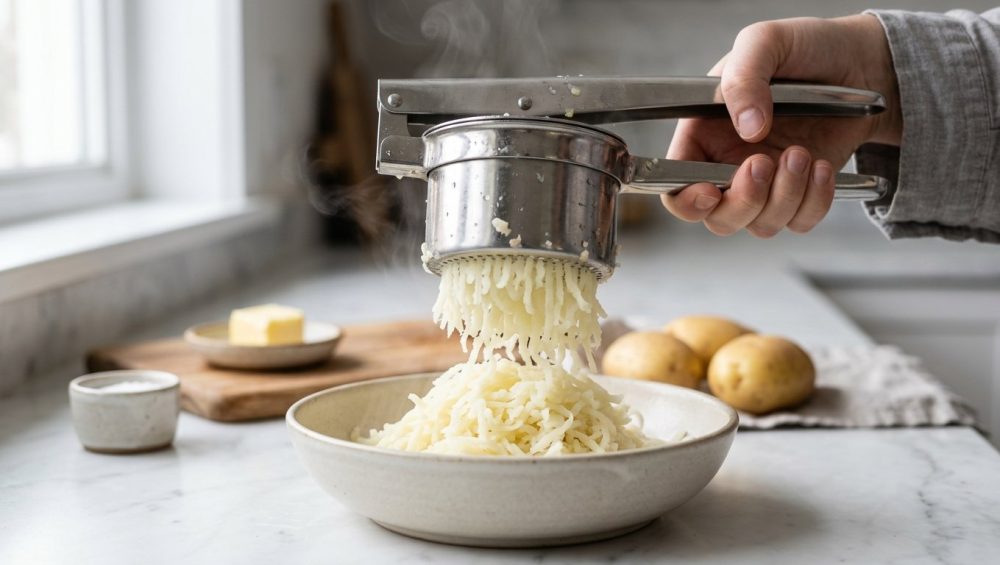
If you’ve never seen one, a potato ricer looks like a garlic press that spent the last three years lifting heavy weights at the gym. It consists of a large hopper (a perforated basket) and a flat plunger attached to two long, levered handles. You place your cooked potato chunks into the hopper, squeeze the handles together, and the potato is forced out through the tiny holes at the bottom.
The secret to fluffy mashed potatoes is literally just avoiding mechanical shear, and this tool is scientifically designed to do exactly that.
The Extrusion Magic: Minimal Cell Rupture
The magic of a potato ricer lies in the physics of extrusion. When you squeeze the handles, the potato is forced through the small perforations in a single, clean motion. It breaks the potato apart exactly once.
Because the potato is extruded into fine, thin strands (roughly the size and shape of rice grains, hence the name), the starch cells are gently separated from one another rather than being violently crushed or sheared. The vast majority of the amyloplasts remain completely intact. Furthermore, as the thin strands fall into your mixing bowl, they trap air, creating a naturally light and voluminous structure.
No friction. No repeated smashing. No ruptured cell walls. Just pure, unadulterated, fluffy perfection.
Why Material Matters: The “No-Go” Rule on Toxic Kitchen Gear
Before you run out and buy a ricer, we need to have a very serious conversation about materials. If you have read any of my previous masterclasses, you know my strict “No-Go” rule. I absolutely despise cheap, toxic kitchenware.
The Perils of Plastic and Peeling Metals
Do not, under any circumstances, buy a $9 plastic potato ricer from a discount bin. Potatoes are dense, heavy root vegetables. When you squeeze those handles, you are applying a significant amount of torque and pressure. Cheap plastic flexes and bends, which means you lose all your mechanical leverage. Worse, hot foods degrade cheap plastics over time, potentially leaching microplastics and endocrine disruptors into your beautiful side dish.
Equally offensive are the mystery-metal tools coated in cheap non-stick paints that inevitably blister and flake off into your food. We are banishing toxic kitchen gear from our homes. Period. You are an adult who cooks real food; you need real tools.
The Unbreakable Glory of Food-Grade Stainless Steel
You must buy a heavy-duty, commercial-grade, 18/10 stainless steel potato ricer. Yes, it might cost you $30 instead of $10, but it will outlive you. Food-grade stainless steel is completely non-reactive, meaning it won’t impart a metallic taste to your food, and it won’t rust after a run through the dishwasher. Most importantly, it provides the rigid, unyielding structural integrity required to force a dense tuber through a metal sieve without the handles snapping off in your hands. Buy it once, buy it right, and enjoy decades of flawless performance.
The Masterclass: Step-by-Step to Fluffy Perfection
Having the right tool is half the battle. Executing the technique flawlessly is the other half. Here is your definitive, no-nonsense guide to making the best mashed potatoes of your life.
Step 1: Choosing the Right Potato (Anatomy of a Russet vs. Yukon)
You cannot make good mashed potatoes out of the wrong raw ingredient. You need high-starch potatoes.
Russets are the undisputed kings of the fluffy mash. They have an incredibly high ratio of amylose to amylopectin. Because of this, they fall apart beautifully and absorb dairy like a sponge. Yukon Golds are the excellent medium-starch alternative; they have slightly more moisture and amylopectin, but they compensate with a naturally buttery flavor and a stunning golden color. (Pro tip: A 50/50 blend of Russets and Yukon Golds is the ultimate chef secret).
Stay far, far away from waxy potatoes like Red Bliss, New Potatoes, or Fingerlings. They are low in starch, high in moisture, and packed with amylopectin. If you try to mash them, your mashed potatoes turn gluey regardless of how gentle you are with the ricer. Save the waxy potatoes for roasting or potato salad where you actually want them to hold their shape.
Step 2: The Prep and the Boil (To Peel or Not to Peel?)
Cut your potatoes into uniform, two-inch chunks. Do not cut them too small, or they will absorb too much water and become waterlogged.
Here is a non-negotiable rule: Always start your potatoes in cold, heavily salted water. If you drop raw potatoes into boiling water, the exterior will instantly overcook and turn to mush before the dense center has a chance to soften. By starting in cold water and bringing the pot to a gentle simmer, the temperature rises evenly, ensuring the entire chunk cooks at the same rate.
Simmer them gently. Do not subject them to a violent, rolling boil, which physically batters the potatoes against each other and prematurely breaks the cell walls. Cook just until a paring knife slides into the center with zero resistance (around 195°F to 205°F internally).
Step 3: The Drying Phase (Crucial but Ignored)
This is the step 90% of home cooks skip, and it ruins their dish. When you drain the potatoes in a colander, they are still coated in surface water. If you mash them while wet, they will be watery and bland.
After draining, immediately dump the hot potatoes back into the empty, hot cooking pot. Set it over low heat for about 60 to 90 seconds. Gently shake the pot. You will see steam rising off the potatoes. You are evaporating the excess moisture. A dry potato is a thirsty potato, and a thirsty potato will absorb butter and cream, not tap water.
Step 4: Ricing Like a Pro
Set your heavy-duty stainless steel ricer over a large, warm mixing bowl. Load the hopper about three-quarters full with the hot, dry potatoes. Squeeze the handles firmly and steadily, letting the gorgeous, fluffy strands fall into the bowl.
Here is my favorite weeknight time-saving hack: You don’t actually have to peel your potatoes before boiling them! If you boil them with the skins on, the ricer will extrude the soft flesh and leave the tough skins neatly trapped behind in the hopper. You just pluck the skin out, toss it in the compost, and load the next batch. You just saved yourself 15 minutes of tedious peeling. This sheer efficiency is exactly why you need a potato ricer in your arsenal.
Step 5: The Fat Integration (Butter Before Milk!)
This is the final hurdle. The potatoes are riced, they are fluffy, and the starch cells are intact. Do not ruin it now by dumping in cold milk.
First, the temperature rule: Your dairy must be hot. Cold dairy shocks the hot starch, causing it to seize up and become grainy. Warm your cream or whole milk in a small saucepan while the potatoes boil.
Second, the order of operations: Always add your melted butter first. The fat from the butter coats the exterior of the starch granules, acting as a lubricating barrier. This barrier prevents the starches from cross-linking and forming a gluey network when the water-based milk is introduced.
Pour the melted butter over the riced potatoes and gently fold it in using a silicone spatula. Do not stir aggressively. Do not whip. Fold gently, like you are incorporating egg whites into a soufflé. Once the butter is absorbed, gradually fold in your warm milk or cream until you reach your desired consistency. Season aggressively with salt and white pepper, and serve immediately.
Advanced Ricer Hacks: Beyond the Spud
I know what you’re thinking. “Sassy Sous-Chef, I have a small kitchen. I don’t have room for a unitasker.”
I hear you. I hate unitaskers too. But the stainless steel ricer is a multi-purpose workhorse. Once you own one, you will find yourself reaching for it constantly.
Gnocchi That Actually Floats
If you want to make homemade potato gnocchi that are light, pillowy, and float gracefully to the top of the boiling water, a ricer is absolutely mandatory. Gnocchi dough requires the driest, fluffiest potato base possible. If you mash the potatoes with a traditional tool, you release too much moisture and starch, forcing you to add massive amounts of flour to the dough. Too much flour equals leaden, chewy gnocchi that sink like stones in your stomach.
Water-Free Spinach and Flawless Egg Salad
Making a spinach and artichoke dip? You know the nightmare of trying to wring out thawed frozen spinach with paper towels. It makes a massive mess and never gets fully dry. Load the thawed spinach into your ricer and squeeze. It acts as a heavy-duty press, extracting every single drop of water in seconds.
Hosting a brunch? Push peeled, hard-boiled eggs through the ricer. It creates perfectly uniform, delicate egg strands that fold into mayonnaise beautifully, giving you the lightest, most luxurious egg salad sandwich of your life.
The Hash Brown Squeeze
The secret to diner-style, shatteringly crisp hash browns is removing all the moisture from the raw, shredded potatoes before they hit the hot oil. A ricer is the ultimate tool for this. Load the raw shreds into the hopper and squeeze over the sink. The mechanical leverage forces out an astonishing amount of potato juice, leaving you with bone-dry shreds ready for the cast-iron skillet.
Troubleshooting: When Good Potatoes Go Bad
I get emails about this every Thanksgiving. “I was in a rush, I used the food processor, and now my potatoes are sticky. How do I fix them?”
Can You Save Gluey Potatoes? (A Brutally Honest Answer)
I promised you no fluff, so I am going to give it to you straight: No. You cannot save them.
Cooking is chemistry. Once you apply aggressive mechanical shear to a hot potato and rupture the amyloplasts, the amylopectin is released. The starch molecules have irreversibly cross-linked into a gel network. You cannot un-rupture a cell wall. You cannot un-ring a bell. Adding more cream won’t fix it; it will just create a thinner glue. Adding more butter will just create a greasy glue. Once your potatoes have crossed the threshold into paste territory, they are dead as a side dish.
But, because we despise food waste, you can repurpose them. Spread the gummy purée thin on a silicone baking mat and bake them low and slow to make potato crisps. Or, mix the gluey mash with an egg, a handful of flour, and some scallions, and pan-fry them into dense, crispy potato cakes. They won’t be fluffy, but the crispy exterior will hide the textural sins of the interior.
Final Thoughts: Reclaiming Your Weekend Culinary Projects
You work too hard all week to spend your precious weekend serving subpar food to the people you love. Professional-level cooking isn’t about having innate, magical talent; it is about understanding the basic physics of your ingredients and utilizing the correct tools to manipulate them.
Throw away the peeling non-stick mashers. Unplug the hand mixer when it’s time for the side dishes. Invest in a heavy-duty stainless steel ricer, respect the science of the starch cell, and watch your meals transform. Upgrade your equipment, eliminate kitchen chaos, and start cooking like the absolute boss you are. Now, go pour yourself that glass of wine—you’ve got a flawless dinner party to host.