The Great Stainless Steel Betrayal (And Why It Is Not Your Fault)
Listen, we need to have a serious, brutally honest conversation about the absolute massacre happening on your stovetop every Tuesday night. I know exactly what you are doing, because I used to do the exact same thing. You go to the butcher, you buy a beautiful, expensive, perfectly marbled cut of meat, or perhaps a delicate fillet of wild-caught fish. You drop it into your gleaming stainless steel skillet, you hear that incredibly satisfying, professional-sounding sizzle, and you feel like an absolute culinary genius.
And then, three minutes later, tragedy strikes.
You go in with your spatula to execute a graceful flip, but the protein has chemically welded itself to the metal. Panic sets in. You scrape, you pry, you curse under your breath, and eventually, you are left serving a mangled, shredded, utterly disrespectful pile of meat to your family. You then spend the next twenty minutes aggressively scrubbing the pan in the sink, wondering why you ever bothered trying to cook like a professional in the first place.
It is one of the most frustrating, demoralizing rookie kitchen mistakes in existence. This exact scenario is what drives perfectly capable, intelligent home cooks back into the welcoming, yet highly toxic, arms of cheap non-stick cookware. If you are tired of banishing toxic kitchen gear to the trash every single year when the coating inevitably starts flaking off into your scrambled eggs, you need to understand that there is a better way.
The global market for non-stick pans is staggering. In 2024 alone, an estimated 457 million non-stick pans were sold worldwide, and despite mounting health and environmental concerns, Teflon (PTFE) coated pans still accounted for roughly 60% of that total volume, representing about 274 million units. We keep buying them because we want the “easy” route. We want the shortcut. But relying on these chemical coatings is a massive mistake. At normal to high cooking temperatures—the exact temperatures required to properly sear a steak or get a crispy skin on a piece of chicken—PTFE coatings can begin to break down, releasing various gases and chemical compounds that present toxicity concerns. While the infamous PFOA has largely been phased out and replaced by chemicals like GenX, these newer alternatives are heavily suspected to carry similar toxicological profiles. Furthermore, using aerosolized cooking sprays heavily ruins nonstick pans by baking an impenetrable layer of soy lecithin onto the delicate polymer surface, rendering the pan useless in a matter of months.
As your resident culinary realist, I am here to tell you that you do not need a culinary degree to cook like a professional, and you absolutely do not need to rely on disposable, chemical-laden pans that belong in a landfill. What you actually need is a basic, working understanding of thermodynamics. By understanding the precise temperature thresholds required to create a microscopic vapor barrier, you can transform an uncoated, heirloom-quality 18/10 stainless steel skillet into a naturally non-stick workhorse. It is not magic; it is physics.
The Science of the Stick: What Is Actually Happening in That Pan?
To fix the problem, we first have to understand why the problem exists. Why does food stick to stainless steel in the first place? It all comes down to microscopic topography and molecular chemistry.
To the naked eye, your stainless steel skillet looks perfectly smooth, polished, and impenetrable. However, if you were to look at that exact same surface under a powerful microscope, it would look like a rugged mountain range. The surface of the steel is completely covered in microscopic peaks, valleys, crevices, and pores.
When you place a stainless steel pan on the stove and apply heat, the metal undergoes thermal expansion. The steel expands, and those microscopic pores and scratches actually widen and constrict. Now, imagine taking a cold, protein-rich food item—like a chicken breast or a cracked egg—and dropping it directly onto that expanding, jagged metal surface.
This is where the chemistry turns against you. Heat causes proteins to denature. The complex, tightly wound three-dimensional structures of the amino acids begin to unfold and unravel. As these weaker amino acids break apart, they expose highly reactive side chains and carboxylate groups. These exposed protein molecules desperately want to bond with something, and they find the perfect partner in the iron and chromium atoms present in your stainless steel pan.
The proteins literally sink into the microscopic valleys of the metal and form strong chemical bonds—specifically covalent bonds and van der Waals forces—directly with the pan. The pan essentially grabs the food, and as the metal continues to heat and constrict, it locks those proteins into place. This chemical reaction is the exact reason why your chicken breast turns out dry and torn to shreds; you are forcibly ripping the meat away from a chemical weld, leaving the surface of the protein permanently glued to the steel.
This phenomenon is also why your fish always sticks so aggressively. Delicate proteins denature incredibly fast, meaning they bond to the metal almost instantaneously if the conditions are not perfectly controlled. To prevent this chemical bonding, we have to introduce a physical barrier between the food and the metal. We have to prevent them from ever touching in the first place.
Enter the Leidenfrost Effect: Your Kitchen’s Best Kept Scientific Secret
To stop the sticking, we are going to rely on a scientific phenomenon that was documented over two and a half centuries ago. In 1756, a German physician and theologian named Johann Gottlob Leidenfrost published a manuscript entitled De Aquae Communis Nonnullis Qualitatibus Tractatus (A Tract About Some Qualities of Common Water). In this text, he described a fascinating physical reaction that occurs when water interacts with extreme heat.
The Leidenfrost effect, also known in physics as film boiling, occurs when a liquid comes into direct contact with a solid surface that is significantly hotter than the liquid’s own boiling point. Normally, when water hits a hot surface, it simply boils, sizzles, and evaporates into steam. However, if the surface is hot enough—reaching what is known as the Leidenfrost point—something entirely different happens.
Because the temperature differential is so extreme, the very bottom layer of the liquid droplet vaporizes the exact millisecond it touches the metal. This instantaneous vaporization creates a microscopic, highly pressurized cushion of steam—typically about 50 microns thick, or roughly half the width of a human hair—that sits directly underneath the rest of the water droplet. This vapor layer acts as a physical, insulating barrier. It suspends the droplet in mid-air, preventing the liquid from actually making physical contact with the hot surface. Because the droplet is levitating on a cushion of its own steam, it experiences almost zero friction, allowing it to skitter, dance, and glide effortlessly across the surface of the pan.
So, how does an 18th-century physics discovery about levitating water droplets help you sear a piece of meat on a Tuesday night?
Think about the composition of the food you cook. Raw meat, poultry, fish, and vegetables are all predominantly made up of water. When you place a piece of food into a stainless steel pan that has been properly preheated to the Leidenfrost point, the exact same physical phenomenon occurs. The moisture on the very surface of the food instantly vaporizes upon contact with the extreme heat. This creates a microscopic, pressurized cushion of steam directly underneath the food, physically lifting the proteins up and away from the jagged, reactive metal of the pan.
If the food is levitating on a vapor barrier, the unraveling amino acids cannot sink into the microscopic pores of the steel. If they cannot reach the steel, they cannot form covalent bonds with the iron atoms. If they cannot bond, they cannot stick. You are essentially turning the water content of your own food into a temporary, completely natural, 100% non-toxic non-stick coating.
The Masterclass: How to Execute the Water Drop Test Perfectly
Understanding the science is one thing, but executing it flawlessly on a busy weeknight is another. The bridge between theory and perfectly pan-seared salmon is a technique known as the Water Drop Test. This is the only foolproof, thermometer-free method to guarantee your stainless steel skillet has reached the exact thermal threshold required for the Leidenfrost effect to occur.
Here is the exact, step-by-step masterclass on how to do it right. Do not skip a single step, and do not rush the process. Patience is an active ingredient in this recipe.
Step 1: The Naked Preheat
Place your impeccably clean, completely dry stainless steel skillet on the stove. Turn the burner to medium heat. Do not add any oil, butter, or fat to the pan yet. This is a crucial rule: you must preheat the pan completely naked.
Do not blast the heat to high in an attempt to save time. Time is money, yes, but thermal shock will warp your expensive cookware, permanently ruining its ability to sit flat on the burner. Furthermore, stainless steel is a relatively poor conductor of heat on its own, which is why high-quality pans are “clad” with a highly conductive core of aluminum or copper. Heating the pan gradually on medium allows the thermal energy to distribute evenly across the entire surface area, eliminating hot and cold spots. Let the pan heat undisturbed for about two to three minutes.
Step 2: The Flick and Assess
After a few minutes, it is time to test the thermodynamics of your cooking surface. Wet your fingers under the kitchen faucet and flick a few small drops of water directly into the center of the dry pan. You must pay very close attention to exactly how the water behaves the millisecond it hits the metal, because the water is going to tell you exactly what temperature the pan is currently sitting at.
Step 3: The Mercury Ball Stage (The Sweet Spot)
When you flick the water into the pan, one of three things will happen. We will cover the failure states in the next section, but right now, we are looking for perfection.
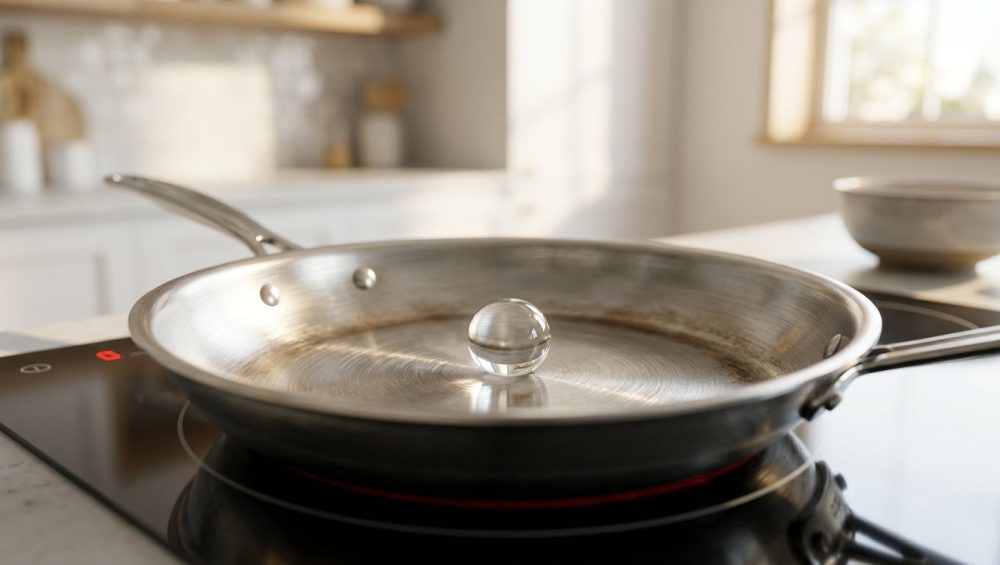
If the pan has successfully reached the Leidenfrost point, the water droplets will not evaporate. Instead, they will instantly pull together to form a perfect, shimmering sphere that looks exactly like a bead of liquid mercury. Because this sphere is levitating on a 50-micron-thick cushion of its own steam, it will glide wildly and frictionlessly around the pan. It will not sizzle aggressively; it will quietly dance.
When you see this mercury ball gliding around your skillet, you have achieved thermal perfection. The pan is ready.
Step 4: The Oil Phase
Once you have confirmed the Leidenfrost effect is active, take a dry paper towel and quickly wipe the dancing water bead out of the pan (or simply let it evaporate, which will take a few seconds). Now, and only now, do you add your cooking oil.
Pour in just enough high-smoke-point oil (like avocado oil, grapeseed oil, or clarified butter) to lightly coat the bottom of the pan. Because the pan is already incredibly hot, the cold oil will heat up almost instantly. As oil heats, its viscosity drops dramatically. The oil will become incredibly thin and fluid, shimmering like a mirror.
This thin, hot oil immediately flows into all of the microscopic valleys, pores, and crevices on the surface of the stainless steel, filling them in and creating a smooth, temporary patina. You now have a two-part defense system: the physical barrier of the thinned hot oil, and the thermodynamic vapor barrier of the Leidenfrost effect.
Wait about ten seconds for the oil to shimmer—but do not let it reach its smoke point—and then immediately add your protein. You will hear a violent, aggressive sizzle. That is the sound of water vaporizing and creating your non-stick steam cushion. Leave the food alone, let the Maillard reaction do its job, and watch in amazement as your food releases effortlessly a few minutes later.
Troubleshooting the Mercury Ball: When Things Go Horribly Wrong
In the real world, things do not always go perfectly on the first try. If your steak won’t sear properly or your food is still tearing, it means you misread the water drop test. Here is how to diagnose your thermodynamic failures.
The Pan is Too Cold (The Sad Puddle)
If you flick water into the pan and it immediately flattens out into a puddle, bubbles aggressively, sizzles loudly, and quickly evaporates into steam, your pan is too cold. It has not yet reached the Leidenfrost point. The water is making direct physical contact with the metal and simply boiling away.
If you get impatient and add your oil and food at this stage, the food will sink directly into the microscopic pores of the steel. The steam cushion will not form, the proteins will denature and bond to the iron, and you will spend your evening scraping burnt chicken off the bottom of your skillet. Wipe the pan dry, wait another sixty seconds, and test it again.
The Pan is Too Hot (The Angry Splatter)
If you flick water into the pan and it instantly explodes into dozens of tiny, aggressive micro-beads that shoot in every direction and vaporize in a fraction of a second, your pan is entirely too hot. You have massively overshot the Leidenfrost point.
If you add oil to a pan this hot, the oil will immediately hit its smoke point. It will thermally crack, degrade, and polymerize into a sticky, impossible-to-remove yellow varnish. Your kitchen will fill with acrid smoke, and any food you add will instantly burn on the outside while remaining raw on the inside. If you hit this stage, turn the burner off, pull the pan off the heat for two minutes to let the thermal mass cool down, and start the test over.
The “I Added the Oil Too Soon” Disaster
This is the most common mistake home cooks make. They place a cold pan on the stove, pour the oil in immediately, and heat them both up together. This is a catastrophic error in stainless steel cooking.
When oil is added to a cold pan and heated slowly over several minutes, it passes through a prolonged temperature range where it actually begins to break down and bond to the surface of the metal, rather than acting as a barrier. By the time the pan is hot enough to cook your food, the oil has already degraded, becoming sticky and gummy. Always heat the dry pan first, verify the temperature with the water drop test, and then add the oil right before the food.
The Temperature Sweet Spot: Let’s Talk Hard Data
For my fellow culinary nerds who want the exact numbers, let’s break down the precise thermodynamics of the Leidenfrost point in a standard home kitchen.
We know that water boils at 100°C (212°F). The Leidenfrost effect—where the vapor barrier fully forms and supports the droplet—begins to occur when the surface temperature of the stainless steel reaches approximately 193°C (379°F).
However, aiming for exactly 193°C is a massive tactical error. Why? Because of thermal mass.
When you take a cold, eight-ounce chicken breast out of the refrigerator and drop it into a 193°C pan, the physical mass and the cold temperature of the meat instantly absorb a massive amount of thermal energy from the steel. The temperature of the pan will rapidly plummet. If the pan drops below 193°C, the vapor barrier instantly collapses. The water in the food stops vaporizing fast enough to lift the protein, the meat makes direct contact with the metal, and the chemical bonding process begins. Suddenly, your food is stuck.
To prevent this, you need a thermal buffer. Extensive testing shows that the ideal target temperature for preheating a stainless steel pan is actually between 220°C and 225°C (roughly 428°F to 437°F).
At 225°C, the Leidenfrost effect is incredibly robust. More importantly, when you drop that cold piece of meat into the pan, the temperature will drop, but it will only drop down to around 200°C. Because you built in a thermal buffer, the pan remains above the critical 193°C Leidenfrost threshold the entire time. The vapor barrier remains intact, the food continues to levitate on its micro-cushion of steam, and nothing sticks.
Do not trust the dial on your stove to hit this temperature. Every stove is calibrated differently, and environmental factors play a huge role. Do not let your fresh herbs turn to slime on the cutting board while you guess what “Medium-High” actually means. Rely strictly on the visual feedback of the dancing water droplet. It is the only thermometer you will ever need.
Beyond the Sear: Essential Stainless Steel Maintenance
Mastering the Leidenfrost effect will solve 95% of your sticking issues, but there are a few other essential rules you must follow to maintain your sanity and your cookware.
First and foremost: patience is an ingredient. Even with a perfect vapor barrier and perfectly thinned hot oil, there will be a brief period where the food feels slightly grabbed by the pan. Do not force it. As the food cooks, the extreme heat triggers the Maillard reaction—the complex chemical reaction between amino acids and reducing sugars that gives browned food its distinctive flavor. As this crust forms, the proteins undergo a structural change that naturally releases them from the metal. If you try to flip a piece of meat and you feel resistance, stop pulling. The pan will release the food when it is ready.
Secondly, embrace the fond. Even with perfect technique, you will likely have a few browned, caramelized bits of protein and sugar stuck to the bottom of the pan after you remove your meat. This is not a failure; this is culinary gold. This layer is called the fond, and it is the foundation of every great pan sauce in traditional French cooking.
Instead of throwing the pan in the sink and scrubbing it, you should be turning burnt bits into sauce by deglazing. While the pan is still hot, pour in a splash of wine, chicken stock, or even water. The liquid will boil instantly, releasing a massive amount of steam that acts like a pressure washer, lifting the caramelized bits right off the metal. Scrape the bottom gently with a wooden spoon, let the liquid reduce, swirl in a knob of cold butter, and you have a professional-grade sauce in under three minutes.
Finally, let’s talk about cleaning. Never, under any circumstances, take a screaming hot stainless steel pan and throw it directly under a stream of cold sink water. The rapid change in temperature causes thermal shock, which will violently warp the metal. A warped pan will never sit flat on your stove again, which means your cooking oil will pool on one side, and your heat distribution will be permanently ruined. Let the pan cool to room temperature before washing.
If you find yourself aggressively scraping the pan with metal utensils, you are actively dulling your knives and damaging the surface of your cookware. If you develop a stubborn, cloudy rainbow stain on the inside of your skillet, do not panic. This is known as heat tint, and it is simply a harmless thickening of the chromium oxide layer on the surface of the steel. A quick scrub with a powdered oxalic acid cleanser, like Bar Keepers Friend, will strip the oxidation away and restore your pan to a mirror finish in seconds. Maintaining a rust-free skillet and a perfectly polished stainless steel pan is entirely about using the right chemical tools, not brute force.
Ditching the Toxic Gear for Good
We have normalized a culture of disposable kitchenware, and it is time to stop. Buying a cheap non-stick pan, scratching the PTFE coating within six months, ingesting microplastics with your morning eggs, and throwing the pan in the garbage is a vicious, expensive cycle.
You are a home cook. You are not running the line at a high-volume diner, frantically flipping three hundred pancakes an hour. You have the time to preheat a pan properly. You have the intelligence to understand basic thermodynamics.
Investing in a high-quality, fully clad stainless steel skillet is an investment in your health, your culinary skills, and your sanity. Unlike non-stick coatings that degrade with every use, high-quality 18/10 stainless steel is virtually indestructible. It actually features a self-healing passivation layer; when the chromium in the steel is exposed to oxygen, it forms a microscopic, invisible shield that protects the iron underneath from rusting. If you scratch it, the chromium simply reacts with the air and heals the microscopic wound instantly. It is quite literally a superhero metal.
Final Thoughts: Reclaiming Your Cooking Confidence
Cooking should not be a battle of wills between you and your equipment. When food sticks, tears, and burns, it is incredibly easy to blame yourself and assume you simply lack the “magic touch” that professional chefs possess.
Let me assure you: professional chefs do not have magic powers. They have technique. They understand that cooking is just applied physics and chemistry.
The next time you pull a beautiful piece of protein out of the fridge, do not reach for the scratched, peeling non-stick pan hiding in the back of your cabinet. Grab your stainless steel skillet. Put it on the stove. Turn the heat to medium. Wait patiently. Flick a drop of water into the center, and watch for the mercury ball.
Once you see that water droplet levitating, dancing, and gliding across the surface of the metal, you will know exactly what to do. You will add your oil, you will add your food, and you will finally experience the effortless, non-stick perfection that comes from mastering the Leidenfrost effect. You can do this. Now go cook something amazing, and for the love of all things culinary, stop scrubbing your pans so hard.