Picture this: It is a beautiful, quiet Saturday morning. You have survived another brutal, soul-crushing workweek, and you are finally standing in your kitchen, ready to treat yourself. You are not rushing out the door with a sad granola bar; you are taking your time. You have a hot cup of coffee in hand, the heat on your stove is perfectly dialed in, and you are about to execute a flawless, creamy, slow-cooked batch of soft-scrambled eggs. You gently fold the delicate curds with your trusty, heat-resistant silicone spatula, watching the butter emulsify perfectly. You plate the eggs, take a deeply anticipated bite, and suddenly, your culinary daydream shatters. Your beautiful, farm-fresh eggs taste exactly like you just took a massive, unhinged bite out of a fresh bar of Irish Spring mixed with a Cascade dishwasher pod.
It is a culinary tragedy of epic proportions. It is frustrating, it is gross, and it is enough to make you want to throw your entire utensil crock into the garbage and order takeout. But before you banish your spatulas to the landfill, take a deep breath. You are not losing your mind, your tastebuds are not broken, and you certainly do not need a culinary degree to understand why this is happening. As a home cook, you deserve kitchen tools that actually work for you, not against you.
The soapy taste phenomenon is a well-documented, scientifically easily explained quirk of modern kitchenware. Today, we are going to dive deep into the fascinating material science of kitchen silicone. We are going to explore exactly why it absorbs the volatile fragrance molecules from your dish detergents, why your dishwasher is secretly sabotaging your weekend baking projects, and, most importantly, how to draw those foul tastes back out using a simple, science-backed heat-treatment method. Grab your coffee, because we are leaving absolutely no stone unturned.
The Physiology of Taste and the Betrayal of Smell
To truly understand why your spatula is ruining your food, we first need to understand how human beings perceive flavor. When you take a bite of those soapy-tasting eggs, or when you bite into a freshly baked chocolate chip cookie that mysteriously tastes like lemon-scented dish detergent, your tongue is not actually tasting soap. Your tongue is only capable of detecting five basic tastes: sweet, salty, sour, bitter, and umami.
The complex “flavor” of dish soap is entirely a product of your olfactory system. When you chew your food, volatile compounds are released and travel up the back of your throat into your nasal cavity. This process, known as retronasal olfaction, is responsible for up to eighty percent of what we perceive as flavor.
Dish soaps and dishwasher detergents are absolutely loaded with synthetic fragrance oils. Manufacturers use highly volatile organic compounds (VOCs) like limonene (which provides that artificial citrus scent) and linalool (which provides a floral, lavender-like scent). These molecules are designed to be incredibly potent and to linger long after the suds have washed down the drain. When your silicone spatula touches hot food, the heat causes those trapped fragrance molecules to release from the spatula and transfer directly into the fats of your meal. Because butter, oil, and egg yolks are highly receptive to fat-soluble compounds, they act like a sponge for the soap fragrance. You put the food in your mouth, the heat of your body vaporizes the fragrance, it hits your olfactory receptors, and your brain immediately screams, “We are eating cleaning supplies!”
The Material Science of Silicone
To understand how the soap gets in there in the first place, we have to look at what silicone actually is. Despite its flexible, plastic-like appearance, silicone is not a plastic, nor is it a natural rubber. It is a synthetic polymer made up of a silicon-oxygen backbone, scientifically referred to as a siloxane polymer.
Silicone is highly prized in the culinary world for a very good reason. It is chemically inert, meaning it generally does not react with food or acids. It has incredible thermal stability, easily withstanding temperatures from well below freezing up to 400°F or even 500°F without melting or off-gassing toxic fumes. It is non-stick, flexible, and gentle on your cookware.
However, silicone has one massive, unavoidable physical flaw: it is semi-permeable and micro-porous. At a microscopic level, the molecular structure of silicone resembles a very dense sponge. The spaces between the polymer chains are incredibly small—too small for large molecules like liquid water or heavy proteins to pass through. But they are just the right size for tiny, non-polar molecules to slip inside.
What qualifies as a tiny, non-polar molecule? Essential oils, volatile organic compounds, and synthetic fragrances. When your silicone spatula is exposed to the fragrance oils in your dish soap, those tiny molecules diffuse directly into the micro-pores of the silicone matrix. Once they are inside, they become trapped. You cannot scrub them away because they are no longer sitting on the surface of the spatula; they are physically embedded inside the actual material. This is the exact same scientific principle that explains why your plastic containers stay greasy after holding leftover spaghetti sauce, as the fat-soluble tomato compounds penetrate the porous structure of the plastic.
The Dishwasher Dilemma: A Perfect Storm
If you are experiencing soapy-tasting silicone, I can almost guarantee that you are running your spatulas, baking mats, and silicone molds through the dishwasher. Yes, the packaging proudly declared that the item was “dishwasher safe.” Technically, it is. The dishwasher will not melt the silicone, nor will it destroy its structural integrity. But the dishwasher is the absolute worst environment for any silicone kitchen tool.
A modern dishwasher cycle is a brutal, chaotic environment. It relies on extremely high heat and highly aggressive, heavily fragranced alkaline detergents to blast baked-on food off your plates. When you put a silicone spatula into this environment, a perfect storm occurs.
First, the high heat of the water causes the silicone to undergo thermal expansion. The microscopic pores in the polymer matrix open up and widen. Second, the dishwasher pod dissolves, releasing a massive cloud of vaporized synthetic fragrance oils, surfactants, and chemical degreasers into the hot, steamy air of the machine. Because the silicone’s pores are wide open, it acts like a vacuum, absorbing these vaporized fragrance molecules deep into its core.
Finally, the dishwasher enters its drying cycle. As the machine cools down, the silicone undergoes thermal contraction. The pores shrink back to their normal size, effectively locking the soap molecules deep inside the material. The next time you use that spatula to cook, the heat of your frying pan causes the pores to expand again, releasing the trapped soap directly into your food.
The dishwasher is a hostile place for many of our favorite kitchen tools. It is the exact same harsh environment that explains why your wooden spoons keep cracking and splintering, and why the protective coating on your favorite tools completely degrades. If you want to protect your gear, you have to keep it away from the machine.
The False Prophets of Kitchen Cleaning
When home cooks first discover that their silicone tastes like soap, they inevitably turn to the internet for a quick fix. Unfortunately, the internet is absolutely full of terrible, ineffective advice. Let us ruthlessly debunk the most common myths for deodorizing silicone, so you do not waste your precious weekend time.
Myth 1: The Vinegar Soak
Vinegar is a phenomenal natural cleaner. It is acidic, which makes it great for breaking down mineral deposits, cutting through surface grease, and neutralizing basic (alkaline) odors. However, vinegar is a polar solvent. The fragrance oils trapped inside your silicone are non-polar. Because polar and non-polar substances do not mix (think oil and water), the vinegar cannot dissolve the fragrance oils. Soaking your spatula in vinegar will sanitize the surface, but it will do absolutely nothing to extract the deeply embedded soap molecules.
Myth 2: The Baking Soda Paste
Baking soda is another holy grail of natural cleaning. It is highly effective at absorbing ambient odors in your refrigerator and scrubbing away surface stains. But baking soda relies on physical contact to absorb odors. Because the soap molecules are trapped deep inside the microscopic pores of the silicone, the baking soda paste simply cannot reach them. You will end up with a very clean, slightly abrasive-smelling spatula that still ruins your scrambled eggs.
Myth 3: Boiling the Silicone
This method actually has a tiny bit of scientific merit, but it ultimately falls short. The idea is that boiling the silicone will force the pores to open and flush out the soap. The problem is a matter of thermodynamics. Water boils at 212°F (100°C). While this is hot, it is simply not hot enough to vaporize the heavier, more stubborn volatile organic compounds trapped in the silicone. You might reduce the soapy smell slightly, but you will not eliminate it.
The Definitive Fix: The Oven Heat-Treatment Method
If you want to actually fix this problem, you have to fight science with science. We know that heat causes the silicone matrix to expand, and we know that volatile organic compounds require high temperatures to evaporate. Therefore, the only definitive, guaranteed way to remove the soapy taste from your silicone is to aggressively outgas the material using dry heat in your oven.
This process is essentially baking the soap right out of the tool. It requires zero scrubbing, zero expensive chemicals, and minimal effort. Here is the exact, step-by-step masterclass on how to execute the oven heat-treatment method.
Step 1: The Deep Surface Clean
Before you put anything in your oven, you must ensure the surface of the silicone is completely free of any residual cooking oils, food particles, or fresh soap. Wash the spatula thoroughly by hand using hot water and a mild, unscented dish soap. (If you only have heavily scented soap, use a tiny drop and rinse aggressively). Do not use an abrasive sponge, as scratching the silicone will only create more physical crevices for odors to hide in. Dry the silicone completely with a clean microfiber cloth or paper towel.
Step 2: The Oven Setup
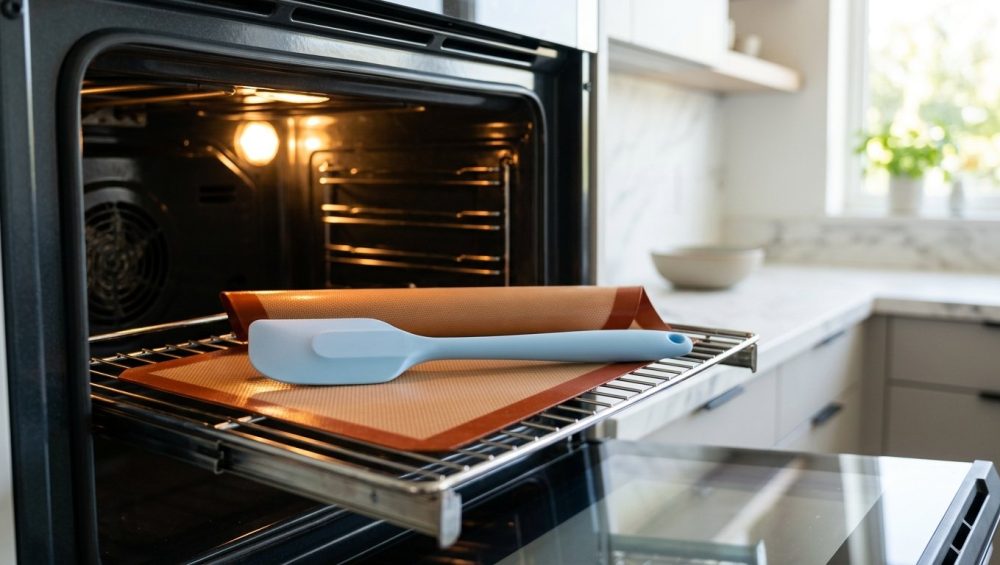
Preheat your oven to 250°F (120°C). If you are dealing with an incredibly stubborn smell that has been baked into the spatula for years, you can push the temperature up to 350°F (175°C).
You need to place the silicone on a stable, heat-safe surface. Use a heavy-duty, bare aluminum sheet pan. This is vital, because cheap, thin pans will drastically warp under prolonged heat, and there is nothing more annoying than when your baking sheets keep warping and violently popping in the middle of a bake. Lay the silicone tools flat on the pan, ensuring they are not touching each other so the air can circulate freely around them. Do not place the silicone in a bare glass baking dish, as dry-heating empty glass can cause thermal shock and unexpected shattering.
Step 3: The Outgassing Bake
Place the sheet pan into the preheated oven. Set a timer for 30 minutes.
Here is exactly what is happening inside your oven: As the ambient temperature rises, the silicone polymer chains begin to relax and expand, opening up those microscopic pores. Simultaneously, the dry, intense heat transfers kinetic energy to the trapped fragrance molecules. Once the molecules reach their specific volatilization point, they transition from a liquid/trapped state into a gas. They literally evaporate out of the expanded pores and are released into the air.
A Crucial Warning: As the soap molecules evaporate, your kitchen is going to smell strongly of hot, baked dish detergent. It is not a pleasant smell. It will smell like a laundromat caught on fire. Turn on your oven exhaust fan, open a window, and do not panic. The smell is the ultimate proof that the method is working. The soap is leaving the spatula and entering the atmosphere.
Step 4: The Sniff Test and Cool Down
After 30 minutes, open the oven and carefully waft the air around the pan. If the silicone still heavily radiates a soapy odor, leave it in for another 20 to 30 minutes. High-quality silicone can withstand these temperatures all day, so you are not in danger of melting your tools.
Once the odor has dissipated, remove the pan from the oven and let the silicone cool completely at room temperature. As it cools, the pores will contract and seal back up, leaving you with a perfectly neutral, odor-free, pure silicone tool that is ready to safely touch your food again.
The “Pinch Test” and the Scourge of Toxic Kitchen Gear
Now that we have solved the soapy taste problem, we need to have a very serious, brutally honest conversation about the actual quality of the gear in your kitchen. As a home cook who deeply values the time, money, and effort you put into your meals, you must adopt a zero-tolerance policy for toxic, low-quality kitchenware.
Not all silicone is created equal. The market is absolutely flooded with cheap, knock-off silicone products that are manufactured using heavy chemical fillers, plastics, and low-grade rubbers. True, high-quality silicone is either 100% food-grade (approved by the FDA) or, even better, LFGB-certified (the European standard, which is significantly stricter and requires platinum-cured silicone). Pure silicone is incredibly durable, heat-resistant, and entirely non-toxic.
Cheap silicone, on the other hand, is cut with plastic fillers to reduce manufacturing costs. These fillers completely compromise the thermal stability of the tool. When you expose cheap, filler-laden silicone to high heat—whether in a frying pan or during our oven heat-treatment method—those plastic fillers can actually melt, degrade, and leach toxic chemical compounds directly into your food.
So, how do you know if your favorite spatula is pure silicone or a toxic imposter? You perform the industry-standard “Pinch Test.”
Take your silicone spatula, baking mat, or mold, and aggressively pinch, twist, or stretch a thick portion of the material. Look closely at the area where the material is being stretched. If the silicone retains its solid, uniform color throughout the stretch, congratulations! You have a pure, high-quality silicone tool.
However, if the stretched area turns stark white, you have a major problem. That white discoloration is the visual evidence of cheap plastic fillers being stretched apart from the silicone matrix. Pure silicone absorbs and reflects light uniformly, regardless of tension. Plastic fillers do not. If your tool fails the pinch test, do not attempt to bake the soap out of it. Throw it directly into the garbage. It is not worth risking your health over a three-dollar spatula.
This philosophy extends to all of your kitchen equipment. We have normalized cooking with garbage, and it has to stop. We accept it when our bamboo cutting boards completely destroy the edge of our expensive chef’s knives because they are glued together with rock-hard resins. We shrug our shoulders when a cheap ceramic pan lost its non-stick capability after only a month of use, forcing us to scrub burnt eggs off the bottom every morning. We even ignore it when the cheap metal on our ice cream scoop oxidizes and leaves a metallic, gray sludge on our dessert.
You do not need a massive collection of tools to be a great cook, but the tools you do own must be high quality. Invest in heavy-duty stainless steel skillets that will last a lifetime and can handle aggressive heat without peeling toxic non-stick flakes into your dinner. Buy a heavy cast iron pan and maintain it properly with a durable chainmail scrubber rather than throwing away scratched Teflon pans every year. Stop guessing if your chicken is safe to eat and invest in a highly calibrated, instant-read meat thermometer that actually tells the truth. Upgrading your gear is the fastest, most effective way to eliminate kitchen anxiety and elevate your daily meals.
Preventative Measures: Protecting Your Silicone
Once you have successfully baked the soapy taste out of your pure silicone spatulas, you need to change your habits to ensure it never happens again. Prevention is always easier than the cure, and a few simple adjustments to your kitchen routine will keep your silicone tasting completely neutral.
1. Ban Silicone from the Dishwasher
This is the golden rule. No matter what the packaging says, treat your silicone tools as strictly hand-wash only. The combination of extreme heat and heavily fragranced alkaline pods is a guaranteed recipe for soap absorption. By keeping your silicone out of the dishwasher, you eliminate ninety percent of the problem.
2. Switch to Unscented, Mild Dish Soap
If you are hand-washing your silicone but still experiencing a soapy taste, your dish soap is too aggressive. The heavily marketed “mountain spring” and “citrus blast” soaps are loaded with the exact volatile organic compounds that silicone loves to absorb. Switch to a high-quality, unscented, clear dish soap. You want a soap that is designed strictly to cut grease, not to leave a lingering perfume on your dishes.
3. Segregate Your Spatulas
Silicone does not just absorb soap; it absorbs savory food odors, too. If you use the same spatula to stir a heavily spiced, garlic-and-onion curry on Friday night, and then use it to fold a delicate vanilla cake batter on Saturday morning, your cake is going to taste like garlic. The oven heat-treatment method works perfectly to remove garlic and onion VOCs as well, but baking your spatulas every weekend is tedious.
Instead, buy two distinct sets of spatulas in different colors. Dedicate the red spatulas exclusively for savory, pungent cooking (garlic, onions, curries, tomato sauces). Dedicate the blue spatulas exclusively for sweet baking (cakes, cookies, scrambled eggs). This simple organizational hack completely eliminates the risk of cross-contamination.
4. Optimize Your Storage
Do not store your freshly washed silicone spatulas crammed into a dark, unventilated drawer right next to your strongly scented cleaning supplies or your spice rack. Silicone needs to breathe. Store your spatulas upright in a countertop utensil crock where they have access to open airflow. This allows any minor residual odors to naturally dissipate into the room rather than compounding in a sealed space.
5. Rinse with Cold Water First
Here is a brilliant, little-known trick: When you finish using a silicone spatula, rinse it immediately under freezing cold water before you wash it with hot water and soap. Because heat expands the pores of the silicone, hitting a dirty spatula with hot water immediately opens the pores and invites the food oils and soap to enter. Rinsing with cold water keeps the microscopic pores tightly closed while you wash away the bulk of the surface grease, drastically reducing the amount of absorption that can occur during the wash.
Reclaiming Your Kitchen
Cooking should be a joyful, deeply satisfying experience, not a source of stress or frustration. There is nothing more demoralizing than doing everything right—buying good ingredients, executing the technique perfectly, plating the food beautifully—only to have the meal ruined by a piece of equipment that tastes like a laundromat.
But now you know the science. You understand the micro-porous nature of siloxane polymers, the volatile organic compounds hiding in your dish soap, and the thermal expansion caused by your dishwasher. More importantly, you know exactly how to fight back. You do not have to throw away your favorite tools, and you do not have to accept food that tastes like chemicals.
Armed with a hot oven, a bare sheet pan, and a refusal to tolerate cheap, toxic gear, you can permanently banish the soapy taste from your kitchen. So go forth, perform the pinch test on your utensil crock, bake the soap out of your surviving spatulas, and get back to making mind-blowing food. Your weekend scrambled eggs are waiting, and this time, they are going to taste absolutely perfect.