Listen, we need to have a serious, brutally honest conversation about your salads. I know you are trying your absolute best. You have gone to the farmer’s market, you have purchased the beautiful, overpriced artisanal mixed greens, you have carefully chopped the heirloom tomatoes, and you have even toasted your own walnuts because you are a weekend culinary overachiever. But then, right at the finish line, you ruin the entire masterpiece by drowning it in a sad, broken, greasy puddle of oil and vinegar that looks less like a dressing and more like a tragic middle-school science fair experiment.
Or worse, you bypass the homemade route entirely and reach for that eight-dollar bottle of store-bought dressing. Did you know the global packaged salad dressing market is currently valued at over $82 billion? That is a staggering amount of money being spent on liquid disappointment. If you actually turn that bottle around and read the label, you will find it loaded with synthetic stabilizers, hidden sugars, cheap highly-refined soybean oil, and artificial vegetable gums designed to keep it sitting perfectly mixed on a supermarket shelf for three years. You do not need those industrial chemicals in your body, and you certainly do not need to spend your hard-earned money on them.
You do not need a culinary degree from Le Cordon Bleu to make a restaurant-quality vinaigrette at home. You just need a basic, fundamental understanding of kitchen science, about thirty seconds of vigorous whisking, and a little dab of Dijon mustard. Today, we are going to dive incredibly deep into the molecular warfare that is currently happening in your salad bowl. I am going to teach you exactly why oil and vinegar fiercely refuse to mix, how the natural biological compounds in a simple spoonful of mustard magically bind them together, and how you can confidently ditch the bottled garbage for good.
The Science of the Split: Why Oil and Vinegar Hate Each Other
If you have ever dumped a glug of extra virgin olive oil and a splash of balsamic vinegar into a glass mason jar, shaken it like your life depended on it, and watched it immediately separate into two stubborn, distinct layers, you have witnessed the uncompromising laws of thermodynamics in action.
Let’s get nerdy for a second, but I promise to keep it painless and entirely relevant to your dinner. Vinegar is predominantly made of water, and water molecules are polar. This means they have a slight positive charge on one end and a slight negative charge on the other. Because of this polarity, water molecules absolutely love each other. They form incredibly tight hydrogen bonds, clinging together like best friends at a crowded bar.
Oil, on the other hand, is completely non-polar. It has no electrical charge whatsoever. Oil and water are the ultimate mismatched couple; they have entirely different chemical properties and simply do not interact well together. When you force oil and water together by furiously shaking that mason jar, you are mechanically breaking the oil down into millions of tiny microscopic droplets and dispersing them throughout the water. But the water molecules despise this arrangement. Because they cannot bond with the non-polar oil, they are forced to form a highly ordered, rigid “cage” (known in chemistry as a clathrate-like structure) around the invading oil droplets.
Here is where the physics of entropy comes in to ruin your salad. The universe always, without exception, favors a state of higher entropy, which basically means it prefers a relaxed, disordered state where molecules can move freely. By forcing the water molecules into these rigid, structured cages around the oil droplets, you are severely restricting their movement and lowering the overall entropy of the system.
The absolute moment you stop shaking the jar, the water molecules aggressively push the oil out of the way so they can get back to bonding freely with each other in three dimensions. The oil droplets merge back together, float to the top because oil is less dense than water, and your dressing splits. This is the exact reason why your vinaigrette always separates. It is literally a thermodynamic inevitability. You can shake it until your arm falls off, but you cannot beat physics with sheer willpower. Just like you can’t stop scrubbing stainless steel pans if you don’t understand heat control, you can’t fix a dressing without understanding emulsions.
Enter the Emulsifier: The Culinary Diplomat
So, how do we stop this molecular divorce? We introduce a mediator. In the culinary world, this mediator is known as an emulsifier.
An emulsion is simply a mixture of two liquids that normally refuse to combine—in this case, oil and water. To force them to coexist peacefully, you need an emulsifier, which acts as a molecular bridge. Emulsifiers are made of amphipathic molecules, meaning they essentially have a split personality. One end of the molecule is hydrophilic (water-loving and polar), and the other end is lipophilic (oil-loving and non-polar).
When you introduce a proper emulsifier into your oil and vinegar mixture, it acts like a microscopic diplomat. The water-loving head grabs onto the vinegar, and the oil-loving tail buries itself deep into the oil droplets. It coats the dispersed oil droplets entirely, preventing them from bumping into each other and clumping back together. Suddenly, the water molecules do not have to form those rigid cages anymore. The entropy of the system stabilizes, the surface tension is broken, and your oil and vinegar remain locked in a smooth, creamy, cohesive embrace.
This is the exact same fundamental science behind how dish soap removes heavy grease from your dirty pans. But please, for the love of all things culinary, do not put dish soap in your salad. We have far more delicious, natural options available in the pantry.
The Magic of Mustard: The Unsung Hero of the Salad Bowl
While commercial food manufacturers rely heavily on synthetic stabilizers, lab-created polysorbates, and generic, highly processed vegetable gums to keep their bottled dressings emulsified, the everyday home cook has access to one of the most powerful natural emulsifiers on the planet: mustard.
But it is not just the sharp, tangy flavor of mustard that makes it a mandatory vinaigrette staple; it is the unique biological composition of the mustard seed itself.
Mucilage: The Secret Weapon
Mustard seeds contain a highly complex carbohydrate—a branched polysaccharide—called mucilage. In the natural world, mucilage is a thick, glutinous, gel-like substance that surrounds the outer hull of the seed, helping the seed retain vital water so it can successfully germinate in the soil. In your kitchen, however, this mucilage acts as an absolute powerhouse of an emulsifying agent.
When you whisk mustard into the watery environment of vinegar, the mucilage immediately hydrates and swells. As you slowly drizzle in your olive oil, the hydrated mucilage coats the microscopic oil droplets, creating a highly viscous, structurally stable emulsion. It literally thickens the continuous water phase of your dressing, trapping the dispersed oil droplets in permanent suspension.
Why Dijon Reigns Supreme
Now, before you go enthusiastically squeezing that bright yellow, artificially dyed hotdog mustard into your salad bowl, we need to talk about varieties. Not all mustards are created equal when it comes to culinary science, and using the wrong one will leave you right back where you started.
Authentic Dijon mustard is traditionally made from brown mustard seeds, whereas standard American yellow mustard is made from white or yellow mustard seeds. Why does this botanical distinction matter to your dinner? Because brown mustard seeds contain a vastly superior amount of our secret weapon.
According to agricultural phytochemical assays, brown mustard seeds yield approximately 12.7% mucilage, whereas yellow mustard seeds contain a measly 4.1%. This means that Dijon mustard has over three times the emulsifying power of standard yellow mustard. When food scientists and test kitchens evaluate emulsion stability, a vinaigrette made with proper Dijon can hold together flawlessly for hours, or even a full week in the fridge, while a yellow mustard vinaigrette will inevitably break and separate within twenty minutes.
Furthermore, high-quality Dijon is formulated with white wine or verjuice (the tart, unfermented juice of unripe grapes) rather than harsh, aggressive distilled white vinegar. This gives Dijon a rounded, sophisticated, complex acidity that perfectly complements the nuanced flavor notes of a high-quality extra virgin olive oil.
The Flavor Catalyst
Beyond its structural superpowers, Dijon mustard acts as a brilliant flavor catalyst. It contains a specific organic compound called allyl isothiocyanate, which is derived from sinigrin and is responsible for that sharp, sinus-clearing pungency. In a vinaigrette, this distinct pungency cuts right through the heavy, fatty mouthfeel of the oil.
It also plays a fascinating psychological trick on your palate. The chemical structure of Dijon actually reduces the perceived bitterness of certain robust olive oils and aged vinegars, while simultaneously amplifying the savory, umami perception of the roasted vegetables or fresh greens you are pouring it over. You will know you have absolutely nailed the flavor balance when you take a bite and realize your dinner actually needs acid to wake up the dull flavors, rather than just mindlessly reaching for another heavy pinch of salt.
The Golden Ratio: Formulating the Perfect Vinaigrette
You do not need a recipe to make a phenomenal vinaigrette. You need a ratio. Once you memorize the basic framework, you can whip up a flawless, customized dressing in thirty seconds without ever having to open a cookbook or search the internet.
The classic French culinary ratio for a standard vinaigrette is 3 parts oil to 1 part acid (vinegar or citrus juice).
However, modern palates often prefer a punchier, brighter, more acid-forward dressing. Depending entirely on the aggressive sharpness of your chosen vinegar and the rich, buttery quality of your oil, you might find yourself gravitating toward a 2:1 ratio. If I am using a very mild, sweet Meyer lemon juice instead of a harsh vinegar, I will often push it all the way to a 1:1 ratio.
Here is the foolproof baseline formula you should permanently memorize:
- 3 tablespoons of high-quality extra virgin olive oil
- 1 tablespoon of acid (white wine vinegar, apple cider vinegar, or fresh lemon juice)
- 1 teaspoon of authentic Dijon mustard
- A generous pinch of kosher salt and freshly cracked black pepper
That is it. That is the holy grail of salad dressings. That single, unassuming teaspoon of Dijon mustard contains enough mucilage to permanently bind the three tablespoons of oil and one tablespoon of vinegar into a silky, luxurious, opaque dressing.
The Foolproof Whisking Technique: Step-by-Step
Having the correct ingredients and the perfect ratio is only half the battle. Emulsification requires mechanical force. You have to physically smash the oil into microscopic droplets so the mustard mucilage can surround and coat them. If your technique is sloppy, your dressing will fail.
Equipment Matters (And Why Cheap Gear is Ruining Your Food)
Before we even start whisking, let’s talk about your kitchen tools. As you know, I have absolutely zero patience for toxic, cheap kitchenware, and neither should you.
Do not, under any circumstances, make your vinaigrette in a cheap, scratched plastic mixing bowl. Plastic is highly porous, meaning it holds onto old, rancid garlic smells from meals past. More importantly, cheap plastics can leach microplastics and endocrine-disrupting chemicals directly into your highly acidic vinegars. Furthermore, if you have ever noticed that your plastic containers stay greasy despite multiple trips through the dishwasher, it is because plastic is inherently lipophilic (oil-loving). It will literally fight against your emulsion by attracting the oil to the sides of the bowl. Always use a heavy glass, ceramic, or high-quality stainless steel mixing bowl.
Next, we need to evaluate your whisk. Throw away that flimsy, peeling silicone whisk that is currently shedding toxic microplastics into your food. Ditch the cheap, dollar-store wire whisk that has started to rust at the base of the handle. If your cheap whisk leaks dishwater from the hollow handle directly into your pristine vinaigrette, you are going to instantly ruin your emulsion (and completely ruin your appetite). Invest in a solid, fully sealed, professional-grade stainless steel balloon whisk. It will last you a lifetime and ensure maximum shearing force.
The Order of Operations
If you just dump the oil, vinegar, mustard, and salt into a bowl all at once and stir them around, you will fail. The specific order in which you introduce the ingredients is the absolute secret to a bulletproof emulsion.
- The Base: Add your vinegar (1 tbsp) and your Dijon mustard (1 tsp) to the clean mixing bowl first.
- The Seasoning: Add your kosher salt and black pepper right now. Why? Because salt easily dissolves in water (the vinegar), but it absolutely does not dissolve in oil. If you wait to add the salt at the very end after the oil is mixed in, it will not dissolve, and you will end up with a gritty, unpleasant dressing. Whisk the vinegar, mustard, and salt together vigorously until they form a completely smooth, uniform liquid.
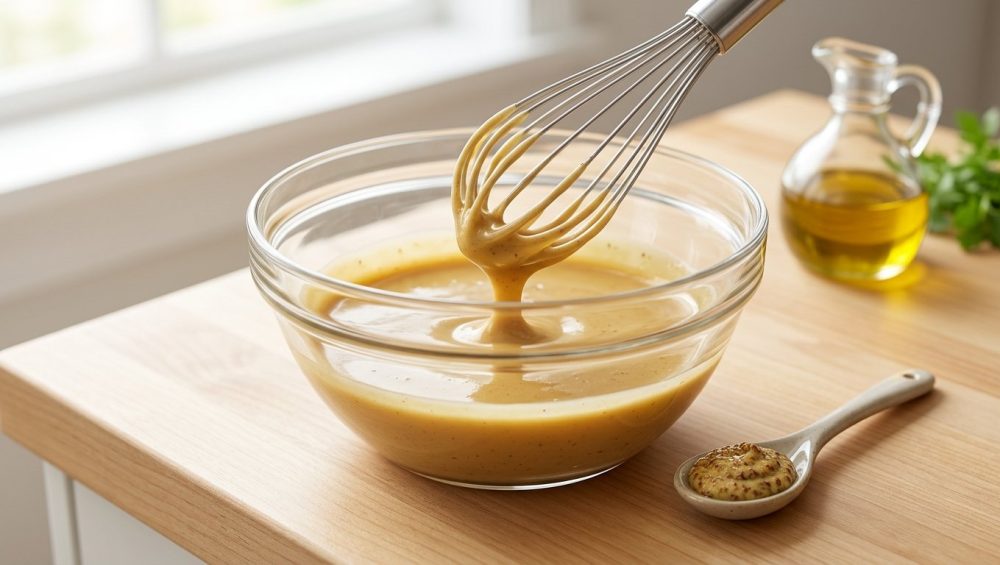
- The Drizzle: This is the critical make-or-break moment. You must add the oil (3 tbsp) incredibly slowly. I am talking about a thin, steady, literal drop-by-drop drizzle to start. While you are dripping the oil in with one hand, you must be whisking vigorously and constantly with the other hand.
As you whisk, the mechanical force of the stainless steel wires is shearing the oil into microscopic droplets. Because you are adding the oil so incredibly slowly, the mustard mucilage has ample time to surround and coat each individual droplet before they have a chance to clump back together. Once you have added about half of the oil and the mixture in the bowl starts to look noticeably thick and creamy, you can safely pour the rest of the oil in a slightly faster, steady stream, but you must never stop whisking.
When you are completely done, the dressing should look opaque, glossy, and beautifully thickened. It should easily coat the back of a spoon without running off. If you toss it with your greens, it will cling beautifully to every single leaf, ensuring you do not end up with a sad pool of grease at the bottom of your bowl. This is crucial, because nobody wants to eat dinner if their salads are always soggy and limp.
Troubleshooting: When Good Emulsions Go Bad
Even the best, most experienced home cooks occasionally break a vinaigrette. Usually, it happens because we get distracted or impatient. If your finished dressing looks greasy, separated, or has little translucent pools of oil floating on the surface, your emulsion has broken. Here is exactly why it happened, and how you can easily fix it without throwing ingredients in the trash.
The Oil Was Too Cold
Temperature plays a massive, undeniable role in the thermodynamics of emulsions. If you store your extra virgin olive oil in a freezing cold pantry, or if you are trying to make a warm vinaigrette using a saturated fat that solidifies at lower temperatures (like bacon fat or duck fat), the fat molecules will simply be too rigid to shear into small droplets. Always make sure your liquid ingredients are at proper room temperature (around 72°F or 22°C). And please, stop ruining your olive oil by keeping it in a clear bottle right next to your screaming hot stovetop; store it in a cool, dark cabinet, but never in the refrigerator.
You Rushed the Drizzle
If you lose your patience and dump all the oil into the bowl at once, the sheer volume of the oil completely overwhelms the water and the mustard. The oil droplets immediately bump into each other, fuse together, and violently separate from the vinegar. You cannot force an emulsion to form if the continuous phase (the vinegar and mustard mixture) is drowning in the dispersed phase (the oil). Patience is non-negotiable here.
How to Rescue a Broken Dressing
Do not throw a broken, separated vinaigrette down the drain. It is incredibly easy to save, and it only takes a few seconds.
Grab a brand new, clean stainless steel bowl. Put exactly one teaspoon of warm water (or another half-teaspoon of Dijon mustard) into the clean bowl. Now, treat your broken, separated dressing as if it were the pure oil in the original recipe. Slowly—drop by drop—whisk the broken dressing into the new bowl with the warm water or mustard.
The warm water relaxes the surface tension, and the fresh, vigorous whisking action shears the clumped oil back down into manageable microscopic droplets. Within thirty seconds, your dressing will be perfectly creamy, cohesive, and fully restored to its former glory.
Beyond the Basics: Flavor Variations That Will Blow Your Mind
Once you have truly mastered the basic 3:1 Dijon vinaigrette technique, the entire culinary world opens up to you. You can use this exact same foundational method to create endless, mind-blowing variations. The Dijon mustard will always operate quietly in the background doing the heavy lifting of keeping the dressing emulsified, leaving you completely free to play with the flavor profile.
The Herbaceous Goddess
Swap out the standard white wine vinegar for freshly squeezed lemon juice. Add a generous handful of finely minced, delicate soft herbs—think flat-leaf parsley, tarragon, chives, and fresh basil. The Dijon operates as the structural backbone, holding the lemon juice and olive oil together, while the fresh herbs provide a massive, vibrant pop of brightness.
The Sweet & Tangy Maple
Use raw, unfiltered apple cider vinegar as your primary acid. Keep the teaspoon of Dijon mustard, but add one tablespoon of pure, high-quality maple syrup. The natural mucilage in the mustard and the viscous, sticky sugars in the maple syrup team up to create an incredibly thick, stable, luxurious emulsion. This is the absolute perfect dressing for a hearty autumn salad loaded with roasted butternut squash, goat cheese, and toasted pecans.
The Garlic Powerhouse
Mince a large clove of fresh garlic and smash it into a fine paste using the flat side of your chef’s knife and a little coarse kosher salt. Add this pungent garlic paste to your vinegar and mustard base before you whisk in the oil. Garlic actually contains its own natural amphipathic emulsifying compounds (specifically diallyl sulfide and diallyl trisulfide), which will reinforce the mustard and make the dressing even more incredibly stable.
Plus, letting the raw garlic sit in the acid of the vinegar for a few minutes will lightly “cook” it, mellowing out its harsh, spicy bite so you get all of the incredible savory flavor without the aggressive, lingering burn. It is a brilliant technique, unlike when your poorly chopped garlic always burns to a bitter crisp in a hot skillet because you added it too early. Drizzling this garlic powerhouse dressing over some sad, soggy roasted veggies will instantly revive them and make them the star of the dinner table.
Storage and Stability: Keeping It Together
One of the absolute greatest time-saving hacks for the busy, overworked home cook is making a large, double-batch of vinaigrette on a Sunday afternoon to use throughout the entire week. Because time is money, and absolutely nobody wants to wash an oily whisk and a mixing bowl every single night after work.
If you used a proper amount of authentic Dijon mustard and whisked it correctly using the drop-by-drop method, your homemade vinaigrette will easily stay perfectly emulsified in a sealed glass jar in the fridge for up to a full week.
However, you might open the fridge on a Tuesday and notice that your beautiful dressing looks thick, cloudy, and completely solid. Do not panic, and do not throw it away. Your emulsion did not break; your oil just solidified. High-quality extra virgin olive oil contains natural waxes and long-chain fatty acids that physically solidify and turn cloudy at cold refrigerator temperatures.
To fix this, simply take the glass jar out of the fridge about twenty to thirty minutes before you plan to eat dinner. Let it sit on the kitchen counter to gently come up to room temperature. Give the jar a few vigorous shakes, and it will magically return to its liquid, creamy, perfectly emulsified state.
If you are using the dressing immediately, you must make sure your salad greens are completely, thoroughly dry before you toss them. If your lettuce is even slightly wet from being washed, the water sitting on the leaves will actively repel the oil in the dressing. The dressing will slide right off the greens, pooling at the bottom of the bowl. You must dry your greens thoroughly with a high-quality tool, otherwise your dressing won’t stick to the leaves, rendering all of your hard scientific emulsification work completely useless.
Conclusion: Reclaiming Your Salad Bowl
Cooking is not magic, it is science. But when you understand the underlying science, the results you can achieve in a standard home kitchen feel pretty magical.
You do not need an expensive high-speed blender, you do not need overpriced store-bought bottles filled with synthetic xanthan gum and artificial preservatives, and you certainly do not need to settle for a greasy, separated, disappointing salad ever again. You just need a heavy bowl, a sturdy stainless steel whisk, a little bit of patience, and the incredible, mucilage-packed binding power of Dijon mustard.
By taking just thirty seconds out of your day to properly emulsify your vinaigrette, you instantly elevate a simple, boring bowl of greens into a luxurious, vibrant, restaurant-quality dish. You take total control of the ingredients you are putting into your body, you banish the cheap, highly processed seed oils from your kitchen, and you prove once again that the everyday home cook holds all the culinary power.
Now, go grab a proper whisk, stop making excuses, and show that olive oil and vinegar exactly who is boss.