Listen to me very carefully. If you are currently boiling a pot of pasta, dumping it into a colander in your sink, and then—heaven forbid—running it under cold tap water, we need to have a serious talk. Put down the strainer and step away from the sink. I say this with all the love in my snarky, culinary-obsessed heart: you are committing a kitchen felony.
I know, I know. You’re just a home cook trying to get a weeknight dinner on the table without losing your sanity. You don’t have a culinary degree, and you certainly don’t have the time to listen to some pretentious chef lecturing you about “authenticity.” But here’s the thing: making restaurant-quality pasta at home doesn’t require a Michelin star or a trust fund. It requires understanding one incredibly simple, entirely free ingredient that you are currently pouring straight down your drain.
I am talking about pasta water. Liquid gold. The starchy, murky, heavily salted nectar of the culinary gods.
If you’ve ever wondered why your pasta sauce slides off your noodles, leaving a sad, watery puddle of separated oil at the bottom of your bowl, the answer is sitting in your sink trap. Today, we are going to dive deep into the magic of starchy water. We’re going to talk about the science of emulsification, debunk some ancient Italian grandmother myths, and teach you how to ditch the post-boil rinse for good. Because your Tuesday night spaghetti deserves better, and frankly, so do you.
The Ultimate Kitchen Crime: Why Are You Rinsing Your Noodles?
The Sink Strainer Tragedy
Let’s set the scene. You’ve boiled your spaghetti. You proudly carry the heavy pot to the sink, dump the contents into a plastic colander, and watch as gallons of cloudy water disappear down the drain. Then, because someone told you in 1998 that it stops the cooking process, you blast the naked noodles with cold tap water. Finally, you dump them onto a plate and spoon a ladle of red sauce on top.
Congratulations, you’ve just created a culinary slip-and-slide.
When you rinse your pasta, you are aggressively washing away the sticky layer of surface starches that naturally form as the wheat cooks. Those starches are the microscopic glue that binds your sauce to your noodles. Without them, your pasta is slick, bare, and completely incapable of holding onto flavor. You might as well be trying to paint a window pane with watercolors.
Furthermore, running cold water over hot pasta drops its temperature rapidly, causing the internal structure of the noodle to seize up and become gummy. You aren’t “stopping the cooking process” in a good way; you are shocking the pasta into a rubbery submission.
The Myth of the Oil Slick
And while we are airing our grievances, let’s talk about another massive mistake: adding oil in your pasta water. People do this because they think it prevents the noodles from sticking together in the pot.
Here is what actually happens: oil and water do not mix. The oil simply floats on top of the boiling water. When you drain the pasta, that slick of oil coats the noodles as they pass through the surface, waterproofing them. Guess what waterproof noodles repel? That’s right: your sauce. If you want your pasta to stop sticking together, you don’t need oil. You just need to stir it vigorously during the first sixty seconds of cooking. It really is that simple.
The Science of Pasta Water: Liquid Gold
What Actually Happens When Pasta Boils?
To understand why pasta water is so magical, we have to put on our safety goggles and look at the actual chemistry of dried pasta. Pasta is essentially just durum wheat semolina and water. Durum wheat is packed with complex carbohydrates, specifically starch molecules tightly bound in a protein matrix.
When you drop dried pasta into boiling water, a process called starch gelatinization begins. The intense heat and hydration cause the starch granules on the surface of the pasta to swell. Eventually, these microscopic granules burst open, releasing their contents directly into the surrounding water. This is why your pasta water turns from crystal clear to a murky, cloudy gray as it cooks.
According to food physicists—yes, that is a real job, and yes, I am jealous—after about eight to ten minutes of boiling, the water contains roughly 0.8% to 1.2% total starch by weight. This isn’t just “dirty water.” It is a dynamic, temperature-sensitive colloidal suspension. It is a highly functional ingredient.
Amylose and Amylopectin: The Unsung Heroes
Not all starches are created equal. The starch released into your pasta water is composed of two distinct polymers that act as an absolute dream team in your skillet: amylose and amylopectin.
Amylose makes up about 15% to 20% of the starch in durum wheat. It is a long, linear molecule that forms thermoreversible gels when heated. More importantly, amylose acts as a natural emulsifier. It has properties that allow it to bind to both water and fat—a crucial detail we will get to in a moment.
Amylopectin makes up the remaining 80% to 85%. Unlike the straight lines of amylose, amylopectin is a highly branched molecule. Its branching structure allows it to hydrate rapidly and provides immediate thickening power upon cooling. It gives your sauce that luxurious, mouth-coating body without turning it into a gummy paste.
When you reserve a cup of this starchy pasta water, you are essentially saving a cup of natural, flavorless thickener and emulsifier that was custom-built by the pasta itself to make your sauce perfect.
The Magic of Emulsification: Why Oil and Water Need a Mediator
Breaking Down the Emulsion Equation
If you’ve ever made a vinaigrette, you know the struggle of emulsification. Oil and water hate each other. They are the Montagues and Capulets of the culinary world. If you whisk olive oil and vinegar together, they might temporarily mingle, but the second you turn your back, they will separate into distinct, greasy layers.
The same problem plagues your pasta pan. Most pasta sauces are a mixture of fats (olive oil, butter, rendered pancetta fat, or cheese) and liquids (tomato juice, wine, or stock). If you just toss your cooked noodles into a pan of oil and garlic, you don’t get a sauce. You get oily noodles sitting in a puddle. This is exactly why your pan sauce separates when you try to serve it.
To force oil and water to play nicely, you need a mediator. You need an emulsifier.
The Role of Starch in Binding Sauce to Noodle
This is where our heroes, amylose and amylopectin, swoop in to save your Tuesday night dinner.
When you ladle a splash of hot, starchy pasta water into a skillet containing your fat-based sauce, the starch molecules physically get in the way of the fat droplets. The amylose acts as a microscopic bridge, grabbing onto the hydrophobic (water-fearing) fat with one hand and the hydrophilic (water-loving) liquid with the other.
When combined with vigorous mechanical agitation (stirring or tossing the pan), the starch forcibly suspends the fat droplets within the liquid. The result? A stable, creamy, glossy emulsion that coats the back of a spoon and clings desperately to every single noodle. You have successfully transformed a greasy, broken mess into a restaurant-quality sauce, and you did it using garbage water you used to throw away.
The Step-by-Step Masterclass to Flawless, Glossy Pasta
Step 1: The Boiling Rules (And Why You’re Probably Using Too Much Water)
For decades, traditional cookbooks have screamed at us to boil pasta in a massive, rolling cauldron of water. “Use at least six quarts!” they demanded. “Give the pasta room to swim!”
I am here to tell you that this is absolute nonsense. In fact, using too much water is actively sabotaging your sauce.
Remember, the goal is to extract starch into the water to use as an emulsifier. If you boil a single box of spaghetti in a swimming pool of water, that starch becomes incredibly diluted. It loses its thickening power. To get the highly concentrated, syrupy pasta water that professional chefs rely on, you need to use less water.
You only need enough water to comfortably submerge the pasta. As the pasta cooks and absorbs moisture, the water level will reduce, leaving you with a dense, starch-heavy liquid that acts like culinary magic. You can even use the frying pan pasta trick, where you cook dried pasta in a wide, shallow skillet with just a few cups of water. It boils faster, saves energy, and yields pasta water so starchy it practically looks like milk.
Step 2: The Salt Factor (Debunking the “Salty as the Sea” Myth)
“Salt your pasta water until it tastes like the sea!” We have all heard this romanticized piece of Italian folklore. It sounds beautiful. It is also a fantastic way to ruin your dinner.
The ocean has a salinity level of roughly 3.5%. If you actually salted your pasta water to 3.5%, your spaghetti would be completely inedible, and your blood pressure would skyrocket before you even finished chewing.
Food physics reveals that the ideal salt concentration for pasta water is between 1.5% and 2.0% by weight. In practical terms, that means you should be using about 1.5 to 2 teaspoons of fine sea salt or kosher salt per quart of water.
Why is this exact concentration so important? It’s all about osmotic pressure. At 1.5% salinity, the sodium chloride creates an environment that allows salt to diffuse directly into the pasta matrix during the first 90 seconds of boiling, seasoning the noodle from the inside out. If you under-salt, the pasta is bland. If you over-salt, the excessive sodium disrupts the starch bonding, causing premature leaching and a sticky mess. Plus, when you eventually add a ladle of this water to your sauce, you don’t want it to turn your dish into a salt lick.
Step 3: The Early Pull (Why Al Dente in the Pot is Overcooked in the Pan)
If you wait until your pasta is perfectly cooked in the boiling water before you drain it, you have already failed.
The secret to restaurant-quality pasta is that the noodles must finish cooking in the sauce. This means you need to pull the pasta out of the boiling water about two to three minutes before it reaches that perfect, chewy “al dente” stage. It should still have a rigid, slightly chalky core when you bite into it.
Why? Because pasta is like a sponge. As it cooks, it absorbs the liquid around it. If it absorbs 100% of its capacity in plain, salty water, it has no room left to absorb your delicious, painstakingly crafted sauce. By pulling it early, you ensure that the final few minutes of hydration happen inside the skillet, allowing the pasta to literally drink up the flavor of the sauce.
Step 4: The Pan Finish (Where the Magic Actually Happens)
This is the crescendo. This is where weekday home cooks become weekend culinary artists.
You have your skillet on medium-high heat, containing your base—maybe it’s a simple garlic and olive oil, a rich tomato passata, or rendered guanciale. You use tongs to transfer your undercooked pasta directly from the boiling pot into the skillet. Do not worry about the water dripping off the noodles; you want that.
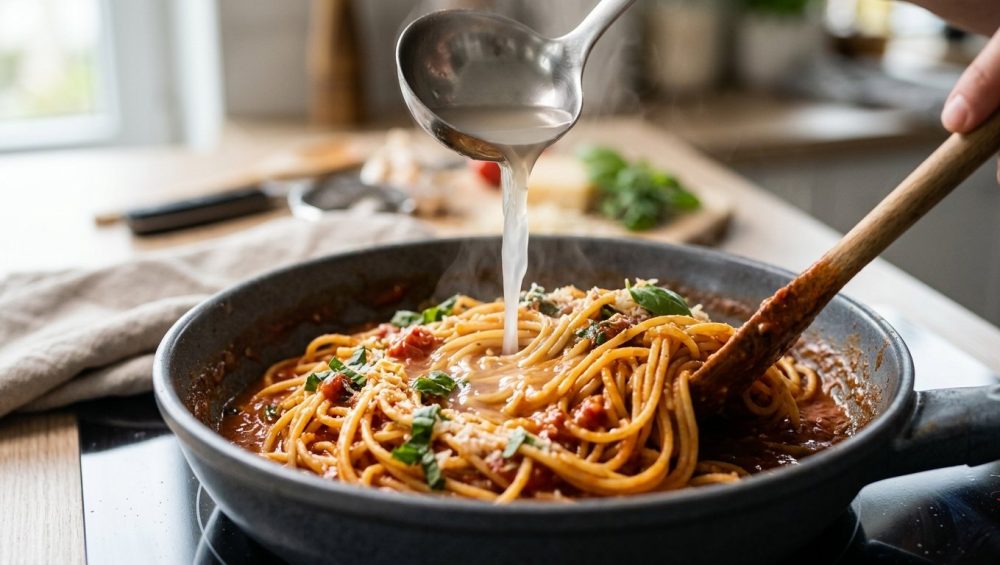
Now, take a ladle and scoop about half a cup of that cloudy, concentrated pasta water into the skillet. The pan will sizzle and roar. This is good.
Begin tossing the pasta vigorously. If you can’t do the fancy chef pan-flip, just stir aggressively with a wooden spoon or tongs. The mechanical agitation is forcing the starch, the fat, and the liquid to bind. As the liquid reduces and the pasta finishes cooking, you will literally watch the sauce transform. It will turn opaque, thicken, and suddenly cling to the noodles like a glossy glaze.
If the pan gets too dry before the pasta is cooked, add another splash of pasta water. Keep stirring. When the sauce coats the back of a spoon and the noodles are perfectly al dente, pull it off the heat immediately.
Essential Gear: Ditch the Toxic Non-Stick for Real Emulsions
The Case for Stainless Steel and Carbon Steel
I have a strict “no-go” rule in my kitchen, and it applies to cheap, peeling, toxic non-stick cookware. I absolutely despise mystery metal pans coated in forever chemicals. Not only are they an environmental and health nightmare, but they are also terrible for making pasta sauces.
To build a proper emulsion, you need a pan that can handle high heat, rapid evaporation, and aggressive metal utensils. Teflon pans simply cannot do this. You need the thermal mass and durability of a high-quality stainless steel skillet or a well-seasoned carbon steel pan.
Stainless steel is brilliant because it allows you to see the exact color and texture of your sauce as it develops. It also builds a “fond”—those deeply flavorful browned bits stuck to the bottom of the pan—which you can deglaze with your pasta water. Just remember to preheat your pan properly so you aren’t crying over why your food sticks to your stainless steel.
Tools of the Trade: Spiders, Tongs, and Ladles
If you are still dumping a heavy pot of boiling water into a sink colander, you are working too hard and endangering your toes.
The smartest investment you can make for pasta nights is a high-quality stainless steel spider skimmer. This long-handled, wire-mesh basket allows you to scoop short pastas (like penne, rigatoni, or farfalle) directly out of the boiling water and drop them straight into your sauce pan. For long noodles like spaghetti or linguine, a sturdy pair of silicone-tipped or stainless steel locking tongs is your best friend.
By moving the pasta to the pan rather than dumping the water, you keep your pasta water hot and ready on the stove. This is crucial because you might need to add more water to adjust the sauce consistency as it cooks down. Plus, keeping the water in the pot prevents the dreaded moment when your pasta pot boils over and ruins your stovetop.
And please, for the love of all things culinary, stop ruining your nonstick pans with aerosol cooking sprays if you insist on using them for other tasks. But for pasta? Stainless or carbon steel is the only way to fly.
Troubleshooting: When Good Sauces Go Bad
Even with the magic of starchy water, things can occasionally go sideways. Here is how to fix the most common emulsion disasters without having a meltdown and ordering takeout.
Why Your Sauce is Still Watery
You followed the steps, you added the water, but your sauce looks like thin, sad soup at the bottom of the pan. What happened?
Usually, this means one of two things: you didn’t reduce the liquid enough, or your pasta water wasn’t starchy enough to begin with. If you boiled your pasta in a massive cauldron, the water might be too dilute.
The Fix: Turn up the heat slightly and keep stirring vigorously. The mechanical action combined with evaporation will usually force the emulsion to come together. If you are truly desperate, you can cheat by swirling in a tiny, pea-sized amount of cold butter off the heat. The milk solids in the butter will act as a secondary emulsifier and help bind the sauce.
Why Your Sauce Turned into Glue
On the opposite end of the spectrum, maybe your sauce seized up into a thick, spackle-like paste that makes the noodles stick together in one giant clump.
This happens when the starch-to-liquid ratio gets entirely out of balance, usually because you let the pan get too hot and all the moisture evaporated instantly. It can also happen if you dump a mountain of grated parmesan into a boiling hot pan, which is exactly why your cheese sauce breaks and turns into a stringy, grainy nightmare.
The Fix: Pull the pan off the heat immediately. Add a generous splash of hot pasta water and stir gently. The fresh liquid will hydrate the seized starches and loosen the sauce back into a silky consistency.
The Leftover Dilemma: Reheating Emulsified Pasta
Let me break your heart real quick: emulsified pan sauces do not survive the microwave.
When an emulsion gets cold in the fridge, the starches retrograde and the fats solidify. When you blast it in the microwave, the emulsion shatters. The fat rapidly melts and separates from the water before the starches have a chance to re-hydrate. You end up with a bowl of dry, hard noodles sitting in a pool of bright orange grease.
The Fix: To reheat leftover pasta properly, put it in a cold skillet. Add a splash of water (or leftover pasta water if you were smart enough to save it in a jar). Turn the heat to medium-low and cover the pan for a few minutes to generate steam. Once the noodles are warm, remove the lid and toss vigorously until the sauce re-emulsifies. It takes three extra minutes and is infinitely better than microwaved mush.
Matching the Noodle to the Sauce: A Structural Guide
You didn’t think we were going to talk about the physics of pasta without talking about the architecture of the noodles, did you? The shape of your pasta dictates exactly how much sauce it can hold, and therefore, how much starchy water you need to build that emulsion.
Long and Thin vs. Short and Tubular
Long, delicate noodles like spaghetti, linguine, and capellini are designed for light, oil-based, or cream-based sauces. Think Aglio e Olio (garlic and oil), Cacio e Pepe (cheese and pepper), or a simple white wine and clam sauce. Because these noodles pack tightly together on the fork, they rely heavily on a slick, well-emulsified sauce to coat their massive surface area. For these, the starchy water trick is absolutely non-negotiable. Without it, the oil just slips off.
Short, tubular, or ridged pastas like penne, rigatoni, and fusilli are architectural marvels designed to capture thick, chunky, heavy sauces. A slow-simmered Bolognese or a thick vodka sauce needs to get trapped inside the tubes and caught in the exterior ridges. While these sauces are already thick, adding a splash of pasta water during the final pan toss helps sheer out the heavy tomato paste, giving it a glossy sheen and ensuring it coats the outside of the noodle rather than just sitting in a lump on top.
The Surface Area Equation
The rougher the surface of your dried pasta, the more starch it will release into the water, and the more sauce it will hold. When shopping for dried pasta, look for the words “bronze die extruded” or “trafilata al bronzo” on the package.
Mass-produced, cheap pasta is pushed through Teflon dies, which makes the noodles perfectly smooth and shiny. Sauce slides right off them. High-quality pasta is pushed through traditional bronze dies, which tears the surface of the dough, leaving a rough, chalky, matte finish. That rough texture acts like microscopic velcro for your emulsified sauce, and it releases significantly more amylose into your boiling water. It costs maybe a dollar more per box, and it will fundamentally change your cooking.
Weeknight Shortcuts vs. Weekend Masterpieces
I am a realist. I know that your cooking energy on a random Wednesday at 6:30 PM is vastly different from your energy on a lazy Sunday afternoon. But the beauty of the starchy water technique is that it scales perfectly to fit your schedule. Time is money, and efficiency in the kitchen is how we survive the week without resorting to delivery apps.
Time-Saving Hacks for Tuesday Night Pasta
When you are exhausted and just need to feed yourself, leverage the low-water boiling method. Grab a wide, 12-inch stainless steel skillet. Drop in your dry spaghetti, add just enough cold water to cover it, and add a heavy pinch of salt. Turn the burner to high.
Because you are heating a small volume of water, it comes to a boil in minutes. The pasta cooks directly in the shallow water, releasing a massive amount of starch. By the time the water has mostly evaporated, the pasta is al dente, and you are left with a thick, starchy syrup right in the pan.
Lower the heat. Toss in a knob of butter, a handful of grated parmesan, and lots of black pepper. Stir vigorously. In less than 12 minutes, using exactly one pan, you have created a flawless Cacio e Pepe. No colander, no draining, no waiting twenty minutes for a massive stockpot to boil.
Just be careful if you are adding aromatics. If you try to toast garlic in this same pan beforehand, remember that garlic always burns if you don’t monitor the heat carefully. Start your garlic in cold oil, let it gently infuse, remove it, and then proceed with your quick-boil method.
Elevating the Weekend Ragu
When the weekend rolls around and you have the luxury of time, the starchy water technique elevates your elaborate projects from “good home cooking” to “restaurant-tier perfection.”
Let’s say you’ve spent four hours slowly braising a pork shoulder in San Marzano tomatoes and red wine. The sauce is rich, deep, and complex. But when you serve it, the heavy meat sinks to the bottom of the bowl, and the noodles sit naked on top.
To fix this, you boil your bronze-die rigatoni in a concentrated, properly salted water bath. You pull the noodles three minutes early. You ladle two cups of your gorgeous ragu into a wide sauté pan and bring it to a bubbling simmer. You drop the undercooked rigatoni into the ragu, followed by a half-cup of the starchy pasta water.
As you toss the pan over medium heat, the starch from the water binds with the rendered pork fat in the ragu. The sauce tightens up, turning glossy and impossibly rich. It forces the heavy tomato and meat mixture to adhere directly to the ridges of the pasta. Every single bite is perfectly balanced.
The Final Verdict
Cooking is often framed as an elusive art form reserved for those with natural talent or years of professional training. I reject that entirely. Cooking is just applied physics and chemistry, wrapped up in a delicious package.
You don’t need a culinary degree to make mind-blowing food. You don’t need expensive, pretentious gadgets. You just need to understand the fundamental rules of the ingredients you are working with.
Your pasta water is not waste. It is a highly functional, scientifically complex ingredient that holds the power to transform your entire meal. It is the bridge between a plate of dry noodles and a luxurious, glossy, perfectly emulsified masterpiece.
So, the next time you make pasta, I want you to look at that murky, boiling water with the respect it deserves. Save a cup. Toss your noodles in the pan. Stir like your life depends on it. And please, for the love of everything holy, throw that plastic colander in the recycling bin where it belongs. You are a home cook, and you are entirely capable of cooking like an expert. Now get into the kitchen and prove it.